
Genetic Engineering in Agriculture Market Size, Share, Forecast 2026 - 2035
Genetic Engineering in Agriculture Market (By Crop Type: Row Crops, Cereals and Grains, Horticulture, Specialty Crops, Oilseeds, Forage and Pasture Crops; By Trait: Herbicide Tolerance, Pest and Insect Resistance, Yield and Biomass Enhancement, Abiotic Stress Tolerance, Quality and Shelf-Life Traits, Nutritional Fortification, Industrial/Feedstock Traits; By Technology: Transgenic, Gene Editing, Marker-Assisted Selection and Genomic Selection, RNA Interference (RNAi) and Gene Silencing, Synthetic Biology and Pathway Engineering, By Application; By End-User) - Global Industry Analysis, Size, Share, Analysis, Trends and Forecast 2026 - 2035
- Last Updated: 10 Feb 2026
- Report Code: ARC3903
- Category: Agriculture
Genetic Engineering in Agriculture Market Size and Forecast 2026 - 2035
The global genetic engineering in agriculture market size was valued at USD 1,194.1 million in 2025 and is projected to reach USD 2,794.4 million by 2035, expanding at a compound annual growth rate (CAGR) of 8.9% during the forecast period from 2026 to 2035.
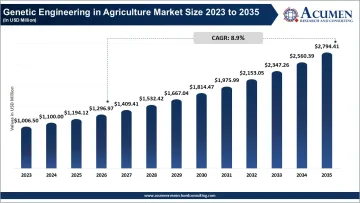
Market Highlights
- In 2025, North America accounted for the largest share of around 39% in the overall genetic engineering in agriculture market.
- Asia Pacific region is expected to display fastest growth at CAGR of 11.9% from 2026 to 2035.
- By crop type, the row crops segment accounted for nearly 49% share of the total genetic engineering in agriculture market.
- By trait, the herbicide tolerance segment held around 36% market share, while pest and insect resistance segment followed with approximately 25% market share.
- By end-user, the seed companies and agri-biotech firms held the largest share at around 47%, followed by farmers and growers with nearly 26% market share.
Genetic Engineering in Agriculture Market Overview
The agricultural genetic engineering market growth is primarily driven by rapid population growth, uneven land distribution, and climate change and its impact on crop production. Research suggests that global population is poised to reach approximately 8.5 billion by 2030, underscoring the need for greater food production to feed the world. Genetic engineering has emerged as a critical technology, enabling the efficient and purposeful rearrangement of plant genomes to acquire favourable traits such as yield, nutritional quality, and resistance to environmental stressors, including drought.
Economic data suggests that the adoption of GM (Genetically Modified) crops has substantial value for the market, with increased land-use efficiency alone estimated to save global agricultural producers USD 50 billion annually by 2030. The market is shifting away from transgenic methods which require introduction of foreign DNA, toward more precise gene-editing technologies, such as CRISPR-Cas9. Instead of crude method of becoming established as transgenic, GM plants will only require specific/new traits, thus enabling seeds bred for Next-Gen quality and resiliency across diverse agricultural geographies.
Genetic Engineering in Agriculture Market Dynamics
Market Drivers
Increasing Global Food Demand and Population Growth
- The main driver of the genetic engineering in agriculture market is the widening gap between global food supply and population's dietary needs. Global food security now demands the maximize yields per hectare as productive land dwindles due to urbanization and environmental decay. Genetic engineering is a suitable answer, as it enables the development of high-yielding crop varieties that can be grown in diverse, often marginal environments. The pressure is greatest in developing regions where food importation costs are expected to dramatically increase, thereby increasing the need for regional biotechnological solutions.
Technological Advancements in Gene Editing and Precision Biotechnology Tools
- The rapid development of technologies such as CRISPR, RNA interference, and genomic selection is a major driver of the market. This is an opportunity to develop improved traits in greater quantities and at a lower cost than through traditional techniques. As a result of advancements in the research and commercialization of these technologies, greater efficiencies will be accessible to agri-biotech companies as they invest in developing new products. Thereby promoting continuous innovation and growth in the agri-biotechnology industry.
Market Restraints
Stringent Regulatory Frameworks and Lengthy Approval Processes for Engineered Crops
- The major constraint of market is the complex and high-cost regulatory climate surrounding the commercialization of genetically engineered crops. The costs of obtaining regulatory approval for a new trait could exceed USD 100 million and, in many cases, short-circuit innovation by small biotech firms not associated with large multinational corporations. Different regions have very different standards for biosafety and environmental impact assessments, creating a fragmented global market that is challenging for international commerce. Some regions have eased some of the excessive burden based on gene-editing products that do not include foreign DNA, while others apply the same barriers and regulatory burdens as traditional transgenic GMOs.
Consumer Resistance and Ethical Concerns Surrounding Genetically Modified Crops
- Public skepticism regarding genetically modified crops continues to be a major barrier to market growth. Consumer concerns about food safety, environmental impact, biodiversity, equity, and ethics influence their purchasing behavior. In addition, negative media coverage and misinformation contribute to public acceptance in many regions. As a result of this resistance, consumers may be subject to strict regulations regarding the labeling of food products produced using genetic engineering. Moreover, they may also be subject to import bans and restrictions, thereby limiting their access to the world marketplace despite significant scientific research indicating the safety and benefits of engineered crops.
Market Opportunities
Expanding Commercialization of Gene-Edited Crops under Favorable Regulatory Policies
- The growing number of supportive regulatory frameworks for gene-edited food in North America and some parts of Asia-Pacific creates significant growth opportunities. The regulation of gene-edited food is generally much less stringent than conventional genetically modified food. Through this lowered level of regulation, companies can produce gene-edited foods quickly and at a lower cost. Therefore, gene-edited food companies can more quickly and economically market enhanced crop traits. Gene-editing research investments will continue to spur the pace of innovation and broaden the commercialization possibilities for gene-edited foods.
Rising Demand for Sustainable, Climate-Resilient, and Nutrient-Enriched Crop Varieties
- The increasing focus on sustainable agriculture, food security, and naturally derived food products is creating opportunities for genetically engineered crops, which improve nutritional content and stress resistance. Biofortified crops will address micronutrient deficiencies, while climate-resilient varieties will reduce reliance on chemical and water inputs. There has been increased government support for sustainable farming, as well as rising consumer concern about food quality and environmental impacts, which are expected to continue to fuel the long-term growth of this market.
Genetic Engineering in Agriculture Market Report Scope
| Attribute | Details |
|---|---|
| Genetic Engineering in Agriculture Market Size 2025 | USD 1,194.1 Million |
| Genetic Engineering in Agriculture Market Forecast 2035 | USD 2,794.4 Million |
| Genetic Engineering in Agriculture Market CAGR During 2026 - 2035 | 8.9% |
| Analysis Period | 2023 - 2035 |
| Base Year | 2025 |
| Forecast Data | 2026 - 2035 |
| Segments Covered | By Crop Type, By Trait, By Technology, By Application, By End-User, and By Geography |
| Regional Scope | North America, Europe, Asia Pacific, Latin America, and Middle East & Africa |
| Key Companies Profiled | Corteva Agriscience, Bayer AG, Syngenta AG, BGI, Illumina, NRGene, Eurofins Scientific, Neogen Corporation, Keygene, Editas Medicine, BASF SE, and Evogene Ltd. |
| Report Coverage | Market Trends, Drivers, Restraints, Competitive Analysis, Player Profiling, Covid-19 Analysis, Regulation Analysis |
Genetic Engineering in Agriculture Market Regional Analysis
- The North America genetic engineering in agriculture market size was reached at USD 465.71 million in 2025 and is expected to hit USD 950.10 million by 2035 at a CAGR of 7.3% from 2026 to 2035.
- The Europe genetic engineering in agriculture market size was estimated at USD 322.41 million in 2025 and is forecasted to grow USD 698.60 million by 2035 with a CAGR of 8% from 2026 to 2035.
- The Asia-Pacific genetic engineering in agriculture market size was valued at USD 298.53 million in 2025 and is projected to reach USD 894.21 million by 2035 at a CAGR of 11.9% from 2026 to 2035.
North America is the largest regional market for genetic engineering in agricultural. The region displays increasing adoption rate of genetically modified crops, supported by a well-developed biotechnological infrastructure and a conducive regulatory framework. Within North America, the USA holds a dominant position in the agricultural genetic engineering industry because of the extensive amount of land being used to cultivate genetically modified crops such as corn, soybean, and cotton. High levels of investment in agricultural research and development, the presence of major players in the agri-biotech industry, and USA being the first region to adopt innovative gene editing methodologies all contribute to the maturity of the agricultural genetic engineering market, allowing USA to maintain its position of revenue dominance.
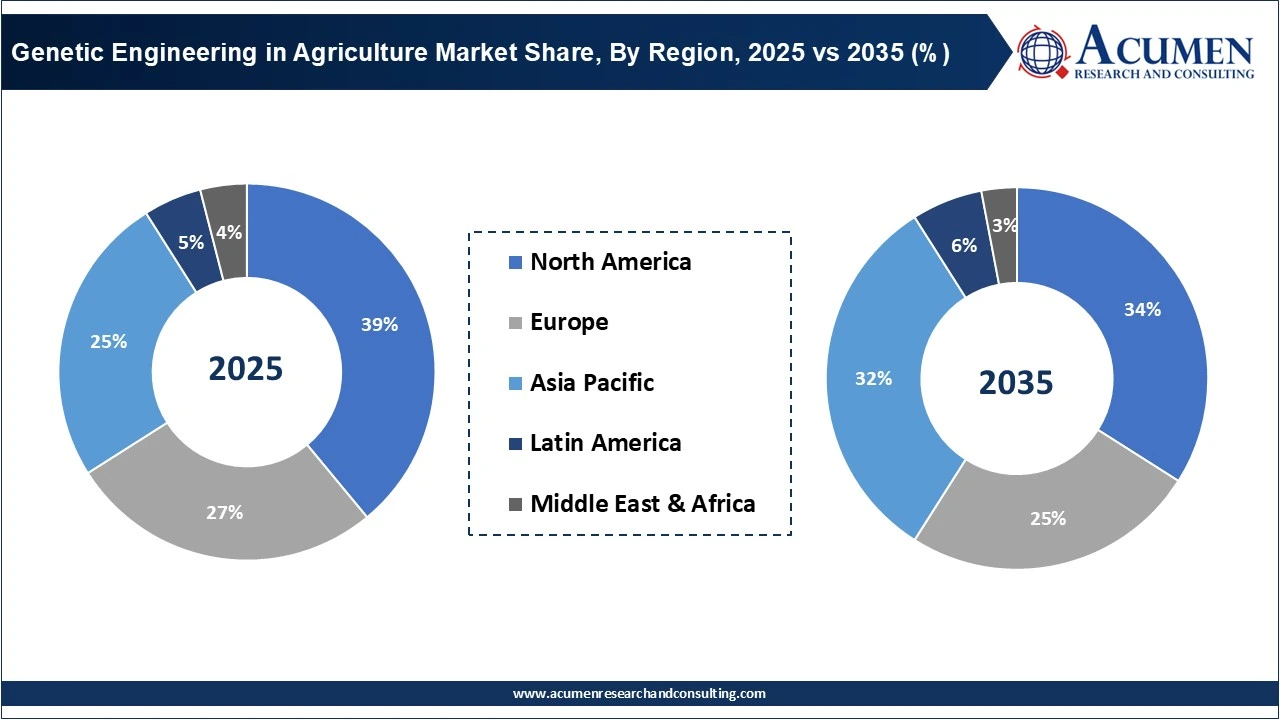
Asia Pacific region is expected to register fastest growth due to rising demand for food, increase in population, and increased demand for food security. Countries like China, India, and Australia will be making significant investments in agricultural biotechnology to enhance the production capabilities of their crops by improving both the yields and stress tolerances of existing cultivars. The increasing acceptance of crops produced using gene editing technologies, initiatives from government bodies supporting sustainable agriculture, and greater investment coming from private sector are all contributing to a rapid market expansion.
Genetic Engineering in Agriculture Market Segmental Insights
The genetic engineering in agriculture market is segmented by crop type, trait, technology, application, end user, and geography.
Crop Type Insight
Row crops (corn, soybeans, cotton, canola, etc.) make up the dominant segment of the genetic engineering market, due to their enormous scale and central role in global commodity trade. These crops provided the first example of widespread commercialization using transgenic traits, and still today constitute the overwhelming majority of global biotech acreage. The prominence of row crops is maintained by high demand for animal feed, biofuels, and cost-efficient processed food ingredients, all of which provide cost savings due to increased herbicide tolerance and insect resistance. In addition, row crops have established distribution and processing infrastructure that allows for contemporary biotechnology to create a stable market for genetically engineered seeds.
| Crop Type | Market Share, 2025 (%) | Key Highlights |
|---|---|---|
| Row Crops | 49% | Dominates due to large-scale cultivation and extensive use of engineered traits in corn and soybean. |
| Cereals and Grains | 20% | Strong adoption driven by yield improvement and stress tolerance in staple food crops. |
| Horticulture | 14% | Fast growth supported by demand for quality, shelf life, and nutrition-enhanced fruits and vegetables. |
| Specialty Crops | 8% | Increasing use of genetic traits for disease resistance and premium crop quality. |
| Oilseeds | 5% | Adoption focused on herbicide tolerance and improved oil quality. |
| Forage and Pasture Crops | 4% | Limited but growing use to enhance livestock feed quality and yield stability. |
The horticulture segment is analyzed as the fastest growing portion of the genetic engineering in agriculture market, propelled by consumers' need for better quality, and also the specific needs of high-value fruit and vegetable production. Row crops are focused on enhancing broad-acre efficiency; horticultural genetic engineering focuses on traits such as disease resistance, improved post-harvest shelf-life, and improved nutritional characteristics. With new advances in gene editing, it is now even possible to alter the complex genetic makeup of various fruits and vegetables, leading to the development of non-browning potato varieties and virus-resistant papaya. Trends leans toward “functional foods”, and consideration for reducing food waste in the value chain is certain to push the horticultural sector toward rapid adoption of biotechnology.
Trait Insights
Herbicide tolerance dominates the market due to its economic advantages for farmers such as lower labor costs, easier weed control, and higher yields. Herbicide tolerance is now used in most major row crops and has also become a major revenue source for seed companies through its high adoption rate. Long-standing commercialization of herbicide-tolerant crops and an established licensing model have all contributed to the high level of dominance that herbicide-tolerant crops have in the global market.
| Trait | Market Share, 2025 (%) | Key Highlights |
|---|---|---|
| Herbicide Tolerance | 36% | Largest trait segment due to cost-effective weed control and higher farm productivity. |
| Pest and Insect Resistance | 25% | Rapid adoption driven by rising pest pressure and reduced chemical pesticide use. |
| Yield and Biomass Enhancement | 18% | Increasing demand to maximize output from limited agricultural land. |
| Abiotic Stress Tolerance | 8% | Growing importance due to climate change and extreme weather conditions. |
| Quality and Shelf-Life Traits | 6% | Supports food supply chains by reducing post-harvest losses. |
| Nutritional Fortification | 4% | Expanding use to address micronutrient deficiencies and improve food quality. |
| Industrial / Feedstock Traits | 3% | Niche adoption focused on biofuels and industrial raw materials. |
Pest and insect resistance is the fastest-growing segment because of increased pest pressure and resistance to pesticides. Engineered insect-resistant crops are provided to help reduce crop losses and reliance on conventional chemical sprays. The growing environmental concern and regulatory restrictions regarding pesticide use are also contributing to the increased adoption of genetically engineered crops with insect-resistant traits. Continuous innovation in stacked trait technology continues to drive the growth of these types of traits.
Technology Insights
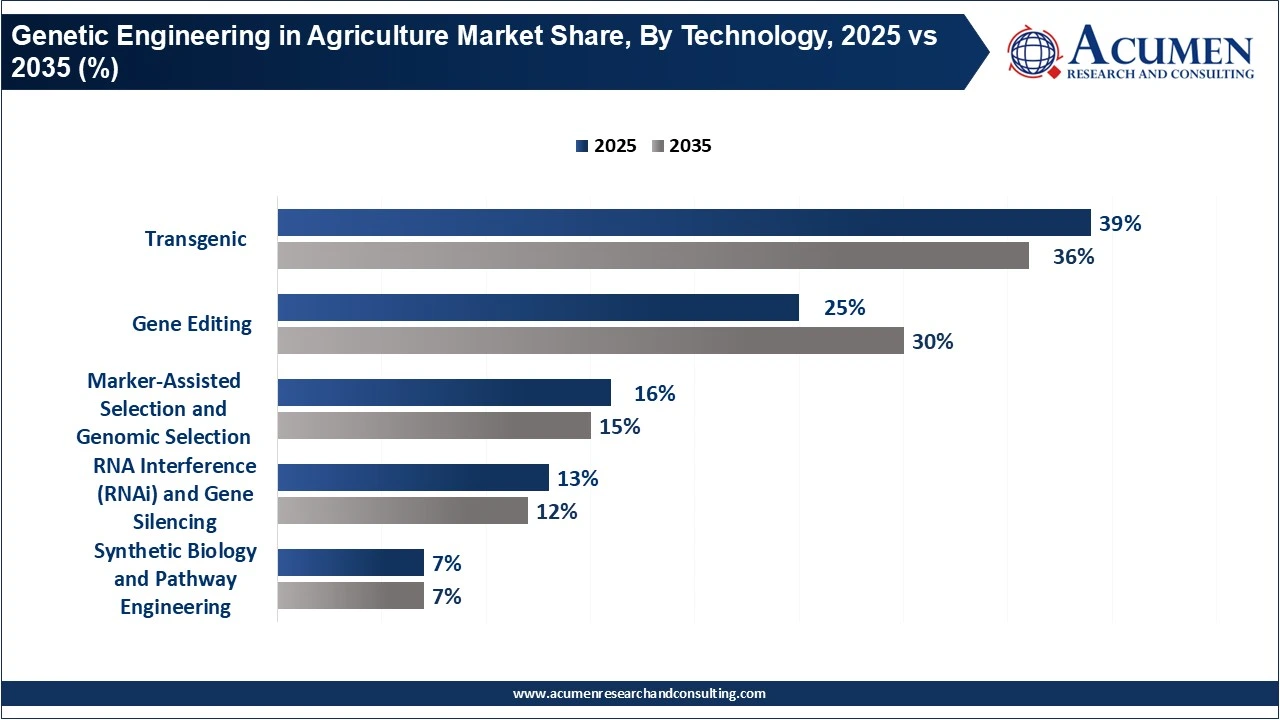
Transgenic technology has dominated the market due to its long and successful commercial history and extensive regulatory approvals. The large number of genetically engineered crops on the market today have been developed utilizing transgenic methods. Transgenic technology has established infrastructure, demonstrated performance, and widespread adoption among major crop species, all of which support the continued dominance of transgenic technology in the agricultural biotechnology sector. Although the following technologies are emerging, transgenic technology is still the primary contributor to current revenues in the agricultural biotechnology industry.
| Technology | Market Share, 2025 (%) | Key Highlights |
|---|---|---|
| Transgenic | 39% | Dominant technology with long-standing commercialization and global adoption. |
| Gene Editing | 25% | Fastest-growing due to precision, speed, and favorable regulatory treatment. |
| Marker-Assisted & Genomic Selection | 16% | Widely used for trait identification and breeding efficiency. |
| RNA Interference (RNAi) & Gene Silencing | 13% | Growing adoption for targeted pest control and gene regulation. |
| Synthetic Biology & Pathway Engineering | 7% | Emerging technology enabling advanced trait design and metabolic optimization. |
Gene editing is the fastest-growing technology segment because of its many advantages, including precision, rapidity, and regulatory advantage over competing technologies. CRISPR technology is the first method of developing targeted traits without the use of foreign DNA. This procedure reduces development cost and time when compared to transgenic approaches. Regulatory acceptance of this process is growing quickly. Increased investment in research and development will continue to support the development of this technology and will be the primary driver for commercialization.
Application Insights
Seed and trait licensing segment dominated the market among all applictions with around 56% market share. This is because it represents the main commercialization model for genetically modified (GM) crops. Large agricultural biotechnology companies earn substantial income by licensing proprietary traits to seed producers. Intellectual property protection provides strong, predictable revenues for biotechnology companies, and ongoing income from royalties leads to predictable growth. The seed and trait licensing application of engineered crop traits is still the largest market for distributing engineered crop traits globally and monetizing engineered crop traits.
| Application | Market Share, 2025 (%) | Key Highlights |
|---|---|---|
| Seed and Trait Licensing | 56% | Primary revenue generator through intellectual property and royalty-based models. |
| Biopesticides / RNAi-based Crop Protection | 15% | Fast growth driven by demand for sustainable and chemical-free crop protection. |
| Trait Discovery and R&D Services | 12% | Increasing outsourcing of research to accelerate innovation. |
| Regulatory and Stewardship Services | 10% | Essential for compliance and responsible deployment of engineered crops. |
| Contract Research and Development | 8% | Supports small and mid-sized firms lacking in-house R&D capacity. |
Biopesticides and RNAi-based crop protection application is the fastest-growing segment. Biopesticides and RNAi-based crop protection products provide very effective pest control, while also having a very low environmental footprint. Chemical pesticide restrictions will eventually limit their use, while the trend toward sustainable agriculture will lead to continued growth in the use of biopesticides and RNA interference products. Developments in technology and the increased acceptance of RNA interference technologies at the field level will result in rapid growth for this segment.
End-user Insights
Seed companies and agri-biotech firms dominate the market due to their involvement in developing, commercializing, and distributing traits. These companies invest significant amounts of money in research and development and retain ownership of intellectual property rights for engineered traits. Additionally, companies have established a strong global presence through licensing partnerships, giving them the most significant share of market revenues and thus maintaining their dominant status in the market.
| End User | Market Share, 2025 (%) | Key Highlights |
|---|---|---|
| Seed Companies / Agri-biotech Firms | 47% | Dominates due to ownership of trait development and commercialization rights. |
| Farmers and Growers | 26% | Fast-growing adoption driven by yield benefits and cost efficiency. |
| Food and Feed Manufacturers | 11% | Use engineered crops for quality consistency and supply reliability. |
| Seed and Trait Developers | 9% | Focus on innovation and early-stage trait development. |
| Government & Public Breeding Programs | 7% | Support food security and crop improvement initiatives. |
Farmers and growers represent the fastest-growing end-user segment as the adoption of genetically engineered crops continues to increase. Therefore, farmers are becoming more informed about the benefits of yield, savings, and resilience to adverse weather conditions associated with genetically engineered crops, leading to an increase in demand for their use on farms. Additionally, government support and improved access to advanced seeds will help the adoption of genetically engineered crops for both small- and large-scale farmers.
Genetic Engineering in Agriculture Market Players
- Corteva Agriscience
- Bayer AG
- Syngenta AG
- BGI
- Illumina
- NRGene
- Eurofins Scientific
- Neogen Corporation
- Keygene
- Editas Medicine
- BASF SE
- Evogene Ltd.
Recent Developments
- In February 2025, Corteva collaborated with Gates Agricultural Innovations to accelerate agricultural innovation and support global food security by developing novel seed technologies focused on yield improvement, climate resilience, and smallholder farmer adoption.
- In February 2024, Syngenta partnered with Lavie Bio, a subsidiary of Evogene, to co-develop novel bio-insecticides aimed at improving pest control efficiency while reducing reliance on chemical pesticides in sustainable agriculture systems.
Market Segmentation
By Crop Type
- Row Crops
- Cereals and Grains
- Horticulture
- Specialty Crops
- Oilseeds
- Forage and Pasture Crops
By Trait
- Herbicide Tolerance
- Pest and Insect Resistance
- Yield and Biomass Enhancement
- Abiotic Stress Tolerance
- Quality and Shelf-Life Traits
- Nutritional Fortification
- Industrial/Feedstock Traits
By Technology
- Transgenic
- Gene Editing
- Marker-Assisted Selection and Genomic Selection
- RNA Interference (RNAi) and Gene Silencing
- Synthetic Biology and Pathway Engineering
By Application
- Seed and Trait Licensing
- Biopesticides/RNAi-based Crop Protection Products
- Trait Discovery and R&D Services
- Regulatory and Stewardship Services
- Contract Research and Development
By End-User
- Seed Companies/Agri-biotech Firms
- Farmers and Growers
- Food and Feed Manufacturers
- Seed and Trait Developers
- Government and Public Breeding Programs
By Region
- North America
- U.S.
- Canada
- Europe
- U.K.
- Germany
- France
- Spain
- Rest of Europe
- Asia-Pacific
- India
- Japan
- China
- Australia
- South Korea
- Rest of Asia-Pacific
- Latin America
- Brazil
- Mexico
- Rest of LATAM
- Middle East & Africa
- South Africa
- GCC Countries
- Rest of Middle East & Africa
Looking for discounts, bulk pricing, or custom solutions? Contact us today at sales@acumenresearchandconsulting.com
Frequently Asked Questions

Other Agriculture Reports
July 2020
February 2023
May 2023
May 2020