
Hydrogen Aircraft Market Size, Share, Growth, Report 2026 To 2035
Hydrogen Aircraft Market (By Propulsion Technology: Hydrogen Combustion Engines Hydrogen Fuel Cell Systems, Hybrid Hydrogen-Electric Systems; By Range: Short-Haul (≤1,000 km), Medium-Haul (1,000–3,000 km), Long-Haul (≥3,000 km); By End Use: Commercial Aviation, Defense, Cargo, Private Aviation, Others) - Global Industry Analysis, Size, Share, Growth, Trends, Regional Analysis And Forecast 2026 To 2035
- Last Updated: 18 Jun 2026
- Report Code: ARC3941
- Category: Aerospace And Defence
Hydrogen Aircraft Market Size, Forecast Report 2026 To 2035
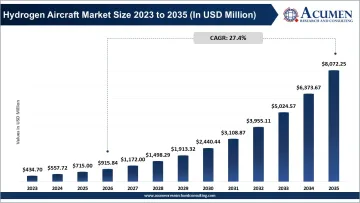
The global hydrogen aircraft market size was calculated at USD 715 million in 2025, expected to reach at USD 8,072 million by 2035. The market is expected to grow at CAGR of 27.4% during the forecast period of 2026-2035. National grants and tax incentives across major countries have already created significant opportunities for the market to expand. Moreover, overall development in high-temperature fuel-cell stacks and lightweight storage systems open notable chances for the hydrogen aircraft market to boom.
Report Highlights
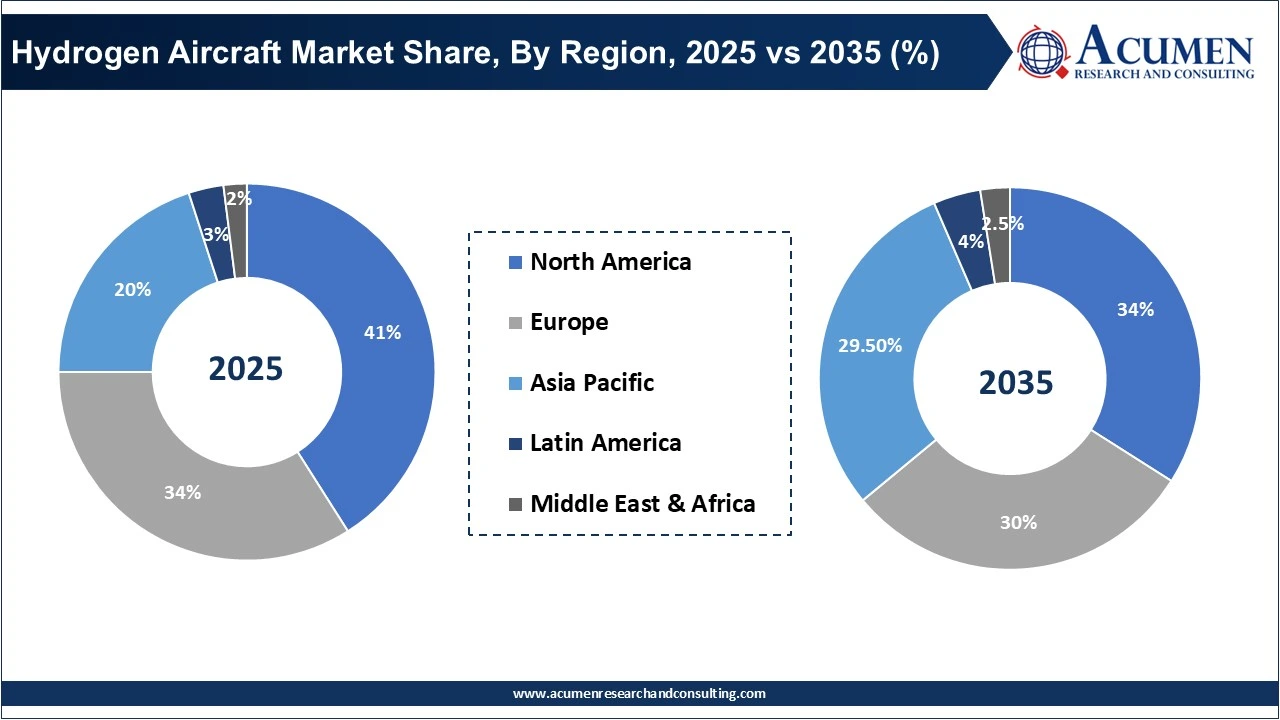
- By region, North America contributed significantly to the hydrogen aircraft market with 41% market share in 2025 and is expected to reach $2,744.56 million by 2035, registering a Compound Annual Growth Rate (CAGR) of 24.7%, primarily owing to its strong aerospace manufacturing base and early investment in hydrogen aviation.
- By region, Asia Pacific is expected to register the highest CAGR of 33.0% from 2026 to 2035, with its market share surging from 20.0% in 2025 to 29.5% by 2035, driven by expanding air passenger traffic in the region and increasing government support for hydrogen-powered aviation.
- By propulsion technology, hydrogen combustion engine held the largest share in the hydrogen aircraft market, with 45% share in 2025, attributing to its potential to use existing aircraft engine technology and its compatibility with current infrastructure.
- By propulsion technology, hydrogen fuel cell technology is anticipated to experience substantial growth, with its market share expected to expand from 35% in 2025 to 50% by 2035, as it offers higher efficiency and emits no direct carbon emissions during flight.
- By range, short-haul aircraft held the predominant market share of 60% in 2025 and is estimated to reach $3,632.51 million by 2035, growing at a CAGR of 23.3%, owing to the current viability of hydrogen propulsion for short-range operations.
- By range, long-haul aircraft is expected to record the fastest CAGR of 33.2%, with its market value escalating from $91.58 million in 2026 to $1,210.84 million by 2035, due to technological advancements in liquid hydrogen storage systems and aircraft design.
- By end-use, commercial aviation captured the largest market share, constituting 55% in 2025, driven by airlines’ increasing efforts to achieve net-zero carbon emissions and a rising adoption of sustainable aviation solutions.
- By end-use, the defense sector secured the second-largest market share, with 20% in 2025, backed by significant investments in next-generation low-emission aircraft and the development of hydrogen-powered tactical aviation systems.
Hydrogen Aircraft Market Overview
The global hydrogen aircraft market is emerging as one of the most transformative sectors within sustainable aviation, driven by the aviation industry’s urgent push toward decarbonization and net-zero emissions. Hydrogen-powered aircraft utilize either hydrogen combustion engines or hydrogen fuel-cell systems to significantly reduce carbon emissions compared to conventional jet fuel systems.
Hydrogen planes are gaining significant traction due to accelerated development, with major aerospace companies like Boeing, Airbus, ZeroAvia investing significant amounts of capital. These hydrogen planes will predominantly start to enter the commercial and cargo operations in regional operations, followed by long-haul operations, as technological innovations with lightweight aircraft structures and hydrogen fuel storage are making the systems efficient enough.
Government Initiatives
| Initiative / Program | Country / Region | Year | Key Highlights |
|---|---|---|---|
| National Green Hydrogen Mission (NGHM) | India | 2023-2026 |
India allocated over ₹19,744 crore to accelerate green hydrogen production, electrolyzer manufacturing, and pilot projects across sectors. The government awarded 8.62 lakh metric tonnes per annum (MTPA) of green hydrogen production capacity and 3,000 MW/year electrolyzer capacity. |
| Modified UDAN Scheme | India | 2026 | India approved a ₹28,840 crore budget to expand regional air connectivity through underserved airports and aerodrome development. |
| Clean Aviation Joint Undertaking | European Union | 2026 | The EU launched new hydrogen aircraft concept funding under its Clean Aviation program, focusing on fuel systems, integration, and hydrogen-powered aircraft demonstrations. |
| Airbus ZEROe Technology Support | France & Germany | 2025 | European public-private collaboration continues to support Airbus’ hydrogen aircraft technology maturation, including integrated fuel-cell systems and hydrogen storage development. |
| Green Aviation Program Grants | Netherlands | 2026 | The Dutch government granted €73–84 million to support hydrogen retrofit programs for regional aircraft. |
Market Dynamics
Driver
Rising Pressure for Aviation Decarbonization
The increasing pressure to decarbonize the aviation industry is by far the strongest driver of hydrogen aircraft market. Aviation today is responsible for nearly 2%-3% of global CO2 emissions, yet global air passenger traffic growth forecasts imply that emissions from regular Jet fuel-powered aircraft will soar in the long term. Governments, aviation regulators and individual airlines are faced with mounting pressure to contend with intensifying international climate initiatives such as International Civil Aviation Organization's net-zero emissions goal by 2050, and thus creating a flurry of activity to find more sustainable means of propulsion other than the advent of sustainable aviation fuel (SAF).
Hydrogen flying aircrafts are now seen as a promising option, as hydrogen engines when running on fuel-cell system have zero impact on CO2 life-cycle emissions and combustion hydrogen engines impose significant reductions if compared to regular aviation liquid fuels. Using green hydrogen produced via electric-powered electrolysis would subsequently have one of the lowest impact.
Restraint
Limited Hydrogen Infrastructure and High Capital Costs
Primarily, the market development is hampered by lack of infrastructure and high commercialization expenses. This sector differs vastly from conventional fuel transport to airports, with hydrogen as a source, it needs to involve a system for production, storage and transportation of H2 into airplanes, and distribution and refueling stations at airports. None of the present-day global airports were built to offer services of this type. Also, storing the hydrogen needs to be done in form of compressed gas under high pressure, or in extremely cold cryogenic state of -253C if using liquid hydrogen as a medium.
Opportunity
Expansion of Regional Air Mobility
One of the most appealing avenues of the hydrogen aircraft market is the quick growing demand for Regional Air Mobility. The general consensus amongst hydrogen aircraft developers is that short-haul and regional flight are one of the best ways to kick off hydrogen aviation, because of the limited amount of hydrogen fuel and short flight times, as well as the less demanding fueling process needed on a flight of this size.
These aspects make hydrogen integration into a fleet considerably easier in the short to mid-term, and the same is much less true when comparing this against medium haul and long haul flights. Regional Air Mobility market opportunity The demand for Regional air connectivity is expanding in response to higher urbanisation levels, growth in domestic travel and demand for quicker connection routes from less accessible areas and underdeveloped regions.
Many regional economies are seeing significant investment in low emission transportation options and regional airport infrastructure, creating the ideal market for the uptake of H2 powered aircraft, especially in growth regions like APAC and Europe where regional air traffic is rapidly expanding.
Segmental Insights
Propulsion Technology Insights
Hydrogen combustion engine had the highest market share of 45% in 2025 and thus, was the most dominant propulsion type. Emerging fuel type technology being hydrogen combustion engine has a dominant position mainly due to its ability to integrate with today's common gas turbine architecture, which smartly lessens the workload of the retrofit pattern of present-day aircraft system.
This mass flow technology gives a transitional advantage for the aviation industry OEMs due to experience in traditional combustion, while significantly cutting carbon emissions. Aviation aircraft manufacturers prefer to use combustion hydrogen aircraft systems for the initial stages of hydrogen aviation, as certification is relatively easier for these systems than for more recent fuel-cell systems.
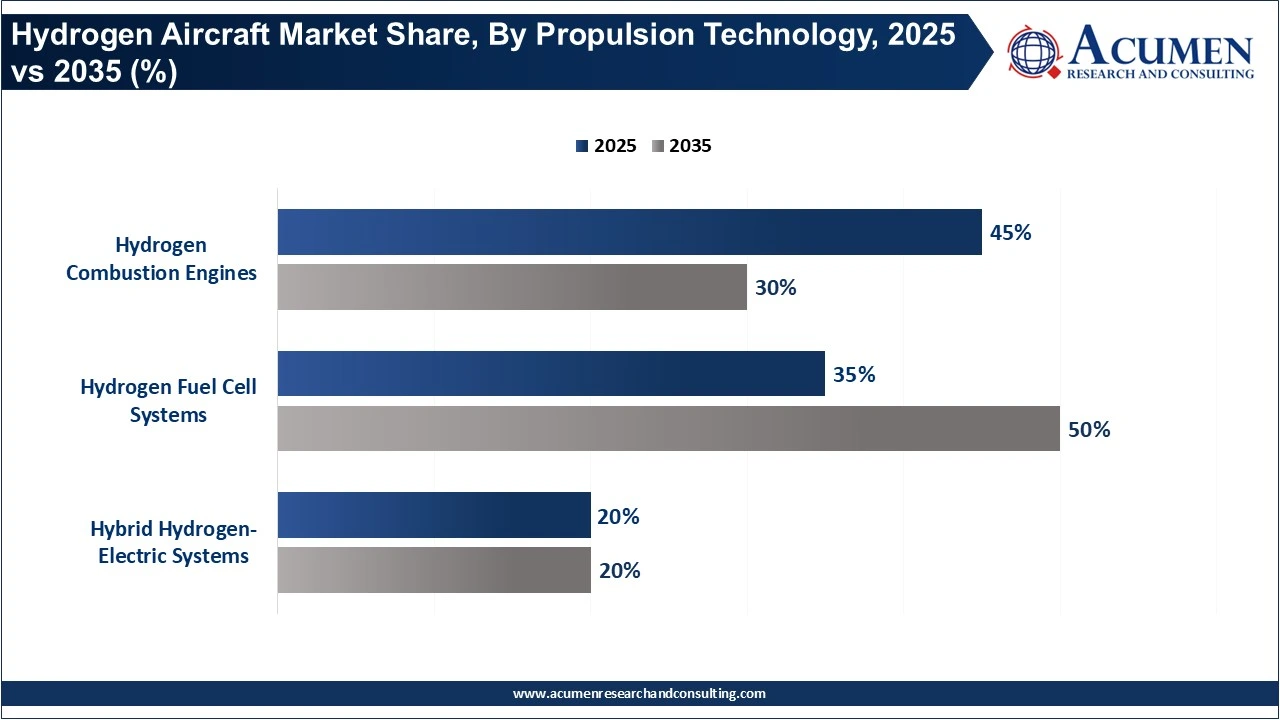
Hydrogen fuel cell is going to be the fastest growing segment with its market share expanding from 35% in 2025 to 50% in 2035. This is a significant leap representing industry’s long-term shift to fully electric zero-emission flight system. The higher energy efficiency, reduced noise level and zero direct emissions of FC systems are more appropriate measures to be achieved for sustainable aviation. The adoption rate is increasing rapidly mainly in the short-haul and regional aircraft where the energy density is less a concern.
Range Insights
Short-haul accounted for 60% market share, growing at a CAGR of 23.3% during the forecast period. It captured the largest share owing to the feasibility of technology in short-haul applications, as the fuel tank and size can be handled efficiently Short-haul flights will be ideal candidates for hydrogen aircraft with relatively less hydrogen and simple refueling mechanisms.
Short distances between regions will gain benefits through this technology and in future with increasing environmental concerns and regulations, domestic flight companies will be on a quest to introduce and implement this alternative mode of travel.
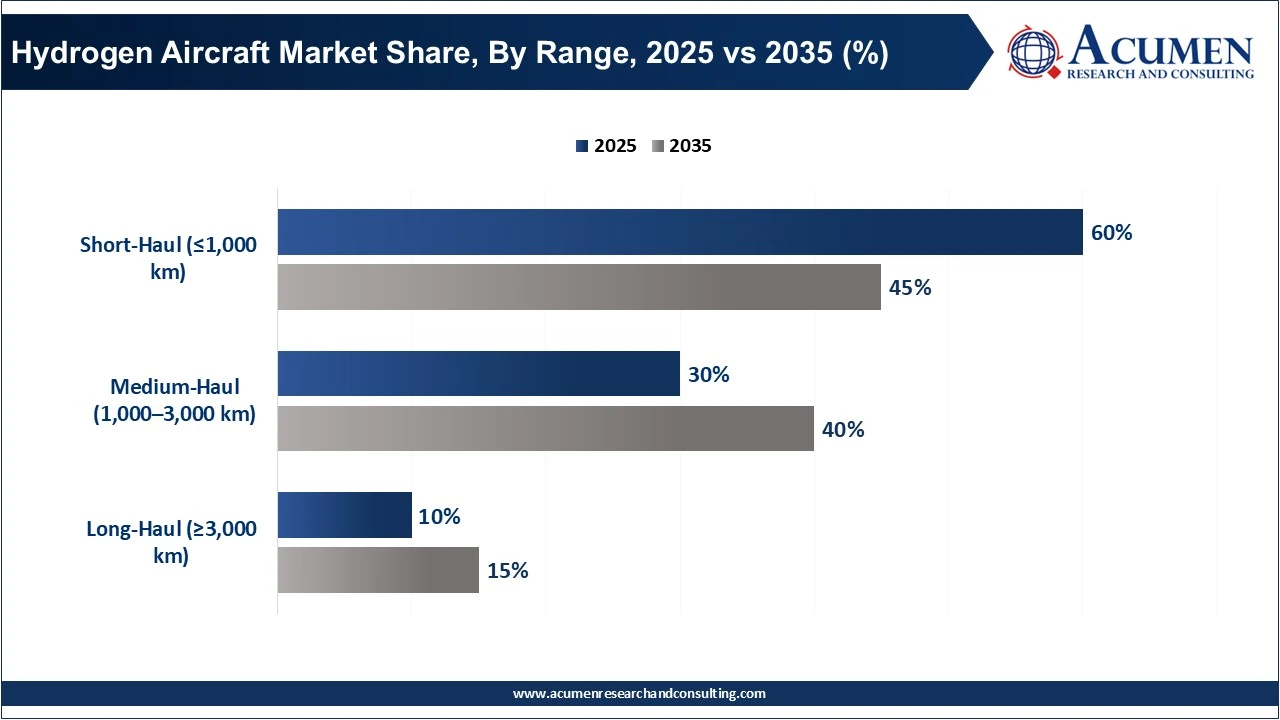
Long-haul segment is expected to capture a CAGR of 33.2% by the period of 2026-2035 The challenges associated with the deployment of hydrogen in long-haul operations range from carrying cryogenic liquid hydrogen on-board to the redesigned airframes. Engineering advancements in designing lightweight and durable composite structures and liquid storage of cryogenic fuels, including the latest cryogenic storage containers, have set the stage for hydrogen powered long haul air transport.
End Use Insights
The commercial aviation segment held the largest market share of 55% in 2025. This is mostly due to an increase in passenger traffic globally, an increase in the airline sustainability pledges and an increased focus on emission reduction policies. Commercial airlines are increasingly collaborating with aircraft manufactures to determine feasibility of hydrogen planes for regional and domestic operation.
Hydrogen Aircraft Market Share, By End Use, 2025 (%)
| End Use | Revenue Share, 2025 (%) |
|---|---|
| Commercial Aviation | 55$ |
| Defense | 20$ |
| Cargo | 12$ |
| Private Aviation | 8% |
| Others | 5% |
The defense segment, in 2025, stood second in terms of market share with 20% and is expected to have a substantial role in future with the emergence of hydrogen-powered aircraft. In this sector, the defense organizations are keenly considering hydrogen for surveillance, logistical &tactical operations, low thermal signatures and enhancing security of fuel supply. Hydrogen based Aircraft can enhance efficiency in defense missions with lower thermal profiles.
Regional Analysis
- The North America hydrogen aircraft market size was valued at USD 293.15 million in 2025 and is expected to reach at USD 2,744.56 million by 2035 at a CAGR of 24.7% during the forecast period 2026-2035.
- The Europe hydrogen aircraft market size was estimated at USD 243.10 million in 2025 and is predicted to hit USD 2,421.67 million by 2035, reflecting a CAGR of 25.6% from 2026-2035.
- The Asia-Pacific hydrogen aircraft market size was calculated at USD 143 million in 2025 and is anticipated to reach USD 2,381.31 million by 2035 with a CAGR of 33% from 2026-2035.
What Made North America Dominate the Hydrogen Aircraft Market in 2025?
In 2025, North America held the highest market share of 41% worth approximately USD 293.15 million and is projected to hit USD 2,744.56 million by 2035, with a CAGR of 24.7%. The dominant share of the region can be attributed to the region's entrenched aerospace manufacturing ecosystem, inherent R&D capability, and assertive adoption of de-carbonization initiatives in the aviation industry.
Moreover, North America is well positioned as the early adopter of the technology, due to the presence of aerospace behemoths like Boeing and RTX Corporation, coupled with their ongoing investments in hydrogen propulsion development. By virtue of its high federal funding for clean aviation and its investments in developing the infrastructure for the use of hydrogen in aircraft, North America is expected to be the leader.
Also, significant partnerships established between energy companies and aircraft manufacturers and expanding need for sustainable alternative to aviation fuel, including zero-emission aircraft prototypes, will fast track the pace of commercialization in North America.
Asia Pacific to Witness the Fastest Pace of Growth
Asia-Pacific is expected to exhibit the fastest CAGR of 33.0% during 2026–2035, from USD 183.17 million in 2026 to USD 2,381.31 million by 2035. The share of this region in the market is likely to witness a substantial rise, from 20.0% in 2025 to 29.5% by 2035, indicating it will be the most aggressive region for expansion across the globe.
Increasing air passenger traffic, government initiatives and hydrogen economy projects, coupled with extensive investments in the next generation aviation technology by China, Japan, South Korea, and India drive this growth. The various countries in the Asia Pacific region have focused on meeting the target of carbon neutrality and are implementing the hydrogen-powered flight into their policy for the future of transportation.
The increased modernization of airports and improved regional air connectivity along with plans to increase domestic aircraft manufacturing will boost the hydrogen aircraft's availability and operations. Different from established markets of the western nations, the Asia Pacific region has presented itself with more scope for growth opportunities as a green field, hence attracting global players.
Top Companies
- Airbus
- Boeing
- ZeroAvia
- Rolls-Royce Holdings
- GE Aerospace
- Pratt & Whitney
- GKN Aerospace
- H2FLY
- Intelligent Energy
- Aerodelft
Recent News
- By 2026, Rolls-Royce Holdings progressed the development of hydrogen combustion trials through its successful first flight demonstration of a full-scale jet engine, powered by hydrogen. Hydrogen combustion marks a near-term decarbonization solution in the aviation sector and supports the refitting of current propulsion systems and speed up the integration across regional aircraft platforms.
- In April 2025 Airbus showed an update of its ZEROe hydrogen aircraft concept with a four-engine fuel cell architecture in which liquid hydrogen is stored in large tanks. This represented a key product step away from its earlier combustion-oriented concepts and suggested increasing industry acceptance of the hydrogen-electric commercial aircraft vision.
Segments Covered in the Report
By Propulsion Technology
- Hydrogen Combustion Engines
- Hydrogen Fuel Cell Systems
- Hybrid Hydrogen-Electric Systems
By Range
- Short-Haul (≤1,000 km)
- Medium-Haul (1,000–3,000 km)
- Long-Haul (≥3,000 km)
By End Use
- Commercial Aviation
- Defense
- Cargo
- Private Aviation
- Others
By Region
- North America
- Europe
- Asia Pacific
- Latin America
- Middle East & Africa
Looking for discounts, bulk pricing, or custom solutions? Contact us today at sales@acumenresearchandconsulting.com
Frequently Asked Questions

Related Market Research Reports
December 2023
April 2023
April 2025
September 2021
August 2021
December 2024
June 2026
October 2024