
Lab-in-the-Loop (LITL) Market Size, Share, Report 2026 To 2035
Lab-in-the-Loop (LITL) Market (By Component: Software & AI Platforms, Cloud/GPU Compute Infrastructure, Services & Integration, Laboratory Automation Hardware, Licensing & Outcome-Based Revenue; By Deployment: On-Premise, Cloud-Based, Hybrid; By Application: Drug Discovery & Development, Genomics & Precision Medicine, Materials Science, Chemical Research, Battery & Energy, Synthetic Biology; By End User: Pharmaceutical Companies, Biotechnology Companies, CROs/CDMOs, Academic & Research Institutes, Government Laboratories, Industrial R&D Centers) - Global Industry Analysis, Size, Share, Regional Analysis, Trends and Forecast 2026 - 2035
- Last Updated: 10 Jun 2026
- Report Code: ARC3937
- Category: Healthcare and Pharmaceuticals
Lab-in-the-Loop (LITL) Market Size, Forecast 2026 to 2035
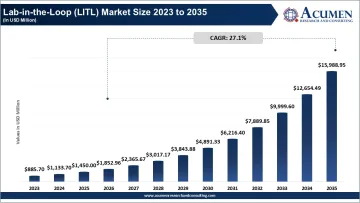
The global lab-in-the-loop market size was valued at $1,450 million in 2025, and it is expected to be worth $15,988.95 million by 2035; growing at a CAGR of 27.1% during the forecast period 2026 to 2035. The market is driven by the integration of AI with advanced laboratory automation. Additionally, overall advancements in the life science sector, rise in R&D activities and integration of cloud-native lab infrastructure focus on the expansion of the LITL market across the globe.
Report Highlights
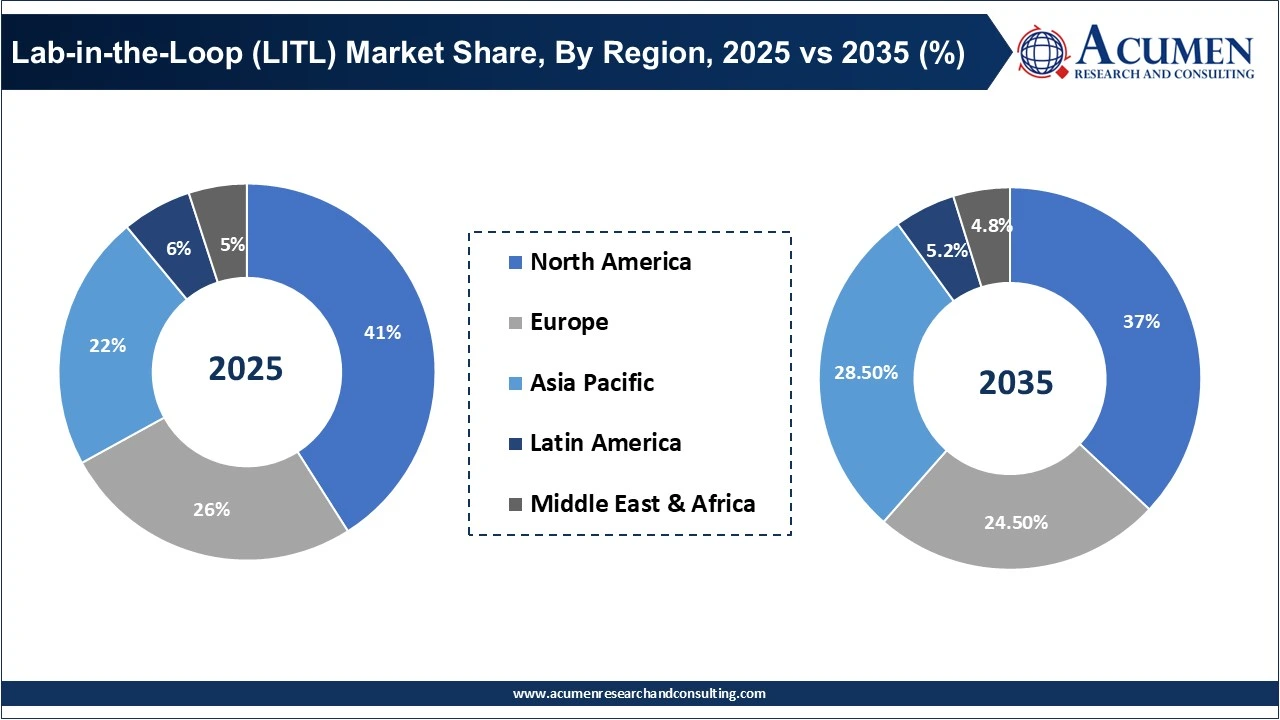
- By region, North America dominated the market with 41% share in 2025, due to the presence of leading pharmaceutical companies, advanced biotechnology and early adoption of AI-enabled laboratory automation technologies.
- By region, Asia Pacific is seen to grow at the fastest rate of CAGR of 30.8% during the forecast period owing to increasing investments in biotechnology and strong government support.
- By component, the software and AI platforms held the largest share of 32% in 2025, owing to the core intelligence layer it carries that enables automated experimentation.
- By component, the cloud/GPU compute infrastructure is projected to be the fastest growing segment supported by rising demand for high-performance computing resources required for AI training, molecular simulations, and large-scale scientific data analysis.
- By deployment type, on-Premise segment accounted for the market share of 52% in 2025 as protection of IP and stringent compliance regulations in pharmaceutical research requires high degree of data security and privacy.
- The cloud-based segment held 28% share in 2025 and is expected to witness the fastest growth during the forecast period as organizations are looking for scalable compute, collaboration, and cost benefits.
- By application, drug discovery & development dominated the market share of 35% in 2025 due to adoption of AI guided experimentation for drug discovery and enhancing research efficiency.
- By application, the genomics & precision medicine segment held 20% of market share and is anticipated to register the highest growth during the forecast period due to advancement in sequencing, biomarker research, and precision healthcare initiatives.
- By end-user, pharmaceutical companies accounted for the highest market share in 2025 with 35% share due to their constant efforts in integrating AI powered laboratory systems to enhance productivity.
- Biotechnology companies segment is expected to witness a CAGR of 30.2% during the forecast period due to increased adoption of autonomous experimentation platform in synthetic biology, genomics and advanced therapeutic research.
Lab-in-the-Loop Market Overview
AI, Robotics & Digital Twin Shaping the Future
A rapidly growing sector of research and development-the Lab-in-the-Loop market is evolving around artificial intelligence, robotics, cloud, and digital twin technologies to enable automatic, self-optimizing lab activities. These systems have the ability to automatically design experiments, perform tasks via robots, analyze experimental outcomes and update future experimental parameters without much human guidance.
Increasing complexity in drug discovery, genomics, synthetic biology, materials science and battery development is driving the adoption of AI-enabled lab environments. Pharmaceutical companies and biotech firms are adopting these lab-in-the-loop platforms in an effort to improve time-to-discovery, increase experimental reproducibility and successful outcomes, and to reduce overall development costs.
Key Statistics (2025-2026)
Integration of AI in Life Science & Drug Discovery
- In 2025, over $12 billion was invested in AI driven life sciences and biotech companies. This trend suggests increasing confidence in AI driven discovery platforms among investors.
- In 2026, 65% of the top pharmaceuticals implemented at least one AI technology at one stage or the other, ranging from discovery, target identification or clinical development processes.
- AI enabled drug discovery platforms may shorten time taken to identify drug candidates at the early stage by 40% to 60% over conventional drug discovery methods.
- There are more than 350 AI focused drug discovery companies operational globally in 2026, compared with fewer than 100 in the last decade.
- Pharmaceuticals will invest more than $25 billion each year into AI driven R&D technologies by 2030, a considerable amount being invested already in 2025-2026.
- In 2026, more than 75 AI driven drug candidates have already been entered in to clinical trials across the globe. This indicates a commercial validation of the AI discovery methods.
- AI driven molecular screening platforms can analyze millions of molecular candidates within few hours, as compared to few weeks to few months of conventional methods.
- The average price for bringing a new drug to market is over $2 Billion, incentivizing the adoption of AI driven technologies to lower development costs.
Market Dynamics
Driver
Growing Demand for Faster and More Cost-Efficient Scientific Discovery
The competitive landscape is pushing pharma, biotech, and research organizations to accelerate innovation, but at lower costs. This is fueling the growth of the lab-in-the-loop market, as it significantly reduces time and investment required in research-a multi-year commitment in conventional R&D-before reaching viable commercialization stage. With an AI, robotics, and automated decision-making system at its core, a lab-in-the-loop platform allows continuous optimization of experiment. Increased research quality and reproducibility as well as shortened cycle times motivate organizations to heavily invest in autonomous lab technologies.
Restraint
High Initial Infrastructure Costs
While lab-in-the-loop technologies offer many benefits, a large financial investment is needed for robotic hardware, cloud computing resources, laboratory automation equipment, and AI software platforms. Furthermore, many research institutions struggle to incorporate the new autonomous systems into their existing laboratory environments and legacy data infrastructure. The limited availability of talent skilled in both life sciences and AI driven lab technologies can also pose a barrier to adopting these technologies especially within small research institutions and newly established biotech companies.
Opportunity
Expansion of Autonomous Laboratories
A huge market growth opportunity arises from the quick growth of AI-native biotech companies and of autonomous labs. The rise of generative AI, digital twin technology, robotic experimentation, and scientific computing on the cloud allows the development of self-operating laboratories. Increasing investments in personalized medicine, synthetic biology, new materials, and next-generation drugs is likely to generate strong demand for closed-loop lab platforms. Adoption of lab-in-the-loop technology is predicted to rise rapidly in academic and commercial research, as the goal of creating continuously learning and self-optimizing labs is pursued.
Regional Insights
North America to Sustain the Dominance: Private Companies to Play Major Role with Investments
The North America lab-in-the-loop market size was valued at $594.50 million in 2025, and it is expected to be $5,915.91 million by 2035; growing at a CAGR of 25.6% during the forecast period 2026-2035. This is directly correlated to well-established biotechnology ecosystem, strong capabilities in pharmaceutical innovation, and the earliest uptake of Artificial Intelligence in laboratory science. The U.S. alone, contributes to a substantial chunk of the world pharmaceutical R&D spending, facilitating an apt environment for the demand of AI enabled laboratory automation solutions. The existence of prominent pharmaceutical & biotechnology companies, cloud service providers, and AI technology developers further increased machine learning adoption within laboratories.
Research organizations throughout the North American region have begun employing autonomous experimentation systems for decreasing the development cycle time, improving reproducibility, and reducing cost of research. Additionally, significant investment in precision medicine, genomics and next generation drug discovery also fuel demand for lab-in-the-loop solutions.
Top Investments in AI-based Life Science in North America
- Xaira Therapeutics emerged with around $1 billion of funding raised through leading venture capital firms such as ARCH, NEA, Sequoia and many others.
- Formation Bio raised roughly $372 million from an important round with emphasis on AI-powered drug development.
- Isomorphic Labs raised $600 million in an important round supported by Alphabet/Google-linked investors and Thrive Capital.
- Insilico Medicine raised around $110 million on an later-stage financing round and the company already has many AI-designed drug candidates.
Asia Pacific to Grow Rapidly in the LITL Market by 2035
The Asia-Pacific lab-in-the-loop market size was valued at $319 million in 2025, and it is expected to be $4556.85 million by 2035; growing at a CAGR of 30.8% during the forecast period 2026-2035. Increased research infrastructure, growth in biotechnology investments and amplified governmental focus on AI in scientific advancement will propel growth in China, Japan, South Korea, Singapore and India. Numerous Pharmaceutical and biotechnology companies across Asia Pacific are increasing their utilization of automated labs to enhance research output and global competitiveness.
Strong demand from the acceleration in genomic research, biomanufacturing and precision medicine undertakings, is expected to spur demand for AI in experimental processes. Modernization of labs by research institutions, and the acceleration of digital transformation processes is likely to make Asia-Pacific one of the fastest growing market for lab-in-the-loop technology.
Leading Asian Countries in the Lab-in-the-Loop Market
- China: Government support initiatives for AI adoption and advanced manufacturing practices are spurring the implementation of automated experimentation platforms among pharmaceutical companies and research organizations. The expanding number of AI based drug discovery collaborations between Chinese biotechnology firms and global pharmaceutical companies is additionally boosting the market.
- Japan: Japanese research organizations are rapidly implementing laboratory automation and machine learning techniques to counter the issue of aging populations, the need for personalized drug development, and research in complex biologics. The continuous government support to the digital transformation programs is expected to stimulate further implementations.
- India: The adoption of AI based lab workflows are encouraged by government supported programs such as the National Biopharma Mission, Digital India, and AI innovation driven initiatives for research organizations. Furthermore, the increase in the number of global capability centers and contract research organizations are boosting the market.
- South Korea: The utilization of AI, robotics and cloud based lab systems in scientific workflows are gradually gaining importance among Korean companies and research institutions to increase lab productivity and development times. The implementation of government driven initiatives focusing on AI leadership is estimated to accelerate the market.
Segmental Insights
Component Insights
Software & AI platforms had the largest share, accounting for 32% of the market in 2025. These platforms act as the intelligence layer in lab-in-the-loop systems, and they handle experimental design, workflow orchestration, data analysis and decision making. As laboratories are increasingly dealing with complex data sets, researchers are depending on the assistance of software with AI capabilities to analyze the data, optimize experimental design and speed up the scientific research.
The increasing use of machine learning algorithms, digital laboratory management systems and predictive analytics tools are also pushing up the demand for this segment. Organizations are actively investing in software solutions that can integrate data from various instruments and make automatic recommendations for the next step in research, making the software platform the "brain" of an autonomous laboratory.
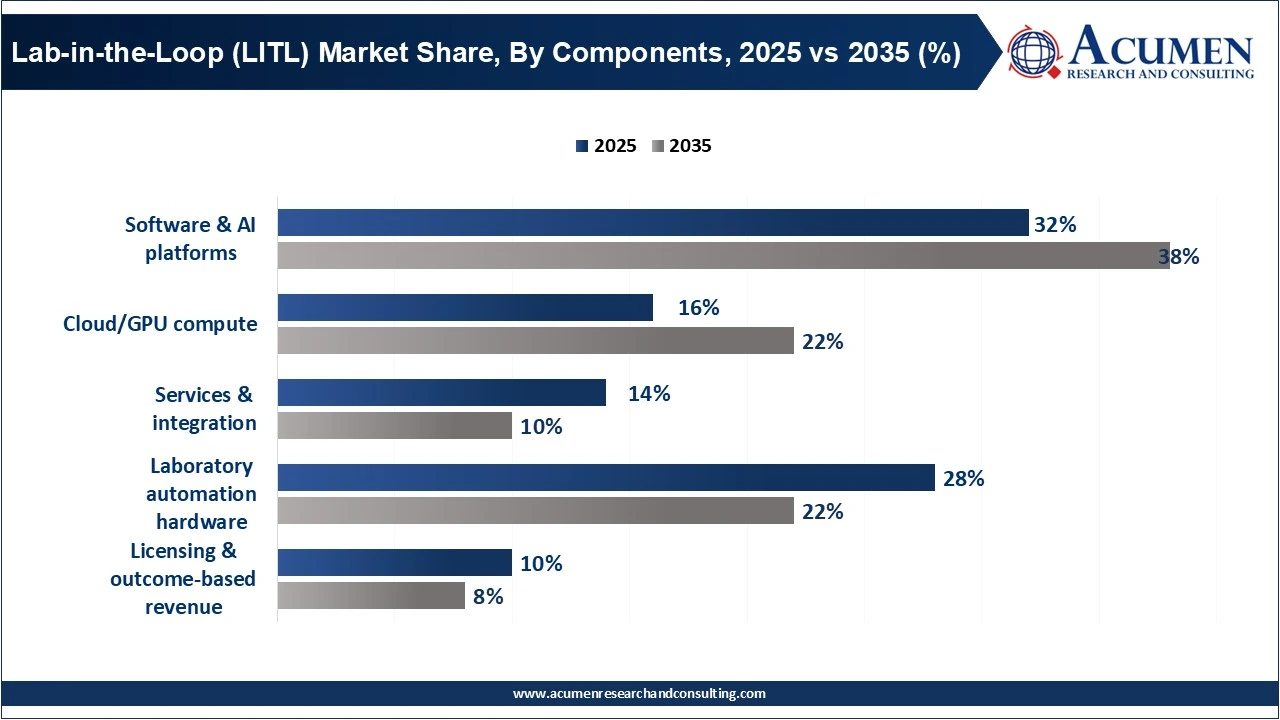
The growth of cloud/GPU compute infrastructure is anticipated to grow at the fastest rate, with its share expanding from 16% in 2025 to 22% in 2035. The increasing sophistication of AI models, the demands of molecular simulations, as well as the need for large scale scientific data analysis are driving the demand for powerful computation.
Researchers find it more beneficial to rely on cloud-based computational infrastructure to gain scalability in computing power without large initial investment. Growing application of generative AI, digital twins, molecular modeling, simulation based experiments are predicted to spur growth of GPU-powered compute environment throughout the forecast period.
Deployment Insights
On-premise was the largest segment in the market with a share of 52% in 2025. The reason behind the preference of the pharmaceutical and biotechnology companies towards the on-premise deployment systems include, intellectual property concerns, security of data and research information and regulatory compliance in the use of such systems.
It is assumed that high value research and drug discovery organizations would require their own infrastructure so that data could be secured and compliance could be maintained with the required regulatory bodies. Consequently, large pharmaceutical companies and the highly research intensive organizations continue to largely use on-premise deployment.
Lab-in-the-Loop (LITL) Market Revenue Share, By Deployment, 2025 (%)
| Deployment | Revenue Share, 2025 (%) |
|---|---|
| On-Premise | 52% |
| Cloud-Based | 28% |
| Hybrid | 20% |
While the cloud-based segment held 28% of the market in 2025, it is predicted that it would witness the fastest growth in the forecast period. The organizations are gaining confidence over the cloud and its security and compliance policies, and the growing interest in collaborations.
By shifting their lab activities over the cloud organizations will be provided with the advanced computational resources, easy sharing of data across various locations and efficient scalability of experimental processes. The agility offered by the cloud and the associated cost benefits, will make it the strongest growth area of the market.
Application Insights
Drug discovery & development holds the largest share by application at 35% in 2025, pharmaceutical companies have increasingly been incorporating AI-guided experiments in their drug research to streamline the discovery and optimization of targets and lead compounds.
Drug discovery and development is extremely costly and time consuming and have a very high failure rate. Lab-in-the-loop technologies assist research scientists in testing hypotheses faster, automate monotonous tasks and extracting actionable information from big data which in turn enables pharmaceutical companies to make rapid discoveries more efficiently and affordably.
Lab-in-the-Loop (LITL) Market Revenue Share, By Application, 2025 (%)
| Application | Revenue Share, 2025 (%) |
|---|---|
| Drug Discovery & Development | 35% |
| Genomics & Precision Medicine | 20% |
| Materials Science | 15% |
| Chemical Research | 15% |
| Battery & Energy Research | 8% |
| Synthetic Biology | 10% |
Genomics & precision medicine held 20% share and is the fastest growing application segment as it is seeing advancements in sequencing technologies, discovery of biomarkers and personalized medicine leading to immense volume of biological data being generated which requires analysis driven by advanced AI techniques.
Lab-in-the-loop technologies enable scientists to automate their genomics experiments, identify clinically relevant patterns within the genes and optimize precision medicine processes. With the growth of personalized medicine within the healthcare industry the demand for AI-driven genomics research technologies is growing immensely.
End User Insights
Pharmaceutical companies segment led the market with a 35% market share in 2025. Pharmaceutical companies are one of the first and most frequent users of lab-in-the-loop technologies due to their constant need to improve drug discovery, enhance research efficiency and decrease development costs. Increased complexity of research in areas such as oncology, rare diseases, and biologics has boosted the demand for automated experimentation systems for these industries. Pharmaceutical companies are heavily investing in AI-driven lab platforms for competitive advantage and increased R&D efficiency.
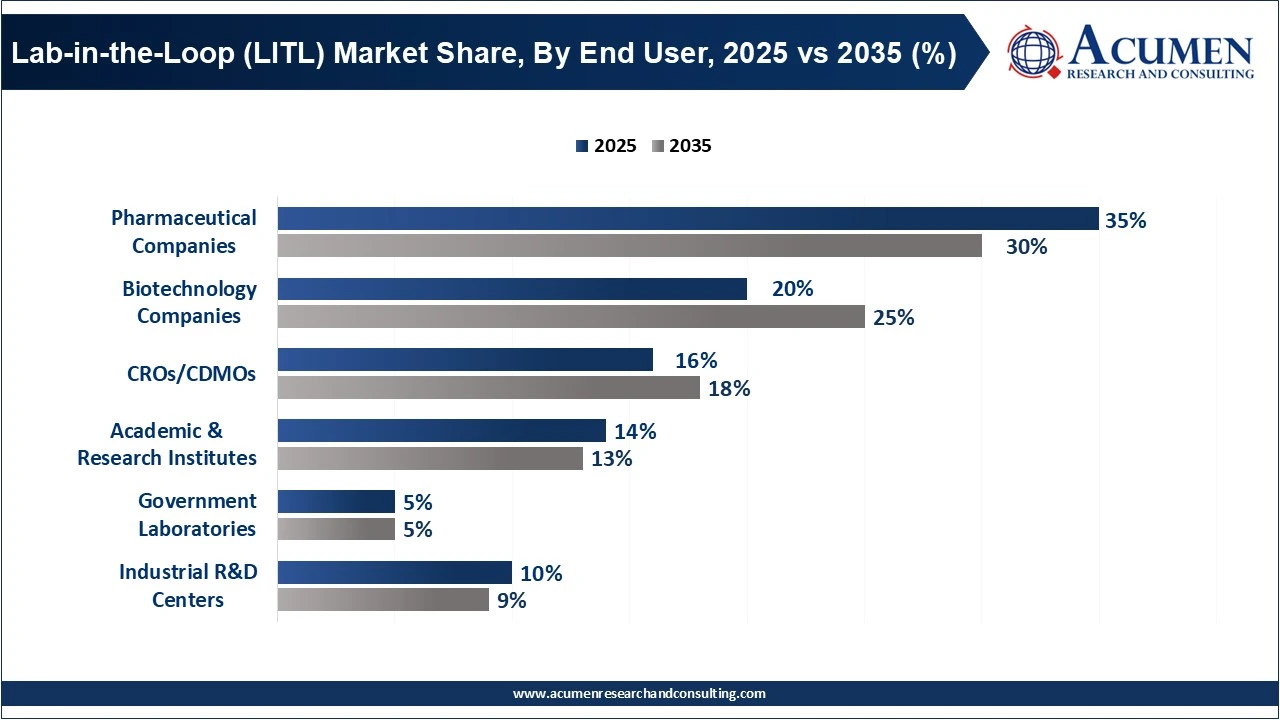
The biotechnology companies segment is expected to witness the fastest growth rate with a 30.2% CAGR during the projected period. Biotechnology companies are adopting automated experimentation platforms rapidly to boost research and development activities in synthetic biology, gene editing, genomics, cell therapy and biologics.
Unlike pharmaceutical giants, most biotechnology companies are comprised of relatively smaller research teams with limited resources, hence the demand for AI-powered lab-in-the-loop systems to maximize productivity, speed up scientific research and allow scalability of research efforts. Persistent and constant research investments are expected to drive this market growth significantly.
Top Companies
- Emerald Cloud Lab
- Strateos
- Recursion Pharmaceuticals
- Insilico Medicine
- Isomorphic Labs
- Synthace
- TetraScience
Recent Breakthroughs & News
- In May 2026 - Benchling Automation launched the hardware-agnostic system which brings lab instruments, automation, and scientific records together in one continuous loop. Up until now, all of these elements needed to be custom-integrated, custom-coded into propriety formats and rebuilt from scratch for every different workflow.
- In April 2026- AWS announced Amazon Bio Discovery, a new AI application that will allow scientists to confidently and rapidly design and test new drugs. Amazon Bio Discovery gives scientists immediate access to an extensive library of expert AI models termed bio-foundation models (bioFMs), which are trained on large amounts of biological data.
Segments Covered in the Market
By Component
- Software & AI Platforms
- Cloud/GPU Compute Infrastructure
- Services & Integration
- Laboratory Automation Hardware
- Licensing & Outcome-Based Revenue
By Deployment
- On-Premise
- Cloud-Based
- Hybrid
By Application
- Drug Discovery & Development
- Genomics & Precision Medicine
- Materials Science
- Chemical Research
- Battery & Energy
- Synthetic Biology
By End User
- Pharmaceutical Companies
- Biotechnology Companies
- CROs/CDMOs
- Academic & Research Institutes
- Government Laboratories
- Industrial R&D Centers
By Region
- North America
- Europe
- Asia-Pacific
- Latin America
- Middle East & Africa
Looking for discounts, bulk pricing, or custom solutions? Contact us today at sales@acumenresearchandconsulting.com
Frequently Asked Questions

Other Healthcare and Pharmaceuticals Reports
April 2021
November 2020
September 2023
March 2023