
Lasik Eye Surgery Devices Market Size, Share, and Forecast, 2026 To 2035
Lasik Eye Surgery Devices Market (By Product: Excimer Laser Systems, Femtosecond Laser Systems, Microkeratomes & Mechanical Flap-Creation Devices, Others; By Treatment Technology: Wavefront-Guided LASIK, Wavefront-Optimized LASIK, Topography-Guided LASIK, Conventional/Standard LASIK, Others; By Procedure Type: Femtosecond/Bladeless LASIK, Microkeratome/Blade-Based LASIK, Others; By Vision Error: Myopia, Hyperopia, Astigmatism, Presbyopia & Other Refractive Errors; By End User: Ophthalmic Clinics & LASIK Centers, Hospitals, Ambulatory Surgical Centers, Academic & Research Institutes, Others) - Global Industry Analysis, Size, Share, Regional Analysis, Trends and Forecast 2026 - 2035
- Last Updated: 19 Oct 2026
- Report Code: ARC1732
- Category: Healthcare and Pharmaceuticals
LASIK Eye Surgery Devices Market Size & Forecast
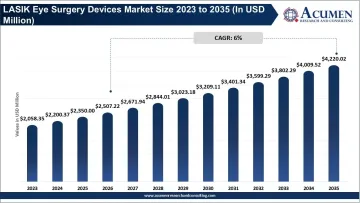
The global LASIK eye surgery devices market size was valued at USD 2,350 million in 2025. The market is seen to reach at USD 4,220.02 million by 2035, while expanding at a promising CAGR of 6.0% during the forecast period of 2026-2035. Rising demand for laser-based vision correction, increasing adoption of advanced femtosecond and excimer laser platforms, and continued innovation in personalized treatment technologies are driving growth in the LASIK eye surgery devices market.
- Base Year Market Size (2025): $2,350 million
- Current Year Market Size (2026): $2,507.22 million
- Estimated Year Market Size (2035): $4,220.02 million
- Forecast Period CAGR (2026-2035): 6%
Report Highlights
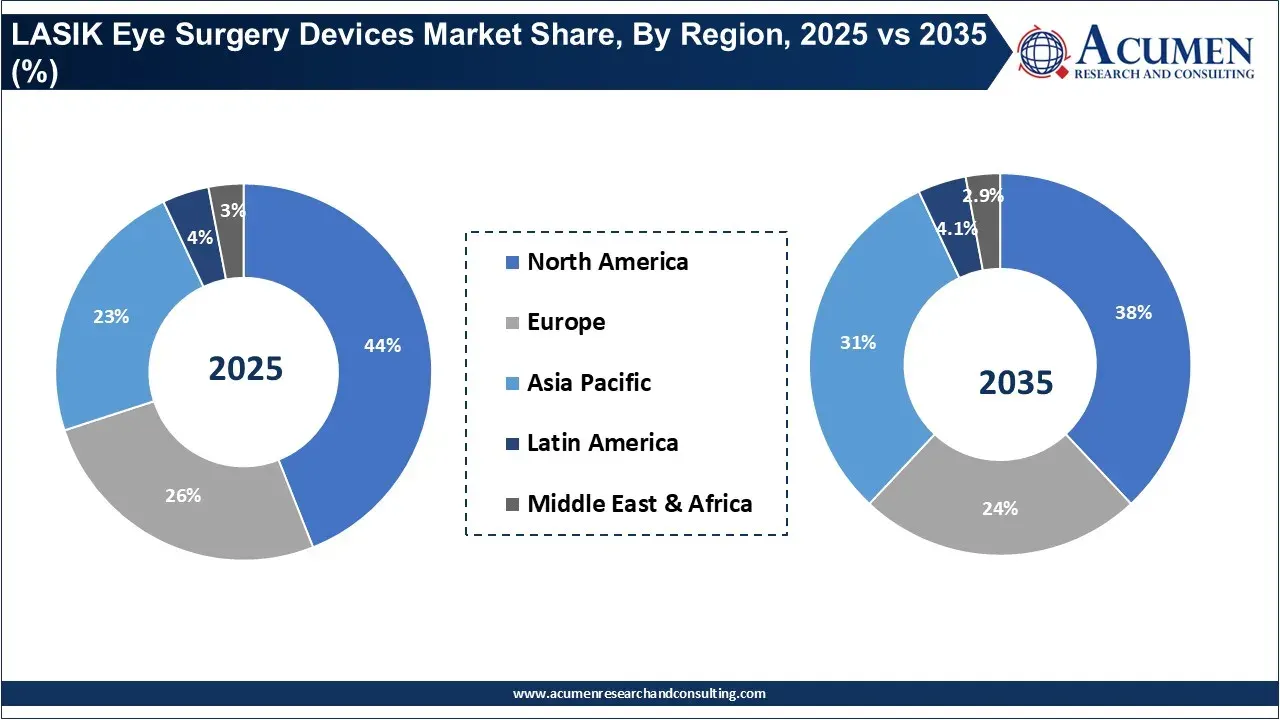
By Region: North America dominated the regional segment with 44.0% share in 2025, supported by mature refractive surgery infrastructure, advanced laser platforms, and established LASIK centers.
By Product: Femtosecond Laser Systems dominated the product segment with 43.0% share in 2025, driven by growing preference for precise, bladeless corneal flap creation.
By Treatment Technology: Wavefront-Guided LASIK dominated the treatment technology segment with 43.0% share in 2025, supported by its ability to provide customized treatment based on individual optical characteristics.
By Procedure Type: Femtosecond/Bladeless LASIK dominated the procedure type segment with 69.0% share in 2025, reflecting increasing adoption of all-laser procedures and precise flap-creation technologies.
By Vision Error: Myopia dominated the vision error segment with 42.0% share in 2025, supported by the large and growing global prevalence of nearsightedness.
By End User: Ophthalmic Clinics & LASIK Centers dominated the end-user segment with 44.0% share in 2025, supported by their specialized infrastructure, high procedure volumes, and dedicated refractive surgery capabilities.
What is the LASIK Eye Surgery Devices Market?
The market for LASIK eye surgery devices includes the total global sector for medical devices that perform laser-assisted refractive eye surgery and related pre-treatment and treatment-planning procedures. LASIK involves primarily the use of an excimer laser for corneal reshaping and the use of a mechanical microkeratome or a femtosecond laser to produce the corneal flap.
Growing demand for customized refractive procedures is helping to drive more widespread adoption of systems designed to take advantage of detailed measurements of individual eye properties.
Continuing approval of FDA indications for existing laser platforms such as Alcon's Wave Light EX500 were announced in March 2025, and new laser platforms are entering the market. Meanwhile, similar excimer lasers used in lens-based treatments such as premium IOLs and laser cataract procedures are increasing competition within the wider ecosystem of refractive procedures, leading to competitive pressures on technology.
Key Adoption and Usage Statistics
- LASIK remains widely utilized: A 2026 study of U.S. refractive surgery trends found that LASIK continued to have substantially higher public search interest than PRK, SMILE, and ICL implantation over the 2015–2025 period, although interest in SMILE and ICL increased more rapidly after 2020.
- Strong U.S. procedure utilization: Industry data cited in a 2024 investor presentation estimated approximately 700,000 refractive procedures annually in the U.S., illustrating the scale of clinical utilization of laser and other refractive technologies.
- High femtosecond usage in South Korea: A Korean ophthalmology survey found that 80% of LASIK procedures were performed using a femtosecond laser in 2015, demonstrating substantial adoption of bladeless flap creation technology among surveyed refractive surgeons.
- India has substantial procedure activity: India performs approximately 600,000–700,000 LASIK and other refractive procedures annually, with procedure volumes reported to be increasing by approximately 8–10% annually in 2025 industry reporting.
- Advanced personalization is expanding: Alcon's WaveLight plus uses more than 100,000 data points from ocular wavefront, biometry, and corneal tomography measurements to construct a 3D "Digital Eye Twin" for personalized LASIK planning.
- Femtosecond systems are expanding beyond traditional LASIK: The FDA's 2025 approval documentation for the VisuMax 800 included post-approval data associated with SMILE, demonstrating the expanding use of femtosecond laser platforms across multiple corneal refractive procedures.
Growth Factors
- Refractive Error Burden: The large population affected by myopia, hyperopia, and astigmatism creates a sustained patient base for refractive procedures. LASIK uses controlled laser ablation to reshape the cornea and correct refractive errors, supporting continued demand for excimer lasers, femtosecond lasers, diagnostic systems, and treatment-planning technologies.
- Laser Technology Advancement: Continuous improvements in excimer and femtosecond laser systems are supporting more precise and customized refractive procedures. The FDA's approved LASIK-device list includes systems such as WaveLight EX500 and MEL90, demonstrating continued development and regulatory advancement of laser platforms used for corneal reshaping.
- Bladeless Procedure Adoption: Increasing use of femtosecond lasers for corneal flap creation is supporting demand for integrated LASIK platforms. Unlike conventional microkeratomes, femtosecond systems use precisely focused laser pulses to create the corneal flap, enabling controlled tissue separation and supporting the development of all-laser LASIK workflows.
Market Dynamics
Market Drivers
- Myopia Prevalence: Rising prevalence of myopia is expanding the potential patient pool for refractive correction and increasing demand for laser-based vision correction technologies. LASIK is specifically used to correct refractive errors including myopia, hyperopia, and astigmatism, supporting continued utilization of excimer-based corneal reshaping systems.
- Customized Treatments: Growth in wavefront-guided and other customized treatment approaches is encouraging demand for advanced diagnostic and laser platforms capable of tailoring procedures to individual corneal and refractive characteristics. FDA documentation describes wavefront-guided systems that use detailed optical measurements to guide LASIK treatment, supporting the shift toward personalized refractive correction.
- Premium Ophthalmic Centers: Expansion of specialized eye clinics and refractive surgery centers is supporting investment in sophisticated laser platforms, diagnostic equipment, and integrated treatment systems. Providers can use these technologies across LASIK and other refractive procedures, improving equipment utilization and strengthening the business case for advanced ophthalmic laser systems.
Market Restraints
- High Equipment Costs: LASIK platforms require substantial investment in laser consoles, patient interfaces, diagnostic systems, treatment-planning software, maintenance, and specialized operating environments. The capital requirements can make advanced systems difficult to justify for smaller ophthalmology practices, particularly where procedure volumes are insufficient to support high equipment utilization.
- Procedure Eligibility: Not every patient with refractive error is an appropriate candidate for LASIK. Patient selection depends on factors including refractive stability, corneal characteristics, eye health, and other clinical considerations. Consequently, the addressable patient population for LASIK devices is smaller than the overall population requiring vision correction.
- Alternative Procedures: LASIK competes with other approaches to refractive correction, including PRK, SMILE, phakic intraocular lenses, and continued use of glasses or contact lenses. The FDA identifies PRK and other refractive procedures as alternatives that also reshape the cornea or correct refractive errors, creating competition for procedure volumes and equipment investment.
Market Opportunities:
- SMILE Integration: The growing ecosystem around femtosecond laser technology creates opportunities for platforms capable of supporting multiple corneal refractive procedures. FDA records for the VisuMax 800 include post-approval data associated with SMILE, demonstrating how femtosecond laser platforms are extending beyond traditional LASIK workflows into broader refractive applications.
- Emerging Markets: Expanding ophthalmic infrastructure and increasing access to refractive surgery in developing healthcare markets can create opportunities for LASIK device manufacturers. Growth in specialized eye-care centers, improving medical infrastructure, and increasing awareness of surgical vision correction can support adoption of laser platforms across Asia-Pacific, Latin America, and other developing markets.
- Integrated Platforms: Combining diagnostics, treatment planning, eye tracking, wavefront or topography measurements, and laser delivery into connected workflows can create opportunities for differentiated LASIK systems. Integrated platforms can streamline the transition from patient assessment to treatment and support increasingly customized procedures using patient-specific measurements.
Market Challenges
- Clinical Safety: LASIK devices operate directly on the cornea, making treatment accuracy and patient safety critical requirements. Laser systems must deliver precise energy and treatment patterns while minimizing unintended tissue effects. Regulators therefore require evidence supporting the safety and effectiveness of devices for specific indications before they can be commercially marketed.
- Surgeon Training: Advanced refractive platforms require ophthalmologists and clinical staff to understand patient selection, diagnostic measurements, treatment planning, laser operation, and complication management. Differences between laser platforms can also require additional training, creating implementation challenges when clinics upgrade equipment or introduce new refractive technologies.
- Technology Competition: Manufacturers must continuously differentiate laser systems through treatment precision, speed, customization, connectivity, and broader procedure capabilities. Competition between excimer, femtosecond, and emerging refractive technologies can increase pressure on manufacturers to invest in research, software, clinical evidence, regulatory submissions, and platform upgrades while maintaining cost competitiveness.
LASIK Eye Surgery Devices Market Segmental Insights
Product Insights
Femtosecond Laser Systems: Femtosecond laser systems dominated the product segment with 43.0% share in 2025, supported by their established role in bladeless flap creation and their ability to provide controlled, precise corneal flap formation. Growing preference for all-laser LASIK and advanced refractive procedures continues to strengthen demand for femtosecond platforms. Industry data also identifies femtosecond lasers as a leading product category in the LASIK device market.
Excimer Laser Systems: Excimer laser systems represented the second-largest product category, with 39.0% share in 2025, supported by their central role in reshaping the cornea during LASIK procedures. Their established clinical use, precision in corneal ablation, and compatibility with wavefront-guided and topography-guided treatments continue to sustain demand.
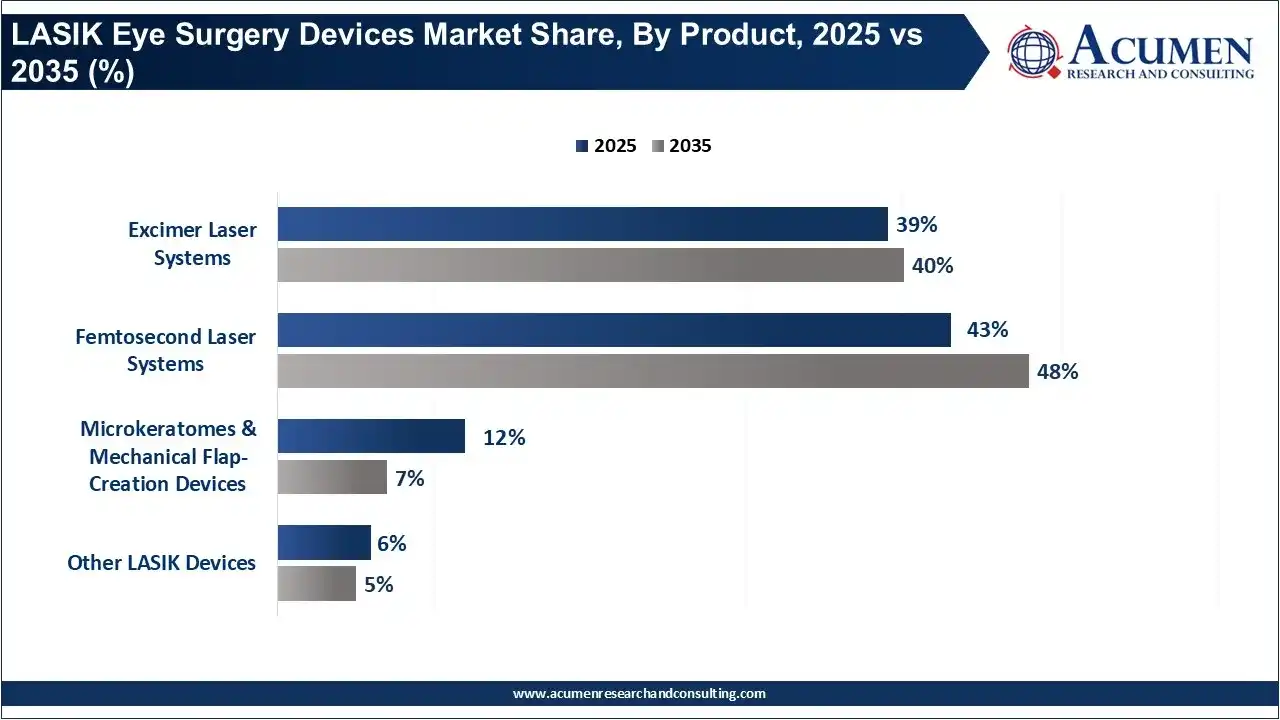
Microkeratomes & Mechanical Flap-Creation Devices: Microkeratomes and mechanical flap-creation devices accounted for 12.0% share in 2025, reflecting their continued use in conventional blade-based LASIK procedures. However, their share is expected to decline as ophthalmic centers increasingly transition toward femtosecond-based bladeless procedures.
Treatment Technology Insights
Wavefront-Guided LASIK: Wavefront-guided LASIK dominated the treatment technology segment with 43.0% share in 2025, supported by its established clinical adoption, personalized treatment planning, and ability to account for higher-order optical aberrations during refractive correction. Its established installed base and continued use in customized vision correction support its leading position.
Wavefront-Optimized LASIK: Wavefront-optimized LASIK represented the second-largest treatment technology category, with 27.0% share in 2025, supported by its ability to maintain corneal asphericity while reducing the induction of certain optical aberrations. Its established workflow and suitability for routine refractive procedures continue to support adoption.
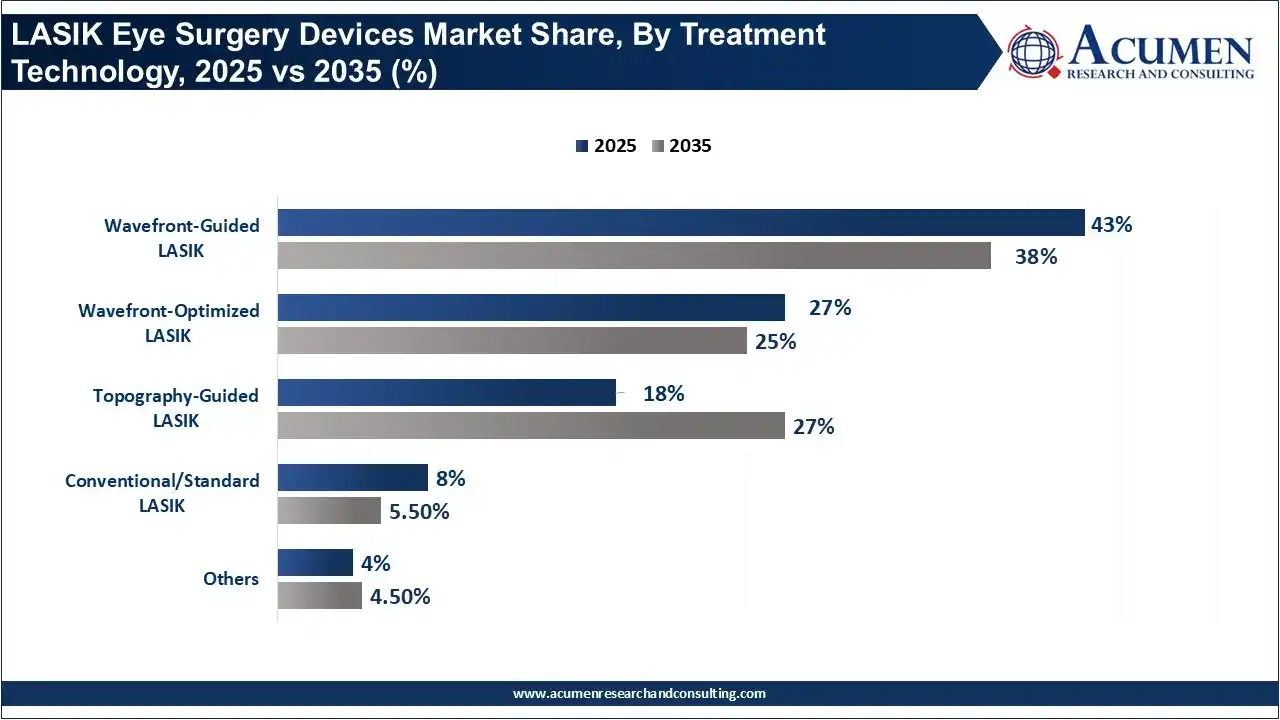
Topography-Guided LASIK: Topography-guided LASIK accounted for 18.0% share in 2025 and is projected to register the fastest CAGR of 10.8% from 2026 to 2035, driven by growing demand for customized treatments based on detailed corneal surface mapping. Increasing use for complex corneal profiles and irregular astigmatism is supporting faster adoption of topography-guided platforms. Industry sources similarly identify topography-guided LASIK as a high-growth technology category.
Procedure Type Insights
Femtosecond/Bladeless LASIK: Femtosecond/bladeless LASIK dominated the procedure type segment with 69.0% share in 2025, supported by the increasing preference for all-laser procedures and precise femtosecond flap creation. The technology enables controlled flap parameters and has become an important component of advanced LASIK workflows.
Microkeratome/Blade-Based LASIK: Microkeratome/blade-based LASIK represented the second-largest procedure category, with 27.0% share in 2025, supported by its established clinical history and continued availability across refractive surgery centers. However, its relative position is being affected by the broader transition toward bladeless procedures.
Lasik Eye Surgery Devices Market Share, By Procedure Type, 2025 (%)
| Procedure Type | Revenue Share, 2025 (%) |
|---|---|
| Femtosecond/Bladeless LASIK | 69% |
| Microkeratome/Blade-Based LASIK | 27% |
| Other LASIK Procedures | 4% |
Other LASIK Procedures: Other LASIK procedures accounted for 4.0% share in 2025, representing alternative procedural approaches and specialized LASIK techniques used for specific clinical requirements.
Vision Error Insights
Myopia: Myopia dominated the vision error segment with 42.0% share in 2025, supported by the large global burden of nearsightedness and strong demand for refractive correction. The increasing prevalence of myopia, particularly among younger populations, continues to expand the potential patient pool for LASIK and other vision-correction procedures.
Astigmatism: Astigmatism represented the second-largest vision error category, with 27.0% share in 2025, supported by demand for laser-based correction of irregular or distorted vision. Advances in wavefront and topography-guided technologies are enabling increasingly customized treatment approaches for astigmatic patients.
Lasik Eye Surgery Devices Market Share, By Vision Error, 2025 (%)
| Vision Error | Revenue Share, 2025 (%) |
|---|---|
| Myopia | 42% |
| Hyperopia | 19% |
| Astigmatism | 27% |
| Presbyopia & Other Refractive Errors | 12% |
Hyperopia: Hyperopia accounted for 19.0% share in 2025, supported by the continued use of LASIK for selected farsighted patients. Improvements in customized treatment planning and laser precision are supporting its application in refractive correction.
End User Insights
Ophthalmic Clinics & LASIK Centers: Ophthalmic clinics and LASIK centers dominated the end-user segment with 44.0% share in 2025, supported by their specialization in high-volume refractive procedures and concentration of dedicated laser equipment. These centers typically maintain specialized ophthalmic infrastructure and trained personnel for advanced LASIK workflows.
Hospitals: Hospitals represented the second-largest end-user category, with 27.0% share in 2025, supported by their comprehensive ophthalmology departments, broader patient bases, and capacity to provide refractive surgery alongside other eye-care services.
Lasik Eye Surgery Devices Market Share, By End User, 2025 (%)
| End User | Revenue Share, 2025 (%) |
|---|---|
| Ophthalmic Clinics & LASIK Centers | 44% |
| Hospitals | 27% |
| Ambulatory Surgical Centers | 20% |
| Academic & Research Institutes | 5% |
| Others | 4% |
Ambulatory Surgical Centers: Ambulatory surgical centers accounted for 20.0% share in 2025, supported by the growing shift toward outpatient ophthalmic procedures and demand for efficient surgical workflows. Their ability to provide specialized procedures without hospital admission supports continued adoption of LASIK devices.
LASIK Eye Surgery Devices Market Regional Outlook
North America LASIK Eye Surgery Devices Market Analysis
North America accounted for the highest share in 2025 accounting for 44.0% of the overall market share supported by the matured diagnostic and refractive surgery infrastructure, availability of large number of modern laser systems, and presence of specialized ophthalmic practices.
U.S. is the key market in the region and the practice of LASIK refractive surgery has one of the highest penetration, with an estimated 800,000 cases of LASIK being performed annually.
Technology is also further supporting this regional market by bringing refractive surgery further into the realm of personalized treatment. Recent advances have centered on treatment planning using detailed corneal and ocular measurements, wavefront-guided procedures, and newer personalized laser platforms.
For example, a ray-tracing-guided laser in situ keratomileusis (LASIK) system that created personalized plans based on more than 100,000 data points from a single eye was presented at the American Academy of Ophthalmology in October 2025.
- United States: The U.S. remains a major regional market due to its large installed base of refractive surgery equipment, established LASIK provider networks, high procedure volumes, and continued introduction of customized laser vision correction technologies. LASIK remains the most popular refractive procedure in the country, with approximately 800,000 procedures performed annually.
- Canada: Canada is supported by established ophthalmic care infrastructure and specialized refractive surgery providers, while continued adoption of advanced diagnostic and laser technologies is supporting the modernization of LASIK treatment workflows.
Asia Pacific LASIK Eye Surgery Devices Market Analysis
Asia-Pacific accounted for 23.0% of the LASIK eye surgery devices market in 2025 and is projected to register the fastest CAGR of 9.5% from 2026 to 2035. Growth is supported by expanding ophthalmic healthcare infrastructure, increasing demand for vision correction, high prevalence of myopia, and greater availability of advanced refractive surgery technologies. The region contains several countries with substantial refractive-error burdens, creating a large underlying need for vision-care services and supporting long-term demand for diagnostic, laser, and surgical technologies. WHO reports that myopia has reached very high levels in parts of East and Southeast Asia, with prevalence among adolescents approaching 50% in countries such as Singapore and China and reaching around 80% among young adults in some areas.
China, Japan, South Korea, India, and other Asia-Pacific markets are strengthening their ophthalmic infrastructure while expanding access to modern vision-care technologies. China's national refractive-error initiatives, for example, include efforts to strengthen service delivery, professional capacity, monitoring, and access to quality-assured eye care.
- China: China represents a major Asia-Pacific opportunity due to its large myopia burden, expanding ophthalmic infrastructure, and national initiatives focused on improving refractive-error services. The country launched its China National Action Plan for Refractive Error with WHO in October 2025, supporting improvements in service delivery, professional capacity, monitoring, and access to eye care.
- India: India has a large underlying refractive-error and vision-care burden and is strengthening eye-care capacity through public and private ophthalmology networks. WHO reported that South-East Asia accounts for nearly one-third of the world's blind and visually impaired population, highlighting the substantial regional need for expanded and improved eye-care services.
Top Companies
- Alcon
- Carl Zeiss Meditec
- Johnson & Johnson Vision
- Bausch + Lomb
- SCHWIND eye-tech-solutions
- NIDEK
- Ziemer Ophthalmic Systems
- Johnson & Johnson Surgical Vision
- Technolas Perfect Vision
- Topcon
Recent Product Launches and Device Developments
- September 2025, Alcon launched WaveLight plus in the U.S. and Canada, describing it as a fully personalized LASIK treatment that uses ray-tracing technology and the Sightmap diagnostic device to create a patient-specific 3D "Digital Eye Twin." The system had previously been introduced in China and several European and Asia-Pacific markets.
- In May 2026, the FDA approved a supplement for Carl Zeiss Meditec's VISUMAX 800 Femtosecond Laser, covering design changes to the laser source intended to address temperature-induced laser beam drift. The regulatory update demonstrates continued engineering development of femtosecond laser systems used for refractive correction.
Segments Covered
By Product
- Excimer Laser Systems
- Femtosecond Laser Systems
- Microkeratomes & Mechanical Flap-Creation Devices
- Other LASIK Devices
By Treatment Technology
- Wavefront-Guided LASIK
- Wavefront-Optimized LASIK
- Topography-Guided LASIK
- Conventional/Standard LASIK
- Other Advanced/Customized LASIK Technologies
By Procedure Type
- Femtosecond/Bladeless LASIK
- Microkeratome/Blade-Based LASIK
- Other LASIK Procedures
By Vision Error
- Myopia
- Hyperopia
- Astigmatism
- Presbyopia & Other Refractive Errors
By End User
- Ophthalmic Clinics & LASIK Centers
- Hospitals
- Ambulatory Surgical Centers
- Academic & Research Institutes
- Others
By Region
- North America
- Europe
- Asia-Pacific
- Latin America
- Middle East & Africa
Looking for discounts, bulk pricing, or custom solutions? Contact us today at sales@acumenresearchandconsulting.com
Frequently Asked Questions

Other Healthcare and Pharmaceuticals Reports
March 2025
March 2023
October 2024
November 2024