
Membrane Filtration Market Size, Share, Growth, Report 2026 To 2035
Membrane Filtration Market (By Technology: Microfiltration (MF), Ultrafiltration (UF), Nanofiltration (NF), Reverse Osmosis (RO), Others; By Membrane Material: Polymeric Membranes, Ceramic Membranes, Metallic Membranes, Composite Membranes; By Module Design: Spiral Wound, Hollow Fiber, Tubular, Plate & Frame, Capillary; By End Use Industry: Municipal Water Utilities, Food & Beverage Industry, Pharmaceutical & Biotechnology Industry, Chemical & Petrochemicals, Electronics & Semiconductor Industry, Others) - Global Industry Analysis, Size, Share, Regional Analysis, Trends and Forecast 2026 - 2035
- Last Updated: 05 Jun 2026
- Report Code: ARC3934
- Category: Chemicals And Materials
Membrane Filtration Market Size, Forecast 2026 To 2035
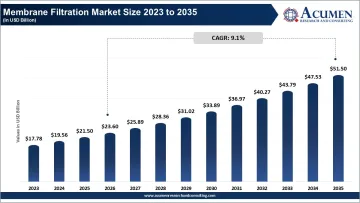
The global membrane filtration market size was valued at $21.50 billion in 2025 and is estimated to surpass around $51.50 billion by 2035 growing at a CAGR of 9.1% from 2026 to 2035. As governments across the globe implement strict water quality standards, the mandates will help the membrane filtration market to grow. In addition, the rising demand for biopharmaceuticals and growth of advanced membrane technologies drive the market’s expansion.
Report Highlights
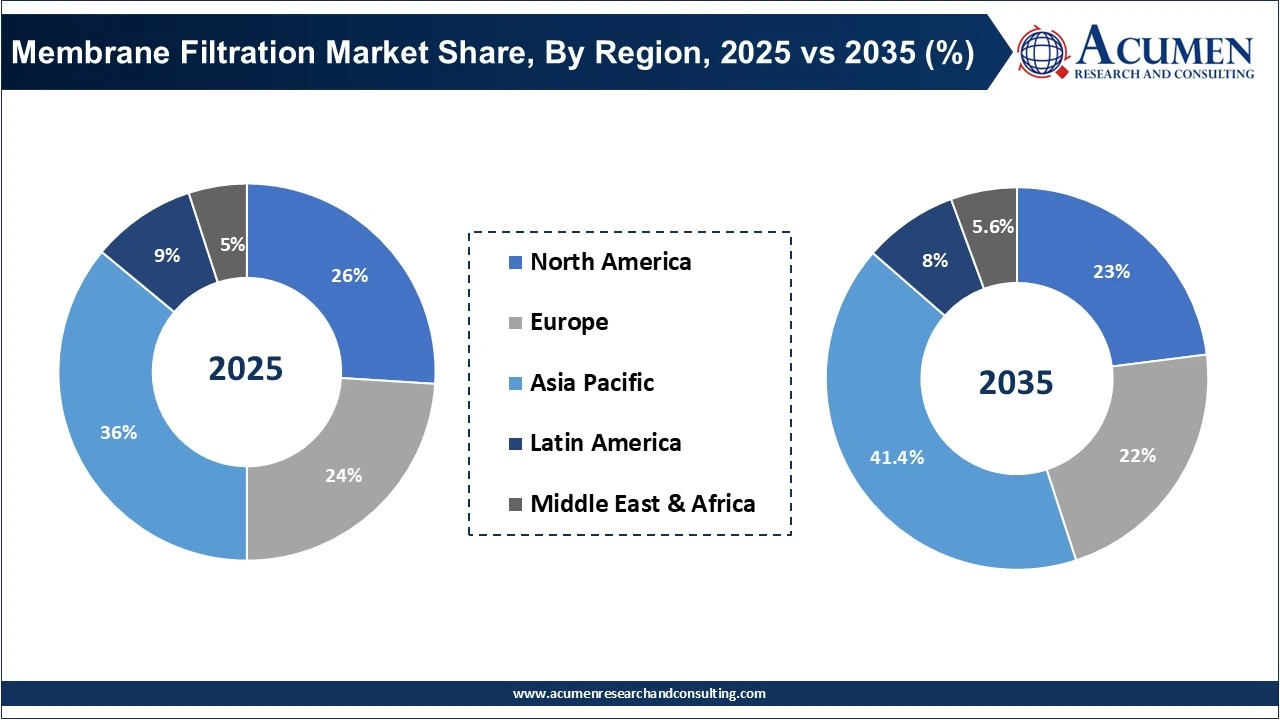
- By region, Asia Pacific dominated the market with 36% share in 2025, it is expected sustain the position while growing at a CAGR of 10.8% during the forecast period owing to the rapid industrialization, expanding wastewater treatment infrastructure and rising water scarcity.
- By region, North America held the second largest share of 26% in 2025 and projected to grow at 7.6% CAGR due to advanced water treatment infrastructure and strong adoption of industrial water recycling technologies.
- By technology, the reverse osmosis segment dominated the market with 38% market share in 2025 due to its superior desalination efficiency for industrial water treatment applications.
- By technology, the ultrafiltration segment held the second largest share of 24% in 2025 and is expected to grow at the fastest CAGR of 10.0% owing to rising demand for wastewater recycling and pharmaceutical filtration applications.
- By membrane material, the polymeric membranes segment dominated the market with 62% share and projected to grow at a CAGR of 7.4% because of their cost-effectiveness, high flexibility, and broad compatibility.
- By membrane material, the metallic membranes segment is expected to witness the fastest CAGR of 19.0% due to rising adoption in high-temperature industrial filtration and advanced petrochemical applications.
- By module design, the spiral wound segment led the market with share of 44% in 2025 owing to their complex structure and high membrane packing density.
- By module design, the hollow fiber membranes held the second largest share of 30% in 2025 due to their high filtration efficiency and rising use in municipal filtration systems.
- By end use industry, the municipal water utilities segment dominated the market with 38% share in 2025 owing to rising urbanization and government investments.
- By end use industry, the food & beverage industry held the second-largest share of 18% in 2025 owing to growing demand for dairy processing, beverage clarification, protein concentration, and safe packaged food production.
Membrane Filtration Market Overview
Membrane filtration market is defined as the worldwide industry concerning the production, development and utilization of membrane-based separation technologies utilized to eliminate suspended solids, microorganisms, salts, contaminants, and impurities from fluids and gasses. Membrane filtration systems employ a semi-permeable membrane to separate components based on characteristics like size, pressure, and chemical nature; and find widespread use in a wide range of sectors namely water & waste water treatment, food & beverage, pharmaceutical and biotechnology, chemical, and semiconductors industries.
Microfiltration (MF), ultrafiltration (UF), Nanofiltration (NF), reverse osmosis (RO), electrodialysis, and forward osmosis fall under different types of membrane filtration systems and are increasingly used in desalination, industrial waste water recycle, ultrapure water, sterile filtration, protein concentration, and sustainable water applications. Increasing awareness on the world-wide scenario of water scarcity, ecological sustainability, and environmental pollution along with stricter regulations is greatly stimulating demand in the global membrane filtration market.
Membrane Filtration Market Country-Level Statistics
| Country | Focus Area | Key Statistics |
|---|---|---|
| United States | Desalination & Wastewater Reuse | The U.S. treats and reuses nearly 5–6% of total municipal wastewater, with states like California reusing over 700,000+ acre-feet of water annually for industrial and agricultural use. |
| China | Industrial Water Treatment Expansion | China accounts for over 30% of global industrial wastewater discharge, with large-scale investments leading to wastewater treatment capacity exceeding 250+ million m³/day in major industrial zones. |
| India | Water Purification Penetration | Safe drinking water access has improved to around 80–85% urban penetration, while rural penetration remains lower at 50–55%, driving strong demand for decentralized filtration systems. |
| Saudi Arabia & UAE | Desalination Dependency | The Middle East relies on desalination for nearly 50–90% of potable water supply, with countries like Saudi Arabia and UAE among the world’s largest desalination users. |
| EU | Industrial Water Reuse Targets | The EU aims to reuse at least 6.6 billion m³ of treated wastewater annually by 2030, with some countries targeting 25–30% industrial water reuse rates. |
Market Dynamics
Driver
Rising Global Water Scarcity and Wastewater Treatment Demand
The increasing global water scarcity and rapid generation of wastewater are the key factors propelling the membrane filtration market. An increasing degree of urbanization, industrialization and growing world population is substantially escalating the strain on worldwide freshwater resources. Global water statistics indicates that nearly 2 billion people are residing in water-stressed regions while municipal and industrial wastewater generation is on a constant rise per year.
Governments and industrial sector are escalating their investments in infrastructure for advanced water treatment, desalination and wastewater recycling, leading to increased acceptance and application of various membrane filtration technologies like reverse osmosis, ultra-filtration and nano-filtration. Furthermore, strict governmental regulations and water discharge policies coupled with high standards for water quality in the world further contribute to the growth in all three market sectors, i.e. Municipal, industrial and food processing/pharmaceutical industries.
Restraint
High Installation and Membrane Maintenance Costs
The large amount of capital invested and operating costs related to membrane filtration systems are considerable drawbacks for growth. This limitation has a great impact on small scale businesses and developing countries. Advanced membrane technologies, such as reverse osmosis, are associated with the initial capital expenditure of the entire system and, are energy consuming processes, necessitating periodic membrane replacement, skilled maintenance.
Moreover, the problems of fouling, scaling and clogging limit efficiency and increase operational expenses over the years. In the case of energy demanding processes like reverse osmosis, water treatment plants and industrial users cannot afford large financial input due to the energy cost of the system and high pressure required for its operation. These disadvantages limit the penetration of membrane filtration technology to regions with less disposable income.
Opportunity
Expansion of Water Reuse, Desalination, and Sustainable Industrial Processing
Rising trends on global focus of water sustainability, industrial water reuse and desalination projects will boost the growth of the membrane filtration market to significant levels. Circular water economy trend on reducing the freshwater consumption and increasing efficiency on wastewater recycling is expected to be more popular among government and industries across the world. Rapid growing investment on seawater desalination plants, zero liquid discharge (ZLD) systems, smart water treatment plants is the key driver of increasing demand on advance membrane technologies.
Pharmaceutical manufacturing, semiconductor industries, food processing industries, biotechnology industries are key sector to boost the demand on high-purity filtration system. Future technological advancement in AI-enable monitoring, low energy membranes, anti-fouling materials, smart filtration systems will drive the growth.
Regional Analysis
Asian Countries to Sustain the Dominance; Rapid Industrialization to Support the Growth
Asia Pacific dominated the membrane filtration market with a share of 36% in 2025 and is expected to grow at the fastest CAGR of 10.8% during the forecast period. Driven by booming industrialization, growing population, shrinking water reserves, expansion in manufacturing industries has created a robust demand for the application of membrane filtration technologies across the Asia Pacific region. China and India were also key contributors towards regional growth with significant investment towards the construction of wastewater treatment industries, municipal water supply infrastructure, desalination plants, and semiconductors industry.
The major concentration of generation of industrial wastewater is from Asia Pacific which leads to robust demand for the advanced membrane filtration systems in the application of industrial water recycling and environmental protection.
Top Government Initiatives in Asian Countries to Support Membrane Filtration Investments:
- China's "Made in China 2025" strategy aims to help Chinese companies build capacity to produce advanced filtration technologies, semiconductor-grade water purification systems, and industrial membranes.
- The Indian government's Jal Jeevan Mission, worth several billion dollars, will provide safe drinking water to every rural household, driving demand for membrane-based water purification and filtration systems.
- The Indian government's Namami Gange Programme involves massive projects in river cleaning, industrial effluent treatment, and wastewater treatment using advanced membrane filtration systems.
- The Japanese government continues to invest in advanced desalination, wastewater recycling, and smart water management technologies to tackle problems of water sustainability and aging water infrastructure.
- South Korea's Green New Deal and smart water management policies are fostering the growth of AI-driven water treatment plants and advanced membrane filtration systems for both industrial and domestic uses.
North America to Grow at Rapid Pace; U.S. to be the Leader in Membrane Filtration Market
The market in North America was the second largest in 2025 with a share of 26% and is anticipated to witness a growth of CAGR 7.6% during the forecast period. Driven by the established water treatment infrastructure, stringent environmental regulations, rapid adoption of advanced technologies based water treatment filtration systems, North America has gained its second largest position in the global membrane filtration market. Biotechnology, semiconductor manufacturing and pharmaceutical sectors in North America also lead the demand of ultrapure water filtration systems in this region.
United States continued to be the prominent market driven by increasing industrial water recycling policies, increasing number of new pharmaceutical manufacturers, increasing government funding towards municipal water treatment and up-gradation of municipal water filtration facilities. Certain regions in the U.S., such as California and the water stressed states are actively involved in deployment of membrane based desalination and water reuse techniques due to increasing scarcity of fresh water.
Segmental Analysis
Technology Insights
The reverse osmosis (RO) segment held the largest market share, of 38%, in the membrane filtration market in 2025. This was because the reverse osmosis (RO) technology has proven to be highly efficient in removing dissolved salts, contaminants, bacteria, heavy metals, organic matter from water, etc. Reverse osmosis (RO) is one of the most widely accepted filtration technologies worldwide for desalination plants, industrial wastewater treatment, pharmaceutical manufacturing, semiconductor processing, municipal water treatment.
“The reverse osmosis (RO) membranes have very high rejection rates for salts-up to 95-99%, making them indispensable for seawater desalination and ultrapure water production. The expanding water crisis around the globe has increased the demand for the reverse osmosis systems. As a recent statistical report highlights, almost 2 billion people around the world have water-stressed conditions and this is spurring more investments in modern water purification systems.”
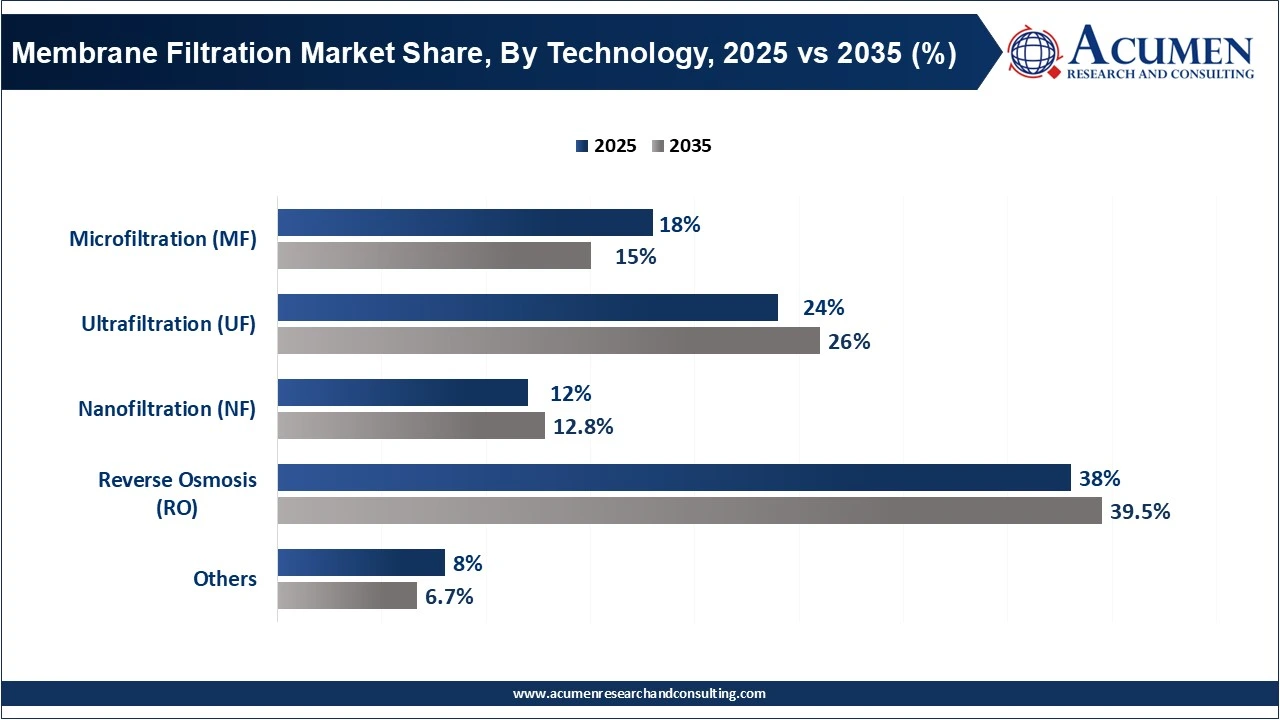
The ultrafiltration (UF) segment was the second-largest segment of the membrane filtration market with a market share of 24% in 2025 and is expected to grow at the highest CAGR of 10.0% in the forecast period. Ultrafiltration (UF) membranes are widely used in the removal of suspended solids, bacteria, viruses, proteins and colloidal matter from water with low energy consumption when compared to RO systems. The increasing need for municipal water treatment, industrial wastewater recycling, purification for pharmaceuticals, etc, is fueling the growth of the UF membrane market worldwide.
Membrane Material Insights
The polymeric membranes segment held a dominant share in the membrane filtration market with 62% in 2025 and it is expected to grow at a CAGR of 7.4% from 2026 to 2035. Polmeric membranes are the highly used due to their high economic feasibility, mechanical flexibility, and ease of manufacturing and they have wide range of application that includes water treatment, food and beverage, pharmaceutical filtration, industrial wastewater. The polymeric membranes materials are widely used such as polysulfone, polyethersulfone, polyvinylidene fluoride and cellulose acetate for membrane filtration due to its resistance to harsh chemicals and high filtration efficiency. In municipal water treatment throughout the globe, the increasing demand for polymeric membrane is supported by the widespread installation of reverse osmosis and ultrafiltration systems.
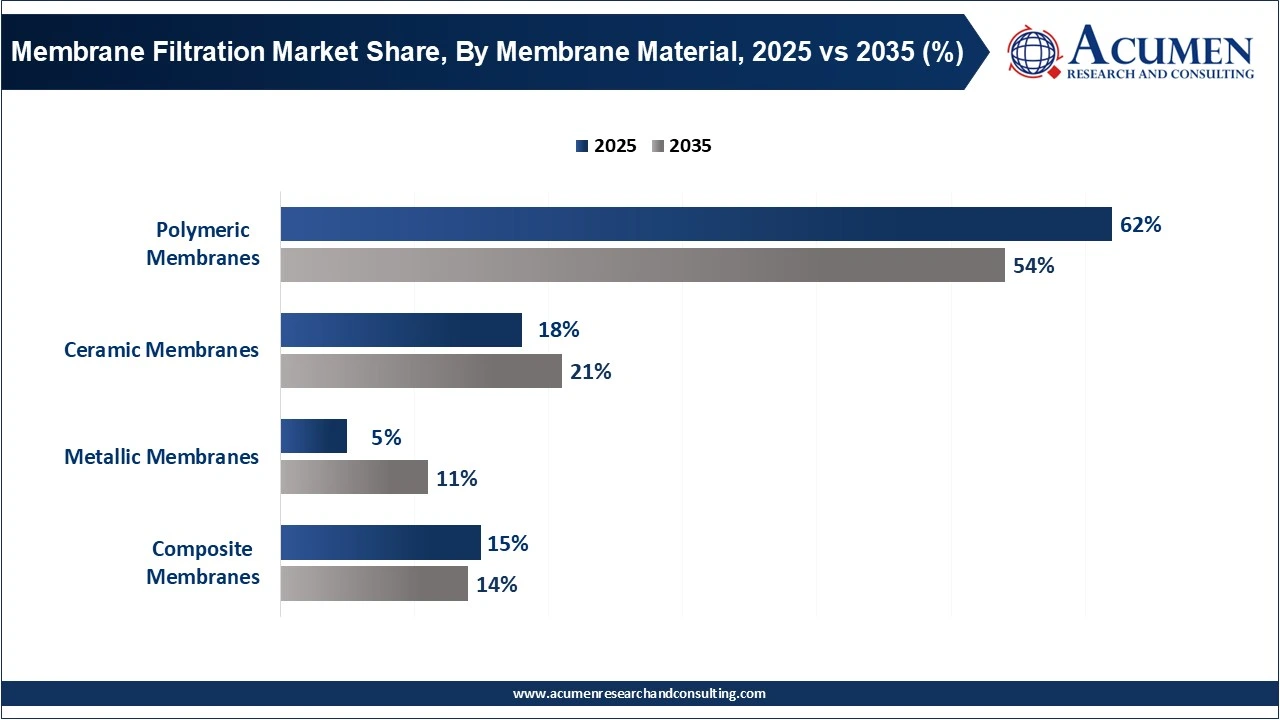
Metallic membrane segment is predicted to grow at the highest CAGR of 19.0% during the forecast period. The metal membranes are considered highly suitable due to their superior thermal stability, mechanical strength and high corrosion resistant and durability at extreme conditions. It is mainly used in petrochemical processing, hydrogen separation, pharmaceutical sterilization and high temperature gas filtration. In order to develop the hydrogen economy project, the significant opportunities will be seen for the metal membrane technology.
Module Design Insights
The spiral wound segment held the largest share of the membrane filtration market in 2025 accounting for 44% of the market share due to the compact design, high packing density, lower cost and extensive utilization in RO & NF applications. Spiral wound modules are widely utilized for treating water at both municipal & industrial level, used in desalination plants and for various purposes in the food processing industry.
Growing global spending on desalination plants and water recycling initiatives in the industries sector are contributing to the growth of the spiral wound membrane systems. They are considered ideal for large industrial applications because of the higher membrane area to volume ratio and compact installations at site locations.
The hollow fiber segment stood second in the market share in 2025 accounting for 30% of the market share as the system offers high filtration efficiency, good surface area to volume ratio and low energy consumption. Hollow fiber membranes are commonly used in ultra-filtration and micro-filtration systems to treat municipal water, for processing in the pharma industry, in biotech applications. Installation of smaller distributed systems and rising demand for compact membrane based technology in developing economies are spurring growth of the hollow fiber membrane.
End Use Industry Insights
Municipal water utilities segment led the market in 2025 and gained market share by holding a 38% revenue contribution in the membrane filtration market. Growth in municipal water utilities was attributed to increasing urbanization, scarcity of freshwater, aging water infrastructure, and tightening government regulations on water quality parameters. Increasing global populations and rising industrialization have placed a heavy strain on municipal water treatment facilities worldwide.
“According to international water statistics, globally approximately more than 380 billion cubic meters of wastewater are produced per year, while approximately 80% of worldwide wastewater is released untreated into the environment. Government agencies in North America, Europe, China, India and the Middle East regions are making significant investments into state of the art water treatment infrastructure, desalination programs and water reclamation processes to address the increasing levels of water stress.”
Food and beverage segment occupied the second position in the market share by contributing an 18% revenue to the membrane filtration market in 2025, driven by the escalating demand for high quality processed foods, dairy products, beverages, and functional food ingredients. Membrane filtration processes have widespread applications in various food processing activities including dairy processing, clarification of juice, beer filtration, concentration of proteins and refinement of sugars.
Recent News
- February 2026 - DuPont launched its new generation of low energy reverse osmosis membranes to enhance desalination performance with reduced energy use in both municipal and industrial water treatment applications.
- January 2026 - Toray Industries increased its capacity for ultra-filtration and reverse osmosis high-performance membranes in the Asia-Pacific market to meet demand from semiconductor and municipal water treatment applications.
- March 2026 - Veolia extended its high performance wastewater recycling programs using membranes throughout Europe and the Middle East.
Top Companies
- DuPont
- SUEZ
- Veolia
- Toray Industries
- Koch Separation Solutions
- Pall Corporation
- 3M
- Pentair
- GEA Group
- Alfa Laval
- Hydranautics
Market Segmentation
By Technology
- Microfiltration (MF)
- Ultrafiltration (UF)
- Nanofiltration (NF)
- Reverse Osmosis (RO)
- Others (Electrodialysis, Forward Osmosis)
By Membrane Material
- Polymeric Membranes
- Ceramic Membranes
- Metallic Membranes
- Composite Membranes
By Module Design
- Spiral Wound
- Hollow Fiber
- Tubular
- Plate & Frame
- Capillary
By End Use Industry
- Municipal Water Utilities
- Food & Beverage Industry
- Pharmaceutical & Biotechnology Industry
- Chemical & Petrochemicals
- Electronics & Semiconductor Industry
- Others
By Region
- North America
- Asia Pacific
- Europe
- Latin America
- Middle East & Africa
Looking for discounts, bulk pricing, or custom solutions? Contact us today at sales@acumenresearchandconsulting.com
Frequently Asked Questions

Other Chemicals And Materials Reports
August 2021
October 2020
November 2024
August 2023