
Neural Network Market Size, Share, Industry Report 2026 - 2035
Neural Network Market (By Component: Hardware, Software, Services; By Deployment: On-premises, Cloud; By End Use: BFSI, Healthcare, Retail & E-commerce, IT & Telecom, Manufacturing, Others) - Global Industry Analysis, Size, Share, Analysis, Trends and Forecast 2026 - 2035
- Last Updated: 08 Jan 2026
- Report Code: ARC3889
- Category: ICT
Neural Network Market Size and Forecast 2026 - 2035
The global neural network market reported a size of USD 46.3 Billion in 2025 and is projected to reach a market size of USD 706.5 Billion by 2035, registering a CAGR of 31.2% from 2026 to 2035. The increasing demand for advanced analytics and AI is boosting the demand of neural networks. In addition, the advancements in computing power are opportunistic for the market growth.
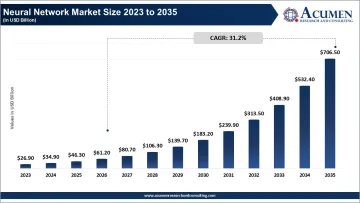
The neural network market includes products, platforms, or solutions that facilitate the creation, development, and deployment of artificial neuronal networks (ANNs). Neural networks mimic the way the human brain works by allowing the processing of massive amounts of data, detecting complex patterns, and allowing automated decision-making. They are the fundamental components of deep learning as well as artificial intelligence (AI), being used extensively in the fields of natural language processing, image recognition, speech recognition, robots, predictive analysis, and self-controlling machines.
The growth in the market is fueled by the exponential increase in big data, advancements in computing power from GPUs/TPUs, cloud AI platforms, and widespread adoption of AI in various industries. The scope of the market covers hardware accelerators, software solutions, service offerings, and industry-specific solutions.
Report Highlights
- By Region, the North America neural network market garnered a revenue of USD 15.4 billion in 2025.
- By Region, the Asia-Pacific neural network market is poised to grow at a robust CAGR of over 32.8% from 2026 to 2035.
- By Component, the software segment accounted for 45% of the total market share in 2025.
- By Deployment, the cloud segment represented approximately 65% of the market share in 2025.
- By End Use, the BFSI segment contributed 28% of the total market share in 2025.
Neural Network Market Dynamics
Market Drivers
Rising Demand for Advanced Analytics and AI
The growing demand for artificial intelligence and analytics solutions is the most significant trend driving the market growth. Data insights need to be analyzed and these neural networks find application in analyzing huge amounts of data in understanding particular outcomes or making programmatic decisions based on those outcomes. Moreover, with a growing need to analyze data in digital platforms such as social media networks, IoT sensors, generating massive amounts of information, there is also a growing need for data insights to be analyzed through cutting-edge technologies, such as artificial intelligence models built through these neural networks, to extract hidden information in these details and help make efficient business decisions. Advances in computational capabilities, such as breakthroughs in particular technologies with Graphics Processing Units or Tensor Processing Units, also add impetus to these models for improvements in their optimization processes.
Exponential Growth in Data Generation
A major driver in the adoption of neural networks is the exponential increase in the volume of data produced across sectors, leading to the demand for sophisticated predictive analytics with automated decision-making tools. Many organizations are applying deep learning models to derive insights from unstructured data sources like images, videos, audio, and sensor data. Such a surge would be made possible by the incredible advances in computation enabling tools such as GPUs, TPUs, and edge AI processors that enable faster model training and inferencing. As businesses look to enhance the level of precision, personalization, and real-time insights, neural networks are projected to be a critical enabling technology in the domain of healthcare, finance, retail, manufacturing, and autonomous systems.
The chart below shows an exponential surge in global data storage capacity, rising from 2.6 exabytes in 1986 to an estimated 149,000 exabytes by 2024. This rapid growth reflects the massive data generation with the expansion of cloud computing, IoT devices, AI-driven workloads, and digital transformation across industries. The sharp surge after 2014 highlights how data generation has accelerated dramatically over the last decade.
Market Restraints
Algorithm Biases
A neural network can work exceptionally well on the trained data, but the network is liable to suffer from overfitting, leading to poor performance on the data or data with missing information. However, methods such as regularization can solve the problem of data not performing well on the trained data, but these methods increase the cost incurred during the procedure. These neural networks can even raise the level of bias in the process, particularly in the information supporting the groups of thoughts, leading to a biased outcome. This is an unjust outcome that can bring about chaos among the groups affected by the misuse of the bias by the neural network.
High Cost and Complexities
One important factor that has been hindering the growth of neural networks in the market is their complexity involved in building, training, and deploying these models. The development of neural networks is a complex process that demands a robust amount of labeled data, expert knowledge, and access to advanced computing infrastructure, which can pose a significant cost burden for SMEs. Furthermore, models utilizing neural networks are considered non-transparent, as it is difficult for them to explain their decision-making results, especially in sectors that are government-regulated, such as healthcare and finance.
Market Opportunities
Expansion of Generative AI
One of the major opportunities for growth in the market is the advent of generative AI models such as Gemini, Claude, and ChatGPT that are able to generate text, images, videos, voice recognition, music, and other forms of data. This can be achieved using advanced technologies like generative adversarial networks, also known as GANs. In addition, with the increasing adoption of AI and its impact in shaping society, opportunities are expected to be created for engineers who can handle efficiently both hardware and software with reduced bias in algorithms and the ability to drive fast training and inference for balanced results.
Rapid Expansion of Edge AI Applications
The fast growth of edge AI and real-time analytics applications also creates immense opportunities for the neural network market. With the adoption of IoT devices, autonomous machines, and smart sensors in industries, the need for lightweight, energy-efficient neural networks that can perform on-device inference is increasing at a rapid rate. This decreases latency, enhances privacy, and provides continuous offline availability. Moreover, new sectors development, including smart manufacturing, personalized healthcare, cybersecurity, and autonomous mobility, is developing more use cases for adaptive neural models. Further advances in neuromorphic computing, self-supervised learning, and generative architectures open new prospects for affordable, scalable, human-like AI systems that reshape enterprise workflows.
Neural Network Market Report Scope
| Attributes | Details |
|---|---|
| Neural Network Market Size 2025 | USD 46.3 Billion |
| Neural Network Market Forecast 2035 | USD 706.5 Billion |
| Neural Network Market CAGR During 2026 - 2035 | 31.2% |
| Analysis Period | 2023 – 2035 |
| Base Year | 2025 |
| Forecast Data | 2026 – 2035 |
| Segments Covered | By Component, By Deployment, By End Use, and By Geography |
| Regional Scope | North America, Europe, Asia-Pacific, Latin America, and Middle East & Africa |
| Key Companies Profiled | Amazon Web Services, Inc., Baidu, Inc., Microsoft, Huawei Technologies Co., Ltd., Google LLC, IBM Corporation, NVIDIA Corporation, Intel Corporation, OpenAI, and Sense Time |
| Report Coverage | Market Trends, Drivers, Restraints, Competitive Analysis, Player Profiling, Covid-19 Analysis, Regulation Analysis |
Neural Network Market Regional Analysis
North America dominated the neural network market by garnering around 33% market share in 2025. The key factors responsible for the leading position of North America include huge investments in AI research studies, government funding to several startups, and collaboration between private tech companies and government institutes for commercializing AI technology. Major technology companies such as Google, IBM, and Nvidia have invested enormously to accelerate intensive research processes in neural network development and their supporting hardware, including GPUs and TPUs.
| Region | Market Share, 2025 (%) | Key Highlights |
|---|---|---|
| North America | 33% | The key factors responsible for the leading position of North America include huge investments in AI research studies, government funding to several startups, and collaboration between private tech companies and government institutes for commercializing AI technology. |
| Europe | 29% | Robust government support with the help of AI strategies and funding programs is accelerating market adoption. |
| Asia-Pacific | 24% | The significant market growth can be attributed to the rapid digitalization process, as well as the widespread application of AI technology in India, Japan, as well as China. |
| MEA | 9% | The MEA is emerging as a fast-growing neural network market driven by large-scale digital transformation initiatives, smart city investments, and rising AI adoption in oil & gas, security, and government sectors. |
| Latin America | 5% | Latin America is experiencing steady neural network adoption supported by expanding cloud infrastructure, fintech-driven innovation, and increasing use of AI for fraud detection, personalization, and operational automation. |
The Asia-Pacific market is expected to observe a significant growth throughout the forecast period. This can be attributed to the rapid digitalization process, as well as the widespread application of AI technology in India, Japan, as well as China. The nations have come up with plans related to the application as well as future prospects for implementing and developing AI technology. These are related to India’s AI Mission, AI Basic Act in South Korea, and investment in the marketplace. The key players for the Asia Pacific marketplace are Alibaba and Tencent, which are providing new-age solutions that simplify the process required for implementing neural networks. The emerging technologies are related to 5G, IoT, and Edge AI, among others.
Neural Network Market Segmental Insights
The worldwide market for neural network is split based on component, deployment, end use, and geography.
Component Insights
Based on component, the market is classified into hardware, software and services.
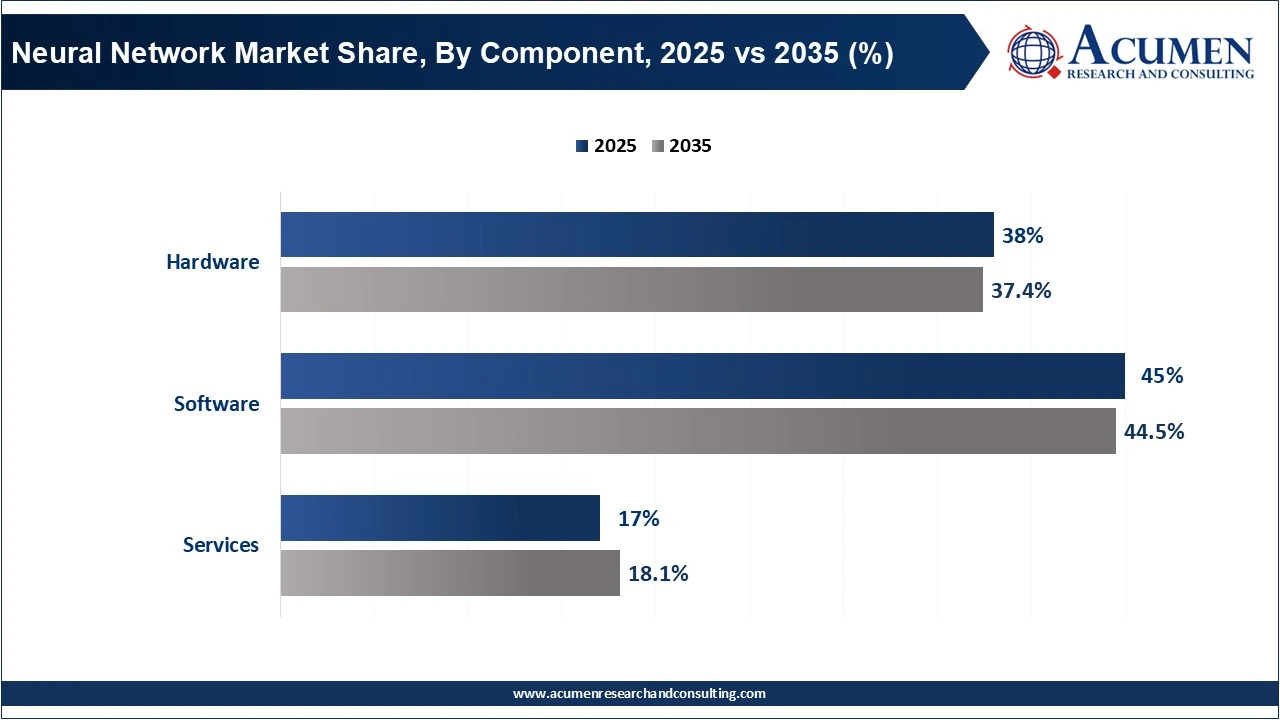
The software segment dominated the neural network market in 2025 with around 45% market share. The software segment dominates the market driven by deep-learning platforms, AI model development and cloud AI services. Hardware is the next largest segment accounting for around 38% market share. This is because hardware components have become critical, as advanced neural networks, particularly deep learning models, necessitate enormous compute power for both inference and training, which typical CPUs are not able to efficiently deliver. Hardware components, including GPUs, play a vital role in offering the required computational power for processing large datasets and performing complex calculations that need training a neural network and its associated deployment. Hardware components are crucial in verticals including healthcare, automotive, and manufacturing applications, which need real-time data analysis.
| Component | Market Share, 2025 (%) | Key Highlights |
|---|---|---|
| Hardware | 38% | Hardware components have become critical, as advanced neural networks, particularly deep learning models, necessitate enormous compute power for both inference and training. |
| Software | 45% | Software platforms (frameworks, model training suites, libraries, toolchains, MLOps) generate strong recurring revenue through enterprise licensing, cloud AI services, and ecosystem lock-in. Growth is propelled by AI adoption across industries. |
| Services | 17% | Services (consulting, integration, customization, support, deployment & managed services) comprise a significant share as enterprises require expertise to integrate neural networks into business workflows, optimize models, and maintain production systems. |
Deployment Insights
According to the neural network industry analysis, in 2025, the cloud deployment dominated the market. The growth is driven by its scalability, malleability, and cost-effectiveness for businesses. Cloud-based solutions of the neural network type are being preferred by organizations in avoiding the infrastructural expenses of the traditional computing type of approaches for speedy model training offered through the utilization of powerful GPUs or TPUs. Cloud-based solutions offer real-time analysis capabilities with easy connectivity to the platforms of big data mechanisms due to their ability to be accessed from anywhere in the world, thus being ideal for global businesses.
| Deployment | Market Share, 2025 (%) | Key Highlights |
|---|---|---|
| On-premises | 35% | Growth is driven by the enterprises’ need for regulatory compliance, enhanced data security, and control over sensitive data. |
| Cloud | 65% | Dominant due to its exceptional properties, including scalability, malleability, and cost-effectiveness for businesses. |
End Use Insights
Based on end user, the market is classified into BFSI, healthcare, retail & e-commerce, IT & telecom, manufacturing, and others.
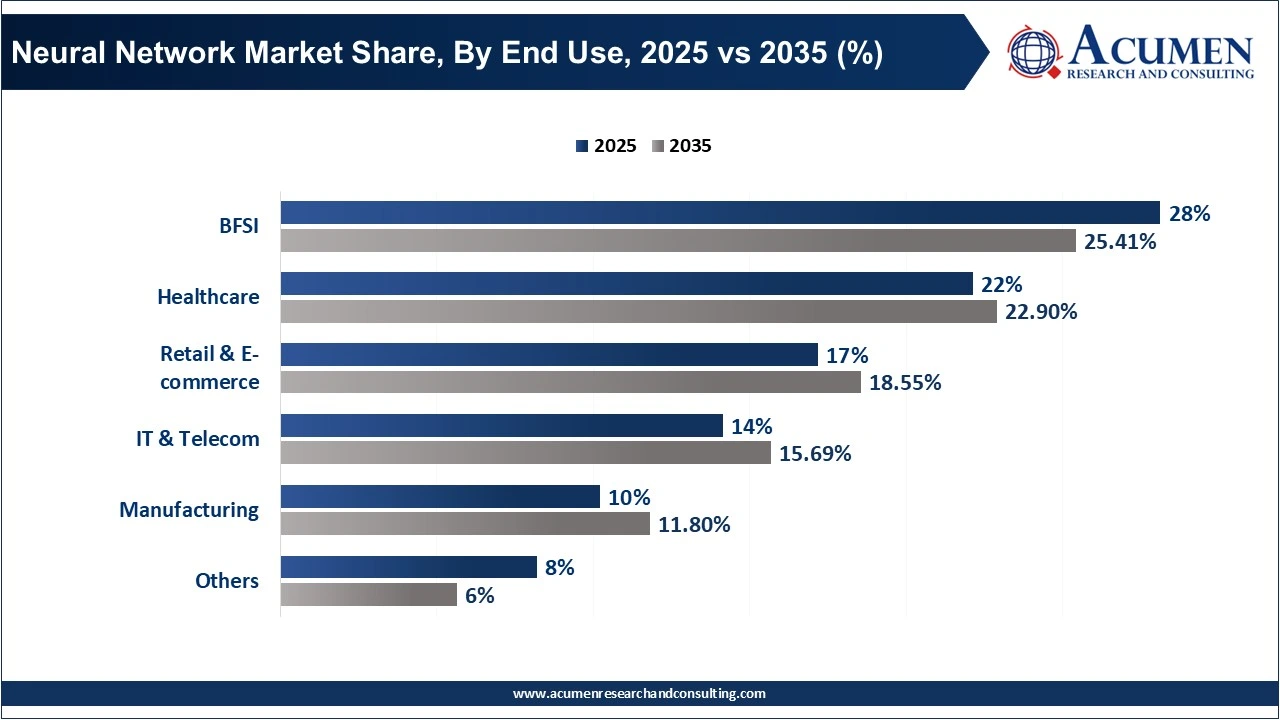
The BFSI segment held the largest market share of around 28% in 2025. The BFSI industry fuels the adoption of neural networks due to its requirement for sophisticated fraud analysis and credit rating methods. Deep learning algorithms are used in banks and financial institutions for analyzing customer transactions in real time and for customized financial services. The application of neural networks increases the efficiency of predictive modeling and algorithmic trades with greater accuracy. The rising demands for regulatory compliance and adoption of digital financial services accelerate the adoption of AI. The rising spends on AI and cloud-based neural network solutions will enable BFSI firms to optimize costs and enhance insight-driven analytics, making the BFSI segment an essential driver for the growth of the neural network market.
| End Use | Market Share, 2025 (%) | Key Highlights |
|---|---|---|
| BFSI | 28% | Dominant segment due to increasing use of neural network in fraud detection, risk scoring, credit assessment, algorithmic trading, customer analytics, and compliance automation. |
| Healthcare | 22% | Growing use in medical imaging, diagnostics, drug discovery, patient monitoring, and operational optimization. |
| Retail & E-commerce | 17% | Strong adoption driven by personalization, recommendation engines, demand forecasting, pricing optimization, and customer behavior analysis. Generative AI further accelerates use cases. |
| IT & Telecom | 14% | This sector deploys neural networks for network optimization, anomaly detection, predictive maintenance, customer churn analysis, and AI-driven customer support. |
| Manufacturing | 10% | Adoption focused on predictive maintenance, quality inspection, robotics, and process optimization. Growth is supported by Industry 4.0 initiatives. |
| Others | 8% | Includes government, automotive, energy & utilities, media & entertainment, logistics, and education sectors with expanding use cases. |
Neural Network Market Players
- Amazon Web Services, Inc.
- Baidu, Inc.
- Microsoft
- Huawei Technologies Co., Ltd.
- Google LLC
- IBM Corporation
- NVIDIA Corporation
- Intel Corporation
- OpenAI
- Sense Time
Neural Network Market Segmentation
By Component
- Hardware
- Software
- Services
By Deployment
- On-premises
- Cloud
By End Use
- BFSI
- Healthcare
- Retail & E-commerce
- IT & Telecom
- Manufacturing
- Others
By Region
- North America
- U.S.
- Canada
- Europe
- U.K.
- Germany
- France
- Spain
- Rest of Europe
- Asia-Pacific
- India
- Japan
- China
- Australia
- South Korea
- Rest of Asia-Pacific
- Latin America
- Brazil
- Mexico
- Rest of LATAM
- The Middle East & Africa
- South Africa
- GCC Countries
- Rest of the Middle East & Africa (ME&A)
Looking for discounts, bulk pricing, or custom solutions? Contact us today at sales@acumenresearchandconsulting.com
Frequently Asked Questions

Other ICT Reports
January 2025
December 2022
January 2023
June 2023