
Non-load Bearing Walls Market Size, Share, Industry Report 2026 to 2035
Non-load Bearing Walls Market (By Material Type: Concrete, Glass, Gypsum Board, Metal Studs, Wood Studs, Others; By System Type: Modular, Pre-fabricated, Traditional; By Construction Type: Commercial, Industrial, Residential; By End Use: New Construction, Remodeling) - Global Industry Analysis, Size, Share, Analysis, Trends and Forecast 2026 - 2035
- Last Updated: 24 Jan 2026
- Report Code: ARC3888
- Category: Construction and Manufacturing
Non-load Bearing Walls Market Size and Forecast 2026 - 2035
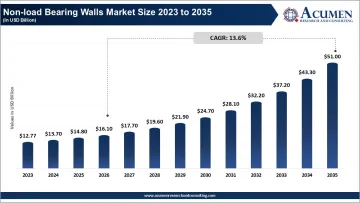
The global non-load bearing walls market was valued USD 14.8 billion in 2025 and it is estimated to grow to USD 51.0 billion by 2035, demonstrating a 13.6% CAGR over the forecast period from 2026 to 2035. The rapid demand in lightweight construction materials is driving the growth or the non-load bearing walls market. Further, the proliferation of remodelling projects is anticipated to create new growth opportunities for the market.
Report Highlights
- By Region, the North America non-load bearing walls market generated a revenue of USD 5.4 billion in 2025.
- By Region, the Asia-Pacific non-load bearing walls market is expected to grow at a rapid growth rate with a CAGR of over 14.3% from 2026 to 2035.
- By Material Type, the gypsum board segment garnered the highest market share of 32% in 2025.
- By System Type, the traditional segment accounts for 45% of the total market share in 2025.
- By Construction Type, residential accounts for 48% of the non-load bearing walls market share in 2025.
- By End Use, the new construction segment represents 67% of the total market share in 2025.
Non-load Bearing Walls Market Overview
Non-load bearing walls or partitions are structural mechanisms that do not hold the weight of the roof or the building. Instead, they act as dividers in a structure, while focusing primarily on privacy, space management, and aesthetics. These walls are typically thinner and lighter than load-bearing walls and these walls can be removed or altered easily without compromising on the building's structure. Some of the common materials that are used for non-load bearing walls are glass, brick, wood, gypsum board, and lightweight concrete blocks. Types of walls are curtain walls, partition walls, cavity walls, panel walls, and parapet walls. Each of these walls caters to specific architectural needs, including soundproofing, insulation, or decorative purposes.
Architectures prefer deploying partitions or walls in co-living areas, offices, and retail units. In 2024, the U.S. Department of Housing and Urban Development (HUD) announced prominent changes to the Manufactured Home Construction and Safety Standards, and over 90 of the revised rules are in place presently. Resultantly, residential spaces with open layouts are made faster and are more affordable. In addition, in 2024, the U.S. Census Bureau revealed that over 1,471,200 apartments and houses were approved for building. This has led to more individuals implementing non-load-bearing walls.
Non-load Bearing Walls Market Dynamics
Market Drivers
- Rapid Urbanization: Increasing infrastructure projects and rapid urbanization drive the demand for non-load bearing walls in residential, industrial, and commercial sectors. Furthermore, expanding urban cities necessitate efficient management of space and interior partition solutions, thereby augmenting the market growth. According to the data by world bank, the urban population reached 58% of the total population in 2024.
- Increasing Focus on Space Optimization: Owing to higher densities of population and smaller spaces for living, there is an increasing need for efficient and versatile partition solutions. Non-load bearing walls provide flexible and customizable options for enhancing the utilization of space in different building types across commercial, industrial, and residential sectors.
Market Restraints
- Restricted Structural Strength: By design, the non-load bearing walls do not support the loads of a building structure, which resists their use in specific types of buildings requiring additional capacity for load-bearing. This limitation can require the use of added structural elements, which impacts the construction efficiency and overall design flexibility in projects that require significant reinforcement or load support.
- High Initial Costs: Non-load bearing wall systems that deploy innovative materials or advanced technologies often include higher initial costs in comparison with the conventional wall options. This expense is projected to be a significant hindrance for projects with limited budgets or in price-sensitive economies, potentially restricting the adoption of these novel systems despite their long-term advantages.
Market Opportunities
- Adoption of Smart Building Technologies: Non-load bearing walls represent opportunities for incorporation with smart building technologies, including climate control, automated lighting, and advanced security systems. This integration improves the adaptability and functionality of interior spaces, thereby driving the demand for connected and smart non-load bearing wall technologies in advanced construction projects.
- Increasing Trend of Prefabricated and Modular Construction: The rapid increase in prefabricated and modular construction approaches has created new growth opportunities for non-load bearing walls, which are perfect for efficient and quick assembly. These walls can be constructed off-site and installed easily, aligning with the growing trend toward quicker and more efficient building processes. This thereby addresses the demand for quick construction solutions.
Non-load Bearing Walls Market Report Scope
| Attribute | Details |
|---|---|
| Non-load Bearing Walls Market Size 2025 | USD 14.8 Billion |
| Non-load Bearing Walls Market Forecast 2035 | USD 51.0 Billion |
| Non-load Bearing Walls Market CAGR During 2026 – 2035 | 13.6% |
| Analysis Period | 2023 – 2035 |
| Base Year | 2025 |
| Forecast Data | 2026 – 2035 |
| Segments Covered | By Material Type, By System Type, By Construction Type, By End Use, and By Geography |
| Regional Scope | North America, Europe, Asia-Pacific, Latin America, and Middle East & Africa |
| Key Companies Profiled | Saint-Gobain S.A., USG Corporation, Knauf Insulation GmbH, Armstrong World Industries, Inc., CertainTeed Corporation, Rockwool International A/S, Johns Manville Corporation, Schluter Systems L.P., Cemex S.A.B. de C.V., and Gypsum Management & Supply, Inc. |
| Report Coverage | Market Trends, Drivers, Restraints, Competitive Analysis, Player Profiling, Covid-19 Analysis, Regulation Analysis |
Non-load Bearing Walls Market Regional Analysis
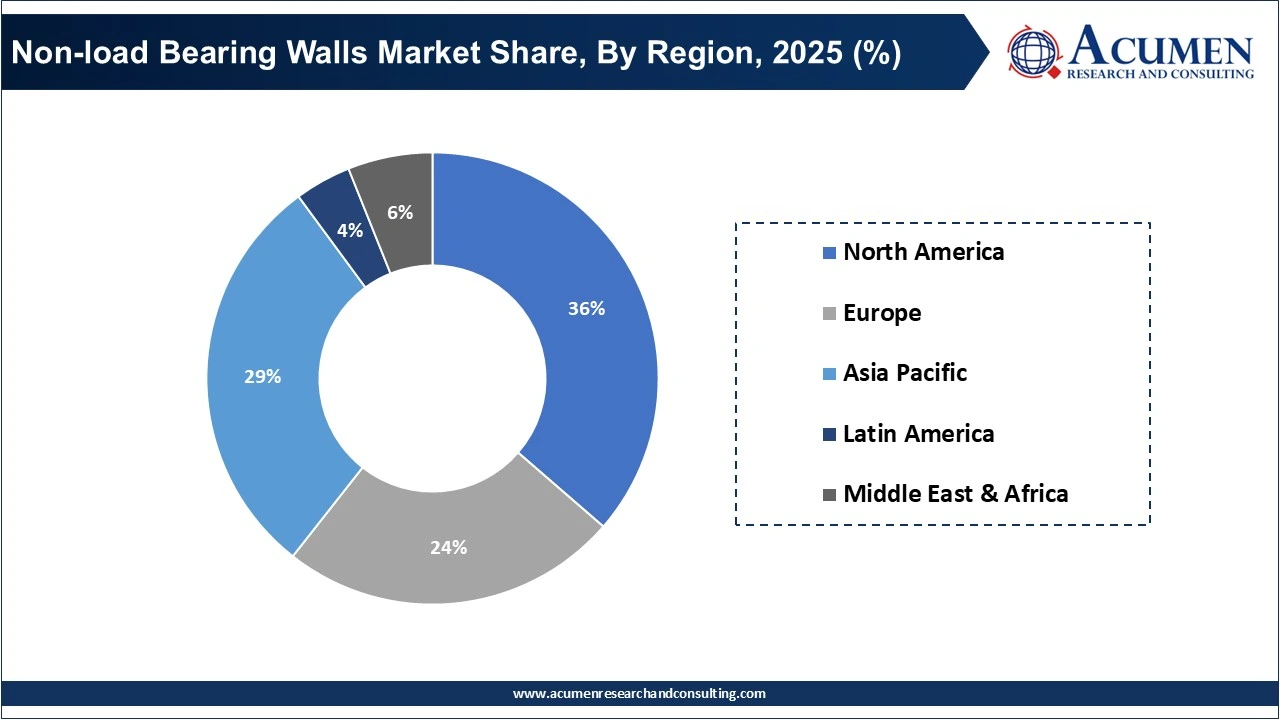
North America dominated the non-load bearing walls market by garnering a major market share in 2025. Growth can be attributed to building modernization and renovation activities in the region. More companies are now focusing on sustainable building construction. The Department of Housing and Urban Development estimates that a considerable amount of money is being spent in remodeling old buildings, particularly in cities that require efficient and flexible interiors.
| Region | Market Share, 2025 (%) | Key Highlights |
|---|---|---|
| North America | 36% | Dominant because of the increasing building modernization and renovation activities in the region. |
| Europe | 24% | Europe is witnessing an increasing trend toward implementing non-load bearing walls in commercial and residential buildings in order to meet strict environmental regulations. |
| Asia-Pacific | 29% | The rise in urban infrastructure development and a robust construction industry in countries including China, India, and Southeast Asian countries is driving market demand. |
| MEA | 6% | Large-scale infrastructure expansion and growing demand for flexible interior layouts in commercial and residential projects are accelerating the use of modern non-load-bearing wall solutions. |
| Latin America | 4% | Rising urban redevelopment and rapid commercial construction are driving increased adoption of lightweight non-load-bearing wall systems for faster, cost-efficient interior partitioning. |
Asia-Pacific is projected to grow at a notable pace during the forecast period. This growth is attributed to the rise in urban infrastructure development and a robust construction industry in countries including China, India, and Southeast Asian countries. The architects are increasingly investing in systems that enable them to get cost-effective and speedy development that can meet the demand arising due to the increasing need for affordable residences and smart city plans. The huge number of construction investments and permits in the commercial real estate is supporting the market energy saving growth in the region.
Non-load Bearing Walls Market Segmental Insights
The worldwide market for non-load bearing walls is split based on material type, system type, construction type, end use, and geography.
Material Type Insights
The gypsum board segment dominated the non-load bearing walls market in 2025. This is attributable to the increasing adoption of gypsum boards owing to cost-effectiveness, ease of installation, and excellent fire-resistance. As gypsum boards are easy to install and suit different types of architectural needs, builders and contractors use them in commercial and residential projects. Moreover, the deployment of gypsum board is growing as a result of sound insulation and fire safety regulations that are a part of the building code by the International Code Council (ICC).
| Material Type | Market Share, 2025 (%) | Key Highlights |
|---|---|---|
| Concrete | 21% | Concrete blocks or panels are widely used in non-load bearing walls as they offer durability and sound insulation. |
| Glass | 15% | The growing trend toward natural light integration and open-plan designs is proliferating the use of glass material in non-load bearing walls. |
| Gypsum Board | 32% | Gypsum board is most opted for because of its ease of installation, versatility, and cost-effectiveness. |
| Metal Studs | 16% | The deployment of metal studs is increasing due to their exceptional properties including recyclability, fire resistance, and ease of installation. |
| Wood Studs | 10% | Despite the increasing demand for alternative material types, wood studs are increasingly used due to their ease of use and natural aesthetic. |
| Others | 5% | This category covers different alternative materials that are used for non-load bearing walls, including PVC panels, fiberboard, and composite materials. |
System Type Insights
In 2025, the traditional system type dominated the market. This is primarily driven by the increasing popularity of conventional building practices over the past few years. Traditional non-load-bearing walls are known for being cheaper than other counterparts. Builders and contractors deploy traditional walls in residential and commercial sectors with limited space. These walls are easy to install and customize according to construction practices. In addition, traditional systems provide various ways to construct and finish the building and are easy to alter during on-site building, thereby facilitating lucrative growth of the segment.
| System Type | Market Share, 2025 (%) | Key Highlights |
|---|---|---|
| Modular | 24% | Modular system supports flexible design and effective construction, enabling rapid reconfiguration and expansion. |
| Pre-fabricated | 30% | Pre-fabricated walls provide advantages including reduced labor costs, faster installation, and consistent quality. |
| Traditional | 45% | Despite being slower to build when compared with advanced systems, traditional methods are predominant owing to their adaptability and familiarity to various architectural styles. |
Construction Type Insights
Based on construction type, the market is segmented into residential, commercial and industrial.
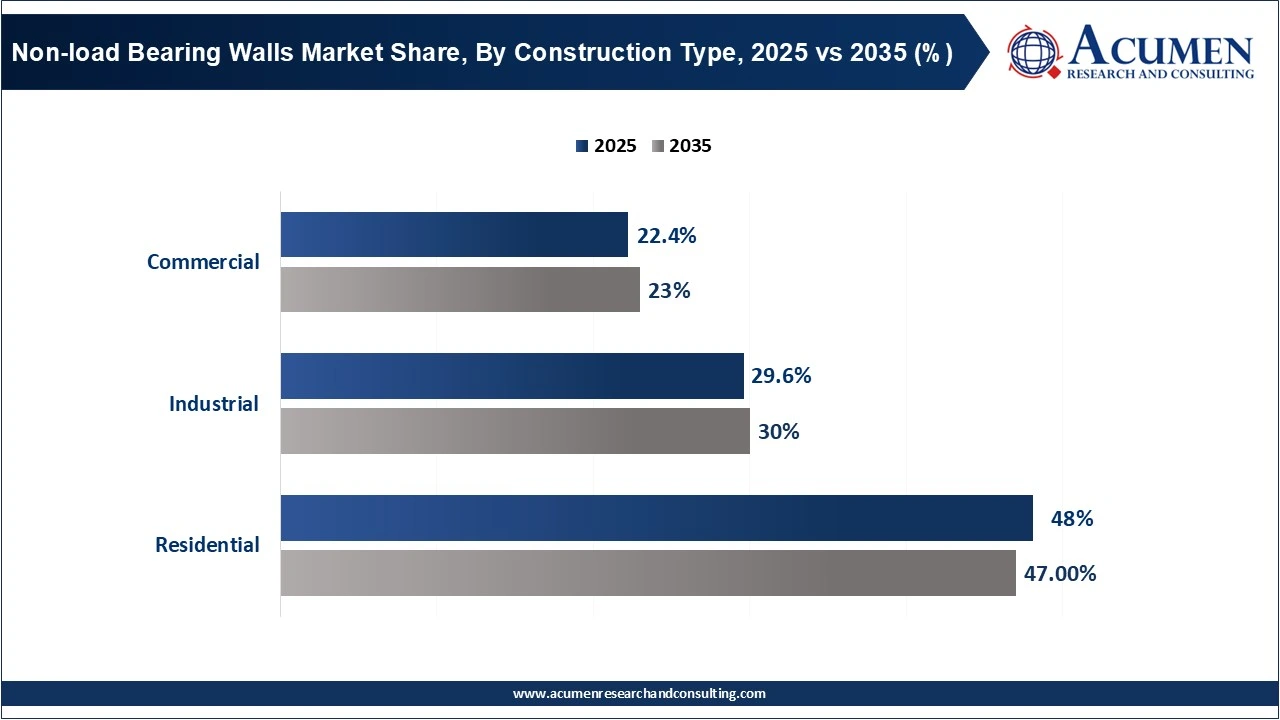
The residential segment led the non-load bearing walls sector owing to the growth in government investments in residential projects. Non-load-bearing walls are employed in residential spaces to segregate home spaces. Homebuilders are focused more on installable and low-cost lightweight wall systems in an effort to finish construction more quickly and be aligned with stringent building regulations,. Utilizing metal studs and gypsum board enables residential buildings to get rid of fires, limit noise, and easily be in line with various architectural designs. Furthermore, as non-load-bearing walls are convenient to modify, they help boost remodeling activities in both suburban regions and cities.
| Construction Type | Market Share, 2025 (%) | Key Highlights |
|---|---|---|
| Residential | 48% | The trend of smart home integration and open floor plans is driving the demand for advanced wall solutions in the residential sector. |
| Commercial | 22% | High-performance materials and enhanced aesthetic options that support functional and branding needs are becoming increasingly popular, supporting adaptive and dynamic work environments. |
| Industrial | 30% | Non-load bearing walls are deployed in industrial settings to separate control environments, work areas, and manage workflow in manufacturing facilities. |
End Use Insights
The new construction segment held the largest market share in 2025. This is driven by the increasing construction activities across the world. Structural partitions are being installed by developers right after initiating the building process for ensuring that they comply with the current acoustic, fire safety, and energy rules. In 2024, the U.S. Census Bureau announced that permits for residential and commercial building increased, generating the need for prefabricated and flexible walls. Builders are able to use prefabricated and modular wall panels to deal with labor issues and complete the projects on time.
| End Use | Market Share, 2025 (%) | Key Highlights |
|---|---|---|
| New Construction | 67% | Dominant owing to the the increasing construction activities across the world. |
| Remodeling | 33% | Innovations in modular wall systems and prefabrication enable less invasive and faster updates, catering to the increasing demand for flexible layouts for interiors in older buildings. |
Non-load Bearing Walls Market Players
- Saint-Gobain S.A.
- USG Corporation
- Knauf Insulation GmbH
- Armstrong World Industries, Inc.
- CertainTeed Corporation
- Rockwool International A/S
- Johns Manville Corporation
- Schluter Systems L.P.
- Cemex S.A.B. de C.V.
- Gypsum Management & Supply, Inc.
Non-load Bearing Walls Market Segmentation
By Material Type
- Concrete
- Glass
- Gypsum Board
- Metal Studs
- Wood Studs
- Others
By System Type
- Modular
- Pre-fabricated
- Traditional
By Construction Type
- Commercial
- Industrial
- Residential
By End Use
- New Construction
- Remodeling
By Region
- North America
- U.S.
- Canada
- Europe
- U.K.
- Germany
- France
- Spain
- Rest of Europe
- Asia-Pacific
- India
- Japan
- China
- Australia
- South Korea
- Rest of Asia-Pacific
- Latin America
- Brazil
- Mexico
- Rest of LATAM
- The Middle East & Africa
- South Africa
- GCC Countries
- Rest of the Middle East & Africa (ME&A)
Looking for discounts, bulk pricing, or custom solutions? Contact us today at sales@acumenresearchandconsulting.com
Frequently Asked Questions

Other Construction and Manufacturing Reports
December 2023
January 2025
July 2022
April 2024