
Precision Reduction Gears Market Size, Share, Report 2026 To 2035
Precision Reduction Gears Market (By Gear Type: Strain Wave Gears (Harmonic Drive), Planetary Reduction Gears, Cycloidal Reduction Gears; By Precision Level: Standard Precision, High Precision; By Configuration: Inline Reduction Gears, right-angle reduction gears; By Application: Robotics, Medical Devices, Semiconductor Equipment, Machine Tools, Aerospace & Defense, Automotive & Transportation, Packaging & Printing Machinery, Others) - Global Industry Analysis, Size, Share, Analysis, Trends and Forecast 2026 - 2035
- Last Updated: 22 Jan 2026
- Report Code: ARC3899
- Category: Construction and Manufacturing
Precision Reduction Gears Market Size and Forecast 2026 - 2035
The global precision reduction gears market size was valued at USD 3,032 million in 2025 and is expected to be worth USD 5,388 million by 2035, expanding at a compound annual growth rate (CAGR) of 5.93% during the forecast period from 2026 to 2035.
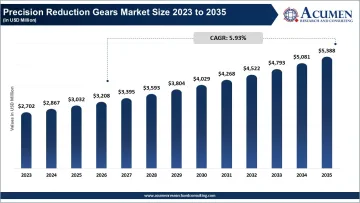
Precision Reduction Gears Market Highlights
- In 2025, Asia-Pacific region held over 42% revenue share in the global market.
- North America region is expected to register fastest-growing CAGR of 9.1% from 2026 to 2035.
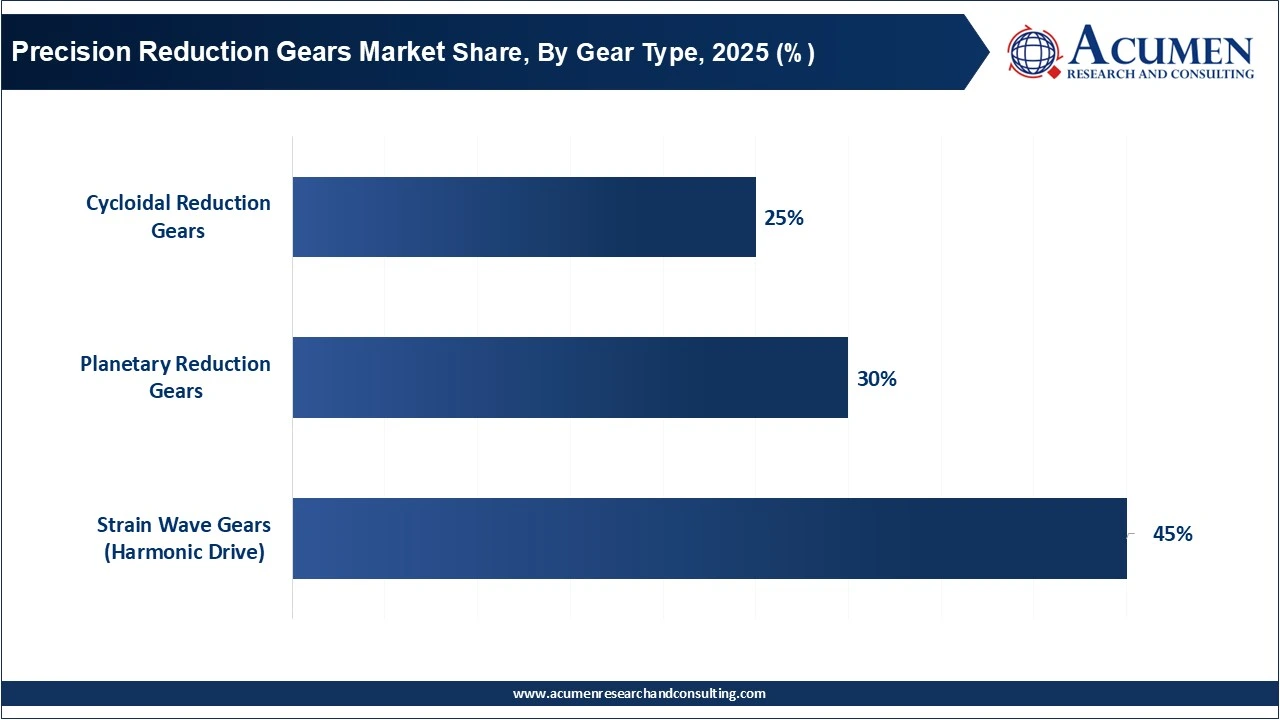
- By gear type, the strain wave gears (harmonic drive) segment accounted for nearly 45% share.
- By precision level, the standard precision segment held around 60% market share, whereas high precision segment represents remaining the 40%.
- By application, the robotics segment led the market with 39% share, followed by aerospace & defense with 22% market share.
Precision Reduction Gears Market Overview
The global precision reduction gears market is going through a sea of change driven by rising demand for motion control quality of precision in autonomous system applications. Unlike traditional gearbox options, precision reducers, namely strain wave and cycloidal reducers, are designed with the least backlash and maximum torque density. With a natural rate of adoption from manual labor to automated labor, precision reducers are now the muscles of robots, enabling the necessary repeatability for complex multi-axis motion applications.
Beyond the traditional factory floor, the medical industry is an important end use industry for the growth of this market. Advanced surgical robotic platforms, require gears with nearly zero backlash to hold patients safely while performing complex procedures with extreme precision. Harmonic drives, or strain wave gears, are often used in these applications due to their small footprint and ability to perform delicate manipulations in tight spaces. Continued competition among surgical robot manufacturers raises technical standards for motion stability, consistent operating characteristics, and stable controls requirements to remove uncertainty and reduce risk in medical procedure.
Precision Reduction Gears Market Dynamics
Market Drivers
Rapid expansion of industrial automation and robotics
- The expansion of industrial automation within the manufacturing sector is driving the precision reduction gear industry. Precision gears provide necessary accurate positioning, low backlash, and high torque transmission that are required for optimum performance in CNC machines, automated systems, and robot applications. There is a growing demand for precision gear solutions that meet the requirements of service robots, collaborative robots, and industrial robots used in the automotive, electronics, and logistics industries.
Rising demand from high-precision industries
- Precision is crucial in various industries such as semiconductor manufacturing, medical devices, aerospace, and defense, and it is another major driver of growth in the market. There is a high degree of motion control in these types of applications as well as a need for high reliability in the components. The precision is important for many operations such as surgical robots and wafer fabrication, as well as for controlling the movement of aircraft and spacecraft. Industry will continue to spend money on advanced equipment and upgrades to their current equipment, which will lead to continued growth in the demand for high-performance precision reduction gearboxes.
Market Restraints
High cost of precision reduction gear systems
- A major restraint for the precision reduction gears market is the high capital costs of manufacturing and maintenance. Manufacturing these gears uses exotic materials and involves extremely tight machining tolerances which often necessitate climate controlled production environments and advanced CNC (Computer Numerical Control) equipment. These costs lead companies to high unit prices and may be a barrier for small and medium sized enterprises (SME) wanting to automate their operations. Replacement and repairs can also be costly and be delayed, as the nature of these gears are specialized, and facilities do not have capability or personnel to fix or maintain precision reduction gears and require a highly skilled technician need to complete repairs.
Technical and installation barriers in precision reduction gear adoption
- The technical complexity and installation restrictions also create a bottleneck for precision reduction gears market. Installing high-precision components into existing mechanical systems or manufacturing processes is challenging and requires advanced engineering and precise component reinstalls to maintain the designed tolerances. Furthermore, as there is no standardized mechanical interface across manufacturers, system integrators must rely more on single-source suppliers for compatibility, which requires engineering talent knowledgeable about precision gear applications to minimise the learning curve and optimise installation or operational outcomes.
Market Opportunities
Growth of electric vehicles and autonomous systems
- The electric vehicle revolution, the autonomous driving technology revolution, and the smart mobility systems revolution all offer large opportunities to the precision reduction gear market. All these require compact, lightweight, high-efficiency gear systems for steering, braking, and drive mechanisms. As the world continues to increase its investments into electric vehicles and autonomous platforms, there will be a significant increase in demand for high-precision motion control component products.
Growing demand for micro-precision gears in high-tech and medical devices
- The ongoing trend of miniaturization in many high-tech sectors presents significant opportunity for market growth in precision reduction gears market. As medical devices, wearable robotics, and handheld professional tools become smaller and more portable, there is a growing need for micro-precision gears that have comparable power output in a compact size. Advancing the compact gear solutions, while maintaining high reduction ratios in small footprints enables more ergonomic and capable devices. A clear example of this is Exoskeleton development and minimally invasive surgical tools, where the tight space does not compromise the high degree of precision.
Precision Reduction Gears Market Report Scope
| Attribute | Details |
|---|---|
| Precision Reduction Gears Market Size 2025 | USD 3,032 Million |
| Precision Reduction Gears Market Forecast 2035 | USD 5,388 Million |
| Precision Reduction Gears Market CAGR During 2026 - 2035 | 5.93% |
| Analysis Period | 2023 - 2035 |
| Base Year | 2025 |
| Forecast Data | 2026 - 2035 |
| Segments Covered | By Gear Type, By Precision Level, By Configuration, By Application, and By Geography |
| Regional Scope | North America, Europe, Asia Pacific, Latin America, and Middle East & Africa |
| Key Companies Profiled | Harmonic Drive Systems Inc., Nabtesco Corporation, Sumitomo Heavy Industries, DieQua Corporation, Cone Drive, Neugart GmbH, Spinea s.r.o., Onvio LLC, Beijing CTKM Harmonic Drive Co., Ltd., Leaderdrive, GAM Enterprises, Inc., and KOFON Motion Group. |
| Report Coverage | Market Trends, Drivers, Restraints, Competitive Analysis, Player Profiling, Covid-19 Analysis, Regulation Analysis |
Precision Reduction Gears Market Regional Analysis
- The North America precision reduction gears market size was valued at USD 788.41 million in 2025 and is expected to be worth USD 1,831.76 million by 2035 at a CAGR of 9.1% from 2026 to 2035.
- The Europe precision reduction gears market size was reached at USD 697.44 million in 2025 and is forecasted to hit USD 1,293 million by 2035, expanding at a CAGR of 6.4% from 2026 to 2035.
- The Asia-Pacific precision reduction gears market size was accounted for USD 1273.58 million in 2025 and is anticipated to surpass USD 2,047.26 million by 2035, at a CAGR of 4.8% from 2026 to 2035.
The Asia-Pacific region leads the precision reduction gears market due to the presence of top manufacturing hub in the region, with countries such as China, Japan, and South Korea hosting some of the largest electronics, automotive, and robotics companies. Japan is a leading producer of precision gears and is home to many leading manufacturers. The industrial automation scale of China coupled with government-led programs to modernize manufacturing continues to spur demand for precision gearing solutions in the region.
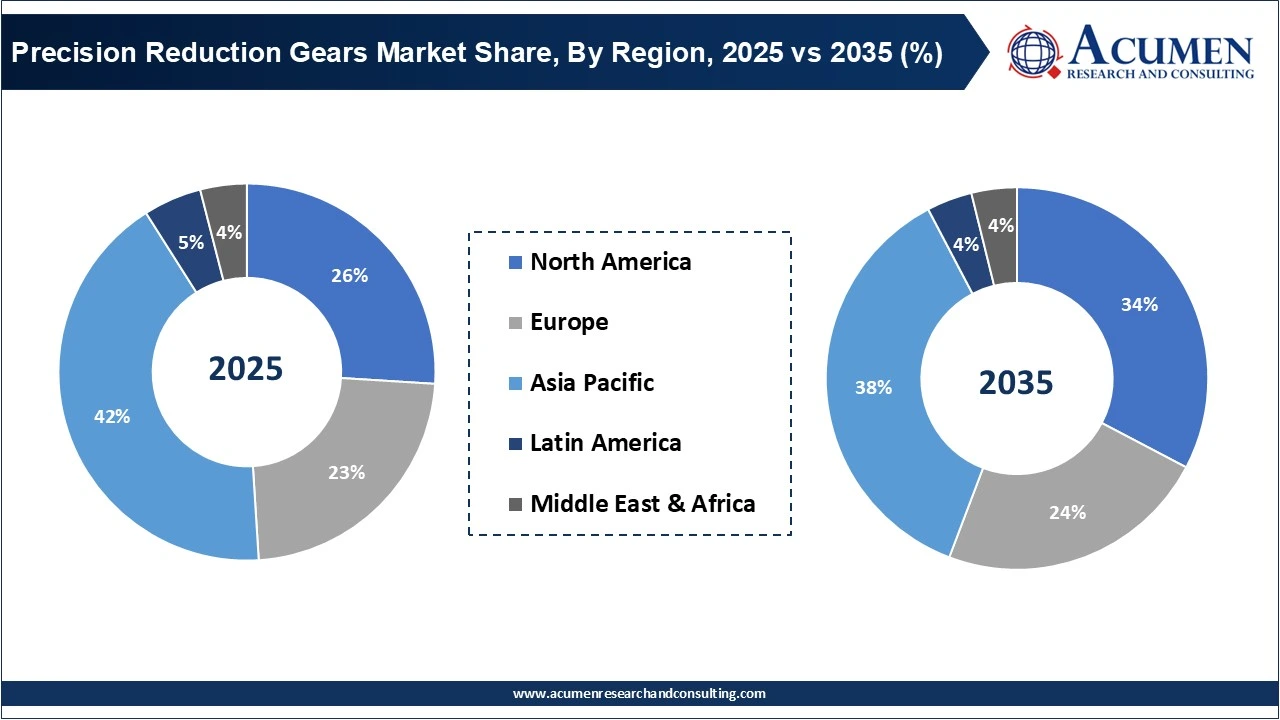
North America represents the fastest growing regional market. This growth results from focused efforts on advanced Research and Development (R&D) and ultra-high-end applications. The market is experiencing rapid growth in surgical robotics and advanced medical technologies, especially in the U.S., along with the resurgence of domestic aerospace markets, which is creating high demand for specialized high-precision gears. Additionally, the recent focus on "smart manufacturing" including artificial intelligence integration with mechanical systems is creating ideal market conditions to sustain high growth in the space.
Precision Reduction Gears Market Segmental Insights
The worldwide market for precision reduction gears is split based on gear type, precision level, configuration, application, and geography.
Gear Type Insights
Strain Wave Gears dominated in the precision reduction gears market in 2025. This is largely due to their specific construction, which involves three basic components: a wave generator, a flexspline, and a circular spline. This can generate a design that is overall very compact and light weight with high reductions and near zero backlash. Due to these features, Strain Wave Gears have become the standard in small to medium robotic arm and co-bot (collaborative robot) joints, where weight and space are the upmost concerns.
| Gear Type | Market Share, 2025 (%) | Key Highlights |
|---|---|---|
| Strain Wave Gears (Harmonic Drive) | 45% | Widely adopted for compact size, zero backlash, and high accuracy, especially in robotics and advanced automation applications. |
| Planetary Reduction Gears | 30% | Preferred for balanced torque transmission and cost efficiency in industrial machinery and automotive manufacturing. |
| Cycloidal Reduction Gears | 25% | Growing strongly due to high shock resistance, durability, and suitability for heavy-load industrial and robotic applications. |
In contrast, cycloidal reduction gears are the fastest-growing type in the market, as they are in an earlier stage of their life cycle in terms of adoption. This is due to the cycloidal design, which uses rolling components rather than sliding teeth that wear down over time. Many of these gears can resist inertial impacts that would damage a strain wave gear or other types. For these reasons, the demand for cycloidal gears is accelerating faster than traditional designs, despite their nontraditional form and size.
Precision Level Insights
The current landscape of the precision reduction gears market is still primarily dominated by standard precision gears. These gears are designed for general industrial applications that prioritise cost-effectiveness and high reliability over extremely precise sub-micron accuracy. As they are driven by price, standard precision gears are common in traditional automotive manufacturing, conveyor systems, and basic material handling equipment. Their strong value as an affordable motion control solution ensures steady demand from a well-defined customer base, including consumers who require dependable motion for high-volume production without the higher costs associated with the most precise gear levels.
| Precision Level | Market Share, 2025 (%) | Key Highlights |
|---|---|---|
| Standard Precision | 60% | Commonly used in general industrial machinery due to affordability and reliable performance. |
| High Precision | 40% | Increasing demand from robotics, semiconductor equipment, medical devices, and aerospace requiring ultra-accurate motion control. |
The high precision segment is the fastest-growing. This growth is mainly driven by pressures faced by end-user industries such as aerospace, defense, and advanced medical robotics, as their design and delivery processes become increasingly complex. Even minor movement adjustments can lead to mission failure or disastrous results in medical procedures. With great level of precision required in activities such as satellite deployment and robot-assisted surgery, planners will continue to seek minimal backlash and maximum repeatability, fueling rapid growth in this segment.
Configuration Insights
Inline reduction gears segment accounted for the largest market share in 2025 due to their ease of mechanical integration and associated efficiencies. Inline means that the input and output shafts are aligned on the same axis, which naturally suits many linear robotic systems and traditional automated machinery designs. Although there are various implementations, inline is by far the most efficient power transmission method and the most common configuration for standard industrial actuators. As a mature technology with well-established manufacturing processes, inline gears are reliable for most current automation projects.
| Configuration | Market Share, 2025 (%) | Key Highlights |
|---|---|---|
| Inline Reduction Gears | 70% | Favoured for simple integration, efficient power transmission, and compatibility with standard motor designs. |
| Right-angle Reduction Gears | 30% | Rising adoption driven by compact layouts and suitability for space-constrained automation systems. |
Right-angle reduction gears is the fastest growing segment of the precision reduction gears market. The rising trend of space saving and compact machine design continue to increase the demand for right-angle gears. Mounting the motor to the output shaft at 90 degree offers a significant advantage for designers, enabling more flexible and creative placement of motors in robotic or automated systems. The move toward modular factory layouts and space-efficient designs is a primary reason for the rapid growth of right-angle gears in the market.
Application Insights
Robotics segment led the market with around 39% market share as precision reduction gears serve core function in a robot joint, base, or end-effector. The precision gear allows a robot to move with the fluidity and precision to do jobs like arc welding, precision assembly, and pick-and-place tasks. The rise of collaborative robots working alongside workers has further cemented the robotics market as the largest consumer of precision-reduction gears, driven by the increased need for back-drivable, safe gears.
| Application | Market Share, 2025 (%) | Key Highlights |
|---|---|---|
| Robotics | 39% | Largest application area, supported by increasing deployment of industrial, collaborative, and service robots. |
| Medical Devices | 17% | Rapid growth due to expanding use of surgical robots and automated diagnostic equipment. |
| Semiconductor Equipment | 13% | Strong demand for ultra-precise positioning in wafer fabrication and chip manufacturing processes. |
| Machine Tools | 10% | Widely used in CNC machines and automated production lines requiring consistent precision. |
| Aerospace & Defense | 8% | Adoption driven by high reliability and accuracy requirements in aircraft and defense systems. |
| Automotive & Transportation | 6% | Used mainly in automated assembly lines and advanced manufacturing processes. |
| Packaging & Printing Machinery | 4% | Supports high-speed, accurate operations in packaging and printing applications. |
| Others | 3% | Includes logistics, energy systems, and specialized industrial equipment. |
The medical device segment remains the fastest-growing market. The primary driver has been "robotic revolution" in healthcare which is happening with robotic-assisted surgical systems that are now commonplace in operating rooms around the world. Robotic surgical systems require precision gears that operate silently, with zero vibration, to enable surgeons to perform delicate tasks. Beyond surgery robotics, medical device makers are increasingly adopting precision gears in their diagnostic imaging equipment and advanced prosthetics where high-performance motion control leads directly to better patient outcomes.
Precision Reduction Gears Market Players
- Harmonic Drive Systems Inc.
- Nabtesco Corporation
- Sumitomo Heavy Industries
- DieQua Corporation
- Cone Drive
- Neugart GmbH
- Spinea s.r.o.
- Onvio LLC
- Beijing CTKM Harmonic Drive Co., Ltd.
- Leaderdrive
- GAM Enterprises, Inc.
- KOFON Motion Group
Precision Reduction Gears Market Recent Developments
- Nabtesco Corporation has announced significant expansion of their RV gear production facilities in Japan and China to support increasing demand for industrial robots. The company has announced plans to increase production capacity by 30% by late 2026.
- Harmonic Drive Systems has recently (2021) announced a new ultra miniaturized strain wave gear series that is designed for surgical robotics and humanoid hand joints to provide newer levels of precision for modern healthcare robotic applications.
- Sumitomo Heavy Industries has launched a new integrated high-torque cycloidal reducer product line that features increased durability with a 15% increase in shock load capacity. The line targets heavy-duty material handling and large-scale industrial automation systems throughout the world today.
Precision Reduction Gears Market Segmentation
By Gear Type
- Strain Wave Gears (Harmonic Drive)
- Planetary Reduction Gears
- Cycloidal Reduction Gears
By Precision Level
- Standard Precision
- High Precision
By Configuration
- Inline Reduction Gears
- right-angle reduction gears
By Application
- Robotics (Industrial Robots, Service Robots, Collaborative Robots)
- Medical Devices
- Semiconductor Equipment
- Machine Tools
- Aerospace & Defense
- Automotive & Transportation
- Packaging & Printing Machinery
- Others
By Region
- North America
- U.S.
- Canada
- Europe
- U.K.
- Germany
- France
- Spain
- Rest of Europe
- Asia-Pacific
- India
- Japan
- China
- Australia
- South Korea
- Rest of Asia-Pacific
- Latin America
- Brazil
- Mexico
- Rest of LATAM
- The Middle East & Africa
- South Africa
- GCC Countries
- Rest of the Middle East & Africa (ME&A)
Looking for discounts, bulk pricing, or custom solutions? Contact us today at sales@acumenresearchandconsulting.com
Frequently Asked Questions

Other Construction and Manufacturing Reports
June 2024
December 2024
February 2020
September 2023