
Prescriptive Analytics Market Size, Share, Trends, Report 2026 To 2035
Prescriptive Analytics Market (By Component: Software, Services; By Deployment: On-Premise. Cloud; By Enterprise Size: Large Enterprises, Small & Medium Enterprises (SMEs); By Industry Vertical: BFSI, Healthcare & Life Sciences, Manufacturing, Retail & Consumer Goods, IT & Telecom, Energy & Utilities, Government & Public Sector, Others; By Application: Supply Chain & Planning, Operations Management, Revenue & Pricing, Sales & Marketing, Risk, Fraud & Compliance, Financial Management, Workforce & Human Capital, Strategic Decision Support) - Global Industry Analysis, Size, Share, Regional Analysis, Trends and Forecast 2026 - 2035
- Last Updated: 10 Sep 2026
- Report Code: ARC3977
- Category: ICT
Prescriptive Analytics Market Size and Forecast Report 2026 to 2035
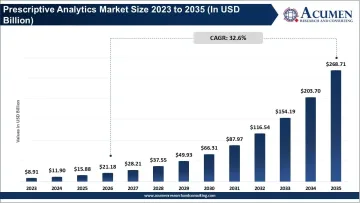
The global prescriptive analytics market size was valued at USD 15.88 billion in 2025. The market is seen to reach at USD 268.71 billion by 2035; growing at a CAGR of 32.6% during the forecast period of 2026-2035.
Report Highlights
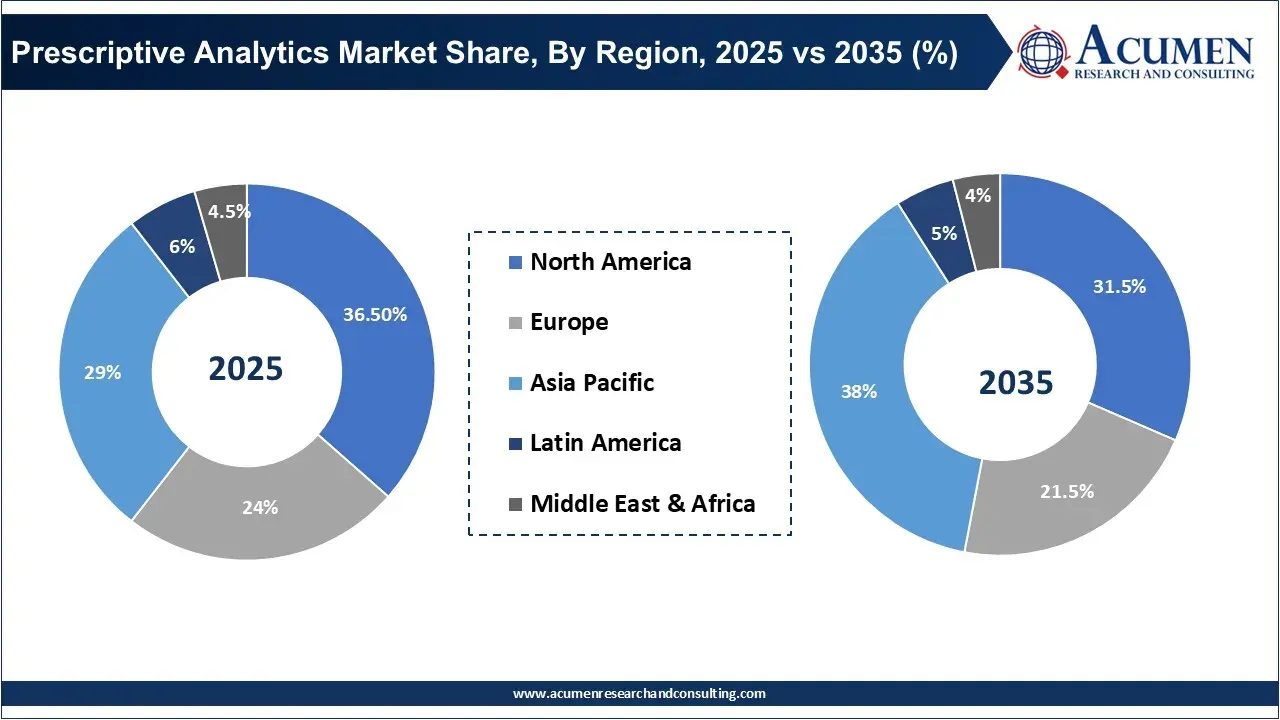
- By region, North America dominated the prescriptive analytics market with a 36.5% share in 2025, supported by its concentration of large enterprises, mature analytics infrastructure, cloud adoption, and extensive use of optimization technologies.
- By region, Asia-Pacific was the second-largest regional market with a 29.0% share in 2025 and is projected to be the fastest-growing region at a 36.7% CAGR from 2026 to 2035, driven by increasing adoption of ai-enabled decision-making and operational optimization.
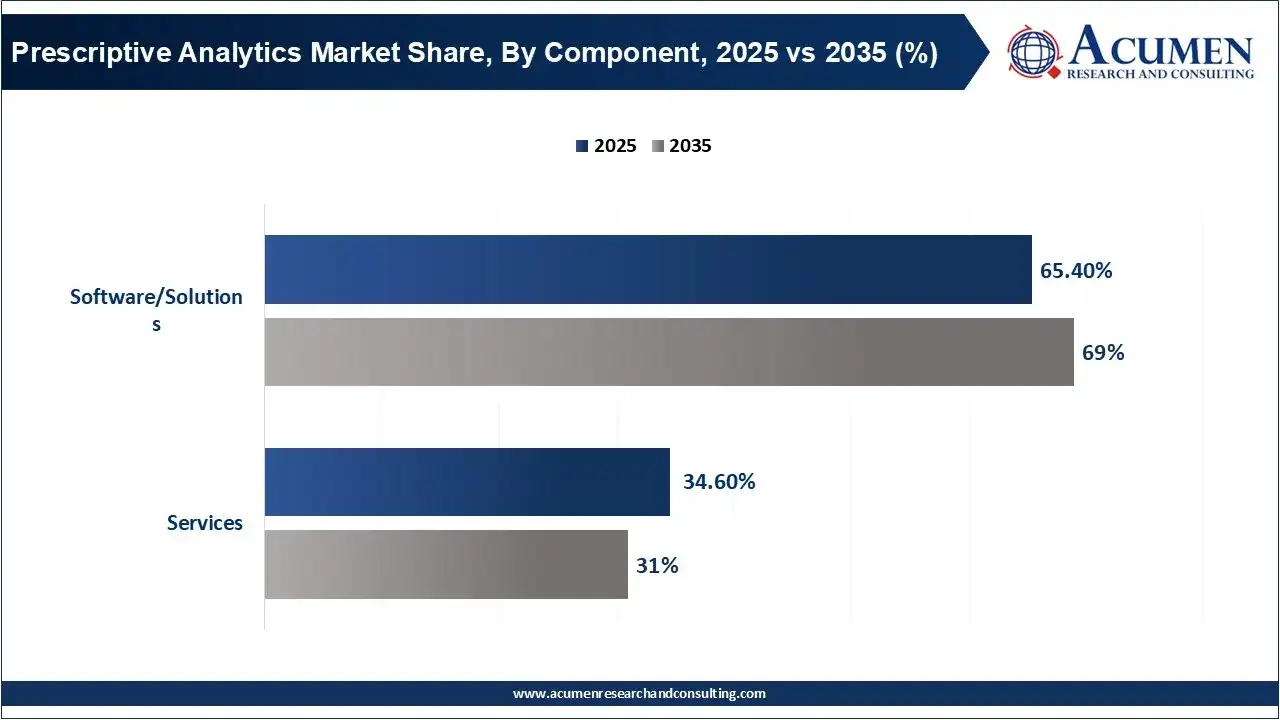
- By component, the software/solutions segment dominated the prescriptive analytics market with a 65.4% share in 2025, driven by its central role in delivering actionable recommendations, scenario simulations, optimization, and enterprise decision intelligence.
- By component, the services segment was the second-largest segment with a 34.6% share in 2025, supported by demand for data integration, model customization, implementation, governance, workflow redesign, and ongoing optimization.
- By deployment, the cloud segment dominated the prescriptive analytics market with a 55.0% share in 2025, supported by its ability to provide scalable computational resources for model training, optimization, scenario simulation, real-time data processing, and system integration.
- By deployment, the on-premise segment was the second-largest segment with a 45.0% share in 2025, retaining relevance among organizations requiring tighter data control, existing infrastructure utilization, and protection of sensitive information.
- By enterprise size, the large enterprises segment dominated the prescriptive analytics market with a 72.0% share in 2025, reflecting their complex operations, extensive data environments, and greater requirements for optimizing interconnected business decisions.
- By enterprise size, the small and medium enterprises segment was the second-largest segment with a 28.0% share in 2025, supported by increasing accessibility to scalable analytics capabilities and cloud-based technologies.
- By industry vertical, the bfsI segment dominated the prescriptive analytics market with a 19.0% share in 2025, driven by extensive requirements for fraud detection, credit decisions, portfolio management, liquidity, pricing, and risk optimization.
- By industry vertical, the manufacturing segment was the second-largest segment with a 17.0% share in 2025, supported by applications across production scheduling, inventory management, predictive maintenance, quality management, procurement, and supply-chain optimization.
- By application, the supply chain & planning segment dominated the prescriptive analytics market with a 21.0% share in 2025, driven by the need to optimize procurement, inventory, production, distribution, demand planning, transportation, and supply capacity.
- By application, the operations management segment was the second-largest segment with an 18.0% share in 2025, supported by demand for continuous optimization of operational resources, processes, and capacity.
Prescriptive Analytics Market Overview
Prescriptive analytics refers to an advanced form of data analytics that uses historical and real-time data, artificial intelligence, machine learning, optimization algorithms, predictive models, and simulation techniques to recommend the best possible actions for achieving defined business objectives. Unlike descriptive analytics, which explains what happened, and predictive analytics, which estimates what is likely to happen, prescriptive analytics determines what an organization should do in response to different scenarios and constraints.
It is increasingly applied across supply chain management, financial services, healthcare, manufacturing, retail, marketing, and transportation to optimize resources, reduce operational costs, manage risks, improve forecasting, and support faster data-driven decision-making.
Prescriptive Analytics Market Adoption, Investments & Enterprise Spending Trends
- In 2025, 43% of organizations adopted AI analytics within production, and 24% of those predicted a threefold increase in their investment within 12 months.
- Organizations made a swift move toward adoption rather than experiment. Over 1000K business customers are subscribed with OpenAI, and 9x annual growth in ChatGPT Enterprise seats.
- With 8x weekly messages increase for enterprises from Nov 2024 and 320% year-on-year increase of per-organization API reason-token consumption, weekly message traffic at an enterprise-level is also increasing rapidly, showing increased demand for optimized and sophisticated analytics capabilities.
- By Nov 2025, following 100 CIOS surveyed across 15 business types, AI investment was shifting away from pilot programs and towards an on-going operating expenditure-enterprise, IT, and individual business unit budgets have already migrated to recurring IT and business unit spending.
- Of surveyed organizations, 93% of Indian enterprises expect their use of both AI and analytics will expand during 2025; specifically, 53% anticipate a high degree of expansion.
Prescriptive Analytics Market Dynamics
Growth Driver
- AI and Machine Learning Integration: Enterprises are increasingly combining machine learning, optimization algorithms, and real-time data with analytics platforms to move from identifying problems toward recommending specific actions. Enterprise AI usage is becoming substantially deeper, with frontier organizations generating approximately 2× more messages per seat than median enterprises, demonstrating increasing integration of AI into repeatable workflows.
Market Restraints
- Data Quality and Integration Issues: Prescriptive analytics has reliance on accurate, readily available, integrated data sets-organizations may be dealing with complex, fragmented legacy systems and data silos. In a recent 2025 global AI+BI survey, imprecise AI answers or irrelevant and inconsistent answers were ranked the number one technical issue, suggesting that data quality/model accuracy is not disappearing anytime soon.
- Difficulty in Proving ROI: Businesses may have difficulty tying specific dollar amounts to investments in advanced analytics; the benefits may cross departmental lines. In a recent Gartner survey, 23 percent of functional leaders said that they had no idea what the return was for their AI investment and median positive returns for companies trying to measure out outcomes were about 10% - not enough to motivate companies to deploy rapidly across the enterprise.
Market Opportunities
- Expansion Across Real-Time Decision-Making: The growing use of AI within repeatable, multi-step workflows creates opportunities for prescriptive analytics vendors to embed recommendations directly into operational systems rather than limiting analytics to dashboards. Enterprise users already report saving 40–60 minutes per day through AI adoption, creating a measurable foundation for broader automated decision-support applications.
- Rapid Growth in Asia-Pacific Enterprise Adoption: Asia-Pacific presents significant opportunities as enterprises increase AI, automation, cloud, and data-platform investments. The prescriptive analytics market is projected to record its fastest regional growth in Asia-Pacific, while India's enterprise AI-and-analytics spending survey showed 93% of respondents expecting higher spending, creating opportunities for vendors targeting manufacturing, BFSI, logistics, healthcare, and retail.
Prescriptive Analytics Market Segmental Insights
Component Insights
In 2025 software/solutions were dominant holding 65.4% of prescriptive analytics market. Software is expected to retain its dominancy because it serves as the infrastructure on which prescriptive recommendations are executed. Unlike typical analytics approach where the focus is to either explain outcomes or predict them, prescriptive analytics need solutions that take this to the next level and actually propose actionable decisions by simulating all sorts of scenarios and alternatives on top of large data sets.
As organizations move toward integrating all aspects of operations into planning, business processes, operational decisions, risk management and commerce, the use of software/solutions becomes an integral component that will be essential for delivering prescriptive intelligence.
Although services represent the smaller component segment, their role remains important where prescriptive analytics requires data integration, model customization, implementation, governance and workflow redesign. The services' share was 34.6% in 2025. Service providers can differentiate through industry-specific implementation, integration with legacy systems, model validation, change management and ongoing optimization rather than competing solely on basic deployment support.
Deployment Insights
Cloud was dominant with 55% of the prescriptive analytics market by 2025. It comes as no surprise given the strong business rationale around prescriptive analytics, that the business case is especially compelling, as the computational burden can be significant.
Training new models, model optimization, running scenarios, capturing real time feeds and updating and integrating models to disparate systems demands computational power. A cloud offering allows firms to scale computationally as and when the need dictates as opposed to building out comparable in house resources.
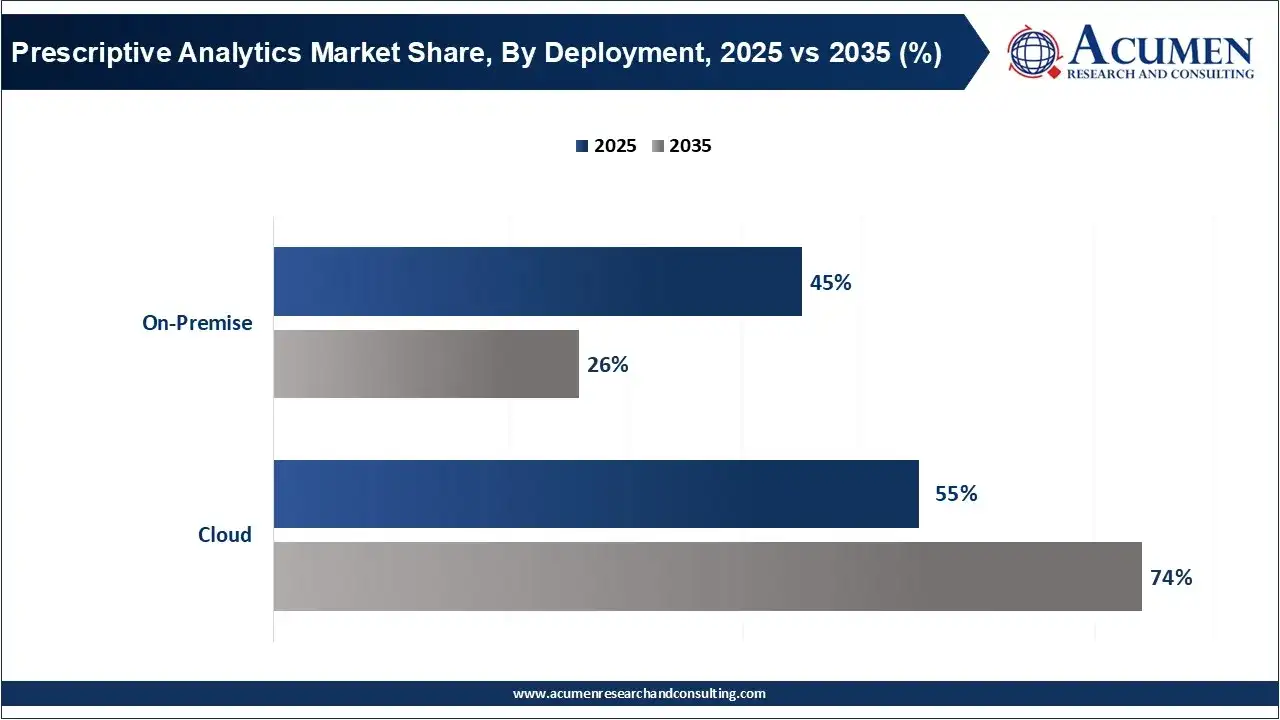
On premise accounted for 45% in 2025. However, there is an continuous observation of an ongoing relevance for organizations with tight data control policies, investment into sunk capital infrastructure, sector-specific operational constraints; and with restricted processes around bringing sensitive data off-site. The predicted decline is merely indicating a trend rather than cessation of on premise operations.
Enterprise Size Insights
Large enterprises accounted for 72.0% of the prescriptive analytics market in 2025, making them the dominant enterprise-size segment. Their leadership is closely associated with the complexity and scale of business decisions that prescriptive analytics is designed to optimize. Large organizations typically manage multiple business units, geographies, suppliers, customer segments and operational processes, creating a substantial number of interconnected decisions involving resource allocation, inventory, pricing, risk, workforce and supply-chain planning.
Prescriptive Analytics Market Share, By Enterprise Size, 2025 (%)
| Enterprise Size | Revenue Share, 2025 (%) | Revenue Share, 2035 (%) |
|---|---|---|
| Large Enterprises | 72% | 58% |
| Small & Medium Enterprises (SMEs) | 28% | 42% |
Large enterprises accounted for 72.0% of the prescriptive analytics market in 2025, making them the dominant enterprise-size segment. Their leadership is closely associated with the complexity and scale of business decisions that prescriptive analytics is designed to optimize. Large organizations typically manage multiple business units, geographies, suppliers, customer segments and operational processes, creating a substantial number of interconnected decisions involving resource allocation, inventory, pricing, risk, workforce and supply-chain planning.
Industry Vertical Insights
The BFSI industry vertical represented the largest portion of the prescriptive analytics market, at 19%, in 2025. Decision volumes and financial impacts associated with fraud detection, credit scoring and origination, portfolio management, liquidity, and pricing, as well as a need for risk and asset portfolio optimization further contributes to the segment's dominance.
Prescriptive analytics assists financial firms by establishing a recommended action rather than merely predicting or risk assessment. Source information suggests a slight loss of share to BFSI over time as more verticals embrace prescriptive analytics.
Prescriptive Analytics Market Share, By Industry Vertical, 2025 (%)
| Industry Vertical | Revenue Share, 2025 (%) |
|---|---|
| BFSI | 19% |
| Healthcare & Life Sciences | 14% |
| Manufacturing | 17% |
| Retail & Consumer Goods | 15% |
| IT & Telecom | 13% |
| Energy & Utilities | 9% |
| Government & Public Sector | 6% |
| Others | 7% |
The manufacturing sector was the second largest industry vertical at 17% in 2025. Some of its particularly well-defined applications of prescriptive analytics span production scheduling, inventory management, predictive maintenance, quality management, as well as procurement and supply-chain optimization. Many firms in the manufacturing sector were well-practiced in operational and predictive data environments, providing them a strong base from which to take advantage of prescriptive analytics functions.
Application Insights
Supply chain & planning was the largest market segment by application in 2025, covering 21% of the market. This is largely attributed to the intricate and complex nature of decision-making that takes place at each step of supply chain processes which extends from procurement and inventory planning through to production, distribution and demand planning.
In supply chains, prescriptive analytics tends to be very effective as organizations are constantly striving to manage numerous constraints such as demand volatility, the levels of inventory and stock being held, supply capacity as well as transportation.
Prescriptive Analytics Market Share, By Application, 2025 (%)
| Application | Revenue Share, 2025 (%) |
|---|---|
| Supply Chain & Planning | 21% |
| Operations Management | 18% |
| Revenue & Pricing | 13% |
| Sales & Marketing | 12% |
| Risk, Fraud & Compliance | 14% |
| Financial Management | 9% |
| Workforce & Human Capital | 6% |
| Strategic Decision Support | 7% |
Operations management held 18% of the total market share of this segment in 2025 coming second to supply chain & planning. This market is driven by demand from businesses for continuous operational resource optimization processes as well as capacity management.
Prescriptive Analytics Market Regional Insights
North America Dominates the Prescriptive Analytics Market as Enterprise AI Adoption Creates a Strong Decision-Optimization Base
In terms of the largest regional share in the prescriptive analytics market, North America occupied the largest share of 36.5% in 2025 when compared with Asia Pacific (29.0%), and Europe (24.0%). North America is the leading market because it involves the concentration of large enterprises already equipped with a strong data foundation, developed analytics maturity, wide use of cloud based systems, and comprehensive use of optimization technology, in finance services, manufacturing, healthcare, retail, technology sectors, etc.
Thus, prescriptive analytics is strongly preferred in North America as large enterprises are shifting from simple descriptive & predictive solutions to decision recommending & automatic prescriptive solutions for optimizing decisions in pricing, risks, supply chains, resource utilization, and operational plans.
The market size in North America in the year of 2025, 2026 and 2035 were recorded to be $5.80 billion, $7.73 billion and $84.64 billion respectively in addition to the predicted CAGR at 30.5% in the period of 2026-2035.
Asia-Pacific Is the Fastest-Growing Regional Opportunity as Prescriptive AI Moves from Analytics Adoption to Operational Decision-Making
The Asia-Pacific region is expected to hold the largest scope for expansion within the prescriptive analytics market, with its market share expected to increase from 29.% to 38.% during 2025 to 2035 and the only significant region within the data supplied to significantly increase its proportion. The region's growth is expected to gain significant ground, experiencing a growth rate of 36.7% CAGR from 2026-2035.
The trend within consulting is expected to signify a shift from the development of analytics infrastructure toward data driven AI applications that enterprises can perform, with complexity within supply chains, production networks, client demands, pricing schemes, workforce deployment and the infrastructure itself.
The increase in regional contribution also suggests that vendors with scalable cloud architectures, localized AI capabilities and industry-specific optimization models may find particularly strong expansion opportunities across Asia-Pacific.
Government Initiatives & Regulations for Prescriptive Analytics Industry
| Country | Government Initiative / Regulation | Key Provisions Relevant to Prescriptive Analytics |
|---|---|---|
| United States | AI Executive Order 14409 and federal AI governance initiatives | The June 2026 executive order focuses on accelerating advanced AI innovation while addressing national-security considerations; federal agencies are also implementing AI governance, risk management, transparency, and responsible-use practices. |
| European Union | EU AI | Act The EU follows a statutory, risk-based AI framework that imposes stronger requirements on higher-risk AI applications, including requirements around transparency and accountability. |
| India | India has developed AI governance guidance emphasizing responsible AI, while its May 2026 National Data Governance Framework | India has developed AI governance guidance emphasizing responsible AI, while its May 2026 National Data Governance Framework focuses on interoperable government databases and responsible data sharing for AI while maintaining security and citizen trust. |
| Japan | Act on Promotion of Research and Development and Utilization of AI-Related Technologies | Japan adopted legislation promoting AI-related technologies in May 2025, establishing an AI Strategy Center and emphasizing innovation, voluntary guidelines, and international cooperation |
| Singapore | National AI Strategy 2.0 and 2026 update | Singapore's National AI Strategy was updated in May 2026 with 10 refreshed priorities, while its broader governance approach includes AI Verify and sector-specific governance frameworks. |
| Canada | AI for All national AI strategy | Canada's June 2026 strategy targets increased AI adoption, stronger AI safety capabilities, privacy protection, transparency, infrastructure, and responsible AI deployment. |
Leading Companies
- Microsoft – The U.S.-based technology company provides cloud, AI, data, and analytics capabilities that support predictive and prescriptive decision-making across enterprise workflows.
- IBM – The U.S.-based company combines AI, optimization, data platforms, and decision optimization technologies for complex enterprise applications including supply chains and operations.
- Oracle – The U.S.-based enterprise technology provider integrates analytics and AI capabilities into its cloud applications, creating opportunities for embedded decision intelligence across business functions.
- SAP – The Germany-based enterprise software provider incorporates analytics, AI, and optimization capabilities across business processes, particularly in enterprise planning and operations.
- SAS Institute – The U.S.-based analytics company has a long-established presence in advanced analytics and provides capabilities for optimization, forecasting, risk management, and data-driven decision-making.
- FICO – The U.S.-based analytics and decision-management company is particularly positioned around decision optimization, risk management, fraud prevention, and financial-services applications.
- Altair Engineering – The U.S.-based technology company provides simulation, optimization, AI, and data analytics capabilities that support complex engineering and enterprise decision-making.
- Teradata – The U.S.-based data and analytics company provides enterprise data and AI capabilities that enable organizations to operationalize advanced analytics and data-driven decisions.
- River Logic – The U.S.-based company focuses on supply-chain and business planning solutions using optimization and prescriptive analytics to support complex operational decisions.
Recent News
- In February 2025, IBM Research presented PrecAIse, a proof-of-concept domain-adaptable prescriptive AI agent at AAAI 2025. The system combines causal and prescriptive tools with a natural-language interface, allowing users with limited expertise in causal machine learning and optimization to interact with prescriptive decision tools through conversational inputs.
- In March 2025, IBM was reported to have expanded its watsonx platform with a prescriptive analytics module focused on supply-chain and operations decisioning. The reported capability translates predictive outputs into recommended actions involving areas such as supplier replenishment, logistics capacity allocation, and inventory balancing, highlighting the market's transition from forecasting toward automated or semi-automated operational decisions.
Segments Covered
By Component
- Software/Solutions
- Services
By Deployment
- On-Premise
- Cloud
- By Enterprise Size
- Large Enterprises
- Small & Medium Enterprises (SMEs)
By Industry Vertical
- BFSI
- Healthcare & Life Sciences
- Manufacturing
- Retail & Consumer Goods
- IT & Telecom
- Energy & Utilities
- Government & Public Sector
- Others
By Application
- Supply Chain & Planning
- Operations Management
- Revenue & Pricing
- Sales & Marketing
- Risk, Fraud & Compliance
- Financial Management
- Workforce & Human Capital
- Strategic Decision Support
By Region
- North America
- Europe
- Asia-Pacific
- Latin America
- Middle East & Africa
Looking for discounts, bulk pricing, or custom solutions? Contact us today at sales@acumenresearchandconsulting.com
Frequently Asked Questions

Related Market Research Reports
December 2023
June 2023
June 2023
December 2022
October 2026
June 2022
July 2022
June 2026