
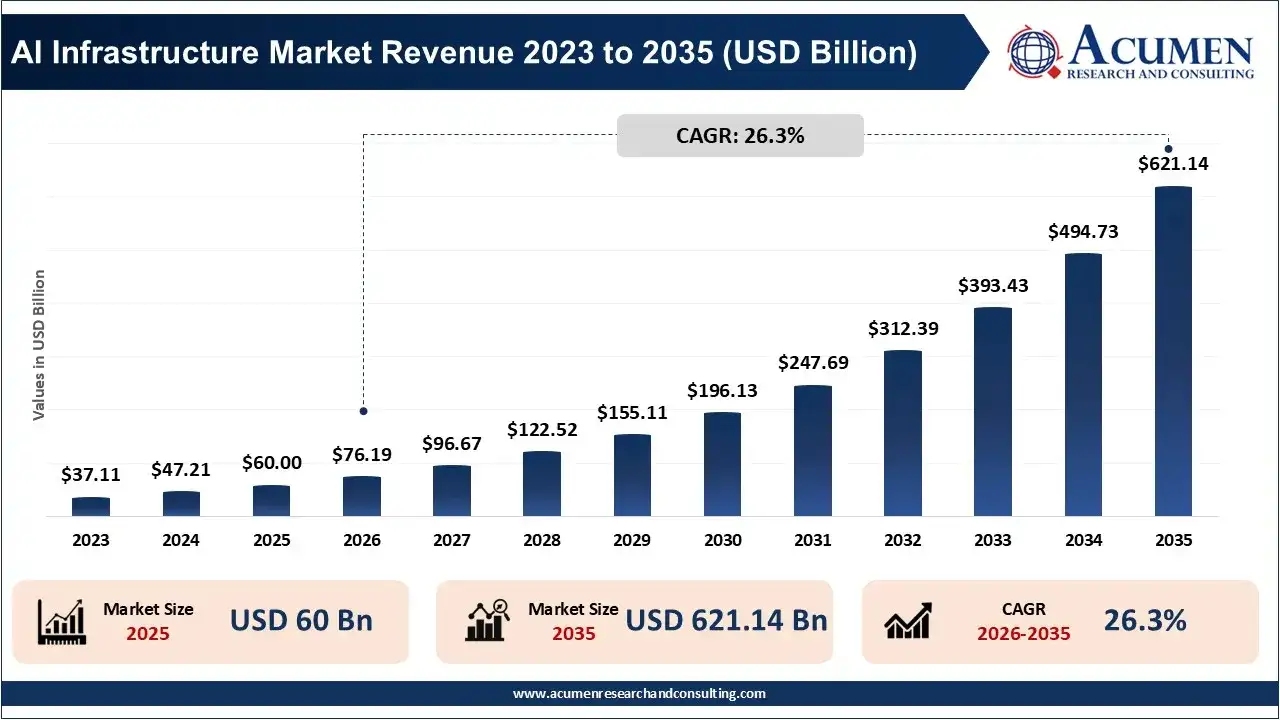
AI Infrastructure Market Size to Surge USD 621.14 Billion by 2035; Growing at a CAGR of 26.3%
Published : 21 Sep 2026
Author : Lucas Hoffmann



What is the AI Infrastructure Market Size?
The global AI infrastructure market size was accounted for USD 60 billion in 2025 and is predicted to surge USD 621.14 billion by 2035; growing at a CAGR of 26.3% over the forecast period of 2026-2035.
What Is Driving Growth in the AI Infrastructure Market?
The AI infrastructure market is growing as enterprises evolve from experimenting with AI toward deploying enterprise-wide ML, generative AI, and AI agents at scale within their businesses. Increased adoption of GPU-accelerated computing, high-bandwidth networking, modular cloud architecture, and high-performance data center capacity is driving investments at all layers of the AI tech stack. Large language models and multimodal AI are accelerating the deployment of compute-intensive training and inference models.
Meanwhile, hyperscale cloud providers, enterprises, and governments are investing in AI-optimized data centers, sovereign AI capabilities, and onshored computing infrastructure. The exponential growth of AI workloads across sectors such as health care, financial services, manufacturing, automotive, cyber security, retail and public-sector will continue to create ever-increasing demands for infrastructure.
AI Infrastructure Market: Key Trends Reshaping AI Computing and Data Centers
- Rapid expansion of AI-optimized data centers: Hyperscalers and enterprises are developing dedicated facilities capable of supporting high-density AI computing workloads.
- Growing demand for GPU and AI accelerator infrastructure: Increasing model-training and inference workloads are driving investments in GPUs, AI accelerators, CPUs, and specialized computing architectures.
- Shift from AI training toward inference at scale: As AI applications move into production, continuous inference workloads are increasing demand for low-latency and cost-efficient computing infrastructure.
- Expansion of high-speed AI networking: Large AI clusters are increasing demand for high-bandwidth Ethernet, InfiniBand, optical interconnects, switches, DPUs, and advanced networking architectures.
- Rise of liquid cooling: Higher rack power densities are encouraging data center operators to adopt direct-to-chip liquid cooling and other advanced thermal-management technologies.
- Growing adoption of generative AI infrastructure: Large language models, multimodal systems, AI assistants, and agentic AI are creating new requirements for computing, memory, storage, and networking capacity.
- Increasing focus on sovereign AI infrastructure: Governments and national technology ecosystems are investing in domestic AI computing capacity, data centers, semiconductors, and secure AI infrastructure.
- AI infrastructure software gaining importance: Infrastructure orchestration, workload scheduling, resource optimization, observability, and automated management are becoming increasingly important as AI environments grow more complex.
AI Infrastructure Market Segmental Outlook
| Segmentation | Dominant Segment | 2025 Share | Key Factors Driving Dominance |
|---|---|---|---|
| By Offering | Compute | 50% | Rising demand for GPUs, CPUs, AI accelerators, and high-performance computing systems to support model training, inference, and increasingly complex AI workloads. |
| By Function | AI Model Training | 55% | Growing development of large AI models, increasing training-data volumes, demand for high-performance computing, and continued investment in foundation models and enterprise AI. |
| By Deployment | Cloud | 52% | Scalability, flexible computing capacity, lower upfront infrastructure requirements, pay-as-you-go models, and easy access to AI computing resources. |
| By Technology | Machine Learning | 38% | Widespread enterprise adoption across predictive analytics, fraud detection, cybersecurity, recommendation systems, automation, and demand forecasting |
| By End User | Enterprises | 50% | Increasing transition from AI experimentation to production deployments, digital transformation initiatives, automation needs, and adoption of AI across multiple business functions |
AI Infrastructure Market Regional Outlook
North America AI Infrastructure Market: Regional Leadership Supported by Advanced Digital Ecosystems
North America accounted for the largest revenue share of 39.0% in 2025. The growth of North America can be attributed to favorable policies, strong ecosystem, & support from cloud data centers, as well as the presence of several hyperscale technology companies that are focused on deploying hyperscale AI infrastructure. The U.S. has substantial investments in developing high-performance data centers, networking infrastructure, advanced chips, and hyperscale AI computing capacity.
- United States: Continues to lead regional growth due to new hyperscale data center capacity, AI cloud infrastructure, MOC investment, and surging demand for GPUs and HPC.
- Canada: Benefits from increasing AI research investments, getting more data centers and data center projects, government is supporting AI development, rising demand for cloud and high performance computing resources.
Asia-Pacific AI Infrastructure Market: Rapid Expansion Driven by AI Adoption and Data Center Investments
Asia-Pacific was the second-largest AI infrastructure market in 2025, accounting for a 29.0% share, and is projected to be the fastest-growing region, registering a 29.3% CAGR from 2026 to 2035. Growth is being driven by accelerating AI adoption across industries, hyperscale data center investments, semiconductor development, cloud infrastructure expansion, and broader digital transformation. Increasing investments in AI computing capacity and national AI infrastructure programs across major economies are further strengthening the region's position in the global market.
- China: AI infrastructure expansion is supported by large-scale investments in domestic computing capacity, data centers, cloud platforms, AI development, and semiconductor capabilities.
- Japan: Growth is driven by enterprise AI adoption, modernization of data center infrastructure, robotics and automation applications, and increasing investments in high-performance computing.
- South Korea: Strong semiconductor manufacturing capabilities, AI chip development, cloud infrastructure investments, and technology-sector demand are supporting AI infrastructure deployment.
- India: Rapid digitalization, expanding data center capacity, increasing AI adoption across enterprises, and government-led AI infrastructure initiatives are creating significant demand for AI computing and networking infrastructure.
What Opportunities Are Emerging Across AI Networking and High-Speed Interconnects?
AI demand fuels global high-speed networking battle as clusters grow The rapid growth of large-scale AI clusters is opening markets for high-speed Ethernet, Infini Band, optical connectivity, switches, DPUs, SuperNICs, and co-packaged optics- as AI workloads demand more bandwidth, lower latency, and increasingly predictable movement of data between accelerators.
- For example, NVIDIA is building out a broader portfolio of Spectrum-X Ethernet, Quantum Infini Band, and Blue Field networking platforms for connecting large GPU clusters. Arista announced rack-scale AI networking platforms using 1.6-terabit switches to reach the bandwidth needed for hundreds of thousands of GPU nodes.
As AI training and inference clusters grow from thousands to hundreds of thousands of accelerators, there is a business opportunity for network providers who can boost interconnect bandwidth, congestion mitigation, power efficiency, and workload efficiency across sprawling AI data centers.
What Role Are Governments Playing in Building Sovereign AI Infrastructure?
- United States: Government-backed efforts increasingly emphasize domestic AI computing, semiconductor capabilities, data center capacity, and secure technology supply chains, supporting the development of nationally controlled AI infrastructure.
- India: The IndiaAI Mission is supporting domestic AI compute capacity, indigenous foundation models, semiconductor development, datasets, and AI research as part of a broader strategy to strengthen technological self-reliance.
- Japan: Japan is strengthening AI infrastructure through investment in computing resources, data centers, semiconductors, and international technology cooperation. In 2026, India and Japan also agreed to strengthen cooperation around AI data centers, GPU and other compute resources, and semiconductor infrastructure.
- South Korea: Government initiatives are focused on strengthening domestic AI computing and semiconductor capabilities, supporting the country's broader strategy around AI competitiveness and advanced technology infrastructure.
- France: France has been supporting sovereign and European AI capabilities through investments and policy initiatives covering AI computing infrastructure, data centers, research, and domestic technology development, with an emphasis on reducing strategic dependence on external technology ecosystems.
Who Are the Key Companies Shaping the AI Infrastructure Market?
Several companies across accelerated computing, semiconductors, networking, cloud infrastructure, and data center platforms are playing in this space such as NVIDIA, AMD, Intel, Broadcom, Arista Networks, Amazon Web Services (AWS), Microsoft, Google, Oracle, Meta, IBM, Dell Technologies, HPE, Cisco Systems, and Supermicro. NVIDIA continues to expand its share across GPUs, networking, DPUs, and AI data-center platforms, while AMD and Intel are supplying CPUs, accelerators, and infrastructure processing technologies.
Broadcom and Arista Networks are working on the skyrocketing networking and switching requirements of massive AI clusters, with Arista's 1.6T platforms driving rack-scale AI fabrics, while hyperscalers such as AWS, Microsoft, Google, Oracle, and Meta continue to pour substantial investments into AI computing capacity and emerging infrastructure, with AWS and NVIDIA preparing an additional 2 million NVIDIA GPUs across AWS datacenter infrastructure in August 2026.
Segments Covered
By Offering
- Compute
- Memory
- Storage
- Networking
- Infrastructure Software
- AI Compute-as-a-Service
By Function
- AI Model Training
- AI Model Inference
By Deployment
- Cloud
- On-Premises
- Hybrid
By Technology
- Machine Learning
- Deep Learning
- Generative AI
- Other AI Technologies
By End User
- Cloud Service Providers
- Enterprises
- Government & Research Organizations
- Others
By Region
- North America
- Europe
- Asia-Pacific
- Latin America
- Middle East & Africa
Contact Us:
Mr. Richard Johnson
Acumen Research and Consulting
India: +91 8983225533