
Sovereign AI Market Size to Surpass USD 248.59 Billion by 2035, Growing at an Accelerated Rate of 20.1%
Published : 07 Sep 2026
Author : Lucas Hoffmann



What is the Sovereign AI Market Size?
The sovereign AI market size was valued at USD 39.72 billion in 2025 and is projected to surpass USD 248.59 billion by 2035; growing at a CAGR of 20.1% over the forecast period from 2026 to 2035.
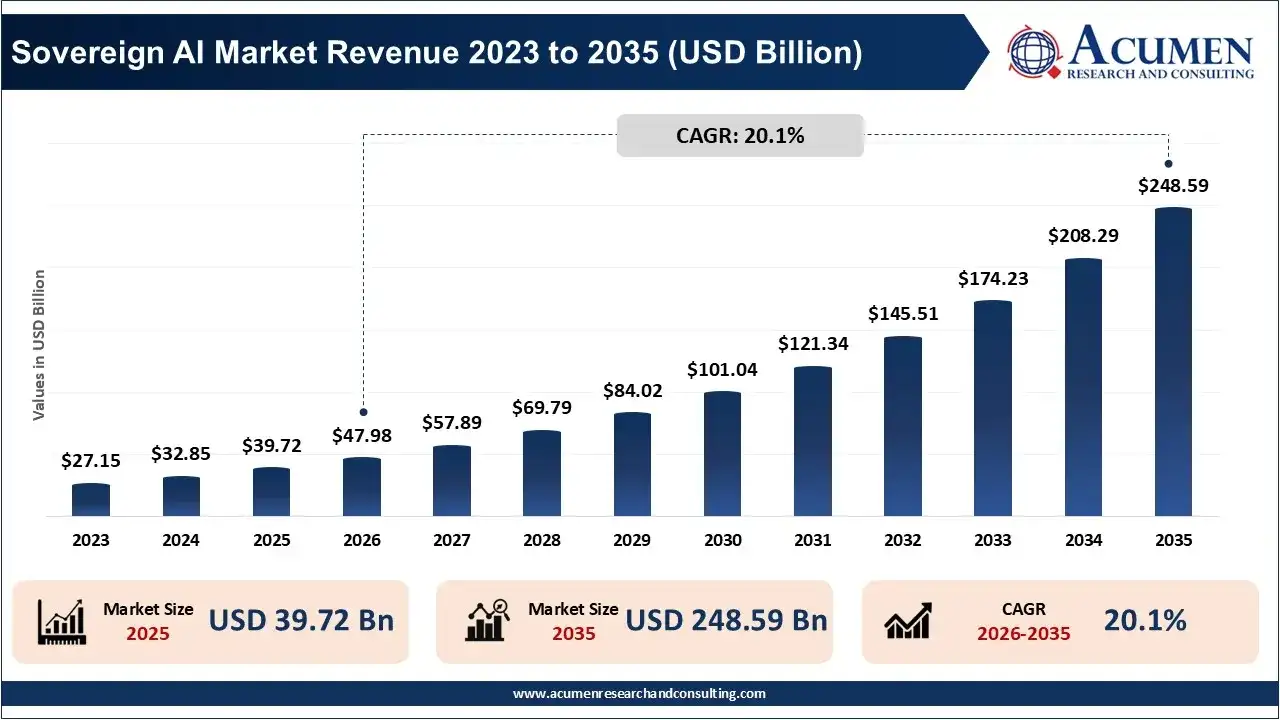
Sovereign AI market includes the globally increasing drive among governments, organizations, and strategists to exert increased control over AI technologies; sovereign AI is considered the infrastructure, hardware ( computing capacity ,data), artificial neural systems (models, software and operating capabilities) that build and drive AI applications while answering the needs that any nation-state requires such as data residency laws , cybersecurity, compliance and national security, and of course tech-related independence.
The market's significance rises as of late with generative AI technology coupled with powerful High-Performance Computing (HPC) demand advanced GPUs, datacenters, cloud access, chip-making infrastructure, and energy-infrastructure capabilities. Therefore, the nations around the globe have begun increased investment in their domestic AIs, sovereign cloud solutions, indigenous computer infrastructure and locally-developed AI technologies, while in parallel tech suppliers develop alliances designed to deliver nation-specific solutions.
What Are the Emerging Trends Reshaping Sovereign AI?
- Shift toward sovereign AI factories: Governments are increasingly developing dedicated AI factories that integrate computing, networking, storage, AI software and energy infrastructure within national or regional jurisdictions.
- Rapid expansion of sovereign cloud: Sovereign cloud is gaining traction as governments and enterprises seek scalable AI computing while maintaining control over data residency, jurisdiction, security and operational access.
- Growth of domestic foundation models: Countries are investing in locally developed large language models and domain-specific AI systems to reduce dependence on foreign model providers and support local languages, regulations and national priorities.
- AI infrastructure becoming a strategic national asset: GPUs, AI servers, data centers, high-performance computing systems, networking and power infrastructure are increasingly being treated as strategic infrastructure rather than conventional IT assets.
- Localization of AI semiconductor supply chains: Governments are encouraging domestic AI-chip design, semiconductor manufacturing, advanced packaging and related supply-chain capabilities to reduce exposure to geopolitical disruptions and export restrictions.
Government Sovereign AI Strategies by Country
| Country | Sovereign AI strategy | Strategic objective |
|---|---|---|
| United States | The U.S. is strengthening sovereign AI capabilities through domestic AI infrastructure, advanced semiconductor manufacturing, national-security AI programs and large-scale private-sector investment in computing capacity. | Maintain global AI leadership while reducing strategic vulnerabilities across critical AI infrastructure and technology supply chains. |
| China | China is pursuing AI self-reliance by accelerating domestic AI-chip development, semiconductor manufacturing, foundation models and national computing infrastructure while reducing dependence on foreign technology. | Build an increasingly self-sufficient AI ecosystem capable of supporting national economic and strategic objectives despite technology restrictions. |
| India | India is developing sovereign AI capabilities through national AI compute infrastructure, indigenous AI models, semiconductor initiatives and government-backed AI programs designed to expand domestic access to advanced computing. | Establish a competitive domestic AI ecosystem while improving access to affordable and locally controlled AI infrastructure. |
| France | France is pursuing AI sovereignty through investment in domestic computing infrastructure, AI data centers, European AI models and strategic technology capabilities while emphasizing data protection and technological independence. | Strengthen national and European technological autonomy and reduce dependence on non-European AI infrastructure and platforms. |
| South Korea | South Korea is building sovereign AI capabilities through investments in domestic AI compute, advanced semiconductors, national AI models and large-scale infrastructure partnerships involving government and technology companies. | Leverage its semiconductor and technology strengths to establish a competitive national AI ecosystem and strengthen technological resilience. |
Sovereign AI Market Regional Outlook
How Is North America Maintaining Its Leadership in the Sovereign AI Market?
North America dominated sovereign AI market in 2025 with 38.90% market share, contributing to revenue of $18.66 billion in 2026 and estimated to continue be the leading regional market until 2035 with 31% of market share. Its sovereign AI market is predicted to reached to US$77.06 billion by 2035, growing at a 17.1% CAGR between 2026 and 2035. This significant growth will be led by the United States as the frontrunner in AI chips, hyperscale data centers, cloud infrastructure, foundation models and national-security AI, coupled by increasing preference of Canada towards homegrown compute infrastructure.
In this context, the reign in North America region is being further buttressed by governments acknowledging AI infrastructure as their strategic national infrastructure. For instance, U.S. is moving to enhance secure HPC for nation-security objectives, while Canada is investing $700 million in commercial AI compute capacity as well as $1 billion into public supercomputing infrastructure.
- United States: Remains the leading sovereign AI country in North America, supported by its dominant AI chip ecosystem, hyperscale cloud providers, advanced data centers, foundation-model developers and substantial private-sector investment in AI infrastructure.
- Canada: The government is also prioritizing Canadian ownership and control of AI infrastructure, with its national AI strategy emphasizing domestic compute, cloud infrastructure, AI talent and Canadian-controlled data environments.
Why Is Asia-Pacific Becoming a Major Sovereign AI Growth Center?
Asia Pacific had a 21.20% sovereign AI market share in 2025, it’s the second largest market by region but its share will grow to 28.00% by 2035. The fast adoption of sovereign AI is encouraged by a combination of national AI roadmaps, semiconductor localization drives, sovereign cloud investment and massive datacentre plans by countries and their commitment to move away from foreign AI providers.
Japan is focused on semiconductor and AI infrastructure improvements, South Korea on its own AI compute and semiconductor capacity while India and China have a variety of technological independence roadmaps in play to foster their own national AI ecosystems.
In example Japanese Kioxia and SanDisk in August 2026 committed to spend over $31 billion in Japan through 2032 to support growing memory and semiconductor output due to AI based demands on hardware.
- India: India is advancing sovereign AI through the IndiaAI Mission, with a focus on expanding domestic compute capacity, developing indigenous foundation models, strengthening AI semiconductor capabilities and supporting AI applications across government and strategic industries.
- Japan: Japan is strengthening sovereign AI capabilities through investments in advanced semiconductors, AI computing infrastructure, domestic AI development and high-performance computing, while leveraging its strengths in robotics, electronics and advanced manufacturing to reduce strategic technology dependencies.
Top Players in Sovereign AI Market
The sovereign AI market features a diverse competitive landscape spanning AI accelerator providers, hyperscale cloud platforms, AI infrastructure companies, semiconductor manufacturers, sovereign AI specialists and foundation-model developers. Key players include NVIDIA, Microsoft, Amazon Web Services (AWS), Alphabet (Google), IBM, Oracle, Hewlett Packard Enterprise (HPE), Dell Technologies, Cisco Systems, Intel, AMD, Huawei Technologies, Alibaba Cloud, G42, Mistral AI, Cerebras Systems, SambaNova Systems, Atos, SAP, and Lenovo, with each company participating in different layers of the sovereign AI ecosystem, including AI chips, sovereign cloud, high-performance computing, data centers, networking, AI platforms and locally controlled foundation models.
Segments Covered in the Report
By Sovereignty Architecture
- Data Sovereignty
- Infrastructure Sovereignty
- Model Sovereignty
- Platform/Operational Sovereignty
- End-to-End Sovereignty
By Component
- Hardware
- Software
- Services
By Deployment
- On-Premises
- Sovereign Cloud
- Hybrid
By AI Technology/AI Workload
- Generative AI
- Predictive AI
- Computer Vision
- Natural Language AI/Speech AI
- Autonomous AI
- Other AI
By Application
- Government & Public Services
- Defense & National Security
- Healthcare
- Financial Services
- Critical Infrastructure
- Manufacturing & Industrial
- Telecommunications
- Enterprise & Other
By Region
- North America
- Europe
- Asia-Pacific
- Latin America
- Middle East & Africa
Contact Us:
Mr. Richard Johnson
Acumen Research and Consulting
India: +91 8983225533