
U.S. Physical AI Market Size to Attain USD 27,275 Million by 2035 | CAGR of 31.7%
Published : 11 Aug 2026
Author : Raghuram Nair



What is the U.S. Physical AI Market Size?
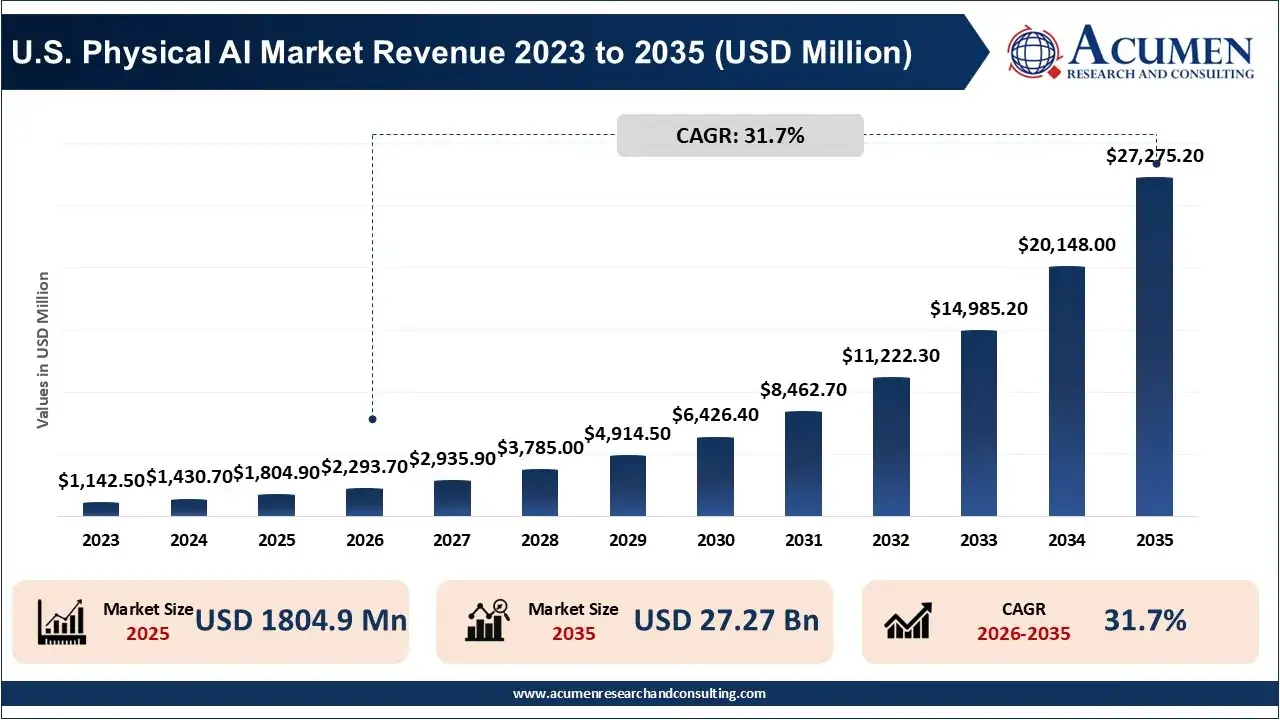
The U.S. physical AI market size reached at USD 1,809 million in 2025 and is projected to attain USD 27,275 million by 2035; growing at a CAGR of 31.7% over the forecast period from 2026 to 2035. Driven by rapid investments in artificial intelligence, robotics, autonomous systems, and advanced computing infrastructure, the U.S. physical AI market is expanding as businesses increasingly deploy intelligent machines capable of interacting with real-world environments.
U.S. Physical AI Market Overview
The United States put about 34,200 industrial robots in place in 2024, which was roughly 68% of all the robots installed throughout the Americas that year, leaving a large installation base for AI powered machines. Physical AI involves embedding artificial intelligence within physical robots and machine systems which use sensors and computer vision to sense the physical world, Artificial intelligence models to reason on this data, and autonomous movement capabilities using control hardware and robotic actuators.
The market encompasses AI-enabled industrial robots, humanoid robots, autonomous mobile robots, service robots, autonomous vehicles, drones, and other intelligent machines, along with the hardware, software, computing infrastructure, and services required to develop and operate these systems. In the U.S., adoption is particularly concentrated across manufacturing and automotive, logistics and warehousing, healthcare, defense, and other industries seeking greater automation, operational flexibility, precision, and autonomous decision-making.
Future Outlook of U.S. Physical AI Market
- Humanoid robotics is expected to become a major growth area, with U.S. companies increasingly moving humanoid platforms from research and pilot projects toward manufacturing, logistics, and commercial applications.
- Industrial physical AI adoption is expected to deepen, as manufacturers move from conventional programmed robots toward adaptive systems capable of autonomous inspection, manipulation, production optimization, and predictive maintenance.
- Edge AI will remain strategically important, particularly for robots and autonomous machines that require real-time decisions, low latency, continuous operation, and localized data processing.
- Foundation models will increasingly power physical AI, enabling robots to combine vision, language, spatial reasoning, planning, and action instead of relying on task-specific programming.
- AI infrastructure investment will continue expanding, with large-scale data centers, AI accelerators, networking infrastructure, and high-performance computing becoming critical foundations for training and simulating physical AI systems.
- Digital twins and simulation-based development will gain wider adoption, allowing companies to train robots, test environments, and optimize physical AI workflows virtually before deploying them in factories, warehouses, and other real-world settings.
- Physical AI adoption will expand beyond manufacturing, with healthcare, logistics, defense, retail, agriculture, construction, and hospitality becoming increasingly important application areas.
AI Infrastructure Investment Landscape
| Company / Initiative | Recent Investment / Scale | AI Infrastructure Focus |
|---|---|---|
| Stargate Project | Up to USD 500 billion over four years | Large-scale U.S. AI data centers and computing infrastructure |
| Amazon Web Services (AWS) | Up to USD 50 billion; nearly 1.3 GW of additional capacity planned | AI and high-performance computing infrastructure for U.S. government customers |
| OpenAI–Oracle Stargate | 4.5 GW of additional data-center capacity | AI data-center expansion using more than 2 million chips |
| NSF Integrated Data Systems and Services | USD 83 million announced in July 2026 | AI-ready scientific data infrastructure and computing access |
| NSF AI-Programmable Cloud Laboratories | USD 380 million from NSF, plus more than USD 20 million philanthropic matching | Nationwide AI-enabled automated laboratory network |
| U.S. DOE–Brookfield and energy partners | More than USD 100 billion private investment | Data-center campus and associated energy infrastructure in Kentucky |
Which Industries Will Generate the Highest ROI from Physical AI?
- Manufacturing & Automotive – The highest ROI is expected with physical AI, improving assembly, quality assessment, material handling, predictive maintenance, and the optimizing of production lines. The automation at scale that can be achieved due to high robot utilization and their repetitive work cycles.
- Logistics & Warehousing – Autonomous robots, smarter picking, automatic sorters, intelligent warehouse movement, and optimized warehouse routing are ideal applications where physical AI can yield a robust ROI.
- Healthcare – Autonomous medical devices such as surgical robots, rehabilitation robots, hospital inventory robots, and assisted elderly-care robots can provide impressive ROI through a combination of operational gains and optimized patient care.
- Defense & Security – High ROI could be achieved with autonomous drones or ground based unmanned systems and other tactical robots including intelligence-gathering drones or surveillance systems, as these can perform high risk tasks safely and reduce resource needs.
- Retail & Hospitality – AI is going to be widely deployed to make restaurant, hotel, retail store, and other multi-unit service providers smarter through robotic staff, delivery services, cleaning operations, or AI backed customer service interactions in hotels etcetera.
- Agriculture – Investment returns can be very high through intelligent robots and devices which perform farm duties such as autonomous harvesting, precision sprayers and crop monitoring robots that offer automation benefits in labor intensive roles.
- Energy & Utilities – Maintenance robots which allow them to access hard to reach areas, perform automated inspections of pipeline equipment and provide increased worker safety can be very important.
How are Companies Investing in U.S. Physical AI Market?
Collaboration is a key characteristic of the U.S. physical AI market. Collaboration between AI developers, robotic companies, cloud providers and industrial automation firms is seen. Many players are making large investments on AI foundation models, humanoid robots, edge AI computation, simulation platform and intelligent automation solutions in response to accelerate physical AI commercialization.
Companies such as NVIDIA, Tesla, Google DeepMind, Microsoft, Amazon Robotics, Boston Dynamics, Figure AI and Rockwell are demonstrating technology leadership by means of partnership, Product launching and the large scale investment on robotics research and AI infrastructure.
Technologies like industrial robots, humanoid robot, warehouse automation, AMRs, AI computing solution and digital twin have enabled the intelligent machines to perceive, reason and act as well as to execute complex tasks in the various domain as industry manufacturing, logistics, healthcare, automobile, retail and enterprise.
The increased investment on multi-modality AI models, robotics software, automatic control system, cloud-edge computation will see higher and higher competition in the future in driving the physical AI adoption.
Segments Covered
By Deployment
- Cloud-based AI
- On-device AI
By Component
- Hardware
- Software
- Services
By Technology
- Computer Vision
- Speech / Natural Language Processing (NLP)
- Gesture / Movement Recognition
- Reinforcement Learning & Control Systems
- Others
By Robot Type / Form Factor
- Industrial Robots
- Service Robots
- Humanoids / Social Robots
- Cobots
- Exoskeletons / Prosthetics
- Mobile Robots / Drones
By Application
- Manufacturing & Automotive
- Healthcare
- Logistics & Warehousing
- Retail & Hospitality
- Defense & Security
- Agriculture
- Education & Research
- Others
Contact Us:
Mr. Richard Johnson
Acumen Research and Consulting
India: +91 8983225533