
Data Center Cooling Market Size to Reach USD 106.72 by 2035, Growing at a CAGR of 17.8%
Published : 16 Oct 2026
Author : Raghuram Nair



What is the Data Center Cooling Market Size?
The global data center cooling market size was valued at USD 20.60 billion in 2025 and is observed to reach at USD 106.72 by 2035 from USD 24.42 in 2026; growing at a CAGR of 17.8% during the forecast period of 2026-2035. North America led the market in 2025, while Asia-Pacific is projected to record the fastest regional growth through 2035 as data center operators invest in cooling systems for increasingly demanding computing workloads.
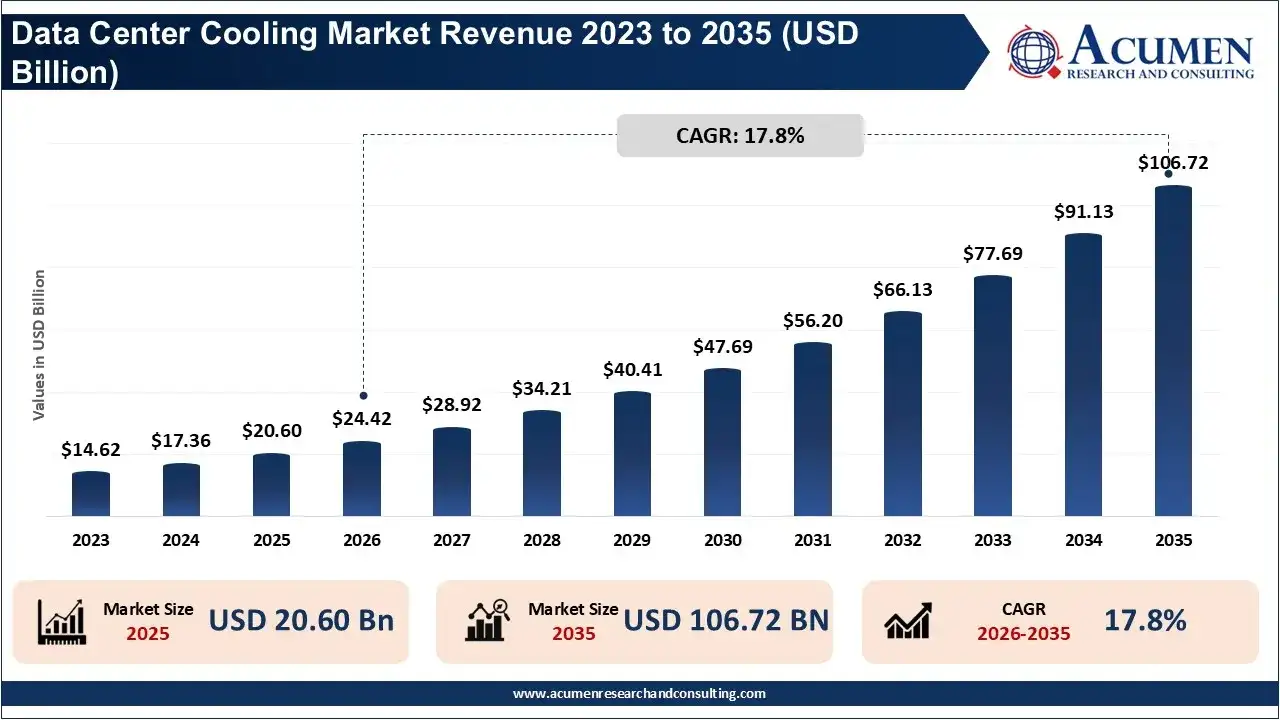
Data Center Cooling Market Outlook
The worldwide data center cooling market is garnering traction as cloud computing, AI and modernization of digital infrastructure demands robust and energy-efficient data center thermal management. Data center management providers are making inroads into traditional air-based cooling systems in response to mounting rack power densities and is further fueling the transition to liquid cooling applications.
Much of the market is driven by multiple interlinked trends: hyperscale vendors are increasing the amount of computing available, AI application workloads are creating higher-heat densities at the rack level, and new data center builds are designing cooling capacity into their facilities earlier in their development cycles. As such, the industry is looking for cooling systems that can handle high-heat densities while delivering reliable energy efficiency.
AI Workloads and Higher Rack Densities Influence Cooling Strategies
The growing concentration of computing power within data center racks is changing cooling requirements across new and existing facilities. AI servers and other high-performance computing systems generate significant heat, making effective thermal management important for equipment performance and operational reliability.
Direct-to-chip liquid cooling is gaining attention because it transfers heat from processors and other components into a liquid-based cooling system. Single-phase liquid cooling also maintains a strong position, supported by its established implementation and relatively straightforward fluid management.
At the same time, investments in new data center facilities are creating opportunities for cooling systems designed around modern computing requirements. Retrofitting existing facilities remains another area of demand as operators seek to support more powerful hardware within established infrastructure.
North America Leads as Asia-Pacific Records the Strongest Growth Outlook
North America held the largest share of 40.0% in 2025 in the data center cooling market. The region's leading share can be attributed to the existing data center infrastructure, significant hyperscale cloud investment, and rising requirement of efficient cooling solutions for handling high-density computing workloads.
Asia-Pacific is predicted to be the fastest-growing regional market, with a CAGR of 20.4% in the forecast period from 2026 to 2035. Asia-Pacific market size was valued at USD 6.84 billion in 2026 and is projected to reach USD 36.28 billion by 2035. The share of global demand in Asia-Pacific is estimated to expand from 28.0% in 2025 to 34.0% by 2035.
The region's digital infrastructure growth and increased need for data center capacity underpin this forecast. As operators invest in data centers to host cloud and AI workloads, there will be a growing need to install cooling equipment able to support higher computing densities.
Data Center Cooling Market Segmental Outlook
| Market Segment | Leading Segment | Market Share in 2025 | Key Growth Factor |
|---|---|---|---|
| By Component | Solutions | 72% | Demand for cooling systems, fluid handling equipment, cooling fluids, and monitoring technologies |
| By Cooling Technology | Direct-to-chip liquid cooling | 48% | Direct heat removal from processors and other high-performance components |
| By Cooling Mechanism | Single-phase liquid cooling | 64% | Established implementation and relatively straightforward fluid management |
| By Data Center Type | Hyperscale and cloud data centers | 41% | Expansion of cloud infrastructure and AI computing workloads |
| By Rack Power Density | 50 to below 100 kW per rack | 31% | Increasing rack power requirements and concentrated heat loads |
| By Deployment Type | New-build data centers | 58% | Purpose-built facilities designed for modern cooling architectures |
| By End-Use Industry | IT and telecommunications | 41% | Growing data traffic, cloud adoption, and digital service delivery |
Emerging Trends
Liquid cooling is becoming more and more popular among data center operators as they introduce ever more powerful chips and higher power densities in their racks. In the meantime, direct-to-chip solutions provide a method to route the heat into a liquid cooling system. Single phase liquid cooling solutions are well known.
Cooling requirements are also becoming a more integral part of data center planning. Developers of new facilities can incorporate cooling infrastructure, rack layouts, and thermal management systems into the original design, helping align cooling capacity with expected computing workloads. This supports demand for cooling solutions designed for modern hyperscale and AI-focused facilities.
The other developing trend is the adoption of monitoring and control systems with the cooling infrastructure. Through sensors, software, and automated controls, operators can monitor temperatures and troubleshoot when there is a cooling deficiency, adjusting cooling performance according to the workload. This is increasingly important for operators as they seek visibility into their facilities.
Future Outlook
The data center cooling market is entering a period in which thermal management is increasingly connected to decisions about computing capacity, facility design, and operational efficiency. The rise of AI infrastructure is bringing greater attention to liquid cooling, while continued cloud expansion supports investment in cooling systems across hyperscale facilities and other data center environments.
Future market development will depend on the pace of data center construction, the adoption of higher-density computing systems, and the ability of cooling technologies to meet evolving operational requirements. Cost, energy use, retrofit complexity, and system compatibility will also influence purchasing decisions as operators compare cooling options for new and existing facilities.
As computing workloads continue to evolve, providers of data center cooling solutions are positioned to play an important role in helping operators manage heat, maintain equipment reliability, and accommodate changing infrastructure needs.
Segments Covered in the Report
By Component
- Solutions
- Cooling Systems & Equipment
- Coolant Distribution & Fluid Handling Equipment
- Cooling Fluids
- Monitoring & Control Systems
- Other Components
- Services
- Design & Consulting
- Installation & Deployment
- Maintenance & Support
- Managed Cooling Services
- Other Services
By Cooling Technology
- Direct-to-Chip Liquid Cooling
- Immersion Cooling
- Single-Phase Immersion Cooling
- Two-Phase Immersion Cooling
- Rear-Door Heat Exchanger (RDHx) Cooling
- Other Liquid Cooling Technologies
By Cooling Mechanism
- Single-Phase Liquid Cooling
- Two-Phase Liquid Cooling
By Data Center Type
- Hyperscale & Cloud Data Centers
- Colocation Data Centers
- Enterprise Data Centers
- Edge & Distributed Data Centers
- Other Data Centers
By Rack Power Density
- Below 20 kW/Rack
- 20 to less than 50 kW/Rack
- 50 to less than 100 kW/Rack
- 100 to less than 200 kW/Rack
- 200 kW/Rack and Above
By Deployment Type
- New-Build Data Centers
- Retrofit / Existing Data Centers
By End-Use Industry
- IT & Telecommunications
- Banking, Financial Services & Insurance (BFSI)
- Healthcare & Life Sciences
- Government & Public Sector
- Manufacturing
- Others
By Region
- North America
- Europe
- Asia-Pacific
- Latin America
- Middle East & Africa
Contact Us:
Mr. Richard Johnson
Acumen Research and Consulting
India: +91 8983225533