
Industrial AI Market Size to Expand USD 326.72 Billion by 2035, Reflecting a CAGR of 25%
Published : 07 Oct 2026
Author : Simone Lamb



What is the Industrial AI Market Size?
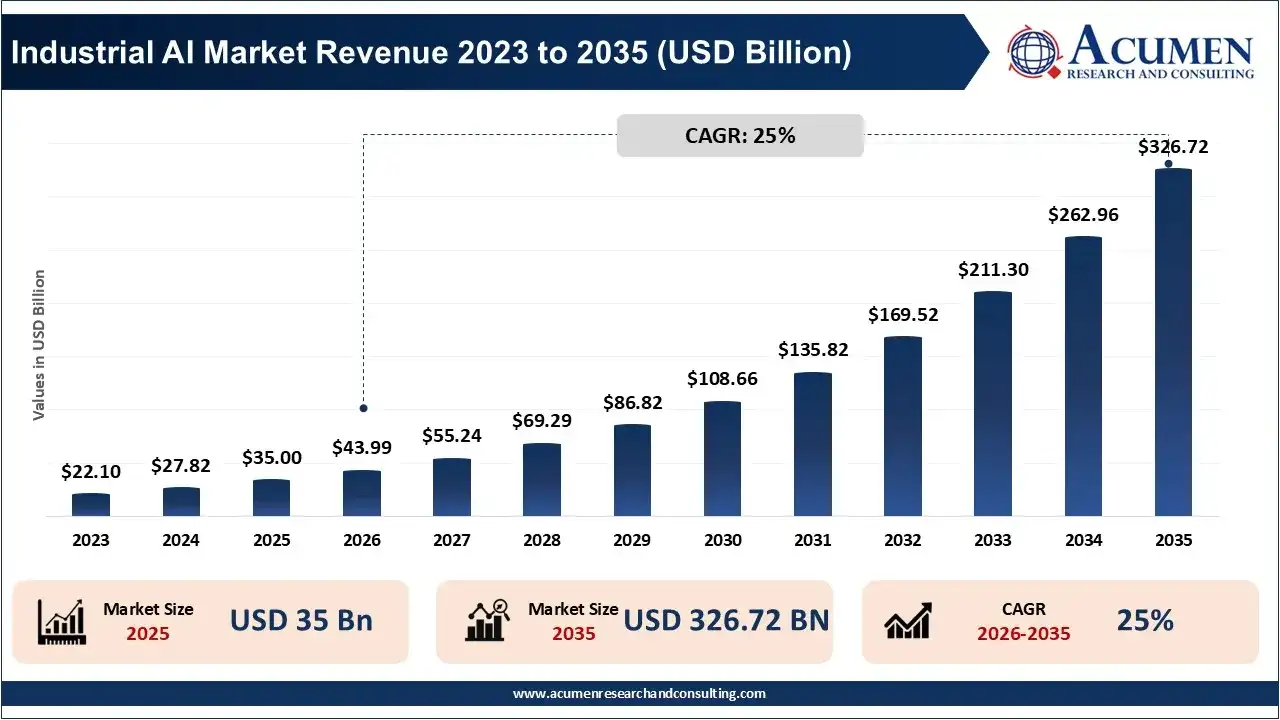
The global industrial AI market size was accounted for USD 35 billion in 2025 and is expected to expand around USD 326.72 billion by 2035; growing at a CAGR of 25% over the forecast period of 2026 to 2035.
Where Is Industrial AI Creating Value Inside the Factory?
Industrial AI is creating value across the factory lifecycle by connecting operational data with software, analytics, automation, and decision-support systems. Its role is expanding beyond isolated predictive maintenance applications into production planning, quality control, process optimization, energy management, supply-chain coordination, and robotics. This broader deployment allows manufacturers to use AI not only to identify operational problems but also to continuously evaluate production conditions and support faster, data-driven decisions.
For example, AI-powered computer vision can analyze production-line images to identify defects in real time, while predictive models can assess equipment data to identify potential maintenance requirements before an unplanned shutdown occurs.
Industrial AI Market: What Are Manufacturers Spending On?
- AI-Powered Quality Inspection: Manufacturers are investing in computer vision and AI inspection systems to identify defects, inconsistencies, and production anomalies faster than conventional manual inspection. These technologies can support continuous monitoring across production lines while generating structured quality data for process improvement.
- Predictive Maintenance: Industrial organizations are deploying AI models that analyze equipment conditions, sensor readings, and historical maintenance information to anticipate potential failures. Investment in predictive maintenance is focused on reducing unplanned downtime, improving asset utilization, and enabling maintenance teams to prioritize interventions.
- Industrial Data Platforms: Manufacturers are increasing investment in platforms that collect, organize, and contextualize data from machines, sensors, enterprise systems, and production environments. These platforms provide the data foundation required for AI models, analytics, digital twins, and increasingly sophisticated industrial decision-making.
- Edge AI Infrastructure: Investment in edge computing is increasing where manufacturers require rapid processing close to production equipment. Edge AI can reduce latency, limit unnecessary data transfers, and support real-time monitoring and decision-making for machines, quality systems, robotics, and other factory-floor applications.
- AI-Enabled Robotics: Manufacturers are directing investment toward robots capable of using computer vision, machine learning, and contextual information to perform increasingly adaptive tasks. The objective is shifting from fixed automation toward systems that can respond to variable production conditions and support more flexible manufacturing.
Industrial AI Market Segmental Outlook
| Segment | Leading Segment | 2025 Share | Key Driver |
|---|---|---|---|
| By Offering | Software | 49% | Growing demand for AI platforms, analytics, model management, and software-defined automation is supporting the leading position of industrial AI software. |
| By AI Technology | Predictive & Analytical AI | 34% | Established applications in predictive maintenance, anomaly detection, production optimization, and forecasting continue to support adoption of predictive and analytical AI. |
| By Deployment | On-Premises | 47% | Requirements for low-latency processing, operational control, data security, and proximity to industrial assets support on-premises deployment. |
| By Enterprise Size | Large Enterprises | 78% | Larger asset bases, extensive operational datasets, multiple production facilities, and greater technology investment capacity support adoption among large enterprises. |
| By Industry | Manufacturing | 52% | Highly instrumented production environments and extensive applications across process optimization, quality inspection, robotics, and predictive maintenance support manufacturing adoption. |
Industrial AI Market: What Will the Factory of 2030 Look Like?
- AI-Native Production Lines: Factories are expected to increasingly embed AI directly into production workflows, allowing machines, quality systems, and industrial software to continuously interpret operational information and adjust recommendations based on changing production conditions.
- Human-AI Industrial Teams: Factory workers and engineers are likely to work alongside industrial copilots that can retrieve machine information, explain abnormalities, summarize production data, and recommend troubleshooting actions, creating a more accessible interface between employees and increasingly complex industrial systems.
- Self-Optimizing Operations: Industrial AI could increasingly connect production, quality, maintenance, and energy information to identify relationships across factory operations. This could allow manufacturers to continuously optimize processes rather than treating each operational function as an isolated source of data.
- Simulation Before Physical Deployment: Digital twins are expected to become more deeply connected with AI models, allowing manufacturers to simulate production changes, evaluate potential bottlenecks, and test engineering decisions virtually before modifying physical equipment or factory configurations.
Industrial AI Market: Regional Adoption Is Becoming More Factory-Specific
North America Industrial AI Market
North America led the industrial AI market with a 36% share in 2025, supported by mature industrial automation, strong computing and cloud infrastructure, substantial enterprise technology spending, and relatively early adoption of artificial intelligence across industrial operations. The region also benefits from a developed ecosystem of industrial software providers, semiconductor companies, cloud platforms, automation vendors, and advanced manufacturers.
Industrial AI adoption in North America is increasingly moving toward connected factory environments rather than isolated analytics deployments. Manufacturers are investing in predictive maintenance, computer vision, robotics, digital twins, edge computing, and industrial data platforms. The region's strong technology ecosystem also supports collaboration between AI infrastructure providers and industrial companies, accelerating the transition from experimentation toward production-scale deployment.
- United States: The U.S. leads the regional market, supported by advanced manufacturing capabilities, strong investment in AI and computing infrastructure, established industrial automation, and a large ecosystem of technology and industrial software companies.
Asia-Pacific Industrial AI Market
Asia-Pacific accounted for 32% of the industrial AI market in 2025 and is projected to reach 38% by 2035, registering a 27.4% CAGR from 2026 to 2035. The region's expansion is closely linked to its manufacturing concentration, rapid industrial automation, expanding electronics and semiconductor production, and increasing investment in smart-factory infrastructure.
Manufacturers across Asia-Pacific are increasingly using AI to address production efficiency, quality control, equipment reliability, and workforce productivity. The region's large-scale automotive, electronics, machinery, semiconductor, and consumer-goods manufacturing base creates significant opportunities for AI deployment across highly instrumented production environments. Growing adoption of robotics and industrial connectivity is also creating the infrastructure required for more advanced AI applications.
- China: China represents a leading country-level market, supported by its large manufacturing base, extensive industrial automation, growing robotics deployment, and continued investment in smart manufacturing and artificial intelligence.
Industrial AI Market Key Companies
The Industrial AI market includes a broad ecosystem of technology, automation, industrial software, and computing companies. Siemens, NVIDIA, Microsoft, IBM, Schneider Electric, Rockwell Automation, Honeywell, ABB, Emerson, PTC, SAP, Google, Amazon Web Services, Intel, and Bosch are among the significant companies shaping the market. Their importance spans different layers of the Industrial AI ecosystem, including industrial automation, AI computing infrastructure, cloud platforms, digital twins, industrial software, edge computing, enterprise data management, predictive analytics, and connected factory technologies.
Industrial AI Market Key Breakthroughs
- In January 2026, Siemens and NVIDIA announced an expanded partnership focused on building an industrial AI ecosystem, including AI-native simulation, adaptive manufacturing, digital twins, and industrial AI infrastructure. The collaboration illustrates the industry's movement toward combining industrial software, simulation, AI computing, and real-world factory data.
- In April 2026, Siemens introduced its AI-ready Industrial Automation DataCenter, designed to bring accelerated AI computing and industrial automation capabilities closer to production environments. The development highlights growing interest in localized industrial computing infrastructure for AI workloads requiring connectivity, cybersecurity, and low-latency processing.
Segments Covered in the Report
By Offering
- Hardware
- AI Accelerators & Computing Hardware
- Industrial Edge AI Hardware
- AI-Enabled Machine Vision Hardware
- AI-Enabled Sensors & Data Acquisition Hardware
- Other Industrial AI Hardware
- Software
- Industrial AI Platforms
- Packaged Industrial AI Applications
- AI Development & Model Management Software
- Other Industrial AI Software
- Services
- Consulting & Advisory Services
- Implementation & Systems Integration Services
- AI Model Development & Training Services
- Support & Maintenance Services
- Managed Industrial AI Services
- Other Services
By AI Technology
- Predictive & Analytical AI
- Vision AI
- Language & Conversational AI
- Generative & Foundation-Model AI
- Decision Optimization & Reinforcement AI
- Other Industrial AI Technologies
By Deployment
- On-Premises
- Cloud
- Hybrid
By Enterprise Size
- Large Enterprises
- Small & Medium Enterprises (SMEs)
By Industry
- Manufacturing
- Energy & Utilities
- Oil & Gas
- Mining & Metals
- Transportation & Logistics
- Construction & Infrastructure
- Others
By Region
- North America
- Europe
- Asia-Pacific
- Latin America
- Middle East & Africa
Contact Us:
Mr. Richard Johnson
Acumen Research and Consulting
India: +91 8983225533