
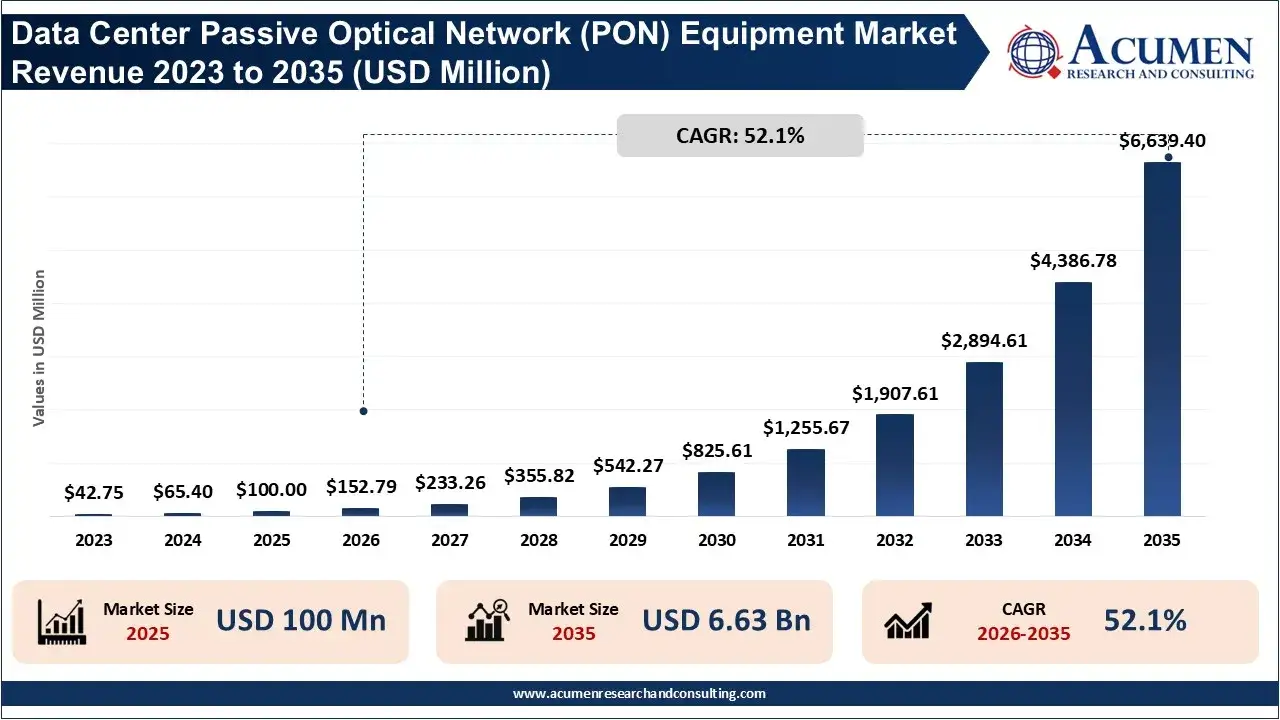
Data Center PON Equipment Market Size to Reach USD 6,639.40 Million by 2035; Growing at a CAGR of 52.1%
Published : 22 Sep 2026
Author : Lucas Hoffmann



What is the Data Center PON Equipment Market Size?
The global data center passive optical network (PON) equipment market size was accounted for USD 100 million in 2025 and is anticipated to surpass USD 6,639.40 million by 2035; growing at a strongest CAGR of 52.1% during the forecast period of 2026-2035. The growing deployment of AI and hyperscale data centers is accelerating demand for scalable, power-efficient, and simplified optical management architectures, creating new opportunities for PON-based data center connectivity.
How Does Passive Optical Networking Work Inside a Data Center?
A PON-style architecture in the data center connects an OLT in a centralized location with multiple hosts, servers, other network devices, management systems and other endpoints via passive optical splitters. In the datacenter, PON is especially interesting in out-of-band management (OOBM), where a separate connectivity system allows an operator to monitor, troubleshoot, provision and recover systems even when the main production network is down.
As hyperscale and AI-ready datacenters scale out their servers and infrastructure densities, operators and architects alike are paying closer attention to how PON can provide a scalable and manageable solution to endpoints while also reducing power consumption, cabling and rack space, and maintenance and management complexity.
Segmentation Highlights
| Segmentation | Dominant Segment | 2025 Market Share | Key Factors Supporting Dominance |
|---|---|---|---|
| By Equipment Type | PON ONTs/ONUs and Optical Modems | 55% | Their role as endpoint-level devices connecting servers and managed equipment to centralized PON infrastructure supports widespread deployment across data center environments. |
| By PON Technology | XGS-PON | 55% | Higher capacity than legacy GPON and suitability for increasingly demanding data center management networks support its leading position. |
| By Application | Out-of-Band Management (OOBM) | 88% | Growing requirements for independent connectivity for monitoring, troubleshooting, and recovery of critical infrastructure drive strong adoption. |
| By Data Center Type | Hyperscale Data Centers | 50% | Point-to-multipoint PON architecture is well suited to managing large numbers of endpoints across extensive hyperscale facilities. |
| By Deployment Architecture | Dedicated PON OOBM | 65% | Demand for independent management networks that remain accessible during primary production-network failures supports its dominance. |
| By Endpoint Type | Servers | 50% | The large number of server endpoints requiring continuous remote monitoring, troubleshooting, and out-of-band management drives adoption. |
Where Are Data Center Operators Investing in PON Infrastructure?
Operators are investing in PON at facilities where they need flexible, resilient, and energy-efficient connectivity to manage the underlying infrastructure. The biggest opportunities for deploying PON are emerging at hyperscale and colocation facilities, including for out-of-band management, where PON provides an alternate management path along with reduced active networking gear and cabling complexity. For example, hyperscale operators can use PON for out-of-band management to ensure reliable remote access to equipment when the production network is offline.
As AI-focused data centers are built out with even denser infrastructure, operators are exploring PON solutions. For example, the numerous GPU-equipped servers at an AI data center can be served by a separate optical management network to allow for non-intrusive troubleshooting and monitoring when the high-performance network is down.
What Opportunities Are Emerging From the Shift Toward AI-Ready Data Centers?
The transition toward AI-ready data centers is creating opportunities for PON equipment manufacturers as operators seek to accommodate higher rack densities, larger endpoint populations, greater infrastructure complexity, and stricter power requirements. Although PON is not a replacement for high-performance AI interconnect technologies, its role in management connectivity creates a distinct opportunity around the supporting infrastructure required to operate large AI facilities.
- For instance: A dedicated PON OOBM network can provide remote access to AI server management interfaces when the primary production network encounters a fault.
Data Center Passive Optical Network (PON) Equipment Market Regional Outlook
North America accounted for the largest share 55% of the data center PON equipment market in 2025, driven by the region's large hyperscale, cloud, colocation, and AI data center footprint. In particular, North America has a high density of large cloud and technology companies, which is fueling investments in greater rack density and higher density, more scalable network architectures.
As rack densities and interconnect levels grow for AI workloads, data center operators are looking more and more at optical architectures to streamline infrastructure and lower costs while providing reliable management connectivity.
PON is gaining popularity for out-of-band management and infrastructure management applications because the point-to-multipoint architecture allows for a reduction in active switching gear and cable counts.
- As the leading market in North America, the U.S. has the largest concentration of hyperscale cloud operators, AI infrastructure providers, colocation providers and large enterprise data centers.
- Growing adoption of AI computing creates the need for scalable network infrastructure, while increasing demand on data center operators to contain power, cooling, cabling and operational costs.
- This leaves U.S. well-positioned for PON-based out-of-band management passive optical distribution can replace some of the active switching in today's data center management fabric. The U.S. remains a key source for innovation in optical networking and investments in AI infrastructure.
Asia-Pacific will be the fastest growing regional market, with its share rising from 18% in 2025 to 27% in 2035, a CAGR of 59.1% from 2026 to 2035. The expanding availability of hyperscale and colocation data centers, growing usage of cloud, digitalization and AI, the deployment of more fiber-optic infrastructure, and investments in new fiber are positive drivers for the adoption of data center PONs.
China, Japan, South Korea, India, Singapore, and other regional markets are actively expanding their digital infrastructure, which, coupled with increasing data traffic, is driving the demand for higher-capacity and energy-efficient connectivity. The wider PON market is already well-established in Asia-Pacific for FTTx, with data center applications being explored as an additional opportunity beyond broadband deployments.
- China is a key market for the growth of PON technology in Asia-Pacific with its mature fiber infrastructure, broadening digital ecosystem, early adoption of cloud computing, and continued investments in digital infrastructure.
- China is experienced in deploying PON technology for telecom, network access and fiber-to-the-room scenarios, with a mature technology and supply chain base that can support the expansion to enterprise and data center markets.
- Chinese providers also continue to launch large volumes of optical network equipment while data center operators seek to optimize infrastructure complexity and energy efficiency.
Technology Roadmap
- Rise of XGS-PON for OOBM: PON will continue to be important for data center out-of-band management, due to its higher capacity, mature ecosystem, and the ability to support large populations of endpoints via centralized optical infrastructure.
- Growth of dedicated PON-based OOBM deployments: Data center operators are increasingly deploying dedicated management networks based on PON infrastructure that are separated from the production Ethernet network, ensuring remote repair capabilities and infrastructure resilience.
- Uptake of PON for Infrastructure Management Platforms: PON equipment will be used in conjunction with data center infrastructure management platforms to provide centralized management and visibility of optical links, endpoint and link state, network and infrastructure conditions, and events.
- Adoption of PON for Infrastructure Management: Hybrid PON + Ethernet Architectures: Hybrid deployments are becoming more important as data centers combine PON's point-to-multipoint architecture with existing Ethernet infrastructure as part of a phased transition away from point-to-point management networks.
- Increased use of 25G-PON: With the need for higher bandwidth endpoints, driven by AI-optimized and hyperscale data centers, operators are scaling their deployment of 25G-PON; in 2025, PON's share of managed endpoints will rise from 15% in 2025 to 35% by 2035.
- Expansion of AI data centers: As AI data centers have higher capacity and density, they will require more scalable management connectivity for their deploying higher numbers of servers, accelerators, networking, and more complex infrastructure.
- Higher device density and Port count: PON OLTs, ONTs/ONUs, optical modems, splitters, and related components will evolve toward higher port densities and smaller form factors, helping to support the large populations of endpoints as well as smaller network sizes, while also minimizing rack space requirements.
Segments Covered in the Report
By Equipment Type
- PON Optical Line Terminals (PON OLTs)
- PON ONTs/ONUs and Optical Modems
- Passive Optical Splitters
- Other PON Equipment
By PON Technology
- GPON
- XG-PON
- XGS-PON
- 25G-PON
- 50G-PON
- Other PON Technologies
By Application
- Out-of-Band Management (OOBM)
- Data Center Infrastructure Management (DCIM)
- Other Applications
By Data Center Type
- Hyperscale Data Centers
- Colocation Data Centers
- Enterprise Data Centers
- Government and Defense Data Centers
- Other Data Centers
By Deployment Architecture
Dedicated PON OOBM
- Hybrid PON-Ethernet OOBM
- PON-based DCIM
- Other Architectures
By Endpoint Type
- Servers
- Network Equipment
- Storage Equipment
- Power and Cooling Equipment
- Other Managed Devices
By Region
- North America
- Europe
- Asia-Pacific
- Latin America
- Middle East & Africa
Contact Us:
Mr. Richard Johnson
Acumen Research and Consulting
India: +91 8983225533