
Digital Twin in Manufacturing Market Size to Surpass USD 190 Billion by 2035, Reflecting a CAGR of 34.9%
Published : 06 Oct 2026
Author : Lucas Hoffmann



What is the Digital Twin in Manufacturing Market Size?
The global digital twin in manufacturing market size was accounted for USD 9.50 billion in 2025 and is forecasted to surpass USD 190 billion by 2035; growing at a CAGR of 34.9% during the forecast period of 2026-2035. The digital twin in manufacturing market is being driven by growing demand for virtual production planning, real-time operational visibility, predictive optimization, and simulation-based decision-making across increasingly automated and data-intensive manufacturing environments.
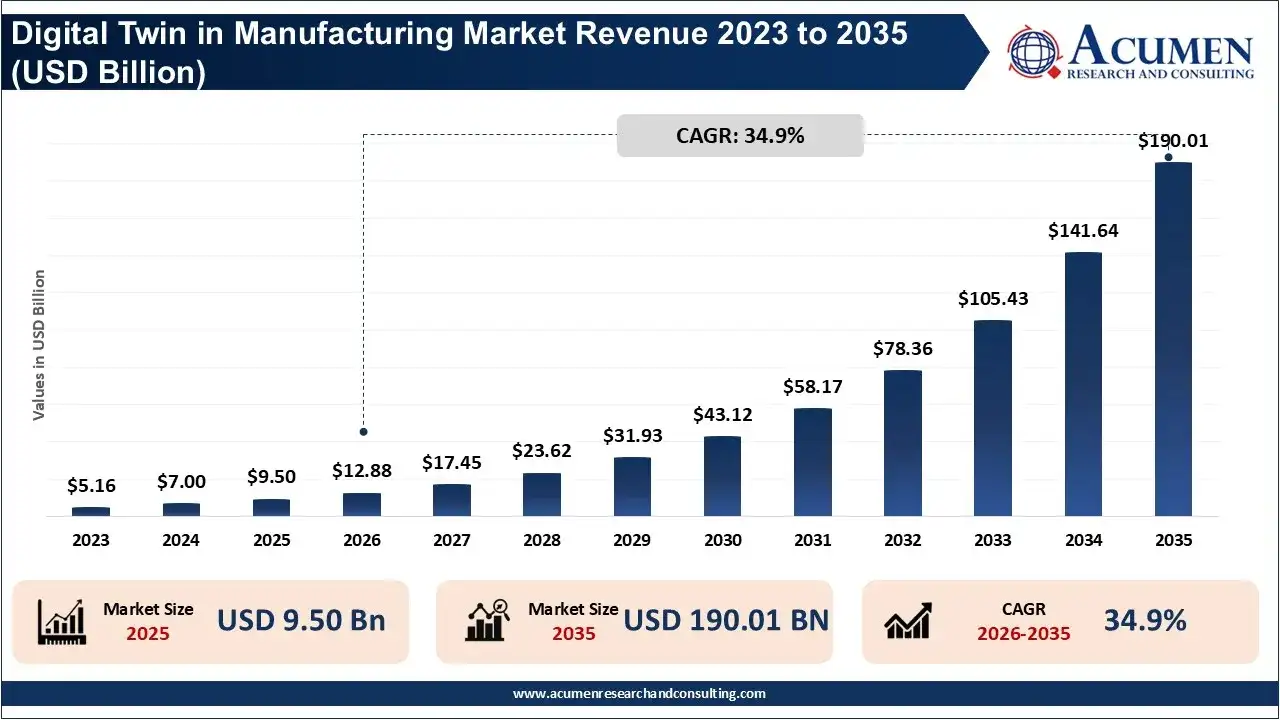
Digital Twin in Manufacturing Market: From Virtual Models to Operational Intelligence
Digital twins are evolving from static digital representations of products, machines, and facilities into continuously updated environments that connect engineering models with real-world manufacturing data. Manufacturers are increasingly using digital twins to simulate production changes, validate equipment configurations, identify bottlenecks, optimize processes, and reduce the risk of implementing changes directly on physical production lines. The shift is also being accelerated by artificial intelligence (AI), IoT, industrial software, and physics-based simulation, allowing digital twins to support decisions across design, commissioning, production, and asset management.
Where Are Digital Twins Creating Value in Manufacturing?
- Production Planning and Layout: Digital twins allow manufacturers to virtually test factory layouts, equipment placement, material flows, and production configurations before making physical changes. This helps identify bottlenecks, evaluate capacity, and improve production planning while reducing disruption associated with trial-and-error changes on operating production lines.
- Virtual Commissioning: Manufacturers can use digital twins to test automation logic, machine interactions, control systems, and production sequences in a virtual environment before equipment is commissioned. This can shorten commissioning timelines, identify integration problems earlier, and reduce the cost associated with correcting issues after physical installation.
- Predictive Asset Management: Digital twins combine equipment models with operational and sensor data to create continuously updated views of asset performance. Manufacturers can use these models to identify abnormal behavior, evaluate degradation, anticipate maintenance requirements, and improve equipment utilization while reducing unexpected production interruptions.
- Process Optimization: Process twins enable manufacturers to simulate interconnected production parameters and evaluate how changes could influence throughput, quality, energy consumption, or material utilization. This creates a virtual environment for testing optimization strategies before applying them to physical manufacturing operations.
Digital Twin in Manufacturing Market Segmental Outlook
| Segment | Leading Segment | 2025 Share | Key Driver |
|---|---|---|---|
| By Component | Software | 70% | Central role of digital twin platforms in integrating, modeling, visualizing, simulating, and analyzing manufacturing data. |
| By Digital Twin Type | Process Twins | 29% | Ability to simulate production processes and optimize interconnected operating parameters across manufacturing workflows. |
| By Deployment Mode | Cloud | 42% | Scalable computing capacity and centralized access to digital models, operational data, analytics, and collaboration tools. |
| By Manufacturing Type | Discrete Manufacturing | 61% | Extensive applications across automotive, electronics, machinery, aerospace, and transportation equipment production. |
| By Enterprise Size | Large Enterprises | 81.0% | Greater financial resources, extensive manufacturing infrastructure, large equipment fleets, and higher volumes of operational data. |
| By Manufacturing Industry | Automotive & Transportation Equipment | 22% | Complex assembly operations, automated production lines, robotics, equipment networks, quality-control requirements, and integrated supply chains. |
Digital Twin in Manufacturing Market: What Will Change by 2030?
- Digital Twins Will Become Continuously Updated: Manufacturing digital twins will increasingly move beyond periodically refreshed models toward continuously synchronized environments. Real-time equipment, production, quality, and environmental data will allow manufacturers to maintain more accurate virtual representations and respond faster to changing physical operating conditions.
- AI Will Turn Digital Twins Into Decision Engines: AI will increasingly operate within digital twin environments to identify patterns, test scenarios, recommend interventions, and evaluate potential outcomes. This will shift digital twins from visualization tools toward intelligent systems capable of supporting more automated manufacturing decisions.
- Factories Will Be Designed Before They Are Built: Digital twin platforms will increasingly support complete virtual factory development, allowing manufacturers to evaluate layouts, equipment, workflows, automation logic, energy requirements, and production capacity before physical construction or installation begins, reducing design uncertainty and potentially shortening deployment cycles.
- Digital Twins Will Connect the Entire Product Lifecycle: Digital twin adoption will increasingly extend from product design and engineering into manufacturing, operations, maintenance, and supply chain management. This lifecycle connection will create greater continuity between engineering decisions and real-world production performance across manufacturing organizations.
Digital Twin in Manufacturing Market Regional Outlook
North America Digital Twin in Manufacturing Market
North America dominated the digital twin in manufacturing market in 2025 with a 34.0% share, supported by mature industrial automation, connected manufacturing infrastructure, industrial IoT adoption, and strong enterprise technology capabilities. The region benefits from a large installed base of automated factories and sophisticated engineering environments across automotive, aerospace, electronics, semiconductor, food and beverage, and industrial equipment manufacturing.
Increasing investment in AI-powered simulation and virtual factory planning is also expanding the role of digital twins beyond visualization toward production optimization and decision support. NVIDIA reported in 2025 that manufacturers including Toyota, TSMC, Foxconn, Caterpillar, Lucid Motors, and Wistron were using Omniverse technologies to develop factory-scale digital twins.
Europe Digital Twin in Manufacturing Market
Europe represents a technologically advanced digital twin market, supported by its strong automotive, machinery, aerospace, pharmaceutical, chemicals, and industrial equipment manufacturing base. Manufacturers are increasingly using digital twins to improve energy efficiency, optimize production assets, strengthen engineering-to-production connectivity, and support more sustainable manufacturing.
Germany is particularly important because of its industrial automation ecosystem and concentration of global manufacturing technology providers. Siemens has also positioned Germany as an important development environment for AI-driven adaptive manufacturing, including its electronics factory in Erlangen.
Asia-Pacific Digital Twin in Manufacturing Market
Asia-Pacific is projected to be the fastest-growing regional market, with a 37.5% CAGR from 2026 to 2035. Rapid industrial automation, smart-factory investments, electronics manufacturing, semiconductor production, automotive manufacturing, and robotics adoption are creating strong demand for digital simulation and virtual production environments. China, Japan, South Korea, and India are key contributors, while manufacturers across the region increasingly use digital twins to manage complex production systems and accelerate new-factory development.
Siemens has also highlighted India as a key market and innovation hub for industrial AI and digital twin technologies, supported by more than 10,000 software and AI experts working on its technology stack in the country.
What Are Companies Investing In?
- January 2026: Siemens and NVIDIA expanded their strategic partnership to develop an Industrial AI Operating System combining industrial software, AI infrastructure, simulation, and digital twins. Siemens also introduced Digital Twin Composer, designed to connect digital twins with simulation and real-time physical data across products, processes, and plants.
- March 2026: NVIDIA announced the general availability of its Omniverse DSX Blueprint for physically accurate AI factory digital twins. The blueprint supports large-scale design, simulation, construction, and operation of AI factories, with companies including Siemens, PTC, Schneider Electric, Dassault Systèmes, Eaton, and Vertiv contributing technologies to the architecture.
Key Companies
The digital twin in manufacturing market includes Siemens, NVIDIA, Dassault Systèmes, PTC, Rockwell Automation, Schneider Electric, ABB, Honeywell, Emerson Electric, Microsoft, IBM, Amazon Web Services, SAP, Autodesk, and Ansys. Siemens, Dassault Systèmes, PTC, Rockwell Automation, Schneider Electric, ABB, Honeywell, and Emerson connect digital twins with industrial automation, engineering, PLM, control systems, and manufacturing operations. NVIDIA provides accelerated computing, simulation, and Omniverse technologies, while Microsoft, AWS, IBM, and SAP contribute cloud, data, AI, and enterprise platforms.
Segments Covered
By Component
- Software
- Services
By Digital Twin Type
- Product Twin
- Equipment/Asset Twin
- Process Twin
- Factory/System Digital Twin
- Supply Chain Twin
By Deployment Mode
- On-Premises
- Cloud
- Hybrid
By Manufacturing Type
- Discrete Manufacturing
- Process Manufacturing
By Enterprise Size
- Large Enterprises
- SMEs
By Manufacturing Industry
- Automotive & Transportation Equipment
- Aerospace & Defense Manufacturing
- Semiconductor & Electronics
- Industrial Machinery & Equipment
- Chemicals & Materials
- Pharmaceuticals & Life Sciences Manufacturing
- Food & Beverage
- Consumer Goods
- Pulp, Paper & Packaging
- Other Manufacturing Industries
By Region
- North America
- Europe
- Asia-Pacific
- Latin America
- Middle East & Africa
Contact Us:
Mr. Richard Johnson
Acumen Research and Consulting
India: +91 8983225533