
Industrial Edge Computing Market Size to Surge USD 134.75 Billion by 2035, Reflecting a CAGR of 20.4%
Published : 07 Oct 2026
Author : Simone Lamb



What is the Industrial Edge Computing Market Size?
The global industrial edge computing market size was valued at USD 21 billion in 2025 and is projected to surge USD 134.75 billion by 2035; growing at a CAGR of 20.4% during the forecast period from 2026 to 2035.
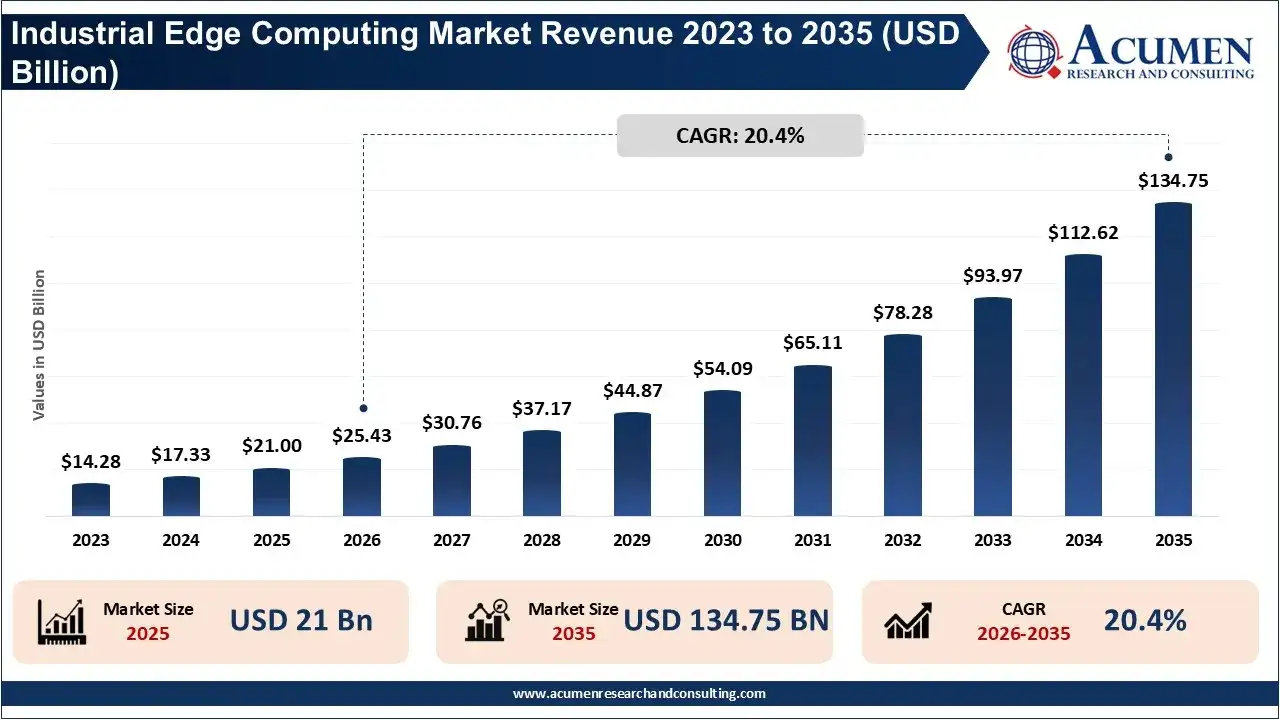
Industrial Edge Computing Market: Why Is Computing Moving onto the Factory Floor?
Industrial operations are generating increasing volumes of data from machines, sensors, robots, cameras, controllers, and connected production systems. Sending all this data to centralized cloud environments can introduce latency, connectivity dependency, and bandwidth costs. Industrial edge computing addresses these limitations by placing computing, analytics, and AI capabilities closer to machines and production processes, enabling faster decisions while keeping critical operational data within the plant environment.
Which Industrial Workloads Are Moving to the Edge?
Real-Time Machine Monitoring: Edge platforms process machine and sensor data locally to identify abnormal operating conditions, equipment deviations, and performance changes without waiting for information to travel to centralized cloud systems, supporting faster intervention and more continuous visibility across production environments.
AI-Powered Quality Inspection: Computer vision workloads increasingly run at the industrial edge because inspection decisions often need to occur within milliseconds. Local AI inference can analyze images, identify defects, classify products, and trigger production responses without continuously transferring high-volume visual data.
Predictive Maintenance: Edge computing enables manufacturers to analyze vibration, temperature, pressure, acoustic, and equipment-performance data near industrial assets. Local models can identify anomalies and potential failures earlier, allowing maintenance teams to respond before equipment problems create significant downtime or production disruptions.
Process Optimization: Edge systems can continuously analyze production parameters and operating conditions to identify opportunities for process adjustment. Local analytics support faster optimization of machine settings, throughput, energy consumption, and material utilization while maintaining operational continuity even when cloud connectivity is limited.
Industrial AI Inference: AI models trained centrally increasingly need to operate close to machines to deliver real-time decisions. Edge infrastructure allows manufacturers to deploy inference workloads locally for anomaly detection, robotics, vision systems, worker assistance, and production optimization without depending on constant cloud communication.
Industrial Edge Computing Market Segmental Outlook
| Segment | Leading Segment | 2025 Share | Key Driver |
|---|---|---|---|
| By Offering | Hardware | 46% | Demand for edge computing systems, gateways, acceleration hardware, and industrial networking infrastructure positioned close to machines and production assets. |
| By Edge Infrastructure Type | Site/Plant Edge | 39% | Ability to centralize computing, analytics, data processing, and AI workloads within industrial facilities while maintaining low-latency operations and local data control. |
| By Deployment/Ownership Model | Customer-Owned & Operated | 61% | Preference among industrial enterprises for direct control over infrastructure, operational data, cybersecurity, and mission-critical workloads. |
| By Enterprise Size | Large Enterprises | 72% | Larger industrial footprints, greater operational data volumes, and stronger investment capacity for automation, IoT, cloud, and edge infrastructure. |
| By End-Use Industry | Manufacturing | 42% | Extensive deployment of connected machines, robotics, sensors, industrial controllers, and automated production systems requiring real-time data processing. |
Industrial Edge Computing Market: What Will Change by 2030?
- Edge AI Becomes Standard Industrial Infrastructure: By 2030, AI inference is expected to become a standard workload across industrial edge environments rather than a specialized deployment. Manufacturers will increasingly combine accelerators, edge servers, industrial PCs, and AI software to support continuous machine-level intelligence.
- Edge and Cloud Will Operate as One Architecture: Industrial computing will increasingly follow a distributed model in which immediate decisions occur locally while model training, enterprise analytics, benchmarking, and long-term data management remain centralized. This architecture will allow manufacturers to balance responsiveness with broader operational intelligence.
- Factories Will Deploy More Autonomous Workloads: As edge AI becomes more capable, industrial systems will increasingly detect conditions, interpret production data, recommend actions, and execute predefined responses locally. This will support more adaptive production lines, autonomous inspection, intelligent robotics, and self-optimizing operational processes.
- Industrial Edge Management Will Become More Important: Scaling edge infrastructure across multiple factories will shift attention from individual devices toward centralized lifecycle management. Enterprises will require platforms that can provision applications, update models, monitor performance, enforce security policies, and coordinate thousands of distributed edge devices.
Industrial Edge Computing Market Regional Outlook
North America dominated the industrial edge computing market in 2025, accounting for 39% of the market and generating approximately $8.19 billion in revenue. Adoption is supported by mature industrial automation, private wireless networks, IoT deployments, AI infrastructure, cloud platforms, and established technology ecosystems. The region is also benefiting from growing investment in AI-enabled manufacturing, where edge infrastructure provides the low-latency computing required for machine vision, robotics, predictive maintenance, and autonomous production workflows.
- United States: The U.S. remains a major deployment center because manufacturers are expanding AI-enabled factories, industrial automation, private networks, and edge infrastructure while technology providers increasingly combine accelerated computing with industrial software and operational systems.
Asia-Pacific Industrial Edge Computing Market
Asia-Pacific is the fastest-growing regional market, with its share projected to increase from 30% in 2025 to 37% by 2035 at a 23.2% CAGR. Rapid industrialization, electronics and semiconductor production, automotive manufacturing, robotics, 5G infrastructure, and smart-factory investment are accelerating edge adoption. China, Japan, South Korea, and India are particularly important as manufacturers seek localized computing for automated production, machine vision, robotics, and AI-enabled industrial systems.
- China: China is expanding industrial edge adoption through smart manufacturing, robotics, industrial AI, 5G connectivity, and large-scale automation programs, creating demand for localized computing across factories and production networks.
Industrial Edge Computing Market: What Are Companies Investing in?
- April 2026: Siemens introduced an AI-ready version of its Industrial Automation DataCenter, integrating accelerated AI computing from NVIDIA and cybersecurity capabilities from Palo Alto Networks. The platform is designed to bring high-performance AI computing and IT/OT infrastructure closer to production environments.
- June 2026: Siemens, Databricks, and FFT announced an edge-to-cloud integration connecting Siemens Industrial Edge and production data directly with the Databricks platform. The initiative targets scalable industrial analytics and AI by creating a unified production-data foundation across shop-floor and enterprise environments.
Industrial Edge Computing Market Key Companies
The industrial edge computing landscape includes Siemens, Schneider Electric, ABB, Rockwell Automation, Honeywell, Emerson, Microsoft, Amazon Web Services (AWS), Google Cloud, NVIDIA, Intel, Dell Technologies, Hewlett Packard Enterprise (HPE), Cisco Systems, and Nokia. These companies span industrial automation, edge platforms, accelerated computing, industrial networking, cloud infrastructure, cybersecurity, and enterprise software. Siemens, Schneider Electric, ABB, Rockwell Automation, Honeywell, and Emerson connect edge infrastructure with industrial control and automation, while NVIDIA and Intel provide accelerated computing for AI workloads.
Segments Covered in the Report
By Offering
- Hardware
- Edge Computing Systems
- Edge Gateways
- Edge AI & Acceleration Hardware
- Industrial Networking Edge Hardware
- Other Industrial Edge Hardware
- Software & Platforms
- Industrial Edge Platforms & Operating Software
- Edge Data Processing & Analytics Software
- Edge AI/ML Software
- Edge Orchestration & Management Software
- Edge Security Software
- Other Industrial Edge Software
- Services
- Consulting & Architecture/Design
- Implementation & Systems Integration
- Support & Maintenance
- Managed Industrial Edge Services
- Other Services
By Edge Infrastructure Type
- Device Edge
- Equipment/Machine Edge
- Site/Plant Edge
- Industrial Edge Data Center
By Deployment/Ownership Model
- Customer-Owned & Operated
- Managed/Dedicated Edge
- Edge-as-a-Service
By Enterprise Size
- Large Enterprises
- Small & Medium Enterprises (SMEs)
By End-Use Industry
- Manufacturing
- Energy & Utilities
- Oil & Gas
- Mining & Metals
- Transportation & Logistics
- Construction & Infrastructure
- Others
By Region
- North America
- Europe
- Asia-Pacific
- Latin America
- Middle East & Africa
Contact Us:
Mr. Richard Johnson
Acumen Research and Consulting
India: +91 8983225533