
Data Center Components Market Size to Surge USD 1,009.56 Billion by 2035, Accelerating a CAGR of 14.5%
Published : 09 Oct 2026
Author : Simone Lamb



What is the Data Center Components Market Size?
The data center components market size was accounted for USD 260 billion in 2025 and is expected to surge USD 1,009.56 billion by 2035; growing at a CAGR of 14.5% during the forecast period from 2026 to 2035. The data center components market is being driven by rapid AI infrastructure expansion, continued cloud adoption, rising computing density, increasing power and cooling requirements, and the need to modernize servers, networking, racks, storage, and supporting electrical infrastructure.
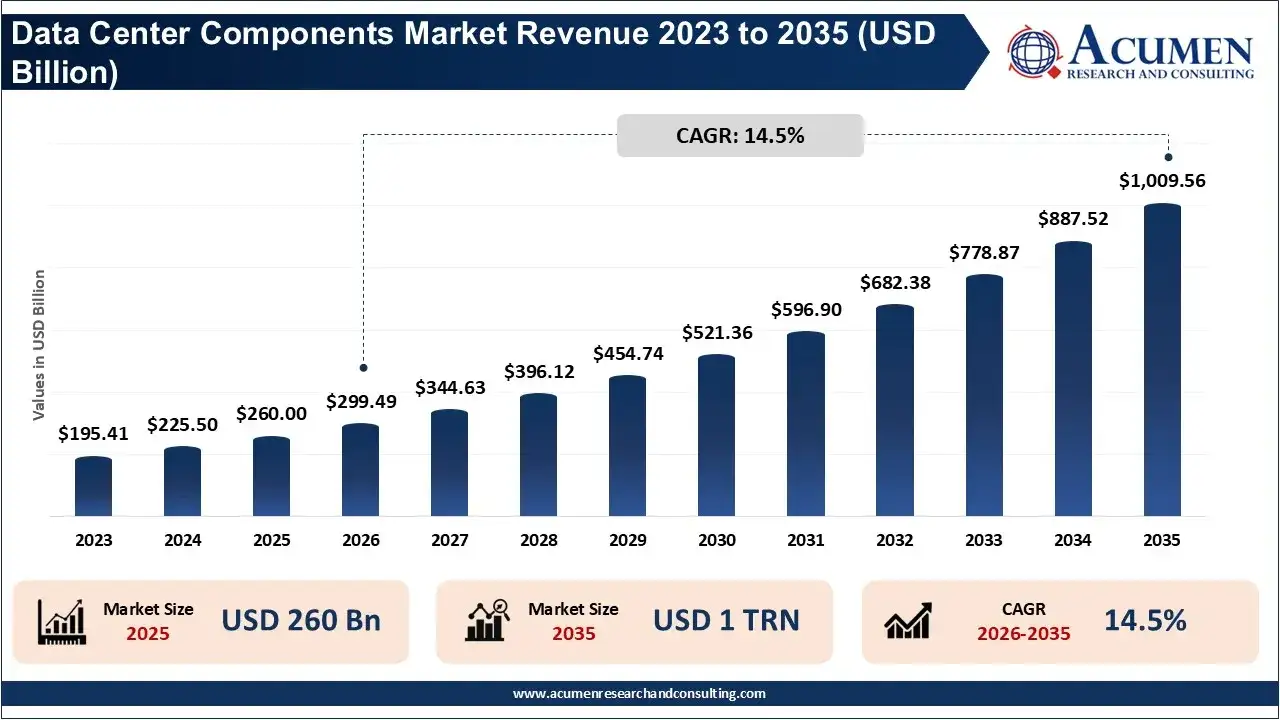
Data Center Components Market Overview
Data center infrastructure is undergoing a structural shift as AI workloads push operators to rethink how computing, networking, power, and cooling are designed together. Traditional enterprise environments were built around relatively predictable workloads, while AI training and inference can create much higher rack densities, greater power demand, and more demanding thermal conditions. This is increasing the importance of components that can support high-speed data movement, accelerated computing, efficient power delivery, and increasingly sophisticated cooling architectures.
NVIDIA's Blackwell platform, for example, has accelerated demand for data center architectures capable of supporting large-scale GPU clusters and high-bandwidth networking. At the same time, hyperscalers and colocation providers are expanding capacity to serve cloud applications, generative AI, digital services, and enterprise workloads.
Where Are Data Center Components Creating Value?
- High-density computing: AI and high-performance computing are increasing the amount of compute that can be concentrated within individual racks. This creates demand for servers, accelerators, high-speed networking, power distribution, and cooling components designed to operate reliably under substantially higher thermal and electrical loads.
- Faster data movement: Modern AI workloads require rapid communication between GPUs, CPUs, storage systems, and networking infrastructure. High-speed switches, optical connectivity, network adapters, and advanced interconnect technologies are therefore becoming increasingly important as operators scale distributed computing clusters.
- Power delivery: Electricity has become a central infrastructure constraint as data center workloads become more computationally intensive. Power distribution units, UPS systems, busways, switchgear, power supplies, and backup systems help operators deliver stable power while improving efficiency and supporting higher rack densities.
- Thermal management: Conventional air cooling becomes increasingly difficult as rack power rises. This is creating greater interest in liquid cooling, direct-to-chip cooling, heat exchangers, advanced chillers, and other thermal-management technologies capable of removing substantially more heat from densely packed computing environments.
- Infrastructure scalability: Hyperscale and cloud operators need components that can be deployed across large facilities without creating bottlenecks in procurement, installation, maintenance, or expansion. Modular racks, standardized power systems, scalable networking, and prefabricated infrastructure can shorten deployment cycles.
Segmental Outlook
| Segment | Leading Segment | 2025 Share | Key Driver |
|---|---|---|---|
| By Components | IT Infrastructure | 52% | Rising demand for servers, storage, networking equipment, AI workloads, cloud services, and high-performance computing infrastructure. |
| By Data Center Type | Hyperscale Data Centers | 40% | Expansion of cloud platforms, AI workloads, large-scale storage requirements, and high-capacity computing and networking infrastructure. |
| By Data Center Size | 10 MW to <50 MW | 35% | Demand from large enterprise workloads, cloud and colocation deployments, and expanding digital services requiring substantial computing capacity. |
| By Rack Density | 10–19 kW | 28% | Suitability for enterprise, cloud, colocation, and networking applications requiring higher computing density without the extreme power and cooling requirements of AI and HPC environments. |
| By End User | Hyperscale & Cloud Service Providers | 36% | Continued investment in cloud infrastructure, AI computing, digital services, storage, networking, power, cooling, and high-density data center environments. |
| By End User | Enterprises | 21% | Ongoing requirements for business-critical computing, data management, cybersecurity, compliance, and operational continuity despite growing adoption of cloud and colocation infrastructure. |
What Will Change by 2030?
- Rack density will keep rising: AI servers and accelerated computing will continue pushing rack power beyond conventional enterprise levels. Operators will increasingly evaluate racks as integrated computing and thermal systems rather than simply physical structures holding servers and networking equipment.
- Liquid cooling will become mainstream for demanding workloads: As AI clusters generate greater heat, direct-to-chip and other liquid-cooling approaches are likely to move from specialized deployments toward a standard part of high-density data center design.
- Power infrastructure will become a strategic bottleneck: Data center expansion will increasingly depend on access to sufficient electricity, making power distribution, backup systems, energy efficiency, and grid connectivity just as important as server procurement when planning new capacity.
- Networking will become increasingly important: AI clusters depend on rapid communication between large numbers of processors. Higher-bandwidth switches, optical technologies, network adapters, and advanced interconnects will therefore become increasingly central to overall data center performance.
- Data centers will be designed around workload requirements: Instead of using one infrastructure model across an entire facility, operators are likely to create different zones optimized for AI, general-purpose computing, storage, networking, and other workloads, with corresponding differences in power and cooling architecture.
Regional Outlook
North America Data Center Components Market
North America dominated the data center components market with a 38% share in 2025, supported by its established hyperscale infrastructure, strong AI investment, mature cloud ecosystem, and concentration of large technology companies. The region continues to see substantial demand for servers, accelerators, networking equipment, power systems, cooling infrastructure, and high-density racks as operators expand capacity for AI and cloud workloads. The U.S. also benefits from a mature ecosystem of data center developers, semiconductor companies, hyperscalers, equipment manufacturers, and infrastructure providers.
- United States: The U.S. remains the region's primary market, with hyperscale AI investment and continued data center construction creating demand across computing, networking, power, cooling, storage, and rack infrastructure.
Asia-Pacific Data Center Components Market
Asia-Pacific is expected to be the fastest-growing regional market, expanding at a 17.4% CAGR from 2026 to 2035. Cloud adoption, AI infrastructure investment, digitalization, and rapid expansion of data center capacity are driving demand across the region. China, Japan, Singapore, India, South Korea, and Australia are emerging as important markets, although the pace and infrastructure profile differ considerably between countries. Growing digital services and local cloud infrastructure are also encouraging operators to deploy more sophisticated power, cooling, networking, and high-density computing systems.
- China: Large-scale cloud infrastructure, AI investment, digital services, and domestic technology development are supporting continued expansion of data center capacity and demand for high-performance infrastructure components.
- India: Rapid cloud adoption, digital services growth, AI deployment, and increasing investment by hyperscalers and colocation operators are creating a growing requirement for modern data center components.
What Are Companies Investing In?
NVIDIA's Blackwell platform and its supporting networking and accelerated-computing ecosystem are increasing demand for high-density systems capable of connecting large numbers of GPUs. The shift is significant for component suppliers because AI infrastructure requires coordinated upgrades across servers, networking, power, racks, and cooling rather than isolated equipment purchases.
Major cloud providers continue to commit substantial capital to data center infrastructure as demand for generative AI and cloud services rises. These investments are broadening the opportunity for component suppliers across computing, storage, networking, power management, thermal systems, and facility infrastructure.
Key Companies
The competitive landscape spans server manufacturers, semiconductor and accelerator suppliers, networking companies, power and cooling specialists, rack manufacturers, and data center infrastructure providers. Key companies include Dell Technologies, Hewlett Packard Enterprise, Supermicro, Lenovo, Cisco Systems, NVIDIA, Intel, AMD, Arista Networks, Schneider Electric, Vertiv, Eaton, ABB, Siemens, and Legrand. Their strategies increasingly center on designing infrastructure around higher computing density, AI workloads, energy efficiency, faster networking, and increasingly sophisticated thermal and power requirements.
Segments Covered
By Components
- IT Infrastructure
- Power Infrastructure
- Cooling Infrastructure
- Racks & Enclosures
- Monitoring & Management Systems
- Physical Security & Safety
- Other Components
By Data Center Type
- Hyperscale Data Centers
- Colocation Data Centers
- Enterprise Data Centers
- Edge Data Centers
By Data Center Size
- Small Data Centers – Below 1 MW
- Medium Data Centers – 1 MW to <10 MW
- Large Data Centers – 10 MW to <50 MW
- Mega/Hyperscale Facilities – 50 MW and Above
By Rack Density
- Below 10 kW
- 10–19 kW
- 20–29 kW
- 30–49 kW
- 50–99 kW
- 100 kW and Above
By End User
- Hyperscale & Cloud Service Providers
- Colocation Data Center Providers
- Telecom Operators
- Enterprises
- Government & Public Sector
- Research & Academic Institutions
- Others
By Region
- North America
- Europe
- Asia-Pacific
- Latin America
- Middle East & Africa
Contact Us:
Mr. Richard Johnson
Acumen Research and Consulting
India: +91 8983225533