
Predictive Analytics Market Size to Surpass USD 425.46 Billion by 2035, Expanding at a CAGR of 30.3%
Published : 29 Oct 2026
Author : Lucas Hoffmann



What is the Predictive Analytics Market Size?
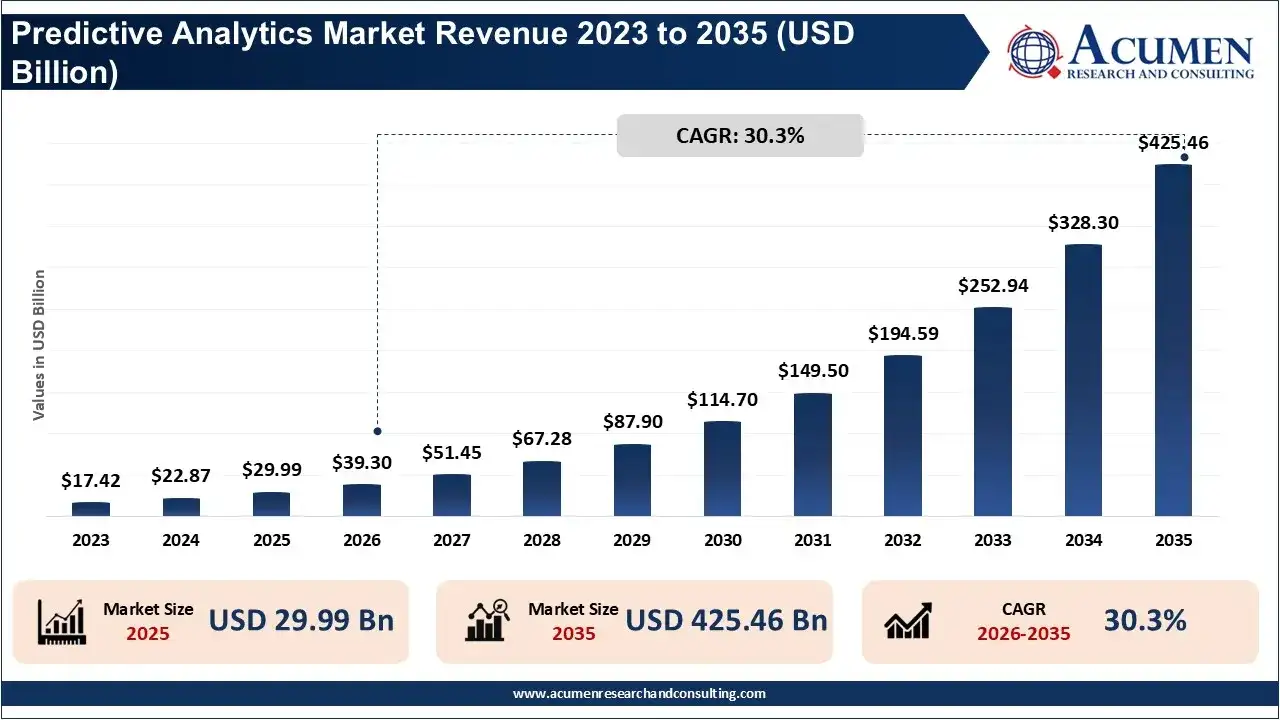
The global predictive analytics market size was estimated at USD 29.99 billion in 2025 and is projected to reach USD 425.46 billion by 2035, expanding at a CAGR of 30.3% during the forecast period of 2026-2035. The increasing integration of artificial intelligence, machine learning, and cloud-based data platforms is a major growth factor for the predictive analytics market, as enterprises increasingly use historical, real-time, and operational data to forecast demand, detect risks, personalize customer interactions, optimize assets, and automate data-driven decisions.
Evolution from Business Intelligence to AI-Powered Forecasting
Today, predictive analytics has transitioned from using Business Intelligence (BI) solutions that provided retrospective or retrospective descriptive reporting to leveraging artificial intelligence-powered next-generation tools that can predict and recommend future outcomes and even drive automation. In the past, business intelligence platforms offered a snapshot view of past performance through interactive dashboards and reports and packaged these insights into time-bound metrics. The power of predictive analytics lies in AI-enabled statistical models and machine learning, which allow industry players to detect patterns in historical data and infer what might happen next.
Predictive Analytics in Retail and E-Commerce: Demand, Pricing and Customer Insights
- Demand forecasting: Retailers use predictive models to analyze historical sales, seasonal patterns, promotions, pricing, customer behavior, and external factors to estimate future product demand. This helps businesses determine purchasing requirements and reduce the risk of overstocking or stockouts.
- Inventory optimization: Predictive analytics can identify products likely to experience higher or lower demand and help retailers determine appropriate inventory levels. This is particularly valuable for e-commerce businesses managing large product catalogs across multiple warehouses and fulfillment locations.
- Dynamic pricing: Retailers can analyze demand patterns, competitor pricing, customer behavior, inventory levels, and market conditions to adjust prices. Predictive models can help identify price points that balance sales volume, inventory movement, and revenue objectives.
- Customer purchase prediction: Machine learning models can identify customers who are more likely to purchase particular products based on browsing behavior, transaction history, preferences, and engagement patterns. These insights can support targeted promotions and personalized product recommendations.
- Customer churn prediction: Predictive analytics can identify behavioral signals associated with customers becoming less active or switching to competitors. Retailers can use these insights to develop targeted retention campaigns and personalized offers.
Where Are Investment Opportunities Emerging in Predictive Analytics?
Investment opportunities in the predictive analytics market are starting to shift from traditional analytics to AI-powered platforms, with opportunities in cloud infrastructure and industry-specific applications; AI-powered predictive analytics market itself; data management and predictive decision-support solutions. Cloud-native predictive analytics offers an opportunity for enterprise, as many have existing investments in on-site data centers, but require scalable systems that can be integrated with their existing environment.
Investment is also happening in automated machine learning and low-code analytics that democratize access to predictive modeling for organizations with smaller data-science teams. Industry-specific opportunities include finance and banking risk and fraud analytics; manufacturing predictive maintenance and production analytics; healthcare predictive modelling; and retail customer or demand forecasting.
Predictive Analytics Market Segmental Analysis
| Segmentation | Dominant Segment | 2025 Market Share | Key Growth Factors |
|---|---|---|---|
| By Component | Software/Solutions | 68% | Growing adoption of cloud platforms, embedded analytics, and automated decision-making tools |
| By Deployment | Cloud | 62% | Scalability, flexibility, lower infrastructure requirements, and easier deployment |
| By Enterprise Size | Large Enterprises | 74% | Larger technology budgets, extensive datasets, established IT infrastructure, and dedicated analytics teams |
| By Industry Vertical | BFSI | 21% | Increasing use for fraud detection, credit scoring, risk assessment, customer analytics, and financial forecasting |
| By Application | Demand Forecasting and Planning | 20% | Demand prediction, inventory optimization, production planning, and improved supply-chain decision-making |
Predictive Analytics Market Regional Outlook
North America Predictive Analytics Market: Regional Leadership Supported by AI and Data Infrastructure
North America accounted for the largest predictive analytics market share of 38% in 2025, and the market for predictive analytics solutions is expected to continue growing in 2025. This is primarily driven by the growing adoption of predictive analytics solutions by businesses across industries such as financial services, IT and telecom, healthcare, retail, manufacturing, and others.
Due to the large number of organizations working with extensive enterprise data, North America is witnessing a high adoption rate of AI solutions at large enterprises, which use predictive analytics platforms in the operational processes.
- United States: The U.S. represents the major country-level market in North America, supported by widespread enterprise adoption of cloud computing, AI, machine learning, and advanced data analytics. Large technology companies, financial institutions, healthcare organizations, retailers, and manufacturers are increasingly integrating predictive models into fraud detection, customer analytics, demand forecasting, risk management, and operational optimization.
Europe Predictive Analytics Market: Strong Enterprise Adoption Across Diverse Industries
Europe held the second-largest share of the predictive analytics market in 2025 at 30%, driven by broad adoption across BFSI, automotive, manufacturing, healthcare, retail, and telecommunications. Enterprises across the region are increasingly using predictive analytics to improve forecasting, automate decision support, optimize supply chains, detect financial and operational risks, and personalize customer experiences.
Europe's strong industrial base, growing AI adoption, and emphasis on digital transformation are creating demand for analytics solutions that can convert large volumes of operational and customer data into actionable insights.
- Germany: Germany is a major country-level market in Europe, supported by its large automotive and manufacturing sectors, where predictive analytics is increasingly applied to predictive maintenance, production optimization, quality control, supply-chain forecasting, and demand planning. The country's industrial digitalization initiatives and established enterprise technology ecosystem further support adoption across manufacturing-intensive industries.
What Technologies Are Powering the Predictive Analytics Market?
- Artificial Intelligence (AI) and Machine Learning (ML): While traditional predictive analytics focuses on statistical rules as input, AI/ML provides sophisticated algorithms that can analyze past and current data to produce predictions. ML systems can evolve to provide improved data analysis as more data is ingested over time, enabling predictive analytics to be used to forecast demand, detect fraud, monitor customer attrition, and more.
- Potential for Advanced Statistical Models: Regression, time-series forecasting, classification, clustering, and probability models continue to be useful in converting history into numbers; in opportunities where it is valuable for a business to know in quantitative terms what is likely to happen.
- Deep Learning: Neural networks and deep-learning architectures are capable of tackling the massive and complex data structures used in predictive analytics platforms, such as images, text, sensor data, and others. Deep learning is becoming more relevant to applications such as anomaly detection, sensor data analysis, customer-behavior prediction, and advanced demand forecasting.
- Generative AI & Large Language Models: Generative AI is democratizing predictive analytics by enabling more natural language interactions with analytical platforms and proactively generating insights, explanations, queries, and even analytical workflows.
Predictive Analytics Market: Competitive Landscape
In predictive analytics, enterprise technology companies, niche analytics vendors and AI startups all compete. The enterprise AI and analytics market is led by Google, Amazon, IBM, Microsoft, Oracle and Salesforce, which all have analytics and predictive capabilities. IBM offers machine learning-driven predictive analytics and modeling in addition to its AI and data platform.
Microsoft in addition to Azure has predictive services built into its larger cloud services and entire analytics platform, Oracle a combination of cloud applications and databases along with its Oracle Cloud Infrastructure, and SAP the integration of AI and analytics into enterprise cloud applications and business processes.
Segments Covered
By Component
- Software/Solutions
- Services
By Deployment
- On-Premise
- Cloud
By Enterprise Size
- Large Enterprises
- Small & Medium Enterprises (SMEs)
By Industry Vertical
- BFSI
- Healthcare & Life Sciences
- Manufacturing
- Retail & Consumer Goods
- IT & Telecom
- Energy & Utilities
- Government & Public Sector
- Others
By Application
- Demand Forecasting & Planning
- Predictive Maintenance & Asset Management
- Risk, Fraud & Compliance
- Customer & Churn Analytics
- Revenue & Pricing
- Sales & Marketing
- Financial & Workforce Forecasting
- Strategic & Operational Decision Support
By Region
- North America
- Europe
- Asia-Pacific
- Latin America
- Middle East & Africa
Contact Us:
Mr. Richard Johnson
Acumen Research and Consulting
India: +91 8983225533