
AI in Asset Management Market Size to Surge USD 35.33 Billion by 2035, Expanding at a CAGR of 22.1%
Published : 13 Nov 2026
Author : Raghuram Nair



What is the AI in Asset Management Market Size?
The AI in asset management market size calculated at $5.86 billion in 2026 and is expected to surge around $35.33 billion by 2035, expanding at a CAGR of 22.1% during the forecast period 2026 to 2035. Growing demand for data-driven investment decisions, portfolio optimization, risk monitoring, and personalized financial services is accelerating AI adoption across asset management. Advances in machine learning, generative AI, and cloud computing are enabling firms to process complex financial data, automate workflows, and improve operational efficiency.
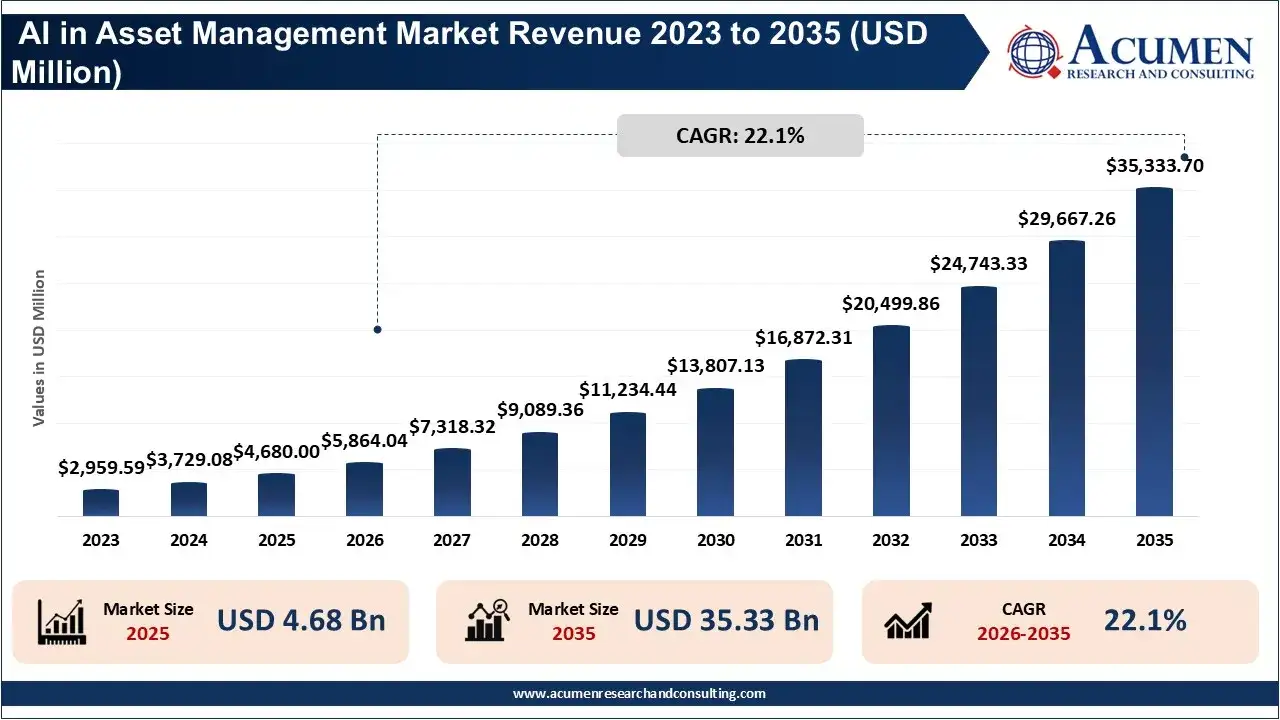
AI in Asset Management Market Overview: Intelligence Becomes an Investment Capability
Artificial intelligence is changing how asset managers research markets, construct portfolios, assess risk, and interact with clients. Traditional investment processes increasingly rely on machine learning models, predictive analytics, natural language processing, and generative AI tools to interpret large volumes of financial and alternative data. These technologies help investment teams identify patterns, evaluate scenarios, automate research activities, and support more responsive portfolio decisions.
The market is also moving beyond standalone AI software. Asset managers are increasingly considering integrated platforms, managed services, cloud infrastructure, and specialized AI applications that can be incorporated into existing investment workflows. In 2025, North America led the global market with a 46.0% share, generating USD 2.15 billion in revenue. Strong financial technology adoption, established asset management firms, and investment in AI-driven financial infrastructure support the region's leading position.
The AI Adoption Curve: Six Changes Reshaping Asset Management
- From quantitative models to generative AI: Machine learning remains central to investment analytics, while large language models are expanding AI use into research summarization, document analysis, and investment communication.
- Portfolio decisions become more data-intensive: Firms are combining traditional market information with alternative datasets to improve forecasting, asset allocation, and risk assessment.
- Client services become more personalized: AI-powered advisory tools can help investment firms tailor portfolio insights, reporting, and communication to different client requirements.
- Cloud adoption gains momentum: Scalable computing environments are helping firms deploy AI applications without maintaining all infrastructure internally.
- Managed AI services attract attention: Asset managers are increasingly exploring external expertise for model development, implementation, integration, and ongoing system management.
- Alternative investments enter the AI workflow: Private equity, private credit, real assets, and other alternative asset classes create opportunities for AI-supported due diligence, valuation, and portfolio monitoring.
Market Segmentation Outlook
| Segment | Leading category (2025) | Fastest-growing category |
|---|---|---|
| Component | Software / platforms: 66%, USD 3.09 billion | Managed services: 24.8% CAGR, USD 5.30 billion by 2035 |
| Technology | Machine learning, including deep learning: 58%, USD 2.71 billion | Generative AI and LLMs: 32.4% CAGR, USD 11.66 billion by 2035 |
| Deployment | On-premises: 57.0%, USD 2.67 billion | Cloud-based: 27.3% CAGR, USD 23.32 billion by 2035 |
| Application | Portfolio optimization and construction: 27%, USD 1.26 billion | Client engagement and advisory: 26.2% CAGR, USD 4.95 billion by 2035 |
| End user | Traditional asset managers: 38%, USD 1.78 billion | Private equity and alternative asset managers: 24.8% CAGR, USD 3.53 billion by 2035 |
| Asset class | Equities: 40%, USD 1.87 billion | Alternatives: 24.8% CAGR, USD 7.07 billion by 2035 |
| Organization size (AUM) | Large firms, above USD 100 billion: 64%, USD 3.00 billion | Small and mid-sized firms, USD 100 billion or less: 24.5% CAGR, USD 15.55 billion by 2035 |
Regional Outlook
North America: Financial Technology Maturity Supports Leadership
North America dominated the AI in asset management market with a 46.0% share in 2025, generating USD 2.15 billion in revenue. The regional market is projected to reach USD 14.13 billion by 2035, registering a CAGR of 20.4% from 2026 to 2035. Its leadership is supported by established asset management companies, a mature financial technology ecosystem, and substantial investment in quantitative research and AI infrastructure. The United States is a major contributor, with financial institutions increasingly applying AI to portfolio analytics, risk assessment, investment research, and client services.
The presence of major technology providers and financial data companies also supports adoption. Firms are exploring generative AI for research workflows while continuing to use machine learning for predictive analytics and portfolio management.
Asia-Pacific: Digital Finance and Investment Activity Expand the Opportunity
Asia-Pacific is positioned to benefit from the increasing digitalization of financial services, expanding investment markets, and the adoption of technology-driven wealth management. Growing institutional investment activity and the development of fintech ecosystems are creating opportunities for AI-enabled portfolio analytics, automated advisory services, and risk management tools. Financial institutions in China, India, Japan, Singapore, and Australia are important potential adopters as they modernize investment platforms and strengthen digital capabilities.
Country Markets to Watch
- United States: A mature asset management industry, established AI infrastructure, and demand for advanced portfolio analytics are supporting the deployment of machine learning and generative AI tools.
- United Kingdom: A well-developed investment management and financial services ecosystem is creating opportunities for AI-based research, compliance monitoring, risk analytics, and client engagement.
- China: Digital financial services, institutional investment activity, and domestic AI development are encouraging the use of intelligent investment and portfolio management technologies.
- India: Expanding wealth management services, growing participation in capital markets, and fintech development are creating opportunities for AI-supported advisory and investment analytics.
- Singapore: Its position as a regional financial hub and growing adoption of digital wealth management are supporting demand for AI-powered investment platforms.
Where the Next Commercial Opportunities Are Emerging
1. Generative AI for investment research
Asset managers can use large language models to summarize financial disclosures, extract information from earnings reports, review investment documents, and support internal research workflows. Vendors offering secure, domain-specific tools can address the need for faster research without compromising data governance.
2. Managed AI services for investment firms
The shortage of specialized AI professionals creates opportunities for providers offering model development, integration, monitoring, and ongoing technical support. Managed services can be particularly attractive to firms that want to adopt AI without establishing large internal engineering teams.
3. AI-powered alternative investment analysis
Private markets often involve unstructured information, lengthy due diligence processes, and limited standardized data. AI platforms that support document extraction, company assessment, valuation analysis, and portfolio monitoring can help alternative asset managers improve investment workflows.
4. Personalized client engagement and advisory
AI-enabled interfaces can help investment firms generate tailored portfolio updates, respond to investor questions, and support financial advisory teams. The opportunity is particularly relevant to wealth managers serving increasingly diverse client groups.
5. Scalable AI infrastructure for smaller asset managers
Cloud-based platforms and subscription software can make advanced analytics accessible to firms with comparatively limited technology budgets. Vendors offering modular solutions, transparent pricing, and straightforward integration may benefit from this expanding customer base.
Challenges Affecting AI Adoption in Asset Management
Despite its potential, AI adoption in asset management faces challenges related to data quality, model transparency, regulatory compliance, and cybersecurity. Investment decisions require reliable outputs, making inaccurate predictions or biased model recommendations a significant concern. Generative AI introduces additional risks, including fabricated information, inconsistent responses, and difficulties validating automated research.
Integration with legacy portfolio management systems can also increase implementation costs and extend deployment timelines. Smaller asset managers may struggle with limited technology budgets, fragmented datasets, and a shortage of AI specialists. In addition, firms must establish clear governance frameworks to ensure that AI-generated recommendations remain explainable, auditable, and consistent with their fiduciary responsibilities.
Competitive Landscape: Technology Providers and Financial Data Platforms
BlackRock, Bloomberg, FactSet, MSCI, S&P Global, London Stock Exchange Group (LSEG), SS&C Technologies, SimCorp, State Street Corporation, Charles River Development, Clearwater Analytics, and Nasdaq are among the prominent companies operating in the AI in asset management ecosystem. These companies are strengthening their technology portfolios through AI-powered investment analytics, portfolio management platforms, financial data services, risk assessment tools, and automated research capabilities.
Segments Covered in the Report
By Component
- Software / platforms
- Professional services, including consulting, integration, and model development
- Managed services
By Technology
- Machine learning, including deep learning
- Natural language processing (non-generative)
- Generative AI and large language models, including AI agents
- Others, including computer vision, knowledge graphs, and intelligent automation
By Deployment
- Cloud-based
- On-premises
By Application
- Portfolio optimisation and construction
- Risk management and compliance
- Investment research and data analysis, including alternative data
- Trading and execution
- Client engagement and advisory, including robo-advice and conversational AI
- Operations and process automation
- Others, including ESG analytics and fraud detection
By End User
- Traditional asset managers, including mutual funds and ETFs
- Hedge funds and quantitative investment firms
- Wealth managers and private banks
- Institutional asset owners, including pension funds, insurers, and sovereign wealth funds
- Private equity and alternative asset managers
- Others, including family offices and fintech robo-advisors
By Asset Class
- Equities
- Fixed income
- Multi-asset
- Alternatives, including private equity, private credit, real estate, and infrastructure
- Others, including commodities and digital assets
By Organization Size (AUM)
- Large firms (AUM greater than USD 100 billion)
- Small and mid-sized firms (AUM of USD 100 billion or less)
By Region
- North America
- Europe
- Asia-Pacific
- Latin America
- Middle East & Africa
Contact Us:
Mr. Richard Johnson
Acumen Research and Consulting
India: +91 8983225533