
Asia-Pacific Physical AI Market Size to Surpass USD 28,910 Million by 2035, CAGR of 34.6%
Published : 12 Aug 2026
Author : Lucas Hoffmann



What is the Asia-Pacific Physical AI Market Size?
The Asia-Pacific physical AI market size was estimated at USD 1,536.4 million in 2025 and is expected to surpass USD 28,910 million by 2035, accelerating a CAGR of 34.6% during the forecast period from 2026 to 2035. Growing robotics adoption, smart manufacturing, AI infrastructure development, and investment in embodied intelligence are accelerating physical AI commercialization across the region.
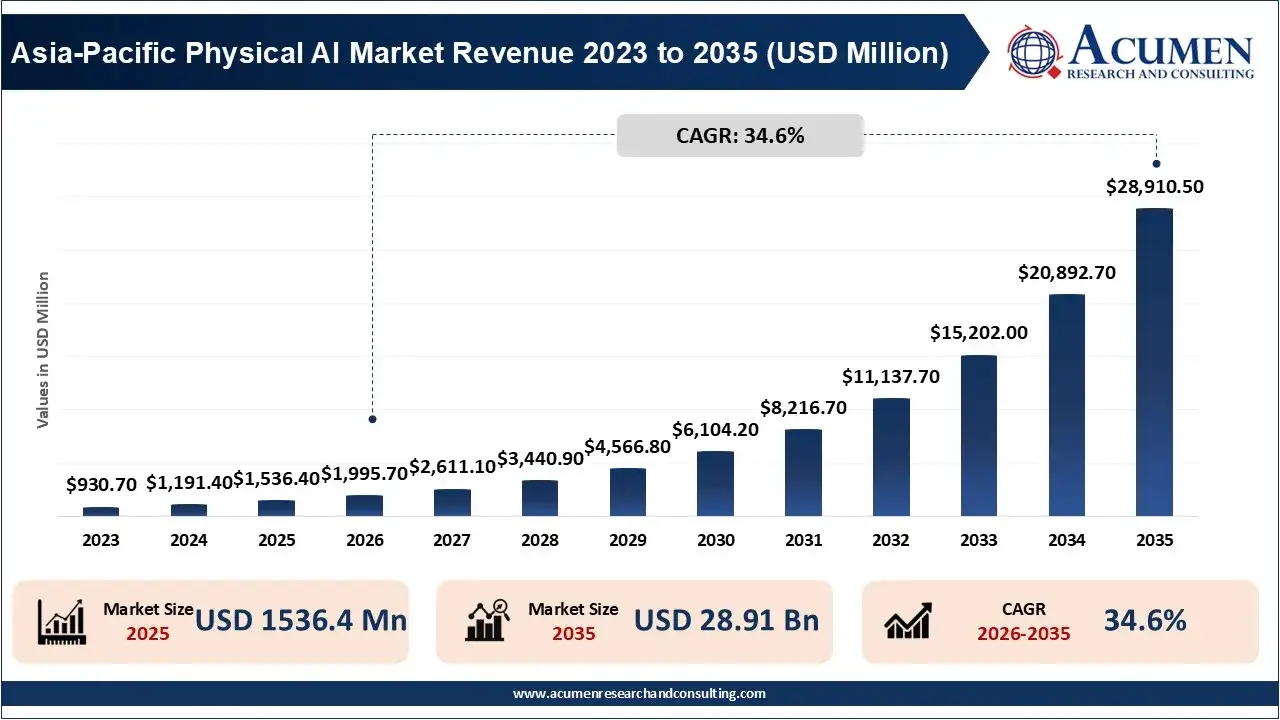
The Asia-Pacific Physical AI market refers to the ecosystem of AI-enabled physical systems that can perceive, interpret, learn, make decisions, and perform actions within real-world environments. It includes intelligent robots, humanoids, autonomous machines, collaborative robots, mobile robots, and AI-enabled industrial equipment supported by computer vision, machine learning, reinforcement learning, natural language processing, sensors, edge computing, and robotic control systems. The market covers hardware, software, and associated services used across manufacturing, automotive, healthcare, logistics, agriculture, retail, defense, and other applications.
Asia-Pacific Physical AI Investment Landscape
Driven by concentrated robot manufacturing, semiconductor capacity, electronics production, AI infrastructure, and automation potential at the industrial scale, Asia-Pacific has emerged as a nucleus of physical AI investment. Asia-Pacific accounted for 74% of robot installation in 2024, with 54% solely from China’s 295k deployments around the world creating a solid installed base for an AI based perception, autonomous control, computer vision and intelligent manipulation to build on.
- China represents the highest interest for venture Capital as well as Unitree preparing to IPO in Shanghai for $6.1B in 2026, with DeepSeek recently investing RMB 140.8 Million for 2.31% in the company coupling AI model capabilities with robotics, physical control, motion control and real world data.
From an investment perspective, the strongest opportunities are moving toward technologies that address the major commercialization bottlenecks of physical AI: high-performance edge computing, AI accelerators, robot sensors, dexterous actuators, simulation, multimodal foundation models, robot data collection, autonomous navigation, and fleet-management platforms. This creates opportunities not only for robot manufacturers but also for semiconductor companies, component suppliers, AI developers, system integrators, cloud providers, and industrial automation firms.
Asia-Pacific Physical AI Market Country-level Analysis
| Country | Key Market Analysis |
|---|---|
| China |
|
| Japan |
|
| India |
|
| South Korea |
|
| Rest of Asia-Pacific |
|
Where Are the Biggest Physical AI Investment Opportunities in Asia-Pacific?
- Humanoid robotics and general-purpose robots - A growing proportion of capital has gone into humanoids capable of perception, reasoning, navigation, and manipulation over multiple tasks. Venture-backed humanoids are gaining investor traction with recent rounds and IPOs for scalable robot startups, although successful commercialization and economics of delivery will matter.
- AI-enhanced industrial automation - Brownfield automation in factories that can be upgraded by computer vision, predictive intelligence, autonomous reasoning, and adaptive control is a near-term avenue of attack.
- Physical AI foundation models - Vision-language-action models, robotics foundation models, reinforcement learning, and other multi-modal AI approaches are getting important as they enable a generic form of robot intelligence across different hardware designs, blurring the lines between robot hardware manufacturers and the teams building those intelligence engines.
- Edge AI for robotics computing – Robotics demands low latency inference and that means the rise of AI chips, module components and specialized computing stacks with the investment in those categories starting to expand from data center GPUs to edge.
Asia-Pacific Physical AI R&D Spending by Country
| Country | R&D / Investments | Key Highlights |
|---|---|---|
| China | Robotics and AI R&D programs | China’s national robotics R&D programs operate under its industrial-development strategy, with the 14th Five-Year Plan for robotics running through 2025. |
| Japan | Corporate and robotics foundation-model investment | ANA Holdings invested in South Korean robotics-foundation-model developer RLWRLD in 2025; RLWRLD subsequently raised about $14.8 million in seed funding from strategic investors across Asia. |
| South Korea | AI and robotics investment | Hyundai Motor Group committed KRW 125.2 trillion ($86 billion) in domestic investment for 2026–2030, including KRW 50.5 trillion for future businesses such as AI, software-defined vehicles and robotics and KRW 38.5 trillion for R&D. |
| Other countries in Asia-Pacific | Robotics R&D programs | The IFR's 2025 review covers robotics R&D funding strategies across 13 countries, including China, Japan, South Korea, and Singapore. |
China-Japan-South Korea Physical AI Competitive Benchmark
Three major competitive model in Asia-Pacific physical AI systems, Chinese, Japanese and South Korean models can be clearly delineated. In China, strengths are pooled in the scale of domestic robot factories, domestic component suppliers, an emerging number of humanoid robots entrepreneurs, and massive investments from China tech giants.
A slew of companies, such as the Unitree, UBTECH, AgiBot, Fourier Intelligence, Xiaomi, all compete on the humanoid robotics and robots the same time compete the industrial robots, service robots market while Unitree successfully filed for listing on the Shanghai Stock Exchange in 2026 for close to $6.1 billion, plus there has been an investment of $140.8 million in Unitree by DeepSeek independently.
On one end the Japanese model is best characterized by the established powers of the industrial robot and precision manufacturing automation players like FANUC, Yaskawa Electric, Kawasaki Heavy Industries, Toyota, Mitsubishi Electric with ready industrial robot machines, controls and manufacturing capabilities to integrate new AI model tech into robot foundations.
On the other hand South Korea with the combined powers of silicon, automotives, consumer electronics, batteries industries is expanding further with the leading tech players from each sector including the big name Samsung Electronics, Hyundai Motor Group, LG Electronics, Doosan Robotics, and Rainbow Robotics and is to invest 125.2 trillion won domestically to 2030 with much of this budget in AI, softwares, robotics, and R&D of new generation AI.
Segments Covered
By Deployment
- Cloud-based AI
- On-device AI
By Component
- Hardware
- Software
- Services
By Technology
- Computer Vision
- Speech/NLP
- Gesture/Movement Recognition
- Reinforcement Learning & Control Systems
- Others
By Robot Type/Form Factor
- Industrial Robots
- Service Robots
- Humanoids/Social Robots
- Cobots
- Exoskeletons/Prosthetics
- Mobile Robots/Drones
By Application
- Healthcare
- Manufacturing & Automotive
- Logistics & Warehousing
- Retail & Hospitality
- Defense & Security
- Agriculture
- Education & Research
- Others
By Country
- China
- India
- Japan
- South Korea
- Rest of APAC
Contact Us:
Mr. Richard Johnson
Acumen Research and Consulting
India: +91 8983225533