
China Physical AI Market to Reach USD 11,679.4 Million by 2035 | CAGR of 34.9%
Published : 11 Aug 2026
Author : Lucas Hoffmann



What is the China Physical AI Market Size?
The China physical AI market size was recorded at USD 606.6 million in 2025 and is expected to reach USD 11,679.4 million by 2035; growing at a CAGR of 34.9% over the forecast period 2026-2035. Growth in China's physical AI market is fueled by rising investments in embodied intelligence and robotics innovation, with China accounting for approximately 60% of global AI patent filings and maintaining one of the world's largest ecosystems for AI research, manufacturing, and commercialization.
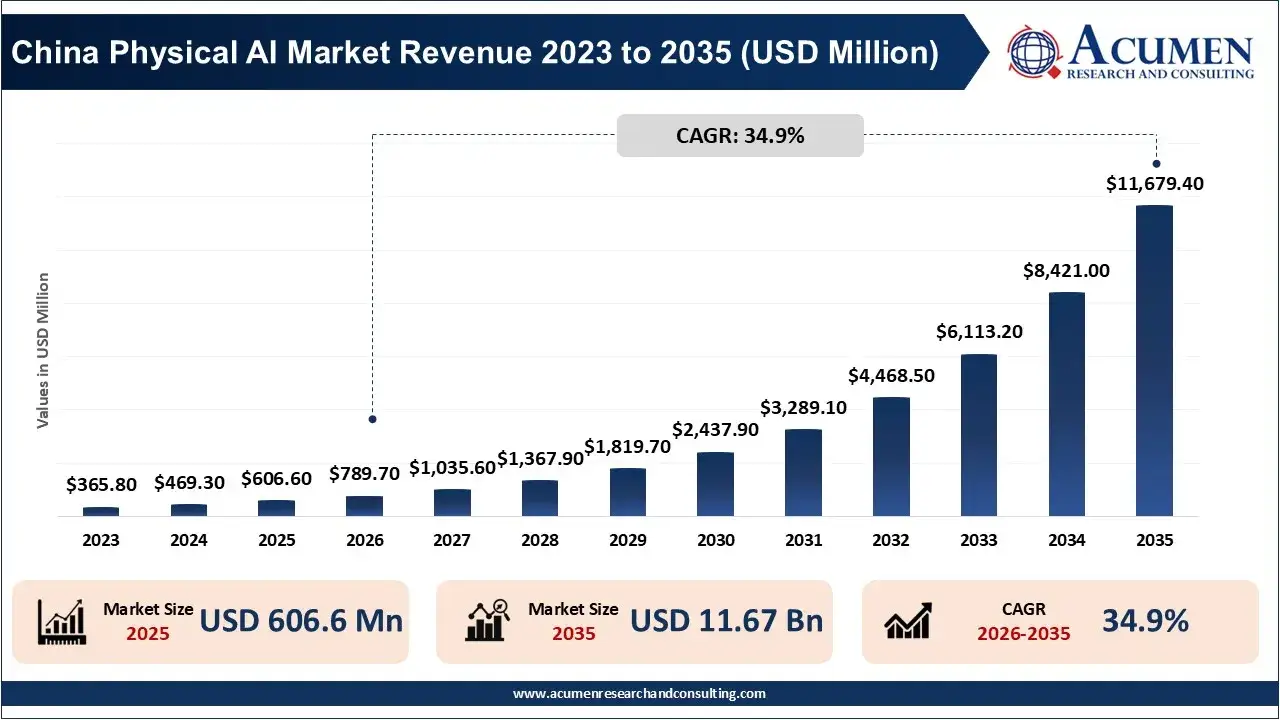
China Physical AI Market Overview
The China physical AI market is set for its new round of growth as new technologies from multimodal AI models to robotic and autonomous system will get transferred from lab into production. Chinese increased AI computing power, immense mass production ecosystem, and booming new applications based on smart physical agents, are the driving factors behind the market development.
According to related data, in 2024, China’s share of the total global value-added of manufacturing approximated 36%, generating a robust application market for AI-powered automation, intelligent production solutions, and autonomous robots.
At precision manufacturing applications, so does the field for machine vision and computer-enabled quality inspection for sophisticated manufacturing sectors. With applications emerging on new levels, supported by massive government policy and continuing infrastructure construction on AI, companies from Huawei, UBTECH, Unitree, Baidu, Alibaba, DJI, Siasun, Estun, are aggressively bringing AI-powered physical intelligence solutions to maturity
Emerging Trends
- Rise of Humanoid Robots in Manufacturing: Chinese companies are accelerating humanoid robot development for factory operations, logistics, and service applications, moving from prototypes toward commercial deployment.
- Integration of AI Foundation Models with Robots: Companies are combining large AI models with robotics platforms to improve perception, reasoning, learning, and autonomous decision-making.
- Growth of Embodied AI Models: China is investing in physical world models that enable robots to learn from simulations and real-world interactions.
- Expansion of AI-Powered Smart Factories: Manufacturers are adopting AI robotics, digital twins, computer vision, and autonomous systems to improve production efficiency.
- Increasing Adoption of Edge AI: On-device AI processing is gaining importance for low-latency decision-making, safety, and real-time robotic operations.
- Localization of Robotics Supply Chain: Chinese companies are expanding domestic production of AI chips, sensors, actuators, and robotic components to strengthen self-reliance.
- Growth of Autonomous Mobile Robots (AMRs): Logistics and warehousing sectors are adopting AI-powered mobile robots for automated material movement and inventory management.
How Is China Investing in AI-Powered Industrial Automation?
| Investment Area / Initiative | Investments | Key Developments and Impact on Physical AI |
|---|---|---|
| Smart Factory Development | China has established more than 400 national-level smart manufacturing demonstration factories and pilot projects across key industries. | Accelerates implementation of AI-driven production planning, autonomous operations, predictive maintenance, and intelligent factory management systems. |
| AI Computing Infrastructure Development | China is expanding national computing infrastructure through the East Data, West Computing (EDWC) initiative, involving multiple national computing hubs and thousands of AI computing clusters. | Provides large-scale computing resources required for training physical AI models, simulation environments, digital twins, and autonomous robotic systems. |
| Humanoid Robot Investment | China identified humanoid robots as a strategic emerging industry, with more than 100 companies involved in humanoid robot development and related technologies. | Supports commercialization of next-generation physical AI systems for manufacturing, logistics, healthcare, and service applications. |
| Industrial AI and Robotics R&D | China’s total R&D expenditure exceeded CNY 3.6 trillion (approximately USD 500 billion) in 2024, maintaining one of the world's largest research ecosystems. | Strengthens domestic innovation in AI algorithms, robotics hardware, sensors, AI chips, and autonomous control technologies. |
| Semiconductor and AI Chip Development | China is investing billions of dollars through national semiconductor initiatives to expand domestic AI chip and computing capabilities. | Reduces dependency on foreign processors and supports development of edge AI systems required for real-time robotic decision-making. |
| Automotive and New Energy Vehicle Automation | China produced approximately 9.5 million new energy vehicles in 2024, supported by highly automated manufacturing facilities. | Drives demand for AI-enabled robotics in battery production, vehicle assembly, automated inspection, and intelligent supply chains. |
| Industrial Internet Expansion | China has deployed more than 300 large-scale industrial internet platforms connecting millions of industrial devices and enterprises. | Enables real-time data exchange between machines, factories, and AI systems, improving autonomous manufacturing and operational optimization. |
| AI Adoption in Manufacturing Enterprises | More than 70% of large Chinese manufacturing enterprises have adopted digital technologies, including AI, industrial IoT, and automation solutions. | Expands the addressable market for AI-powered industrial robots, autonomous systems, and intelligent production platforms. |
Where Will the Biggest Investment Opportunities Emerge in China’s Physical AI Market?
Within the physical AI market in China, there is a strong appetite for investment in the humanoid robotics space as well as those with applications in AI-enabled manufacturing, robotic components, industrial software, and autonomous systems. As China has established a manufacturing base that delivered more than CNY 40 trillion in 2025 (equivalent to approximately $5.6 trillion) in industrial value-added output, the opportunity to implement and adopt intelligent machines, fully-automated systems and AI-powered factory solutions for industrial production is considerable.
The biggest opportunities will come in automobile as well as new energy vehicle segment where China produced more than 12 million vehicles in 2025 and the growing number of new energy vehicles on road will boost the demand for the AI enabled assembly lines, robots enabled testing, intelligent battery facilities production as well as the supply chain systems.
Which Chinese Areas are Becoming Physical AI Innovation Centers?
- Beijing: Beijing is emerging as China’s leading AI research center, supported by major universities, national laboratories, and technology companies developing large AI models, robotics platforms, and autonomous systems.
- Shanghai: Shanghai is developing a strong humanoid robotics ecosystem through government-backed robotics programs, manufacturing partnerships, and AI innovation zones.
- Shenzhen: Shenzhen benefits from its advanced electronics manufacturing ecosystem, supporting production of sensors, cameras, AI chips, drones, and robotic components.
- Guangdong Province: Guangdong has become one of China's largest robotics manufacturing regions, supported by automotive, electronics, and precision manufacturing industries.
Top AI Infrastructure Investments in China
- Alibaba is expanding AI infrastructure through its large-scale cloud computing network, AI model platforms, and data center investments, supporting robotics simulation, intelligent manufacturing, and enterprise AI deployment.
- Tencent is investing in AI computing clusters, cloud infrastructure, and large-scale AI platforms to support industrial AI, robotics, simulation environments, and intelligent enterprise solutions.
- SenseTime is investing in AI infrastructure through its SenseCore AI computing platform, providing AI computing resources, foundation model training capabilities, and computer vision solutions.
Segments Covered
By Deployment
- Cloud-based AI
- On-device AI
By Component
- Hardware
- Software
- Services
By Technology
- Computer Vision
- Speech / NLP
- Gesture / Movement Recognition
- Reinforcement Learning & Control Systems
- Others
By Robot Type / Form Factor
- Industrial Robots
- Service Robots
- Humanoids / Social Robots
- Cobots
- Exoskeletons / Prosthetics
- Mobile Robots / Drones
By Application
- Manufacturing & Automotive
- Healthcare
- Logistics & Warehousing
- Retail & Hospitality
- Defense & Security
- Agriculture
- Education & Research
Contact Us:
Mr. Richard Johnson
Acumen Research and Consulting
India: +91 8983225533