
Airborne ISR Market Size to Reach USD 26.72 Billion by 2035, Growing at a CAGR of 5.5%
Published : 02 Jul 2026
Author : Raghuram Nair



What is the Airborne ISR Market Size?
The global airborne ISR market size accounted for USD 15.60 billion in 2025 and is estimated to attain around USD 26.72 billion by 2035 growing at a CAGR of 5.5% from 2026 to 2035. Growing geopolitical tensions, ongoing defense modernization initiatives, and surging demand for real-time surveillance across the world have propelled the airborne ISR (Intelligence, Surveillance, and Reconnaissance) market within the global aerospace and defense industry.
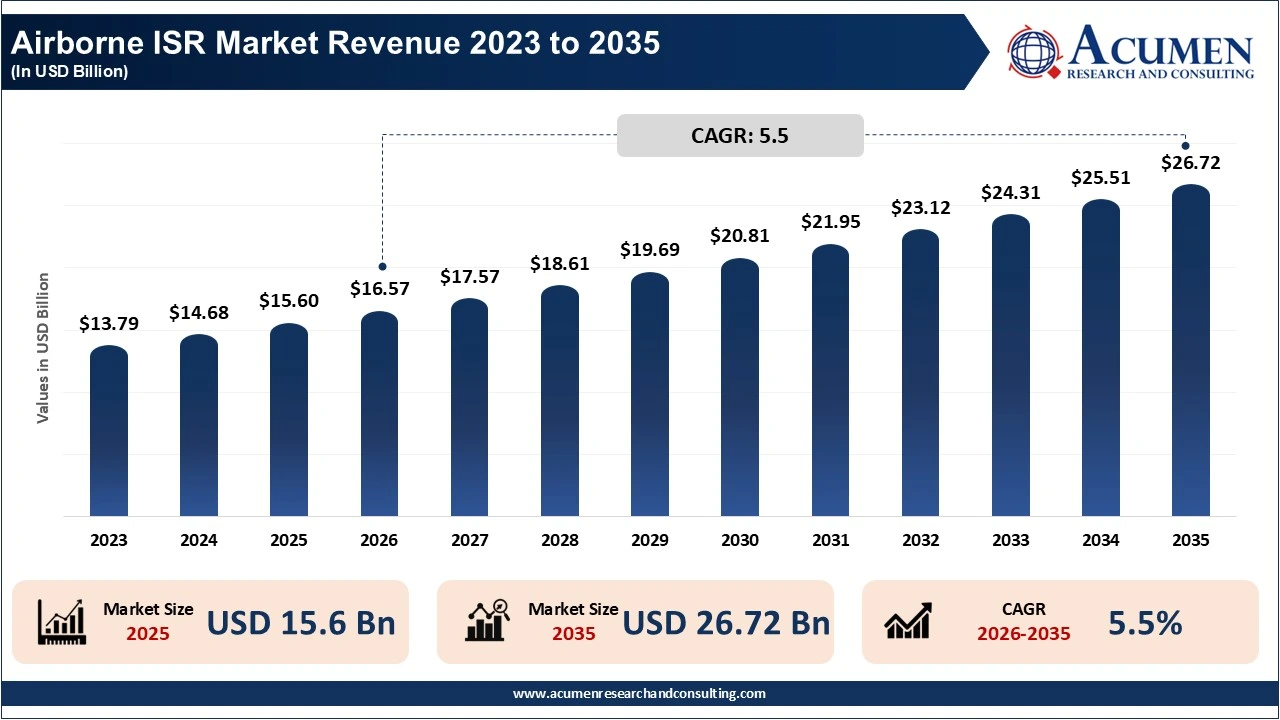
The airborne ISR market represents the global market of technologies and solutions pertaining to airborne intelligence, surveillance and reconnaissance systems, utilized for gathering, processing and transmitting of real-time strategic and tactical data. This includes fixed-wing, rotary-wing, unmanned aerial systems (UAS), high altitude, and other airborne intelligence platforms that leverage sophisticated ISR sensor technologies.
The market revolves around technologies such as radar systems, electro-optical/infrared sensors (EO/IR), and signals intelligence (SIGINT) systems. These technologies are mainly employed by military and homeland security agencies, and intelligence bodies to surveil the battlefield, border protection, sea lane control, antiterrorism and disaster management.
Airborne ISR Market Statistics
- By platform, fixed-wing aircraft contributed 46% to the total market in 2025, owing to their extensive coverage and the simultaneous deployment of numerous sophisticated ISR payloads.
- By platform, UAVs commanded a significant 31% of the market in 2025 and are expected to demonstrate the most robust growth by 2035. The preference for UAVs by many defense organizations in the wake of increased deployments in prolonged and highly challenging surveillance tasks is expected to contribute significantly to the growth.
- By aircraft type, military aircraft dominated 82% of the market share in 2025 owing to the rising demand for real-time intelligence during combat operations and in strategic missions.
- By aircraft type, the government and homeland security aircraft segment occupied 13% of the market share in 2025, driven by increasing threats to domestic security and the growing need to monitor borders due to the increased rate of illegal cross border movement of illegal migrants.
- By range/endurance, medium-endurance aircraft acquired the highest market share of 42% in 2025. They represent the optimal compromise between cost and operation time and, thus, are widely employed in various domestic security and tactical intelligence operations.
- By range/endurance, long-endurance aircraft had a market share of 30% in 2025. Due to their capabilities to carry advanced payloads for long periods over the battlefield, including more than 24 hours, long-endurance aircraft are well suited for extensive monitoring and maritime operations.
- By payload, electro-optical (EO)/Infrared (IR) payload had a 39% market share in 2025. This payload is used to identify and track objects and is most commonly employed in both day and night time vision capabilities for ground support, search and rescue operations and a variety of other military missions.
- By payload, radar payload commanded a second major segment with a 27% market share in 2025. Radar payloads offer effective surveillance capabilities, including the ability to monitor movement and scan larger areas in a multitude of conditions. The use of advanced technologies, such as synthetic aperture radar (SAR) payloads, in modern ISR systems contributes significantly to this segment's expansion.
- By end user, the military segment held the largest 74% market share in 2025. Rising levels of conflict globally are contributing to the increasing demand for airborne ISR technologies in defense missions.
- By end user, homeland security gained a significant 12% market share in 2025. Rising terrorism risks, border security concerns, and the demand for efficient migration monitoring systems continue to contribute to the increasing preference for these platforms.
- By application, military ISR garnered a whopping 58% of the total market in 2025. Driven by military operations, strategic decision making, and the increasing adoption of advanced and targeted ISR technologies, military ISR is expected to lead the growth in the ISR market during the forecast period.
- By application, the counter-terrorism market segment occupied 11% of the total market share in 2025. Counter-terrorism requires immediate information and targeted response; therefore, ISR systems are playing an essential role in surveillance, reconnaissance, and intelligence gathering to prevent and combat terrorist threats globally.
Integration of Artificial Intelligence and Predictive Analytics: Market’s Massive Opportunity till 2035
Machine learning and other AI capabilities offer promising advantages in airborne ISR, such as enabling faster processing of enormous datasets and minimizing the requirement for human intervention. AI systems can quickly analyze live radar, thermal imagery, and signal intelligence to identify likely threat targets at much lower detection levels than a human operator can reliably manage.
Furthermore, predictive analytics enabled by AI would allow armed forces to forecast anticipated movement, identify anomalous behavior, and optimize planning and targeting. For both government and defense contracting firms aiming to capitalize on recent progress, machine learning approaches, autonomous sensing technology and cloud-based data infrastructure are anticipated to be distinguishing factors in next generation airborne ISR.
Airborne ISR Market Regional Outlook
What makes North America the leader in the airborne ISR market?
North America represented the dominant airborne ISR market in terms of revenue in 2025, contributing 39% to the overall market. North America’s prominent position is mainly due to a well-established aerospace-defense ecosystem, robust technology expertise, and a significant presence of ISR platforms utilized across military and homeland security operations.
North America's continuous development and integration of emerging airborne ISR technologies, including AI-driven target detection, sensor fusion, and the implementation of comprehensive airborne-space surveillance systems, are a crucial factor driving the market.
The U.S. is the key driver in the North America airborne ISR market as the nation’s vast fleet modernization programs, demand for persistent surveillance operations in forward locations, and upgraded airborne command and control systems have boosted its investment in advanced intelligence, surveillance, and reconnaissance (ISR) technologies.
Why is Asia Pacific poised to be the fastest growing airborne ISR market?
Asia Pacific is poised to be the fastest growing airborne ISR market, exhibiting a CAGR of 8.5% from 2026 to 2035. Rising border disputes and territorial claims, extensive deployment of naval vessels and heightened surveillance needs across strategically located airways are the key growth drivers of the region's market.
China is intensifying its airborne surveillance and intelligence efforts, with investments in long-range unmanned surveillance drones and Airborne Early Warning & Control (AEW&C) systems, and an anti-submarine patrol aircraft fleet aimed at surveillance of the South China Sea and Taiwan Strait.
India is investing in indigenizing its indigenous airborne ISR systems with indigenous development programs for AEW&C aircraft, small surveillance drones, and integrated intelligence systems under the national ‘Make in India’ initiative.
Who are the top players in the Airborne ISR Market?
Companies like Lockheed Martin, Northrop Grumman, and L3Harris Technologies lead the market in developing sophisticated airborne early warning and control systems, electronic warfare, and mission-focused intelligence platforms. Northrop Grumman's Global Hawk drone, for instance, is a leading airborne intelligence, surveillance, and reconnaissance (ISR) platform.
The companies' efforts to integrate advanced sensor technologies and AI-powered analytics will fuel growth in new generation ISR platforms. European firms like Thales Group and Israel Aerospace Industries also contribute to the rapidly expanding market, providing state-of-the-art surveillance and intelligence systems.
Market Segmentation
By Platform
- Fixed-Wing Aircraft
- Rotary-Wing Aircraft
- UAVs
- Aerostats/HAPS
By Aircraft Type
- Military Aircraft
- Government & Homeland Security Aircraft
- Commercial/Special Mission Aircraft
By Range/Endurance
- Short-Endurance (<10 hours)
- Medium-Endurance (10–24 hours)
- Long-Endurance (>24 hours)
By Payload
- Electro-Optical (EO)/Infrared (IR)
- Radar
- SIGINT/ELINT/COMINT
- Multi-INT
By End User
- Military
- Homeland Security
- Intelligence Agencies
- Law Enforcement
By Application
- Military ISR
- Counterterrorism
- Border Surveillance
- Maritime Domain Awareness
- Search & Rescue
- Disaster Response
- Environmental Monitoring
- Critical Infrastructure Protection
By Region
- North America
- Europe
- Asia-Pacific
- Latin America
- Middle East & Africa
Contact Us:
Mr. Richard Johnson
Acumen Research and Consulting
India: +91 8983225533