
Aseptic Packaging Market Set to Expand Beyond USD 170 Billion by 2035
Published : 05 Nov 2026
Author : Raghuram Nair



What is the Aseptic Packaging Market Size?
The global aseptic packaging market size was valued at USD 80 billion in 2025 and is expected to surpass USD 170 billion by 2035, while expanding at a CAGR of 7.8% during the forecast period 2026 to 2035. Rising demand for shelf-stable food, beverages, and pharmaceutical products is driving the adoption of aseptic packaging. Improvements in sterilization technologies, growing consumption of packaged dairy and ready-to-drink beverages, and the need to extend product shelf life without conventional preservatives are supporting market expansion.
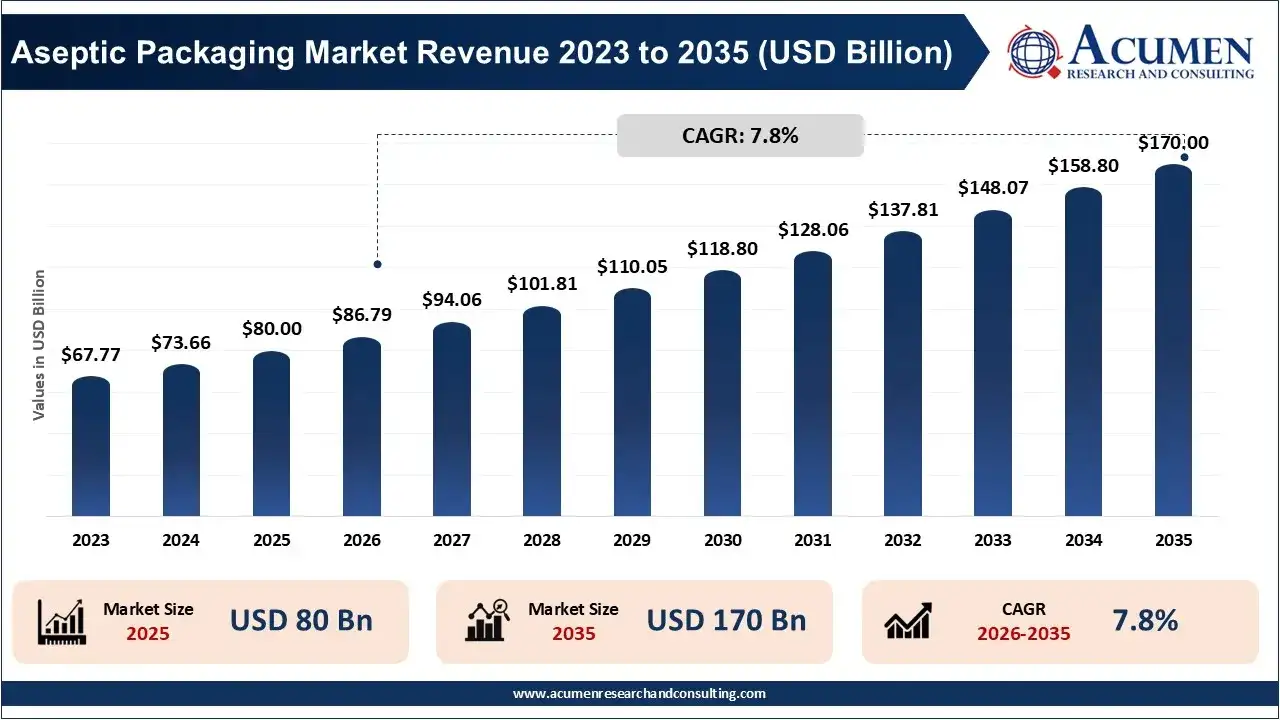
Aseptic Packaging Market: An Industry Moving Beyond Shelf Life
Aseptic packaging is becoming an important part of modern food, beverage, and pharmaceutical supply chains. By sterilizing the product and packaging material separately before filling and sealing under controlled conditions, manufacturers can maintain product safety and quality while reducing dependence on refrigeration in suitable applications.
In 2025, Asia-Pacific accounted for 39.0% of the global market, generating USD 31.20 billion in revenue. Strong demand for packaged beverages, dairy products, and convenient food formats, combined with expanding manufacturing capabilities, supports the region's leadership. Meanwhile, the Middle East & Africa is emerging as a high-growth market as food processing capacity, urban consumption, and modern retail networks expand.
Four Shifts Reshaping Aseptic Packaging
- Shelf-stable beverage innovation: Dairy alternatives, flavored milk, juices, and ready-to-drink products are creating demand for packaging that protects quality during storage and distribution.
- More diversified packaging formats: Cartons continue to serve high-volume beverage applications, while bottles, pouches, vials, and prefilled syringes address more specialized product requirements.
- Material innovation: Packaging producers are exploring improved barrier materials, recyclable structures, and alternative material combinations to balance product protection with environmental considerations.
- Pharmaceutical-grade packaging requirements: Increasing demand for sterile medicines and injectable products is creating opportunities for packaging formats that meet stringent quality and contamination-control requirements.
Where the Market Is Concentrated: Segment Breakdown
Product Formats: Cartons Retain Their Stronghold
Cartons held the largest product-type share in 2025, accounting for 39.0% of the aseptic packaging market. Their widespread use in milk, juices, dairy beverages, and other shelf-stable liquid products supports their leading position. Cartons offer convenient storage, efficient transportation, and established compatibility with high-volume filling systems.
Bottles and cans ranked second with a 22.0% share. Their adoption is supported by demand for convenient dispensing, resealable packaging, and differentiated product presentation. Bags and pouches, vials and ampoules, and prefilled syringes serve additional requirements across food, beverage, and pharmaceutical applications.
Material Choices: Plastics Lead, Alternative Structures Gain Attention
Plastics dominated the material segment with a 46.0% share in 2025, reflecting their flexibility, lightweight properties, sealing performance, and compatibility with different packaging formats. Plastic-based structures are widely used in aseptic bottles, pouches, closures, and multilayer packaging systems.
Paper and paperboard ranked second, accounting for 32.0% of the market. Their use in beverage cartons is supported by structural strength, printability, and opportunities to reduce reliance on conventional plastic packaging. Other materials are expected to grow at the fastest rate, with a projected CAGR of 16.4% from 2026 to 2035, reflecting interest in alternative barrier solutions and evolving material technologies.
Application Mix: Beverages Remain the Primary Demand Centre
Beverages accounted for 42.0% of the market in 2025, making them the leading application segment. Aseptic packaging is widely used for milk, flavored dairy drinks, fruit juices, plant-based beverages, and ready-to-drink products. Its ability to support ambient distribution and extended shelf life makes it particularly relevant to beverage manufacturers serving geographically dispersed markets.
Food ranked second with a 31.0% share, supported by applications such as soups, sauces, liquid foods, and prepared products. Pharmaceuticals accounted for 19.0%, reflecting the importance of sterile packaging in maintaining product integrity and preventing contamination. This segment also creates opportunities for specialized formats such as vials, ampoules, and prefilled syringes.
What Will Define the Market Through 2035?
- Broader beverage applications: Demand for shelf-stable dairy, plant-based drinks, juices, and functional beverages is expected to sustain investment in aseptic cartons and bottles.
- Faster regional expansion: The Middle East & Africa is positioned for strong growth as food processing and modern distribution infrastructure develop.
- Material diversification: Alternative barrier materials and improved recyclable structures are likely to attract greater research and development investment.
- Pharmaceutical opportunities: Increasing requirements for sterile drug packaging are expected to support specialized aseptic formats and advanced filling technologies.
- Automation and process control: Manufacturers are likely to invest in automated sterilization, filling, inspection, and packaging systems to improve production consistency and reduce contamination risks.
- Packaging format diversification: Bottles, pouches, vials, ampoules, and prefilled syringes are expected to complement the established carton segment across different applications.
Regional Performance
Asia-Pacific: The Largest Consumption and Manufacturing Base
Asia-Pacific dominated the aseptic packaging market with a 39.0% share in 2025, generating USD 31.20 billion in revenue. The region benefits from its large population, expanding middle-class consumption, and established food and beverage manufacturing industries. Rising demand for packaged milk, juices, dairy products, and ready-to-drink beverages is supporting the adoption of aseptic cartons and bottles. Investments in automated filling lines and modern packaging facilities are further strengthening regional production capabilities.
Middle East & Africa: A High-Growth Market Taking Shape
The Middle East & Africa is projected to register the fastest regional growth, with a CAGR of 10.5% from 2026 to 2035. The regional market is expected to increase from USD 3.47 billion in 2026 to USD 8.50 billion by 2035. Growing urban populations, changing food consumption patterns, and rising demand for products with longer shelf lives are creating opportunities for aseptic packaging suppliers. Investments in food processing, dairy production, and modern retail infrastructure are also encouraging manufacturers to adopt advanced packaging and filling technologies.
Country Markets to Watch
- China: Large-scale beverage production, growing consumption of packaged dairy products, and investments in automated filling technologies are supporting demand for aseptic cartons and bottles.
- India: Expanding dairy processing, rising consumption of packaged milk and juices, and the growth of organized food retail are creating opportunities for aseptic packaging manufacturers.
- Saudi Arabia: Investments in domestic food production, beverage manufacturing, and food security initiatives are supporting the adoption of shelf-stable packaging solutions.
- United Arab Emirates: Modern retail networks, demand for imported packaged food and beverages, and regional distribution activities are creating opportunities for advanced aseptic packaging formats.
Market Constraints and Operational Challenges
Despite its growth potential, the aseptic packaging market faces challenges related to high equipment costs, complex sterilization processes, and stringent quality-control requirements. Establishing aseptic production lines requires specialized machinery, controlled operating environments, and trained personnel. Even minor failures in sterilization or filling conditions can compromise product safety and result in significant losses.
Material sustainability is another important concern. Multilayer packaging structures can be difficult to separate and recycle, particularly when they combine plastics, paperboard, and barrier materials. Manufacturers must therefore balance product protection, packaging performance, production economics, and end-of-life requirements.
Companies Competing in the Aseptic Packaging Market
Tetra Pak, SIG Group, Elopak, Greatview Aseptic Packaging, Amcor, UFlex, Mondi, Schott Pharma, Gerresheimer, Syntegon Technology, Krones AG, and IPI are among the key companies operating in the aseptic packaging market. These players are focusing on packaging innovation, advanced filling technologies, production capacity expansion, and material development to strengthen their market positions.
Competition is shaped by investments in aseptic carton systems, lightweight bottles, flexible packaging formats, pharmaceutical-grade containers, and automated sterilization solutions. Companies are also exploring improved barrier materials and recyclable packaging structures to address changing customer requirements and sustainability expectations.
Segments Covered
By Product Type
- Cartons
- Bottles & Cans
- Bags & Pouches
- Vials & Ampoules
- Prefilled Syringes
- Other Aseptic Packaging Formats
By Material Type
- Plastics
- Paper & Paperboard
- Glass
- Metal
- Other Materials
By Application
- Beverages
- Food
- Pharmaceuticals
- Other Applications
By Region
- North America
- Europe
- Asia-Pacific
- Latin America
- Middle East & Africa
Contact Us:
Mr. Richard Johnson
Acumen Research and Consulting
India: +91 8983225533