
Packaging Coatings Market Size to Reach USD 6,950.95 Million by 2035, Growing at a CAGR of 4.7%
Published : 19 Nov 2026
Author : Raghuram Nair



What is the Packaging Coatings Market Size?
The global packaging coatings market size was valued at USD 4,379 million in 2025 and is expected to reach around USD 6,950.95 million by 2035, expanding at a promising CAGR of 4.7% during the forecast period of 2026-2035. The packaging coatings market is gaining momentum as manufacturers seek better product protection, longer shelf life, improved packaging aesthetics, and compliance with evolving food-contact regulations. Rising consumption of packaged food, beverages, pharmaceuticals, and personal care products is strengthening demand for high-performance coating solutions.
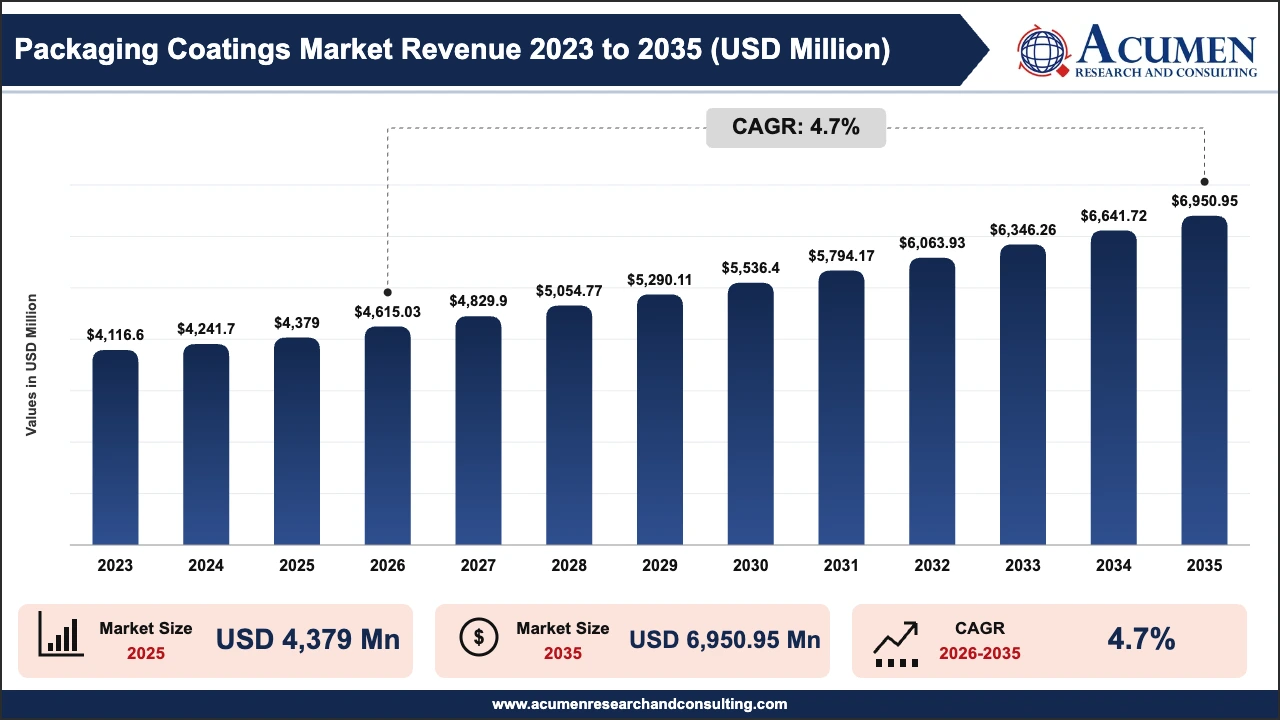
Packaging Coatings Market Key Highlights
- Asia-Pacific dominated the packaging coatings market with a 41.0% share in 2025, generating USD 1,795.39 million, and is also the fastest-growing region at a 5.2% CAGR.
- Epoxies led the resin type segment with a 36.0% share in 2025.
- Water-based coatings accounted for 36.0% of the coating technology segment.
- Rigid packaging held a 65.0% share by packaging application, while food and beverages represented 52.0% of demand by end-use industry.
- The Middle East & Africa accounted for 6.0% of global revenue and is projected to reach USD 417.06 million by 2035.
Packaging Coatings Market: Industry Overview
Packaging coatings play an important role in protecting packaging materials from moisture, oxygen, corrosion, chemicals, and external contamination. Applied to metal, paper, plastic, and other packaging substrates, these coatings help preserve product quality while improving durability, printability, and visual appeal. Their importance is particularly evident in food and beverage packaging, where packaging integrity directly affects product safety and shelf life.
The market is evolving as packaging manufacturers balance performance requirements with sustainability objectives. Traditional epoxy and solvent-based formulations continue to serve established applications, while water-based and radiation-curable technologies are gaining attention for their potential to reduce volatile organic compound emissions and improve production efficiency. At the same time, demand for recyclable packaging is encouraging coating suppliers to develop formulations that work effectively with emerging packaging materials and recycling processes.
What Is Driving Demand for Packaging Coatings?
- Growth of packaged food and beverages: Rising consumption of packaged foods, ready-to-eat meals, dairy products, and beverages increases demand for coatings that provide moisture resistance, grease protection, and product safety, in line with the growth of the wider packaging market.
- High-performance packaging requirements: Extended shelf life, corrosion protection, and better barrier properties are pushing metal cans, paperboard cartons, and specialty containers to rely on advanced coatings.
- Regulation-led reformulation: New limits on bisphenols and PFAS in food-contact packaging are creating a large replacement cycle, as can makers and converters qualify new coating systems.
- Sustainability goals: Brand owners' commitments to recyclable and lower-impact packaging are creating demand for coatings that support sustainable packaging designs.
How Are BPA and PFAS Regulations Changing Packaging Coatings?
Regulation is now one of the strongest forces in the market. In the European Union, Regulation (EU) 2024/3190 bans bisphenol A and other hazardous bisphenols in food-contact coatings, with the main transition period ending on July 20, 2026, forcing can makers to reformulate epoxy linings. Since August 12, 2026, the EU Packaging and Packaging Waste Regulation (PPWR) has also restricted PFAS in food-contact packaging. In the United States, a growing number of states restrict intentionally added PFAS in food packaging. As a result, BPA-free polyester and acrylic can linings, fluorine-free paper barrier coatings, and low-VOC systems are moving from niche products to mainstream requirements.
Packaging Coatings Market Trends Reshaping Product Development
- Shift toward lower-emission coating formulations: Environmental regulations and sustainability commitments are encouraging manufacturers to explore water-based and UV-curable coatings. These technologies offer opportunities to reduce solvent use while maintaining the surface protection and performance required in demanding packaging applications.
- Growing demand for food-contact-compliant coatings: Food and beverage manufacturers require coatings that protect packaging without compromising product safety. This is driving innovation in formulations designed to meet food-contact requirements, resist chemical interactions, and maintain performance throughout storage and transportation.
- Development of coatings for recyclable packaging: Packaging producers are increasingly evaluating coatings that support recycling and material recovery. Solutions that provide barrier protection without disrupting recycling processes are becoming important as brands move toward more circular packaging systems.
- Increasing use of advanced coating technologies: UV and electron-beam-curable coatings are attracting interest because of their rapid curing capabilities, production efficiency, and potential for lower energy consumption. Their adoption is expected to expand as manufacturers seek faster processing and improved coating performance.
Packaging Coatings Market Segmental Analysis
| Segment | Leading Category | Market Share (2025) | Key Market Influence |
|---|---|---|---|
| Resin Type | Epoxies | 36.0% | Strong adhesion, chemical resistance, and corrosion protection |
| Coating Technology | Water-Based Coatings | 36.0% | Lower solvent use and broad packaging applications |
| Packaging Application | Rigid Packaging | 65.0% | Demand for protective coatings on cans, closures, and containers |
| End-Use Industry | Food & Beverages | 52.0% | Food safety, shelf life, and product protection requirements |
Beyond the leading categories, acrylics ranked second by resin type with a 19.0% share, while polyester is the fastest-growing resin, with its share projected to rise from 13.0% in 2025 to 17.0% by 2035 as demand for bisphenol-free chemistries grows. Solvent-based coatings held 28.0% of the technology segment, and UV / electron-beam curable coatings are expected to grow the fastest at a 7.0% CAGR. Flexible packaging accounted for 30.0% of demand by application, and pharmaceuticals and healthcare represented 15.0% by end use.
Packaging Coatings Market Regional Outlook
Asia-Pacific Leads the Global Packaging Coatings Market
Asia-Pacific dominated the packaging coatings market with a 41.0% share in 2025, generating USD 1,795.39 million in revenue. The region's leading position is supported by its extensive food and beverage manufacturing base, expanding pharmaceutical sector, growing consumer goods industry, and increasing demand for packaged products. Rising investments in packaging production and the presence of major manufacturing economies further strengthen regional demand.
Asia-Pacific is also projected to remain the fastest-growing regional market, registering a CAGR of 5.2% from 2026 to 2035. Its revenue is expected to reach USD 2,988.91 million by 2035. Increasing adoption of advanced packaging materials, demand for improved product protection, and the gradual shift toward more sustainable coating technologies are expected to support this expansion.
Middle East & Africa Shows Steady Market Expansion
The Middle East & Africa packaging coatings market accounted for 6.0% of global revenue in 2025, generating USD 262.74 million. The region's demand is supported by growing consumption of packaged food and beverages, pharmaceutical products, personal care items, and industrial chemicals. Investments in local manufacturing and packaging capabilities are also contributing to market development.
The regional market is projected to reach USD 417.06 million by 2035, expanding at a CAGR of 4.7% from 2026 to 2035. Growth in organized retail, food processing, and pharmaceutical distribution is expected to create additional demand for coatings that improve packaging durability, safety, and product protection.
North America and Europe
North America accounted for about 25.0% of the market in 2025, led by the United States, where demand comes from metal food and beverage cans, aerosol containers, and pharmaceutical packaging. Europe held about 24.0% and is the leading region for reformulation, with strong demand for bisphenol-free can coatings, recyclable paper barrier coatings, and low-VOC systems.
Country-Level Market Developments
- China: Strong packaging manufacturing capacity and high consumption of packaged food, beverages, and consumer products support demand for industrial packaging coatings. Investments in manufacturing efficiency and sustainable packaging are also encouraging product development.
- India: Expanding food processing, pharmaceutical production, personal care consumption, and organized retail are creating opportunities for packaging coating suppliers. Demand for reliable and cost-effective coating solutions is expected to increase alongside packaging capacity.
- Japan: Established food, beverage, and pharmaceutical industries sustain demand for high-performance coatings. Manufacturers place particular emphasis on packaging quality, product safety, and advanced material technologies.
- South Korea: Advanced manufacturing capabilities and demand for packaged consumer goods support the use of specialized coatings. Innovation in packaging materials and production technologies is also influencing market development.
- United Arab Emirates: Growth in food imports, beverage distribution, pharmaceutical supply chains, and regional manufacturing is supporting demand for protective coatings across different packaging formats.
Challenges in the Packaging Coatings Industry
- Regulatory compliance and food-contact safety: Coating manufacturers must meet stringent requirements governing chemical migration, material composition, and product safety. Maintaining compliance across different markets can increase formulation, testing, and certification costs.
- Raw material price volatility: Changes in the prices of resins, solvents, additives, and other chemical inputs can affect production costs and profit margins. Manufacturers must manage sourcing risks while maintaining consistent product quality.
- Transition costs for sustainable formulations: Developing and commercializing lower-emission and recyclable-compatible coatings requires investment in research, testing, production adjustments, and customer validation. Performance expectations can also make the transition challenging for established packaging applications.
- Performance requirements across diverse substrates: Coatings must deliver reliable adhesion, barrier protection, flexibility, and durability across different materials and packaging formats. Developing formulations that meet these requirements without increasing cost remains an important technical challenge.
Recent Developments in the Packaging Coatings Market
- In August 2026, shareholders of AkzoNobel and Axalta approved the all-stock merger of the two companies, which is expected to close in late 2026 or early 2027, subject to regulatory approvals.
- In July 2025, PPG expanded its BPA-NI and PFAS-NI easy-open end coatings for aluminum beverage cans to meet growing global demand.
- In August 2024, AkzoNobel introduced Accelshield 300, an internal aluminum beverage can coating formulated without bisphenols, styrene, PFAS, and formaldehyde.
Competitive Landscape of the Packaging Coatings Market
AkzoNobel N.V., PPG Industries, Inc., The Sherwin-Williams Company, Axalta Coating Systems Ltd., Kansai Paint Co., Ltd., Nippon Paint Holdings Co., Ltd., Valspar, TIGER Coatings, Toyo Ink SC Holdings Co., Ltd., and ACTEGA are among the key companies operating in the packaging coatings market. These participants compete through formulation innovation, product performance, regulatory compliance, manufacturing capabilities, and relationships with packaging producers.
Frequently Asked Questions
How big is the packaging coatings market?
The global packaging coatings market was valued at USD 4,379 million in 2025 and is projected to reach USD 6,950.95 million by 2035.
What is the growth rate of the packaging coatings market?
The packaging coatings market is expected to grow at a CAGR of 4.7% from 2026 to 2035.
Which region leads the packaging coatings market?
Asia-Pacific led with a 41.0% share in 2025 and is also the fastest-growing region, at a 5.2% CAGR.
Which end-use industry uses the most packaging coatings?
Food and beverages was the largest end-use industry with a 52.0% share in 2025, driven by food safety, shelf life, and product protection requirements.
Market Segments Covered in the Report
By Resin/Product Type
- Epoxies
- Acrylics
- Polyurethane
- Polyester
- Polyolefins
- Other Resins
By Coating Technology
- Water-Based Coatings
- Solvent-Based Coatings
- UV / Electron-Beam (EB) Curable Coatings
- Heat-Cured / Hot-Melt Coatings
- Other Specialty Coating Technologies
By Packaging Application
- Rigid Packaging
- Flexible Packaging
- Other Packaging Applications
By End-Use Industry
- Food & Beverages
- Pharmaceuticals & Healthcare
- Personal Care & Cosmetics
- Industrial & Chemicals
- Household Products & Other End Uses
By Region
- North America
- Europe
- Asia-Pacific
- Latin America
- Middle East & Africa
Contact Us:
Mr. Richard Johnson
Acumen Research and Consulting
India: +91 8983225533