
Packaging Coatings Market Size, Share, Trends and Forecast 2026 to 2035
Packaging Coatings Market (By Resin/Product Type: Epoxies, Acrylics, Polyurethane, Polyester, Polyolefins, Other Resins; By Coating Technology: Water-Based, Solvent-Based, UV / EB Curable, Heat-Cured / Hot-Melt, Others; By Packaging Application: Rigid Packaging, Flexible Packaging, Others; By End-Use Industry: Food & Beverages, Pharmaceuticals & Healthcare, Personal Care & Cosmetics, Industrial & Chemicals, Household & Others) - Global Industry Analysis, Size, Share, Regional Analysis, Trends and Forecast 2026 - 2035
- Last Updated: 19 Nov 2026
- Report Code: ARC3874
- Category: Packaging
Packaging Coatings Market Size and Forecast 2026 to 2035
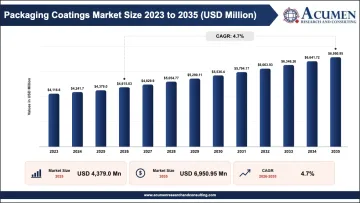
The global packaging coatings market size was valued at $4,379.0 million in 2025. The market is projected to reach $6,950.95 million by 2035 from $4,615.03 million in 2026, expanding at a CAGR of 4.7% during the forecast period from 2026 to 2035. Growth in the packaging coatings market is driven by rising demand for packaged food and beverages, longer shelf-life requirements, corrosion protection for metal cans and containers, and advances in high-performance barrier coatings. At the same time, the EU ban on bisphenol A (BPA) in food-contact materials and new PFAS limits for food packaging are speeding the move to BPA-free, PFAS-free, water-based, and recyclable coating formulations.
- Base Year Market Size (2025): $4,379.0 million
- Current Year Market Size (2026): $4,615.03 million
- Estimated Year Market Size (2035): $6,950.95 million
- Forecast Period CAGR (2026-2035): 4.7%
Key Takeaways
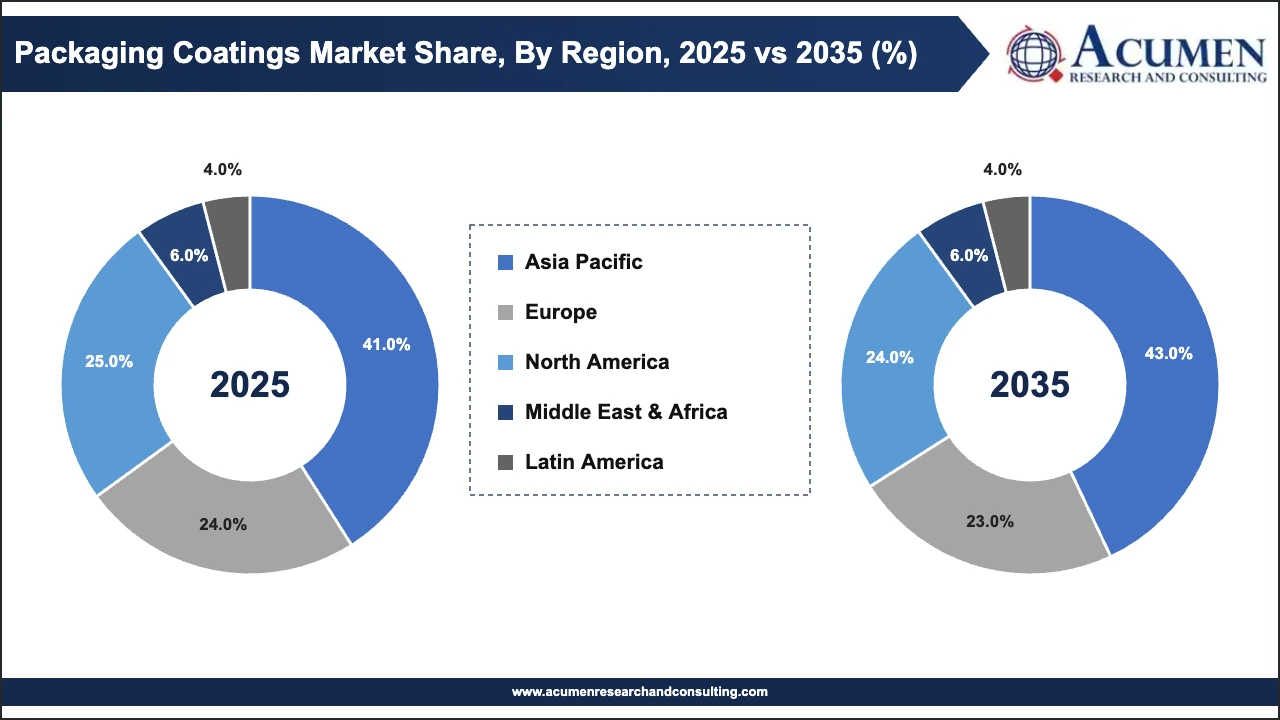
- By region: Asia-Pacific dominated the packaging coatings market with a 41.0% share in 2025, generating USD 1,795.39 million in revenue. The region is also the fastest-growing, with a projected CAGR of 5.2% from 2026 to 2035, and is expected to reach USD 2,988.91 million by 2035.
- By resin type: Epoxies dominated the packaging coatings market with a 36.0% share in 2025, while acrylics ranked second with a 19.0% share. Polyester is gaining importance, with its share projected to rise from 13.0% in 2025 to 17.0% by 2035.
- By coating technology: Water-based coatings dominated the market with a 36.0% share in 2025, while solvent-based coatings ranked second at 28.0%. UV / electron-beam (EB) curable coatings are the fastest-growing technology, with a projected CAGR of 7.0% from 2026 to 2035.
- By packaging application: Rigid packaging dominated the market with a 65.0% share in 2025, followed by flexible packaging at 30.0%, supported by metal cans, closures, and containers that require corrosion protection.
- By end-use industry: Food and beverages dominated the market with a 52.0% share in 2025, generating USD 2,277.08 million, followed by pharmaceuticals and healthcare at 15.0%.
Packaging Coatings Market Overview
Packaging coatings are thin functional layers applied to the inside or outside of packaging materials such as aluminum and steel cans, closures, plastic films, paper and paperboard, and glass. Internal coatings, such as can linings, create a barrier between the package and its contents to prevent corrosion, protect flavor, and limit the migration of substances into food or drugs. External coatings, varnishes, and overprint coatings protect printed graphics, add gloss or matte effects, and improve scratch and abrasion resistance. Functional barrier coatings on paper and film provide resistance to moisture, oxygen, grease, and heat so that lighter or recyclable materials can replace heavier or multi-material packaging.
The industry serves can makers, closure producers, flexible packaging converters, paperboard and carton manufacturers, and brand owners in food, beverages, pharmaceuticals, personal care, household products, and industrial chemicals. Coating suppliers compete on food-contact compliance, protective performance, line speed and curing efficiency, and compatibility with recycling systems.
Executive Summary
The global packaging coatings market is expected to be driven by rising demand for protective, functional, and sustainable coatings in food and beverage, personal care, pharmaceutical, and industrial packaging. Coatings deliver corrosion protection, product protection, visual enhancement, and barrier performance that help packaging manufacturers meet safety and shelf-life standards.
Resin and chemical prices, compliance costs, and the technical challenge of matching coating performance with recyclability continue to shape product choices and adoption. Suppliers that offer application-specific performance, regulatory readiness, and cost-effective formulations will be best placed to meet the changing needs of packaging substrates and end-use markets.
Recent Trends
- Transition to bisphenol-free can coatings: Can makers are replacing BPA-based epoxy linings with BPA-NI polyester, acrylic, and other non-bisphenol systems, driven by the EU BPA ban and brand-owner commitments.
- PFAS-free grease and oil barriers: Paper-based food packaging is moving to fluorine-free water-based dispersion and bio-based barrier coatings as PFAS limits take effect.
- Shift from plastic to coated paper: Brand owners are replacing plastic and multi-material packs with coated paper and paperboard that can be recycled in standard paper streams.
- Energy-curable coatings: UV- and EB-curable coatings are gaining ground because they cure almost instantly, reduce energy use, and contain little or no solvent.
- Lower film weights and higher line speeds: New can-end and internal coatings are designed to work at lower film weights and faster stamping speeds, cutting material use and carbon emissions.
- Industry consolidation: AkzoNobel and Axalta announced an all-stock merger in November 2025, approved by shareholders of both companies in August 2026 and expected to close in late 2026 or early 2027, subject to regulatory approvals.
Industry Statistics
- Retail consumer packaging volumes increased by 1.4% in 2024, reaching approximately 4 trillion packs worldwide.
- Global PET bottle sales increased by 3.5% in 2024, supported by demand for bottled water, convenience beverages, and hydration products.
- Global plastic pouch volumes increased by 6% in 2024, reinforcing demand for lightweight packaging formats that combine product protection with material efficiency.
- Packaging grades accounted for 63.9% of total paper and board production in Cepi countries in 2025, compared with 62.9% in 2024.
- Containerboard production in Cepi countries increased by 1.7% in 2025, while cartonboard production decreased by 5.6%.
- Germany produced 16.7 million tonnes of packaging in 2025, down 2.4% from 17.1 million tonnes in 2024.
- Output of plastic packaging and packaging films reached 3.857 million tonnes in 2025, compared with 3.850 million tonnes in 2024. Production of cups, containers, cases, crates, and pallets increased by 4.5%, while closures output rose by 6.5%.
Regulatory Landscape
| Region | Regulation / Authority | Impact on Packaging Coatings |
|---|---|---|
| European Union | Commission Regulation (EU) 2024/3190 on bisphenol A in food-contact materials | Bans BPA and other hazardous bisphenols in food-contact varnishes, coatings, inks, adhesives, and plastics. The main transition period ended on July 20, 2026, with later deadlines for selected packaging until January 2028, forcing reformulation of epoxy can linings. |
| European Union | Packaging and Packaging Waste Regulation (PPWR), Regulation (EU) 2025/40 | Since August 12, 2026, food-contact packaging containing PFAS above set limits cannot be placed on the EU market. The PPWR also sets recyclability requirements that favor coatings compatible with recycling. |
| United States | U.S. FDA food-contact substance rules (21 CFR Parts 175 and 176) and state PFAS laws | Food-contact coatings must be cleared by the FDA, and a growing number of states restrict intentionally added PFAS in food packaging, supporting fluorine-free barrier coatings. |
| China | National food safety standards for food-contact coatings (GB 4806.10) and GB 9685 additives standard | Set composition and migration limits for coatings used in food and beverage packaging. |
| India | Food Safety and Standards (Packaging) Regulations, FSSAI | Define material and migration requirements for food packaging, raising demand for compliant coatings as packaged food consumption grows. |
| Global | VOC emission limits | Air-quality rules on volatile organic compounds encourage the move from solvent-based to water-based, high-solids, and UV / EB-curable coatings. |
Cost and Regulatory Impact
| Factor | Impact on the industry | Implications for manufacturers |
|---|---|---|
| Resin price fluctuations | Changes in the prices of epoxy, acrylic, polyester, and polyurethane resins affect formulation costs and product pricing. | Diversify suppliers, optimize formulations, and negotiate long-term procurement contracts. |
| Solvent and chemical costs | Volatile solvent, additive, and specialty chemical prices influence coating production expenses. | Improve material efficiency and develop lower-solvent or water-based alternatives where technically suitable. |
| Energy and manufacturing costs | Energy-intensive production, mixing, curing, and quality-control operations increase operating expenditure. | Invest in process automation, energy-efficient equipment, and optimized curing systems. |
| Packaging substrate costs | Changes in steel, aluminum, plastic film, and paperboard prices affect customers' packaging economics and coating demand. | Develop substrate-compatible formulations that reduce application waste and improve coating performance. |
| Transportation and logistics | Freight costs, supply-chain disruptions, and delivery delays affect the availability of resins, additives, and finished coatings. | Strengthen regional sourcing, inventory planning, and supplier diversification. |
| Food-contact regulations | Requirements on chemical migration and packaging safety can require formulation changes, testing, and customer qualification. | Invest in compliance testing, traceability, and application-specific product validation. |
Packaging Coatings Market Dynamics
Growth Drivers
Expansion of food and beverage packaging: Rising consumption of packaged foods, ready-to-eat meals, dairy products, and beverages is increasing demand for coatings that provide moisture resistance, grease protection, heat-sealing performance, and product safety. Coatings also help preserve packaging integrity during storage, transportation, and distribution, supporting growth in the food packaging and beverage packaging sectors.
Increasing adoption of high-performance packaging: Growing requirements for extended shelf life, chemical resistance, corrosion protection, and better barrier properties are supporting the adoption of advanced packaging coatings. Metal cans, flexible packaging, paperboard cartons, and specialty containers increasingly rely on coatings to meet application-specific performance requirements.
Regulation-led reformulation: The EU BPA ban and PFAS limits in food-contact packaging are creating a large replacement cycle, as can makers and converters must qualify new bisphenol-free and fluorine-free coating systems.
Restraints
Volatile raw material prices: Fluctuations in the prices of resins, solvents, pigments, additives, and other chemical inputs create cost pressures for packaging coating manufacturers. These changes can reduce profit margins, complicate procurement planning, and increase pricing uncertainty for packaging converters and end users.
Stringent chemical safety regulations: Restrictions on certain substances, including specific PFAS, bisphenols, and other potentially hazardous chemicals, increase formulation complexity. Manufacturers must invest in testing, compliance, and alternative chemistries while ensuring that replacement coatings maintain the required performance and food-contact safety.
High reformulation and qualification costs: Moving to sustainable or high-performance coating systems requires investment in research, production adjustments, and application testing. Packaging manufacturers may also need to validate compatibility with existing substrates, filling lines, curing systems, and recycling processes before commercial adoption.
Opportunities
Recyclable and repulpable coatings: Demand for circular packaging creates opportunities for coatings that provide functional barriers without compromising material recovery. Repulpable paper coatings, recyclable flexible packaging coatings, and easily removable barrier layers help manufacturers develop packaging aligned with recycling infrastructure and sustainable packaging requirements.
Bio-based and water-based coatings: Advances in renewable feedstocks, waterborne coatings, and low-emission technologies reduce reliance on conventional solvent-based systems. Suppliers that deliver effective barrier performance, process compatibility, and competitive costs can strengthen their position in environmentally conscious packaging.
Advanced barrier technologies: New formulations that improve oxygen, moisture, grease, and chemical resistance can support lightweight packaging and material reduction. Opportunities are emerging in high-barrier paper packaging, flexible food packaging, pharmaceutical packaging, and metal packaging.
Challenges
Balancing sustainability with functional performance: Replacing conventional coatings with recyclable or bio-based alternatives remains challenging because packaging must keep its barrier protection, adhesion, durability, and heat-sealing performance. Achieving all of these properties without increasing material use or cost requires continued formulation and process innovation.
Compatibility with existing manufacturing infrastructure: New coating systems may require changes to application equipment, drying temperatures, curing times, and production speeds. Converters must ensure that alternative coatings run on existing machinery without compromising throughput, coating uniformity, product quality, or operational efficiency.
Packaging Coatings Market Segmental Insights
Resin Type Insights
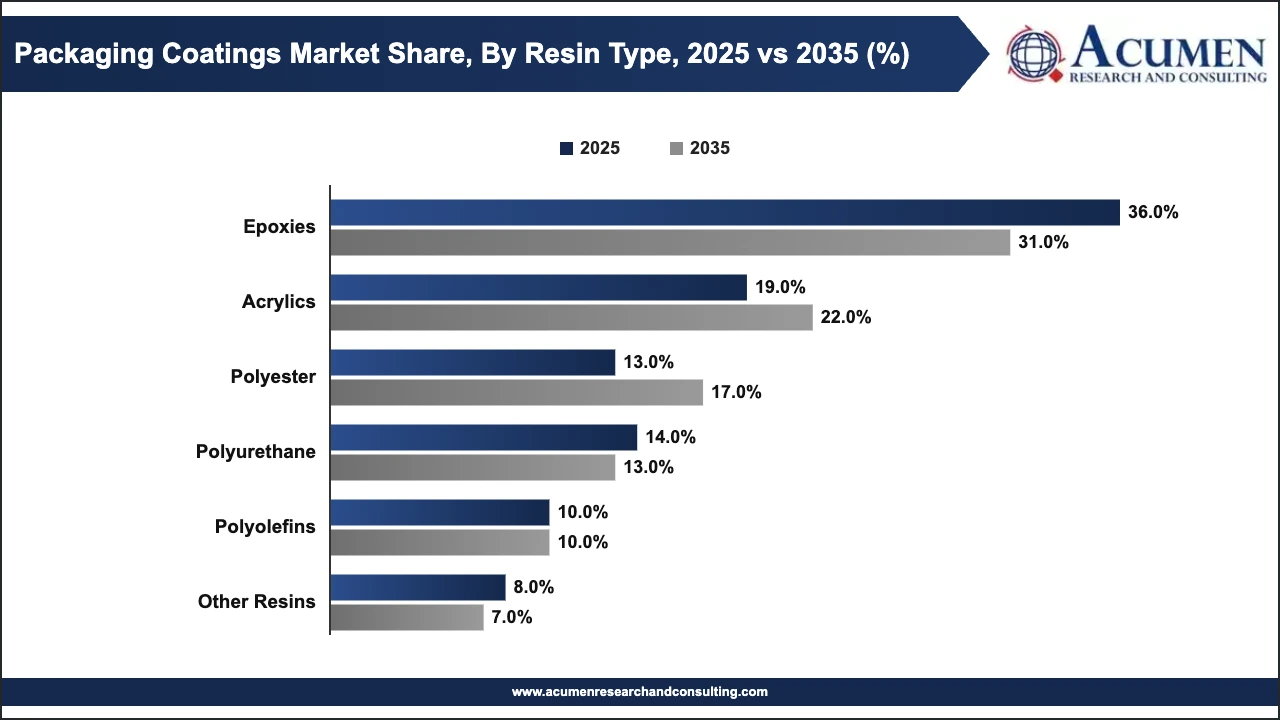
Epoxies: Epoxy coatings dominated the market by resin type in 2025, accounting for 36.0% of the market. Their share is projected to decline to 31.0% by 2035 as manufacturers develop alternative coating systems. Epoxies, made from epoxy resin, remain important in metal packaging because of their adhesion, chemical resistance, and corrosion protection, particularly in demanding food and beverage containers.
Acrylics: Acrylic coatings were the second-largest resin category in 2025, with a 19.0% share, projected to rise to 22.0% by 2035. Their versatility, surface appearance, weatherability, and suitability for water-based formulation support adoption across many packaging substrates.
Polyester: Polyester coatings accounted for 13.0% of the market in 2025, with their share projected to rise to 17.0% by 2035, making polyester the fastest-growing resin type. Its growing role reflects demand for bisphenol-free coating chemistries in metal packaging, including systems designed to meet new food-contact and bisphenol requirements. Polyurethane, polyolefins, and other resins, including bio-based and hybrid chemistries, make up the remainder of the market.
Coating Technology Insights
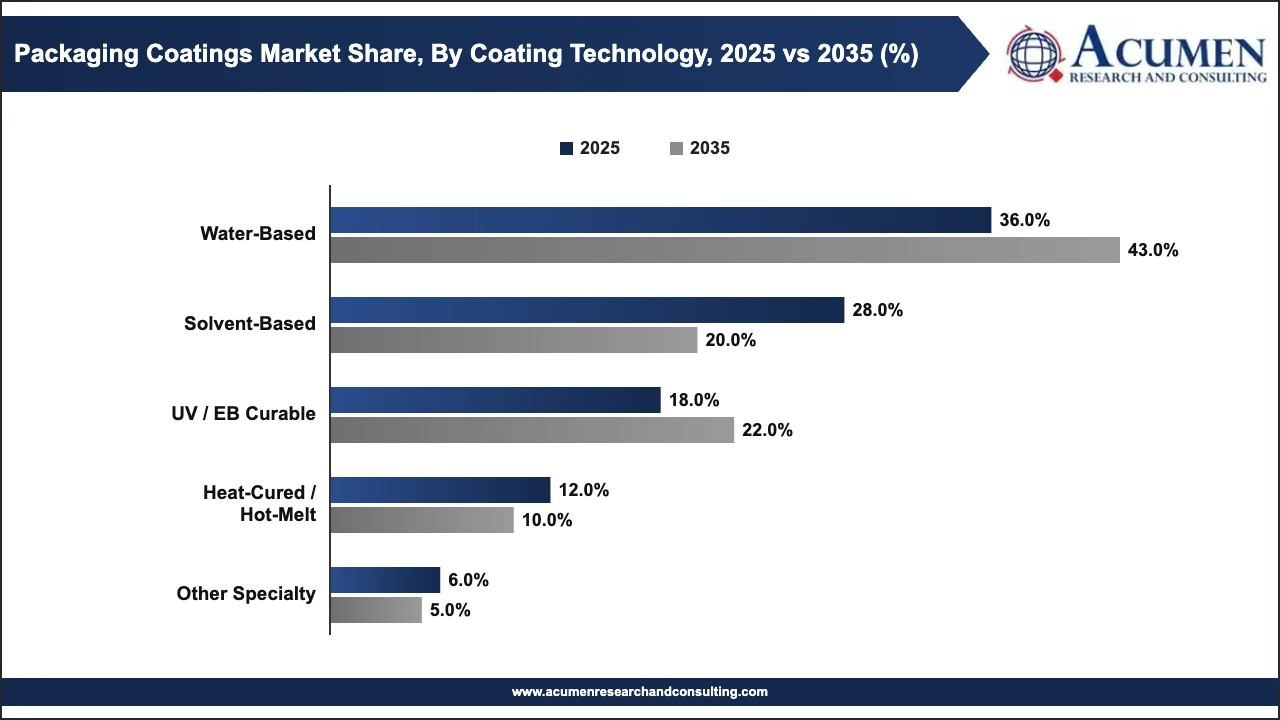
Water-based coatings: Water-based coatings accounted for 36.0% of the packaging coatings market in 2025, the largest technology category, and their share is projected to rise to 43.0% by 2035. Demand is supported by efforts to reduce volatile organic compound (VOC) emissions while maintaining application performance.
Solvent-based coatings: Solvent-based coatings ranked second in 2025 with a 28.0% share, which is projected to decline to 20.0% by 2035 as alternative formulations gain adoption. They remain relevant where rapid drying, established processes, adhesion, and specific performance requirements favor solvent-based systems.
UV / electron-beam (EB) curable coatings: UV- and EB-curable coatings represented 18.0% of the market in 2025 and are projected to reach 22.0% by 2035, growing at a CAGR of 7.0% from 2026 to 2035, the fastest of any coating technology. They cure quickly, use less energy, and improve production efficiency in suitable applications. Heat-cured / hot-melt coatings and other specialty technologies make up the rest of the market.
Substrate Insights
Metal: Aluminum and steel cans, ends, closures, tubes, and aerosol containers are the largest users of packaging coatings, because every food and beverage can needs an internal lining and most need external decoration and protection. Demand is closely linked to the metal packaging industry.
Plastic: Coatings on plastic films, pouches, bottles, and containers add oxygen and moisture barriers, printability, anti-fog, and sealing properties, supporting growth in flexible packaging.
Paper and paperboard: Barrier coatings that resist water, grease, and heat are enabling paper packaging to replace plastic in food service, cups, and cartons. This is one of the fastest-changing parts of the market as PFAS-based treatments are phased out.
Glass: Coatings protect glass bottles and jars from scratching and breakage and are used on metal lids and closures for glass containers.
Packaging Application Insights
| Application | Share 2025 (%) | Key Highlights |
|---|---|---|
| Rigid Packaging | 65.0 | Metal cans, containers, closures, and other formats that require corrosion protection, adhesion, chemical resistance, and reliable surface performance. |
| Flexible Packaging | 30.0 | Functional films, pouches, and other flexible formats that require barrier properties, printability, sealing compatibility, and product protection. |
| Other Packaging Applications | 5.0 | Paperboard, specialty, and other formats that use functional and decorative coatings for protection and branding. |
End-Use Industry Insights
| End-Use Industry | Share 2025 (%) | Key Highlights |
|---|---|---|
| Food & Beverages | 52.0 | Generated USD 2,277.08 million in 2025. Demand is supported by food-contact safety, corrosion resistance, barrier performance, and shelf-life protection across metal cans, beverage containers, and other formats. |
| Pharmaceuticals & Healthcare | 15.0 | Generated USD 656.85 million in 2025. Demand is driven by product integrity, chemical resistance, and strict quality requirements for pharmaceutical packaging and healthcare products. |
| Industrial & Chemicals | 13.0 | Generated USD 569.27 million in 2025. Coatings improve corrosion resistance, chemical compatibility, and durability in packaging for industrial products, lubricants, and chemicals. |
| Personal Care & Cosmetics, Household Products & Other End Uses | 20.0 | Aerosol cans, tubes, and premium containers that need decorative finishes, chemical resistance, and brand appeal. |
Packaging Coatings Market Regional Insights
Which Region Dominated the Packaging Coatings Market in 2025?
Asia-Pacific led the packaging coatings market in 2025, holding a 41.0% share of global revenue and contributing USD 1,795.39 million. The regional market is estimated to reach USD 2,988.91 million by 2035, with its share rising to 43.0%. The region's large packaging manufacturing base, growing food and beverage consumption, pharmaceutical production, and demand for consumer goods support its leading position.
Investment in packaging conversion capacity, coating formulation, manufacturing automation, and sustainable packaging technologies is creating opportunities for coating suppliers across major Asian markets. China, India, Japan, and other regional manufacturing hubs offer demand across metal containers, flexible films, paperboard packaging, and protective coating applications.
Which Region Is Expected to Grow the Fastest?
Asia-Pacific is also the fastest-growing region, with a projected CAGR of 5.2% from 2026 to 2035, ahead of the global average of 4.7%. Rising packaged food consumption, expanding beverage can capacity, and the growth of flexible packaging conversion in China, India, and Southeast Asia are the main drivers.
North America and Europe Packaging Coatings Market Outlook
North America accounted for about 25.0% of the market in 2025, led by the United States. Demand comes from metal food and beverage cans, aerosol containers, and pharmaceutical packaging, while state-level PFAS restrictions and brand-owner commitments are speeding the shift to BPA-free can linings and fluorine-free paper barrier coatings. Europe held about 24.0% of the market in 2025. The EU BPA ban and PPWR PFAS limits make Europe the leading region for reformulation, with strong demand for bisphenol-free can coatings, recyclable paper barrier coatings, and low-VOC systems.
Middle East & Africa and Latin America
The Middle East & Africa packaging coatings market is supported by growing demand for packaged food and beverages, pharmaceutical products, personal care items, and industrial chemicals. In 2025, the region accounted for 6.0% of the global market, generating USD 262.74 million in revenue, and is projected to reach USD 417.06 million by 2035, expanding at a CAGR of 4.7% from 2026 to 2035. Investments in food processing, packaging manufacturing, and modern retail infrastructure are creating opportunities in the United Arab Emirates, Saudi Arabia, South Africa, and other developing markets, although raw material import dependence, infrastructure constraints, and price sensitivity may influence adoption. Latin America accounted for about 4.0% of the market in 2025, supported by beverage can demand and growing packaged food consumption in Brazil and Mexico.
Country-Level Opportunities
- U.S.: Opportunities are driven by protective coatings for metal food and beverage cans, aerosol containers, and pharmaceutical packaging. Investment priorities include BPA-free and PFAS-free can linings, low-VOC systems, and formulations that meet changing food-contact requirements, along with upgrades to existing coating lines.
- China: A large domestic packaging manufacturing base and strong packaging use by the food, beverage, consumer goods, and e-commerce sectors create opportunities for coating suppliers. Investment in automated coating lines, water-based formulations, high-speed curing, and barrier coatings can add value for manufacturers.
- India: Expanding packaged food consumption, pharmaceutical manufacturing, flexible packaging conversion, and organized retail create opportunities for coating producers. Investment potential includes domestic resin and coating formulation capacity, water-based technologies, paper barrier coatings, and local technical service for small and medium-sized converters.
- Germany: High-value packaging, industrial efficiency, chemical regulations, and recyclable packaging concepts offer leading opportunities, especially in low-emission paper coatings, recyclable paper barriers, and food-contact compliant formulations for plastic packaging.
- Japan: Demand for technically advanced food, beverage, pharmaceutical, and personal care packaging supports specialty coating systems, including thin-film protective coatings, high-performance metal can linings, precision application technologies, and low-defect manufacturing.
Value Chain Analysis
| Value chain stage | Key process | Main participants |
|---|---|---|
| Raw material sourcing | Procurement of resins, pigments, solvents, additives, curing agents, and specialty chemicals | Petrochemical companies, resin producers, and chemical suppliers |
| Resin and chemical manufacturing | Production of epoxy, acrylic, polyester, and other polymers, along with functional additives | Polymer manufacturers and specialty chemical companies |
| Coating formulation | Blending, dispersion, viscosity adjustment, curing optimization, and performance testing | Packaging coating manufacturers and formulation specialists |
| Packaging substrate manufacturing | Production of metal sheets, aluminum, plastic films, paperboard, glass, and other packaging materials | Metal producers, film manufacturers, paper mills, and glass manufacturers |
| Coating application | Application through roll coating, spray coating, printing, curtain coating, or other processes | Can makers, packaging converters, and coating applicators |
| Packaging conversion | Forming cans, producing closures, converting films, and manufacturing coated paper packaging | Packaging converters and container manufacturers |
| Distribution and technical support | Warehousing, logistics, troubleshooting, and customer-specific formulation support | Coating distributors, manufacturers, and technical service teams |
Top Companies
The packaging coatings market is moderately consolidated, with a few global suppliers leading metal packaging coatings and a wider group of specialty chemical companies supplying barrier coatings, resins, and additives for paper and flexible packaging. Key companies include:
- AkzoNobel N.V.
- PPG Industries, Inc.
- The Sherwin-Williams Company
- Axalta Coating Systems
- BASF SE
- Henkel AG & Co. KGaA
- Arkema Group
- Evonik Industries AG
- The Dow Chemical Company
- Eastman Chemical Company
- Kansai Paint Co., Ltd.
- Nippon Paint Holdings Co., Ltd.
- DIC Corporation
- ALTANA AG
- Michelman, Inc.
Recent Breakthroughs
- In August 2026, shareholders of AkzoNobel and Axalta approved the all-stock merger of the two companies, which is expected to close in late 2026 or early 2027, subject to regulatory approvals.
- In August 2026, the EU Packaging and Packaging Waste Regulation began to apply, restricting PFAS in food-contact packaging and accelerating demand for fluorine-free barrier coatings.
- In July 2026, the main transition period of the EU ban on BPA in food-contact materials ended, marking a major milestone for bisphenol-free metal packaging coatings.
- In July 2025, PPG expanded its BPA-NI and PFAS-NI easy-open end coatings for aluminum beverage cans under its PPG INNOVEL and PPG iSENSE series to meet growing global demand.
- In September 2024, Solenis and HEIDELBERG collaborated on barrier coatings for paper packaging integrated with flexographic printing, supporting functional paper packaging with better manufacturing compatibility.
- In August 2024, AkzoNobel introduced Accelshield 300, an internal aluminum beverage can coating formulated without bisphenols, styrene, PFAS, and formaldehyde.
- AkzoNobel advanced plans for a facility in Vilafranca, Spain, to manufacture bisphenol-free coatings for the Europe, Middle East and Africa region.
Segments Covered
By Resin/Product Type
- Epoxies
- Acrylics
- Polyurethane
- Polyester
- Polyolefins
- Other Resins
By Coating Technology
- Water-Based Coatings
- Solvent-Based Coatings
- UV / Electron-Beam (EB) Curable Coatings
- Heat-Cured / Hot-Melt Coatings
- Other Specialty Coating Technologies
By Packaging Application
- Rigid Packaging
- Flexible Packaging
- Other Packaging Applications
By End-Use Industry
- Food & Beverages
- Pharmaceuticals & Healthcare
- Personal Care & Cosmetics
- Industrial & Chemicals
- Household Products & Other End Uses
By Region
- North America (U.S., Canada)
- Europe (U.K., Germany, France, Spain, Rest of Europe)
- Asia-Pacific (China, India, Japan, Australia, South Korea, Rest of Asia-Pacific)
- Latin America (Brazil, Mexico, Rest of Latin America)
- Middle East & Africa (GCC, South Africa, Rest of Middle East & Africa)
Looking for discounts, bulk pricing, or custom solutions? Contact us today at sales@acumenresearchandconsulting.com
Frequently Asked Questions

Related Market Research Reports
October 2026
October 2026
July 2026
May 2026
November 2025
May 2025
April 2025
December 2024