
Food Packaging Market Size, Share, Trends, Report 2026 To 2035
Food Packaging Market (By Material: Plastic, Paper & Paperboard, Glass, Metal, Biodegradable & Compostable Materials, Others; By Packaging Type: Flexible Packaging, Rigid Packaging, Semi-Rigid Packaging; By Product Format: Bags & Pouches, Bottles & Jars, Cans, Boxes & Cartons, Trays & Clamshells, Cups & Tubs, Wraps & Films, Sachets & Stick Packs, Others; By Packaging Technology: Modified Atmosphere Packaging (MAP), Vacuum Packaging, Active Packaging, Intelligent/Smart Packaging, Aseptic Packaging, Retort Packaging, Conventional Packaging: By Food Type: Fruits & Vegetables, Meat, Poultry & Seafood, Dairy Products, Bakery & Confectionery, Ready-to-Eat & Convenience Foods, Others) - Global Industry Analysis, Size, Share, Growth, Trends, Regional Analysis And Forecast 2026 To 2035
- Last Updated: 13 Jul 2026
- Report Code: ARC3950
- Category: Packaging
Food Packaging Market Size, Forecast 2026 To 2035
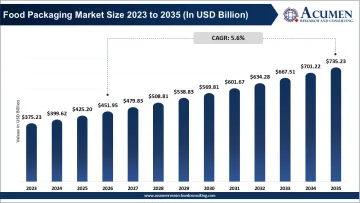
The global food packaging market size was recorded at USD 425 billion in 2025, it is expected to reach at USD 735.23 billion by 2035; growing at a CAGR of 5.6% during the forecast period of 2026-2035. The rapid expansion of online food delivery, convenience foods, and ready-to-eat meal consumption is accelerating the adoption of durable, lightweight, and high-barrier food packaging solutions that enhance product safety and extend shelf life.
Report Highlights
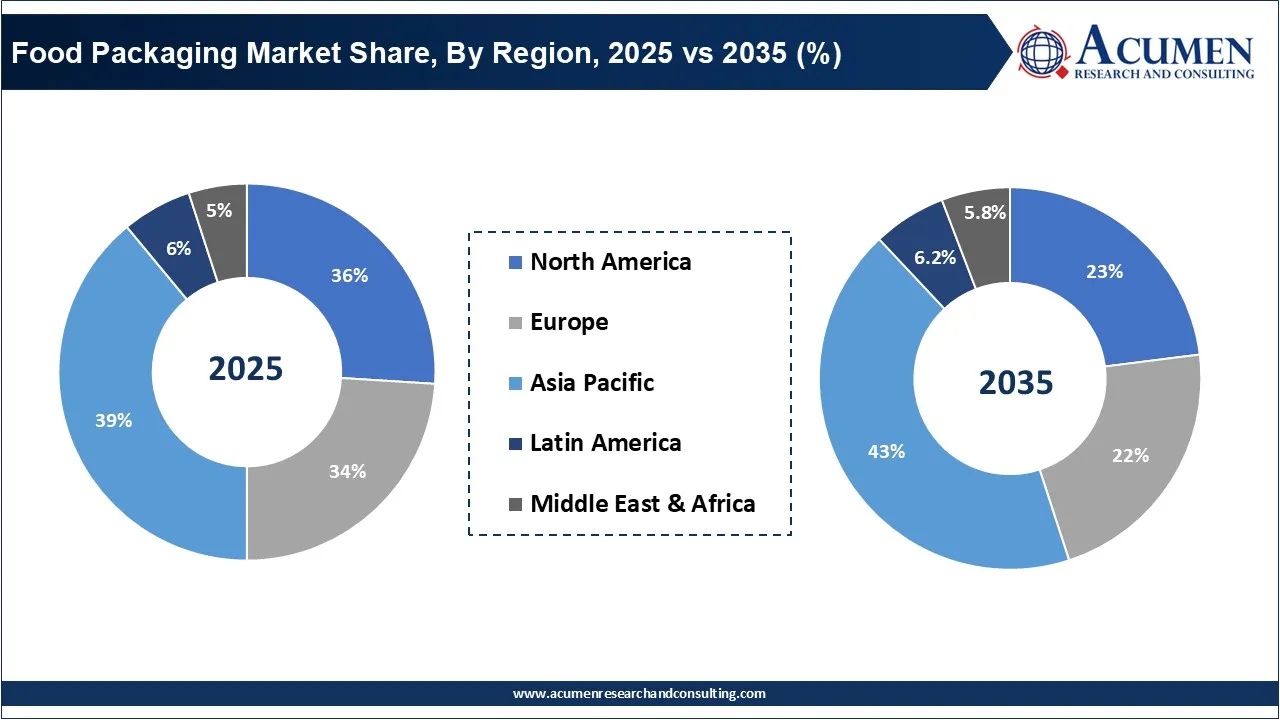
- By region, Asia Pacific dominated the food packaging market with a 39% share in 2025 owing to its expanding food processing industry, rapid urbanization, and growing demand for packaged and convenience foods.
- By region, Europe held the second-largest market share of 24% in 2025 due to stringent sustainability regulations, strong adoption of recyclable packaging, and continuous innovation in food packaging technologies.
- By region, Middle East & Africa is expected to register the fastest CAGR of 7.3% during the forecast period, driven by rising investments in food manufacturing, expanding retail infrastructure, and increasing demand for packaged food products.
- By material, plastic held the largest market share of 42% in 2025 owing to its excellent barrier properties, lightweight nature, durability, and extensive use across multiple food packaging applications.
- By material, paper & paperboard accounted for the second-largest market share of 29% in 2025 due to increasing consumer preference for renewable packaging materials and growing regulatory support for sustainable alternatives.
- By packaging type, flexible packaging dominated the market with a 49% share in 2025 owing to its lower material consumption, superior barrier performance, and growing adoption in convenience food packaging.
- By packaging type, rigid packaging held the second-largest market share of 39% in 2025 due to its high structural strength and widespread use in beverages, dairy products, and premium food packaging.
- By packaging type, semi-rigid packaging is projected to witness the fastest CAGR of 7.4% during the forecast period owing to rising demand for lightweight, durable, and recyclable packaging formats for ready meals and fresh foods.
- By product format, bags & pouches captured the largest market share of 24% in 2025 owing to their lightweight design, excellent product protection, and increasing popularity of resealable packaging solutions.
- By product format, boxes & cartons accounted for the second-largest market share of 18% in 2025 due to their recyclability, superior printability, and growing adoption of paper-based packaging.
- By packaging technology, conventional packaging held the largest market share of 49% in 2025 owing to its cost-effectiveness, established production infrastructure, and broad applicability across food products.
- By packaging technology, modified atmosphere packaging (map) accounted for the second-largest market share of 18% in 2025 due to its ability to extend product shelf life, preserve freshness, and reduce food waste.
- By food type, meat, poultry & seafood dominated the market with a 17% share in 2025 owing to increasing demand for advanced packaging technologies that preserve freshness and ensure food safety.
- By food type, ready-to-eat & convenience foods held the second-largest market share of 16% in 2025 due to rising consumption of on-the-go meals, expanding food delivery services, and changing consumer lifestyles.
Why Is Consumer Demand Reshaping the Future of Food Packaging?
The food packaging market's primary source of innovative input comes from consumers and their changing preferences. They are no longer primarily deciding whether or not a product is good and affordable-it is more so about if it is sustainable, portable, safe, visible, and usable. Moreover, as many as 44% of global consumers reported the environmental footprint of packaging to be extremely or very important when choosing food products, suggesting a recent drive towards sustainability-regardless of the economic climate. Furthermore, several recent surveys showed the vast majority of global consumers are willing to pay extra for sustainably packaged products, especially young people and residents of emerging countries.
Key Data and Insights on Sustainable Food Packaging
- Over 500 companies and governments have signed the UN Global Commitment aiming to eliminate unnecessary plastic packaging and scale up the use of reusable, recyclable or compostable alternatives.
- Lightweight packaging solutions can decrease the quantity of packaging material by 10%-30%, therefore lowering transport emission and logistics costs.
- The EC aims at reducing the amount of waste per inhabitant from packaging by 5% by 2030, 10% by 2035 and 15% by 2040, compared to 2018 levels.
- More than 45 countries have introduced or are developing national circular economy roadmaps, incorporating packaging waste reduction, recycling infrastructure, and Extended Producer Responsibility (EPR) policies.
- Signatories to the Global Commitment have collectively avoided the use of 14 million tonnes of virgin plastic and are preventing approximately 7.8 million tonnes of CO₂ emissions annually through increased recycled content and circular packaging initiatives.
AI and Automation in Food Packaging
AI and automation are revolutionizing the food packaging sector globally. The food packaging market is seeing an increase in the use of machine vision, predictive maintenance, robotic automation, digital twins and data analytics due to increased operational efficiencies, quality control, cost reduction and increased support for green manufacturing practices.
- Amcor plc – Utilizes AI-driven manufacturing analytics and automated quality inspection systems to improve packaging consistency, reduce material waste, and optimize production efficiency.
- Tetra Pak – Integrates AI, IoT, and predictive maintenance solutions through its connected packaging and smart factory platforms to monitor equipment performance and reduce unplanned downtime.
- Mondi Group – Deploys digital automation and AI-based process optimization technologies to improve manufacturing efficiency, reduce energy consumption, and enhance sustainable packaging production.
Machine vision system (MVS) using artificial intelligence can inspect labels and packaging for defects, leaks and contamination in a manner which is quicker and more precise than previously possible, and also allows for manufacturers to meet high food packaging standards. Consumer demand for more adaptable packaging, shortened lead times, and environmental manufacturing practices will continue to support further growth for AI and automation.
Market Dynamics
What Drives the Growth of Food Packaging Market in 2026?
One of the major reasons for the rise of the food packaging market by 2026 is the surging demand for safe, reliable, and high-quality products that are environment-friendly. Consumers today have become hyper-aware and are consciously looking for brands using materials that can be composted, recycled, biodegraded, and reused in a variety of applications. This inclination has spurred food manufacturers towards adopting biodegradable or eco-friendly replacements to their usual plastic-packaging options while ensuring that they can preserve their packaged goods properly, as well as increase shelf life.
Simultaneously, there has been a massive growth in ready-to-eat meals, online groceries, as well as food-delivery services, all of which necessitates the demand for heavy-duty, lightweight, and sealed food packaging. Further, the innovative application of technologies such as MAP (modified atmosphere packaging), antimicrobial films, active packaging, and smart packaging technologies are making packaging more functional, thereby preventing waste of food, extending shelf life, and thus contributing to the expansion of the global food-packaging market.
What is the Challenging Factor for the Expansion of Food Packaging Market?
Volatile raw material pricing and growing environmental regulations continues to dominate headlines in the food packaging market. Packaging raw materials, including plastic resins, paper pulp, aluminum, glass, and bio-based polymers are prone to market dynamics including supply chain disruptions, fuel costs, geo-political instability, and inflationary pressures, impacting costs of production and profit margins particularly for small and medium-sized packaging producers.
Furthermore, regulations impacting food packaging such as bans on single use plastics, mandatory recycled content, extended producer responsibility schemes (EPR), and reduced carbon emissions are spreading across the globe and necessitating heavy investment from food packaging companies on research and development, production updates, investment in recycling, and ongoing compliance efforts.
What Holds the Largest Opportunity in Food Packaging Market by 2030?
Expanding adoption of smart packaging solutions and the adoption of circular economy concepts represents one of the most significant food packaging market opportunities for 2030 Food and beverage makers are integrating advanced packaging functions, including the application of QR codes, radio frequency identification tags, NFC enabled packaging labels, spoilage-sensors, freshness indicators, temperature sensors, and RFID, NFC and Blockchain tracking technologies.
The deployment of these smart technologies would help food and beverage manufacturers track food quality and product information throughout the whole value chain and assist them in reducing their food waste. Simultaneously, global push towards packaging circularity is opening up massive market for reusable, recyclable, refillable and compostable packaging solutions across the food and beverage market.
Regional Insights
Rapid Growth in E-commerce & Food Delivery Platforms to Sustain Asia’s Dominance in Food Packaging Market
The Asia-Pacific food packaging market size was recorded at USD 165.83 billion in 2025 and is expected to reach USD 316.15 billion by 2035; growing at a CAGR of 6.7% during the forecast period from 2026 to 2035. The growth of the food packaging market for Asia-Pacific is being led by its gigantic food manufacturing sector, growing population, fast-paced urbanization, and surging consumption of packaged food and processed foods. Rapidly growing modern retail sector, growing e-commerce platforms, and rise of online food delivery services in the Asian countries is boosting demand for sustainable, durable, lightweight, and cost-effective food packaging products.
In addition, major food packaging providers based in the region, abundant supply of raw materials, and considerable funding to flexible packaging innovation technology is further fueling growth in this regional market.
Furthermore, due to the increasing awareness on eco-friendly and sustainable packaging, various government initiatives on recycling infrastructure development and to boost domestic food processing sector is leading to increase in the usage of recycled and bio-based food packaging products. Given steady expansion of food & beverage industry and a growing taste among the consumers for convenient and shelf-stable foods is likely to fuel Asia Pacific to lead the food packaging industry across the globe.
What Made Europe Hold a Significant Share in Food Packaging Market?
The Europe food packaging market size was recorded at USD 102.05 billion in 2025 and is expected to reach USD 161.75 billion by 2035; growing at a CAGR of 4.5% during the forecast period from 2026 to 2035. Strong consumer preference towards sustainable packaging solutions, rapid advancement in food packaging technology and strict food safety regulations coupled with European food manufacturers that continually invest in mono-material and fiber-based packaging, also supports growth. Strong adoption of intelligent and active packaging solutions are some of the prominent factors bolstering the growth in Europe food packaging market.
The availability of leading food packaging providers in Europe as well as their significant investment towards developing sustainable and innovative packaging products makes it one of the important segments of the global food packaging market.
How is Middle East & Africa Expanding in Food Packaging Market?
The Middle East & Africa food packaging market size was recorded at USD 21.26 billion in 2025 and is expected to reach USD 42.64 billion by 2035; growing at a CAGR of 7.3% during the forecast period from 2026 to 2035. The market is growing on the account of faster urbanization, surging food imports, widening network of modern retail channels, and increasing consumption of packaged food products among developing economies. Several initiatives such as food security program, food processing facilities and the presence of an extended cold chain are undertaken by the governments to curb the reliance on imports while ensuring quality and food safety.
Increasing number of tourist activities, flourishing hospitality sector and surging investments on sustainable packaging technology are also creating new avenues for packaging manufacturers. Increasing consumption of sustainable food packaging materials along with new technology development in the area of food preservation techniques are anticipated to drive growth in the regional market.
Top 5 Countries Leading the Food Packaging Market
| Country | Key Highlight | Key Strengths |
|---|---|---|
| China | The world's largest food manufacturing and processing industry, coupled with rising packaged food consumption and strong investments in sustainable packaging technologies, positions China as the leading food packaging market. | Massive food production, expanding e-commerce, strong flexible packaging industry, government sustainability initiatives |
| United States | High demand for convenience foods, advanced packaging technologies, stringent food safety regulations, and the presence of major food and packaging companies support market leadership. | Smart packaging adoption, high R&D investments, mature retail sector, advanced food processing industry |
| Germany | Germany leads Europe through its strong emphasis on recyclable packaging, circular economy policies, and technologically advanced packaging manufacturing capabilities. | Sustainable packaging innovation, high recycling rates, advanced machinery manufacturing, strong export market |
| India | Rapid urbanization, growing middle-class population, increasing consumption of packaged foods, and government support for food processing and manufacturing are driving significant market expansion. | Fast-growing FMCG sector, expanding food processing industry, rising organized retail, increasing demand for flexible packaging |
| Japan | Japan's advanced packaging technologies, premium food industry, and emphasis on food quality, convenience, and shelf-life extension continue to strengthen its position in the global market. | Intelligent packaging, high-quality food packaging standards, automation, innovation in barrier packaging technologies |
Segmental Insights
Material Insights
The market was led by the plastic segment, which held a substantial 42% market share in 2025. Its versatility, lightweight nature, outstanding barrier performance, enhanced durability, and cost-effectiveness were major factors. Consumers widely employ plastic packaging for various fresh food and beverage types, including fresh foods, dairy, snacks, frozen foods, ready-to-eat meals, and beverages because it shields the content against contaminants and provides the barrier properties essential for preventing oxidation and humidity exposure.
Due to new advances in mono-materials and post-consumer recycled content, food packaging producers are using sustainable practices. In addition, improvements in packaging technology are helping make use of the benefits of plastic in additional food products. The material, in turn, aids to enhance the shelf-life and taste of foodstuffs and the safety from contaminants.
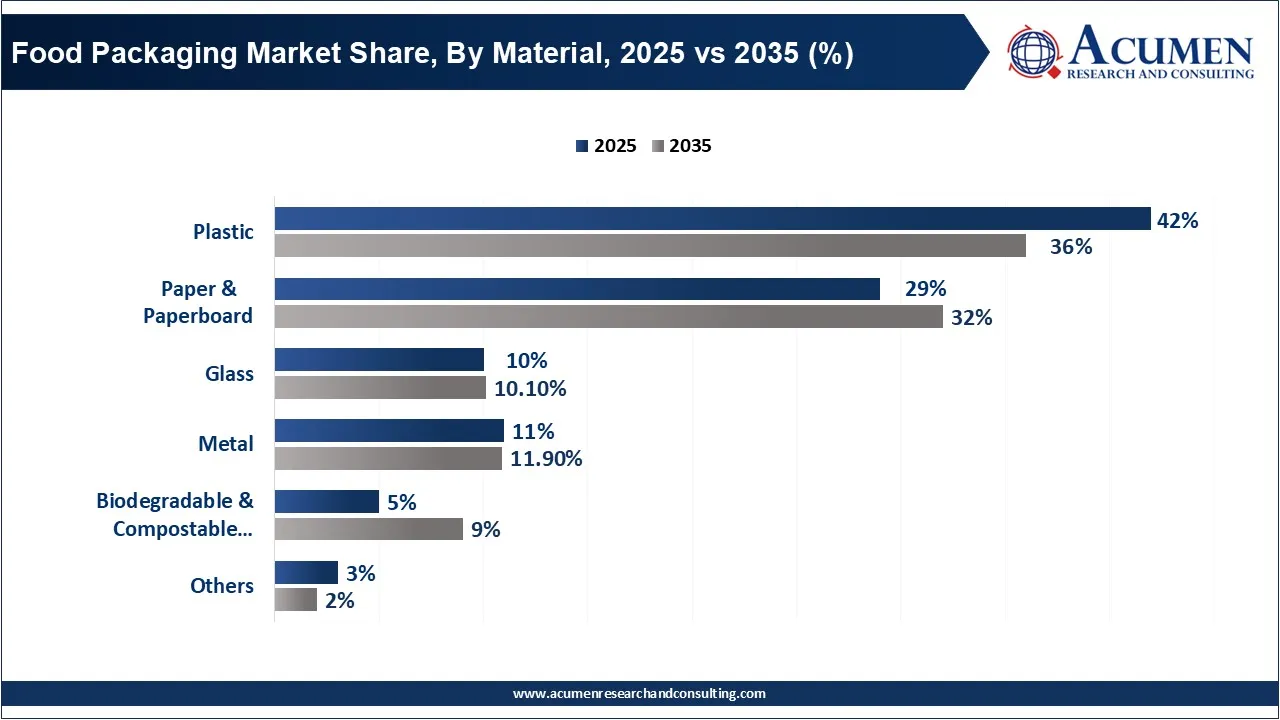
Paper and paperboard held the second largest share of 29% of the market share in 2025. Growing demand for renewable and natural packaging and changing customer habits toward sustainable alternatives has been driving growth. Food producers are quickly using this packaging for their bakery, fresh produce, and takeaway products as regulatory actions are restricting using single-use plastics.
Innovations and breakthroughs in barrier coatings and paper-based food packaging technologies are helping to drive a growth in these alternative products, thereby helping the use of paper-based packaging for additional categories in food.
Packaging Type Insights
Flexible packaging segment garnered the highest market share of 49% in 2025. Flexible packaging is emerging as a dominant packaging format, attributed to factors such as lighter weight, less material usage, excellent barrier properties and the ability to efficiently transport the packaging format. The sector has vast applications across snacks, frozen foods, dairy, beverage, pet food, and ready-to-eat meals, providing enhanced shelf life while minimizing waste.
Manufacturers are increasing their investment in the recyclable flexible film, mono-material pouch and high-barrier laminates that are conducive to sustainability objectives and retaining product freshness. The e-commerce food delivery and convenient food consumption increase are also bolstering flexible packaging solutions.
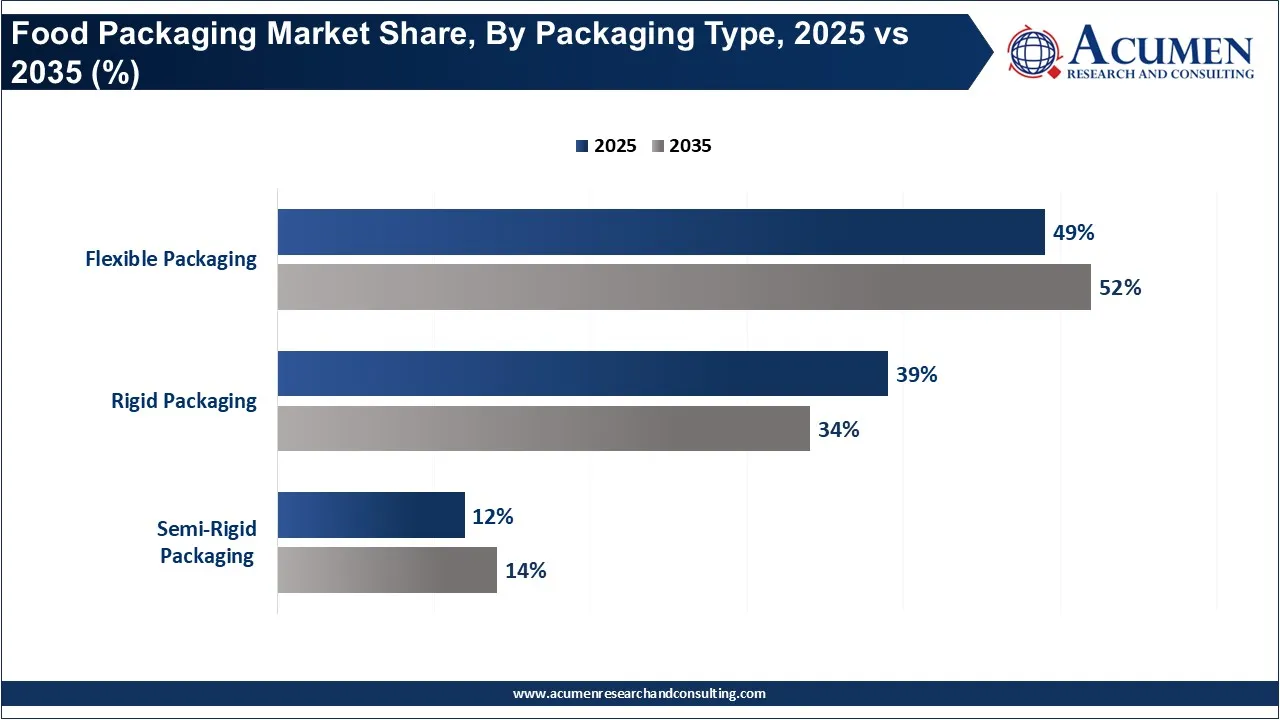
The semi-rigid packaging segment is poised to register the highest growth rate at a CAGR of 7.4% during the forecast period Growing demand for lightweight yet sturdy packaging formats combining the best of structural rigidness with flexible soft material properties, the semi-rigid segment is gaining ground in ready meals, fresh produce, bakery and convenient foods packaging. The growth of segment is also attributed to rising investments made in semi-rigid packaging solutions.
Product Insights
Bags & pouches segment recorded the largest share, with approximately 24% of the global market in 2025. The popularity of such pouches is attributed to the lightweight material, lower amount of raw material utilization, easier handling and superior barrier properties. They are used across applications like snack food, frozen food, pet food, coffee, dairy products, ready to eat meals. Resealable, stand-up and recyclable pouch segments contribute to the market growth.
Food Packaging Market Share, By Product Format, 2025 (%)
| Product Format | Revenue Share, 2025 (%) |
|---|---|
| Bags & Pouches | 24% |
| Bottles & Jars | 16% |
| Cans | 11% |
| Boxes & Cartons | 18% |
| Trays & Clamshells | 10% |
| Cups & Tubs | 8.10% |
| Wraps & Films | 7.90% |
| Sachets & Stick Packs | 3% |
| Others | 2% |
Boxes & cartons segment captured a significant 18% of the market in 2025, with increasing popularity of paper-based sustainable packaging solutions. They are primarily utilized for cereals, bakery items, frozen food products, drinks, fast food and other e-commerce food deliveries, due to its high recyclability, better printability and protective properties.
Packaging Technology Insights
In 2025 the conventional packaging sector dominated the global food packaging market with a share of 49%, due to their application across all the food products and presence of manufacturing processes and low cost. Traditional food packaging materials have been in high demand among various food manufacturers as these packaging materials can easily produce with adequate raw materials available at cheaper rates and can be produced in bulk by utilizing industrial machines. Conventional food packaging includes materials like the box, cardboard food packaging and a plastic bag.
Food Packaging Market Share, By Packaging Technology, 2025 (%)
| Packaging Technology | Revenue Share, 2025 (%) |
|---|---|
| Modified Atmosphere Packaging (MAP) | 18% |
| Vacuum Packaging | 14% |
| Active Packaging | 6% |
| Intelligent/Smart Packaging | 2% |
| Aseptic Packaging | 7% |
| Retort Packaging | 4% |
| Conventional Packaging | 49% |
In 2025, the modified atmosphere packaging (MAP) segment stood second with a market share of 18%, attributed to the technology to increase shelf-life of the food products by modifying the environment of the internal composition of the packaging by manipulating the level of oxygen and carbon dioxide.
MAP is commonly used to packaging ready to eat food products, ready to eat meat, seafood, ready to eat fruits and ready to eat vegetables, and ready to eat dairy products. The increase in concern over food wastage is another driver for the rise of MAP market.
Food Type Insights
The meat, poultry & seafood segment dominated the market with a share of 17% in 2025. The segment’s high share was attributed to increasing demand for sophisticated packaging technologies aimed at retaining the freshness, inhibiting the microbial spoilage and prolonging the shelf life of the products along the supply chain. Modified atmosphere packaging, vacuum packaging, and high-barrier films are the key packaging techniques being utilized in the segment.
Food Packaging Market Share, By Food Type, 2025 (%)
| Food Type | Revenue Share, 2025 (%) |
|---|---|
| Fruits & Vegetables | 15% |
| Meat, Poultry & Seafood | 17% |
| Dairy Products | 13% |
| Bakery & Confectionery | 12% |
| Ready-to-Eat & Convenience Foods | 16% |
| Frozen Foods | 8% |
| Snacks | 9% |
| Beverages | 8% |
| Others | 2% |
The ready-to-eat & convenience foods segment constituted for 16% of the total market in 2025, driven by evolving lifestyles, increased urbanization, and growing demand for on-the-go meals. The surge in the adoption of online food delivery services, convenience stores, and supermarkets has propelled the demand for lightweight, microwave-safe, tamper-evident, and sustainable packaging alternatives in the segment.
Top Companies
- Amcor plc (Zurich, Switzerland) – Expanded recyclable and high barrier packaging capabilities and strengthened partnerships to drive faster adoption of fiber-based food packaging.
- Berry Global Inc. (Evansville, Indiana, U.S.) – Boosted investment in circular packaging technology and post-consumer recycled (PCR) content to address growing consumer demand for sustainability in food packaging.
- Sealed Air Corporation (North Carolina, U.S.) – Continued developing automated packaging systems and protective food packaging solutions for enhanced food safety and shelf-life extension.
- Mondi Group (Weybridge, United Kingdom) – Advanced paper-based and flexible packaging innovation with partnerships targeting the substitution of traditional plastic packaging.
- Sonoco Products Company (South Carolina, U.S.) – Expanded sustainable rigid paper container offerings and invested in recyclable packaging technology for food and beverage sectors.
- Smurfit Westrock (Dublin, Ireland) – Enhanced global corrugated and paper-based food packaging portfolio post-Smurfit Kappa and WestRock merger.
- Tetra Pak International S.A. (Pully, Switzerland) – Introduced a new generation of aseptic cartons with paper-based barriers to lower carbon emissions and increase renewable content.
- Huhtamaki Oyj (Espoo, Finland) – Grew fiber-based and recyclable food packaging portfolio to support circular economy goals and compliance.
- DS Smith plc (London, United Kingdom) – Stepped up the innovation and adoption of recyclable corrugated solutions for food retail, e-commerce, and fresh produce packaging.
- Graphic Packaging Holding Company (Atlanta, Georgia, U.S.) – Increased usage of paperboard packaging innovations to enable food producers to move away from single-use plastics.
Recent News
- April 2026 – Amcor, Metsä Group, and G. Mondini announced a strategic collaboration to develop a fully integrated fiber-based food packaging system for protein and chilled ready-meal applications. The partnership combines molded fiber trays, advanced barrier liners, and automated sealing technologies to accelerate the commercialization of recyclable food packaging solutions.
- April 2026 – Tetra Pak partnered with Sterilgarda Alimenti to launch the world's first 1-litre aseptic carton with a paper-based barrier. The innovation increases renewable material content to approximately 90% while reducing the package's carbon footprint by up to 50%, supporting the industry's transition toward low-carbon food packaging.
Segments Covered
By Material
- Plastic
- Paper & Paperboard
- Glass
- Metal
- Biodegradable & Compostable Materials
- Others
By Packaging Type
- Flexible Packaging
- Rigid Packaging
- Semi-Rigid Packaging
By Product Format
- Bags & Pouches
- Bottles & Jars
- Cans
- Boxes & Cartons
- Trays & Clamshells
- Cups & Tubs
- Wraps & Films
- Sachets & Stick Packs
- Others
By Packaging Technology
- Modified Atmosphere Packaging (MAP)
- Vacuum Packaging
- Active Packaging
- Intelligent/Smart Packaging
- Aseptic Packaging
- Retort Packaging
- Conventional Packaging
By Food Type
- Fruits & Vegetables
- Meat, Poultry & Seafood
- Dairy Products
- Bakery & Confectionery
- Ready-to-Eat & Convenience Foods
- Frozen Foods
- Snacks
- Beverages
- Others
By Region
- North America
- Europe
- Asia-Pacific
- Latin America
- Middle East & Africa
Looking for discounts, bulk pricing, or custom solutions? Contact us today at sales@acumenresearchandconsulting.com
Frequently Asked Questions

Other Packaging Reports
June 2024
April 2020
March 2025
April 2025