
Cold Chain Market Size to Reach USD 2.23 Trillion by 2035, Reflecting a CAGR of 19.5%
Published : 06 Jul 2026
Author : Raghuram Nair



What is the Cold Chain Market Size?
The global cold chain market size was recorded at USD 375 billion in 2025 and is projected to reach USD 2,232.38 billion by 2035; accelerating a CAGR of 19.5% during the forecast period from 2026 to 2035. Technological advancements such as integration of AI, IoT sensors and cloud-based tracking platforms alongside real-time monitoring requirements create potential for the cold chain market to boom.
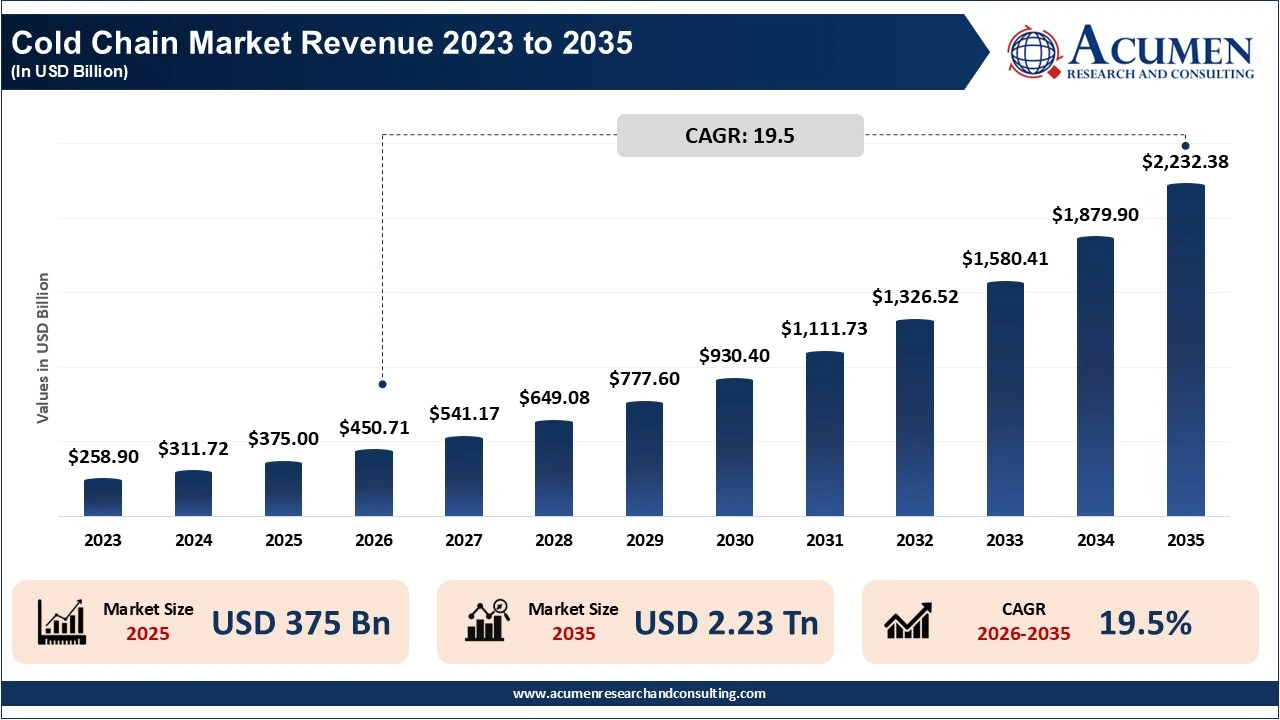
The cold chain market involves all storage, transportation, distribution, and packaging technologies for the efficient, reliable and effective maintenance of temperature-controlled conditions for goods that require protection from cold, warmth, or temperature fluctuations between their place of manufacture and use. The goods that commonly come under the temperature controlled storage systems market are food, beverages, chemicals and pharmaceuticals or vaccines. Factors such as increased demand for food and pharmaceuticals globally and increase in trade have propelled the cold chain market to its highest growth.
Cold Chain Market Statistics
- The cold storage segment dominated the market, securing a 58% market share in 2025, with rising demand for frozen foods, dairy products, seafood, and medicines, coupled with inventory buffer and the expansion of organized retail networks being the primary drivers.
- Refrigerated transportation captured a 42% share in 2025, predicted to reach 44% by 2035, spurred by the expansion of the e-commerce grocery market and growing cross-border food trade, along with the increasing demand for efficient transport of vaccines and specialty drugs.
- Among the different temperature ranges, chilled (0 °C–8 °C) registered the highest market share of 48% in 2025, remaining the most dominant due to the necessity of storing dairy products, fresh fruits and vegetables, and a variety of medicines.
- The deep frozen/cryogenic range (−40 °C–−196 °C) segment is forecast to grow at the fastest pace with a 20.7% CAGR from 2026 to 2035, driven by the surge in demand for the ultra-low temperature storage and transportation of biologics, cell and gene therapy products, and mRNA-based vaccines.
- The food & beverages sector had a 69% share in the cold chain market in 2025, influenced by the growing consumption of processed food products, including frozen meals and beverages, and the increasing need to reduce food waste and adhere to strict food safety regulations.
- Pharmaceuticals & healthcare held a 17% share in 2025, fueled by the increasing distribution of vaccines, blood plasma, and insulin, as well as the expanding research on advanced treatments and personalized medicine.
- The chemicals segment had a 7% share in the market in 2025, as the transport of specialty fertilizers and other temperature-sensitive industrial chemicals became increasingly vital due to expanded industrial production and chemical exports.
Latest Breakthroughs in Cold Chain Market
- Electric Refrigerated Fleets: Electric refrigerated vehicles are picking up momentum among logistics companies looking to reduce their environmental impact and reduce operating expenses. United Parcel Service is also investing in electrified cold transport fleets as part of their roadmap.
- Digital Twin Technology for Cold Warehousing: Logistics companies are leveraging Digital Twin technology to simulate how warehouse would behave and where bottlenecks may occur before undertaking major construction or retrofitting. In this respect digital twins will be integral to future cold chain planning and expansion on a global scale.
- Multi-Temperature Last-Mile Delivery Models: High-performance refrigerated vehicles are able to carry frozen, chilled and ambient temperatures all at once. Multi-temperature delivery models have now made it possible to effectively fulfill deliveries for everything from e-commerce groceries to sensitive pharmaceuticals as the global demand for quick and same-day delivery intensifies for groceries, fast casual restaurants, and the broader quick commerce market.
How is Sustainability Creating New Opportunities in the Cold Chain Market?
Sustainability and energy-efficient logistics is driving rapid growth in the cold chain market. Solar-powered refrigerators, electric refrigerated vehicles, and low-emission cooling technology are being adopted by a number of companies to limit carbon footprint and operating costs. Also, stringent environmental regulations to limit greenhouse gas emissions and an adoption of eco-friendly refrigerants are spurring investment in green cold chain logistics. This rise in demand for green cold chains is estimated to present an unprecedented market opportunity, particularly in food logistics and pharmaceutical logistics.
Cold Chain Market Regional Landscape
Why has North America held the largest share of the cold chain market?
North America held the largest cold chain market share in 2025, commanding 33% of the global share. A highly developed cold chain storage infrastructure, an established pharmaceutical logistics ecosystem, coupled with a growing appetite for frozen food, contributed significantly to the North America’s USD 123.75 billion market value in 2025.
The region’s cold chain market is anticipated to increase at a CAGR of 17.8% from 2025 to 2035 to reach a market value of USD 647.39 billion by 2035, mainly driven by the increasing demand for the transportation of biologics, vaccines distribution, and the adoption of innovative refrigerating warehousing.
Leading market players in the region including Lineage Logistics and Americold Realty Trust are adding further strength to the region. E-commerce online grocery and the rising demand for frozen ready meals are driving further expansion of efficient cold chain services.
Why is Asia Pacific region expected to experience the most impressive CAGR?
The Asia Pacific region accounted for 30% share in 2025 and expected to experience the most impressive CAGR over the forecast period, with 22.6% throughout the period. The market value was USD 112.50 billion in 2025 and is estimated to grow up to USD 848.30 billion in 2035, the regional market share increasing to 38% by the end of forecast period.
Fast pace growth can be accredited to swift urbanisation, increasing food exports and burgeoning pharmaceutical industries and governmental investment to develop modern cold chain infrastructure. Countries such as China and India have the potential to become growth engines of this region owing to the growing demand for biologics, vaccines, dairy products, and processed food.
Which are the top companies operating in the cold chain market?
The cold chain market in terms of global cold chain supply and market share is competitive and consolidated, the major players include multiple types of global and local, multinational giants to specialized cold chain solutions providers. Companies such as Lineage Logistics, Americold Realty Trust, A.P. Moller - Maersk, United Parcel Service (UPS), DHL and Kuehne + Nagel hold leading market shares.
The market also revolves around global logistics and transportation companies NewCold, Nichirei Corporation, CEVA Logistics, DB Schenker, United States Cold Storage, Congebec Logistics which enhance their competitive advantage with geographic expansion, automation initiatives, and considerable investments in warehouse improvements.
Market Segmentation
By Type
- Cold Storage
- Refrigerated Transportation
By Temperature Range
- Chilled (0°C to 8°C)
- Frozen (-18°C to -25°C)
- Deep Frozen/Cryogenic (-40°C to -196°C)
By Application
- Food & Beverages
- Pharmaceuticals & Healthcare
- Chemicals
- Floral & Horticulture
- Others
By Region
- North America
- Europe
- Asia-Pacific
- Latin America
- Middle East & Africa
Contact Us:
Mr. Richard Johnson
Acumen Research and Consulting
India: +91 8983225533