
Frozen Food Market Size to Expand USD 601.58 Billion by 2035, Growing at a CAGR of 6%
Published : 10 Jul 2026
Author : Raghuram Nair



What is the Frozen Food Market Size?
The global frozen food market size was reported at USD 335 billion in 2025 and is projected to expand around USD 601.58 billion by 2035, growing at a CAGR of 6% during the forecast period from 2026 to 2035. The growing number of dual-income households, rapid urbanization, and increasingly busy lifestyles are significantly driving demand for frozen food products worldwide.
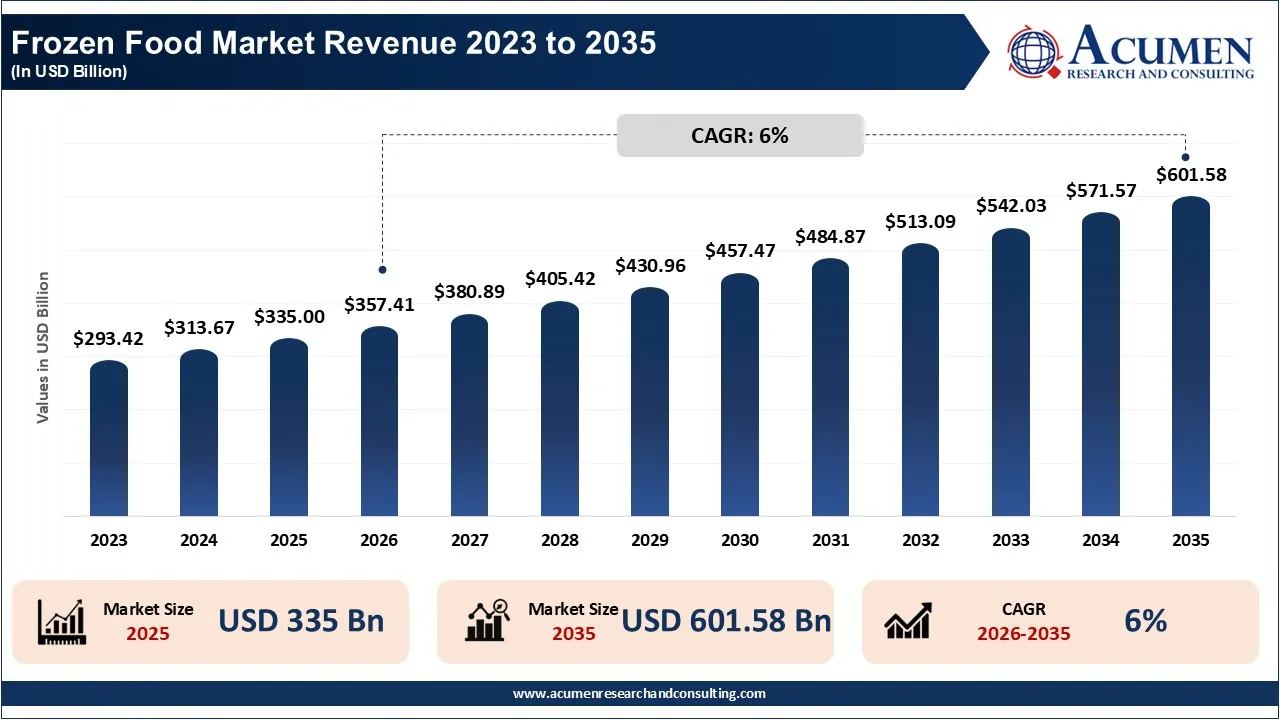
The frozen food market consists of food items that are frozen using rapid freezing and stored at sub-zero temperatures to keep their freshness, nutritional content, texture and shelf life intact till the time of consumption. It covers a wide assortment of product categories such as prepared meals, frozen fruits and vegetables, meat and poultry, seafood, bakery products, snacks, desserts and other frozen food items sold via supermarkets, convenience stores, specialty outlets, e-commerce sites, and foodservice establishments. Growing consumer preference for convenient meal options, ongoing developments in freezing and cold chain logistics technology, increasing rates of urbanization and the growth of the organized retail and e-commerce grocery sectors are key factors propelling the market growth.
Frozen Food Market Statistics
- Europe emerged as the leading region in the frozen food market, with a share of 38.0% of the total revenue in 2025. The market in this region is expected to hold 35.0% of the revenue by 2035, with a compounded annual growth rate (CAGR) of 5.0% during the 2026-2035 forecast period. Europe's position is driven by well-established cold storage infrastructure, high penetration of private label brands, and consistent consumer preference for premium frozen products across key European nations.
- The Asia Pacific region captured the fastest-growing market position, commanding a share of 23.0% in 2025, with projections to reach 29.0% by 2035. The growth rate is propelled by increasing investments in refrigerated logistics, rapid adoption of online grocery platforms, and evolving dietary patterns of urban consumers.
- By the product type front, ready meals commanded the market, accounting for 29.0% of the revenue in 2025, a figure projected to rise to 31.0% by 2035. The escalating workforce participation, the demand for portion-controlled meals, and the continuous innovation in gourmet and health-focused frozen recipes bolster this segment.
- The meat & poultry category secured the second-largest share at 20.0% in 2025. Sustained demand for protein-rich options, the growing consumption of frozen processed meat products, and broad availability through retail and foodservice channels contribute to the segment's strength.
- The food category breakdown shows that non-vegetarian food dominated the market, with a significant share of 68.0% in 2025, growing at a CAGR of 5.2%. The increased consumption of frozen meat-based convenience foods and the expansion of quick-service restaurant chains contribute to the consistent demand in both mature and emerging markets.
- The vegetarian food category is anticipated to be the fastest-growing segment, with its market share projected to increase from 32.0% in 2025 to 36.0% by 2035, with a CAGR of 7.4%. This growth is attributed to consumers' rising preference for clean-label products, plant-based nutrition, and frozen vegetable-based meal solutions.
- The bags & pouches packaging type dominated the frozen food market with a share of 42.0% in 2025, attributed to their flexibility, cost-effectiveness for transportation, and product freshness preservation capabilities.
- The boxes & cartons segment emerged as the second-largest packaging type, holding a 28.0% market share in 2025, driven by their structural integrity, attractive shelf presentation, and recyclability.
- Among distribution channels, supermarkets & hypermarkets captured the largest market share of 52.0% in 2025. These channels provide an extensive freezer capacity, diverse product ranges, and aggressive promotional strategies, catering to a wide consumer base seeking both premium and value frozen products.
- Convenience stores captured the second-largest market share of 15.0% in 2025. Increased population density in urban areas, the demand for immediate purchases, and strategic store locations near residential areas contribute to their popularity.
- By end users, the household segment was the largest, with a 67.0% market share in 2025. This dominance stems from the increased prevalence of home meal preparation, the growing ownership of freezers in homes, and the effort to reduce food waste.
- The commercial foodservice segment represented the second-largest end user, accounting for 25.0% of the market in 2025. Foodservice providers leverage frozen ingredients to optimize inventory management, maintain consistent product quality, and reduce preparation times, thus enhancing operational efficiency.
Expansion of Plant-Based and Health-Oriented Frozen Food Products: Market’s Largest Opportunity
Health-conscious eating, sustainable lifestyles, and increasing concern for nutrition among consumers are providing major opportunities for manufacturers to diversify their frozen products by introducing healthier alternatives. The rise in the popularity of plant-based options, organically grown fruits and vegetables, free-from alternatives, high protein snacks and clean labeled food items are driving manufacturers towards more innovative products in the frozen space. Higher sales potential may exist in premium, sodium-reduced or low-preservative frozen meals with additional functional benefits.
Frozen Food Market Regional Outlook
Why does Europe leading region in the global frozen food market?
Europe was the leading region in the global frozen food market with a share of 38.0% in 2025 and is expected to retain the position with a market share of 35.0% in 2035, growing at a CAGR of 5.0% from 2026 to 2035. Favorable market conditions are due to robust food processing industries in the region, easy availability of frozen products in organized retail outlets, and strong consumer trust regarding healthy and convenient meals through frozen products. Continuous product launches, rising consumption of clean-label and premium products and innovation in food preservation technologies are factors likely to bolster growth in Europe over the coming decade.
Why is Asia Pacific poised to experience the most rapid expansion in the frozen food market?
The frozen food market in the Asia Pacific is poised to experience the most rapid expansion and will increase its share from 23.0% in 2025 to 29.0% in 2035 at the highest CAGR of 8.7% between 2026 and 2035. The increasing urban population and disposable income of consumers, along with higher working professional population, are driving the demand for convenient food products across the region. Moreover, growing investments in building cold chain logistics infrastructure, expanding reach of modern trade channels and rapid adoption of quick commerce are among factors expected to enhance the market across key Asia Pacific countries.
Who are the top companies in the frozen food market?
Leading companies such as Nestlé S.A, Unilever N.V, General Mills Inc, Conagra Brands Inc, McCain Foods Limited, Kellogg Company, Nomad Foods Limited, Dr. Oetker GmbH, Tyson Foods, Inc, Birds Eye Ltd, Ajinomoto Co., Inc, and Schwan’s Company are a crucial part of global frozen food market by offering their broad product range and brand awareness. They supply the industry with a comprehensive product catalog consisting of a variety of frozen ready meals, fruits & vegetables, meat & poultry, seafood, bakery products, snacks, desserts and plant-based food items for both the retail and foodservice sectors.
These are likely to continue to use their investment in research & development, cutting-edge freezing technologies, automation, sustainability, and expansion into fast-growing emerging markets in their efforts to keep driving new product developments, building consumer confidence and ensuring the sustained growth of the global frozen food market.
Segments Covered
By Product Type
- Ready Meals
- Fruits & Vegetables
- Meat & Poultry
- Seafood
- Bakery Products
- Snacks & Appetizers
- Desserts & Ice Cream
- Others
By Food Category
- Vegetarian
- Non-Vegetarian
By Packaging Type
- Bags & Pouches
- Boxes & Cartons
- Trays
- Tubs & Cups
- Others
By Distribution Channel
- Supermarkets & Hypermarkets
- Convenience Stores
- Specialty Stores
- Online Retail
- Foodservice
By End User
- Household
- Commercial Foodservice
- Institutional
By Region
- North America
- Europe
- Asia-Pacific
- Latin America
- Middle East & Africa
Contact Us:
Mr. Richard Johnson
Acumen Research and Consulting
India: +91 8983225533