
Retail Automation Market Size, Share, Industry Report 2025 To 2033
Retail Automation Market (By Implementation: Warehouse, In-store; By Product: Point-of-Sale (POS), Camera, RFID & Barcode, Warehouse Robotics, Electronic Shelf Label, Others; By End-Use: Hypermarkets, Supermarkets, Single Item Stores, Retail Pharmacies, Fuel Stations, Others) - Global Industry Analysis, Size, Share, Regional Analysis, Trends and Forecast 2025 To 2033
- Last Updated: 28 Apr 2026
- Report Code: ARC3920
- Category: Semiconductor and Electronics
Retail Automation Market Size and Forecast 2025 - 2033
The global retail automation market size was accounted for USD 27.60 billion in 2025 and is estimated to surpass USD 57.94 billion by 2033 growing at a CAGR of 9.7% from 2025 to 2033.
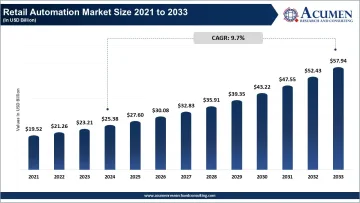
Retail automation means using technology to make retail tasks faster and easier, with less need for people to do them. It includes tools like self-checkout machines, software for tracking inventory, digital price tags, and AI chatbots for customer service. These tools help stores work more efficiently, lower costs, and give customers quicker and more personalized service. Retail automation also includes warehousing robotics, digital payment solutions, and data analytics platforms that help merchants make informed decisions. Automating routine operations allows retailers to focus on strategy and customer connection. Shopping automation is rapidly gaining steam as consumers expect greater convenience, accuracy, and efficiency in both online and in-store transactions.
Retail Automation Market Report Highlights
- The global retail automation market is expected to reach USD 57.94 billion by 2033, with a CAGR of 9.7% from 2025 to 2033.
- The North America retail automation market was valued at approximately USD 8.63 billion in 2024.
- The Asia-Pacific market is projected to grow at a CAGR of over 10.8% from 2025 to 2033.
- The point-of-sale (POS) product sub-segment accounted for 24% of the retail automation market share in 2024.
- Based on the implementation, the in-store sub-segment generated around USD 15.48 billion revenue.
- Demand for omnichannel retailing creates scope for integrated automation platforms is a popular retail automation market trend that fuels the industry demand.
Retail Automation Market Dynamics
Market Drivers
- Rising demand for self-checkout systems in supermarkets and hypermarkets
- Increasing labor costs encourage retailers to adopt automated solutions to cut expenses
- Growing e-commerce industry fuels the need for automated inventory and warehouse management
- Advancements in AI and IoT technologies enhance retail automation capabilities
Market Restraints
- High initial investment limits adoption among small and mid-sized retailers
- Concerns over data privacy and cybersecurity hinder full-scale automation
- Lack of skilled personnel to manage and maintain advanced automation systems
Market Opportunities
- Expansion of cashless and contactless payment systems opens new automation avenues
- Integration of AI-powered analytics offers smarter customer insights and engagement
- Emerging economies present untapped markets for retail automation adoption
Retail Automation Market Report Scope
| Attribute | Details |
|---|---|
| Retail Automation Market Size 2024 | USD 25.38 Billion |
| Retail Automation Market Forecast 2033 | USD 57.94 Billion |
| Retail Automation Market CAGR During 2025 - 2033 | 9.7% |
| Analysis Period | 2021 - 2033 |
| Base Year | 2025 |
| Forecast Data | 2025 - 2033 |
| Segments Covered | By Implementation, By Product, By End-Use, and By Geography |
| Regional Scope | North America, Europe, Asia Pacific, Latin America, and Middle East & Africa |
| Key Companies Profiled | Kuka AG, Casio Computer Co. Ltd., Honeywell Scanning and Mobility, ECR Software Corporation, NCR Corporation, Datalogic S.p.A., Kiosk & Display LLC, Diebold Nixdorf, Incorporated, Amazon Web Services, Inc., E&K Automation GmbH, and Pricer AB. |
| Report Coverage | Market Trends, Drivers, Restraints, Competitive Analysis, Player Profiling, Covid-19 Analysis, Regulation Analysis |
Retail Automation Market Insights
The global retail automation industry is going through a major shift, driven by the growing use of technology and the need for more efficient operations. Tools like self-checkout systems, AI-based inventory management, and electronic shelf labels are now common in both physical stores and online platforms. These technologies not only improve the consumer experience by shortening wait times and speeding up service, but they also help businesses cut labor costs and better manage their supply chains.
One of the primary drivers of this transition is the growing desire for contactless and self-service solutions. Studies show that most shoppers, especially in the U.S., prefer using self-checkout kiosks because they are faster and more convenient. Automation is also being used behind the scenes, with robots and AI now widely used in warehouses to help with tasks such as picking, sorting, and restocking goods. In fact, more than half of retailers have already adopted robotic systems in their logistics operations.
Across regions, Asia-Pacific is becoming a major center for retail automation, supported by rapid urbanization, the growth of e-commerce, and government efforts to improve digital infrastructure. Meanwhile, North America continues to lead in technology adoption, with large retailers actively testing and expanding the use of automation.
Government regulations also influence market behavior. In India, for example, the Karnataka state government has developed the Gig Workers' Welfare Scheme to assist informal retail workers while also encouraging the use of technology in the field. These advancements suggest an increasing trend toward smarter, faster, and more adaptive retail systems.
Retail Automation Market Segmentation Insight
The worldwide market for retail automation is split based on implementation, product, end-use, and geography.
Implementation Insight
According to retail automation industry analysis, the in-store segment leads the market because it directly enhances the parts of the shopping experience that customers interact with. Today, when entering a store, shoppers often see automated checkout machines, digital price tags, smart inventory displays, and various self-service options. Retailers are aggressively investing in these technologies because they meet immediate requirements by shortening wait times, cutting labor costs, and providing customers greater control over their visits.

In contrast to warehouse automation, which happens behind the scenes, in-store automation offers clear and immediate benefits that customers can see and feel. Additionally, it allows retailers to adopt new technologies gradually, testing them without making major changes to their entire store layout. This makes in-store automation an accessible and practical first step for many businesses looking to enter the automation space.
Product Insight
The point-of-sale (POS) sector generates significant revenue in the retail automation industry due to its vital role in optimizing checkout procedures and improving customer experience. Modern POS systems incorporate a variety of technologies, including contactless payments, mobile wallets, and cloud-based software, to enable faster and more secure transactions. Retailers benefit from real-time sales tracking and inventory management, which increase operational efficiency. The growing desire for quick and frictionless payment choices, particularly in crowded retail situations, is driving the development of modern POS technologies. Furthermore, the ability of POS systems to adapt to various retail formats, ranging from small stores to giant supermarkets, makes them an important component of retail automation. This widespread use considerably adds to the retail automation market's revenue growth.
End-Use Insight
In terms of retail automation market forecast, supermarkets are an important category in the industry due to their size and complexity, making automation both necessary and cost-effective. These stores handle hundreds of products per day, maintain complicated inventories across multiple categories, and serve a big number of consumers, all of which can cause delays if they are not automated. Unlike hypermarkets, which may face budget challenges due to their large size, or small stores with simpler operations, supermarkets are well suited for automation to deliver clear benefits. They gain greatly from automated checkout systems, inventory management, and supply chain solutions that speed up processes while maintaining the personalized shopping experience customers expect. This balance of operational needs and manageable costs makes supermarkets natural leaders in adopting retail automation technologies.
Retail Automation Market Regional Analysis
The retail automation market is growing differently across various regions, influenced by technology use, infrastructure, and customer preferences. North America leads the market because of its advanced technology and strong investment in new solutions. Retailers in the United States and Canada quickly adopt tools like AI, self-checkout systems, and robots to improve customer service and operations. The rise of online shopping and demand for contactless options also boost automation. Supportive government policies help speed up this growth.

Europe is also a major player, with countries such as the UK, Germany, and France focusing on smart retail technologies to increase efficiency and promote sustainability. European retailers commonly combine automation with measures to reduce energy use and waste. Regulations on innovation and data security encourage businesses to invest in these technologies.
Asia-Pacific is the fastest-growing region throughout the retail automation market forecast period, due to rapid urbanization, rising incomes, and increased internet shopping in China, India, and Japan. Governments contribute to this expansion by improving digital infrastructure through initiatives such as India's Digital India and China's smart city projects. Other regions, including Latin America, the Middle East, and Africa, are starting to use retail automation. Though still in development, these areas have potential due to expanding retail markets and increased demand for better shopping experiences.
Retail Automation Market Players
- Kuka AG
- Casio Computer Co. Ltd.
- Honeywell Scanning and Mobility
- ECR Software Corporation
- NCR Corporation
- Datalogic S.p.A.
- Kiosk & Display LLC
- Diebold Nixdorf
- Incorporated
- Amazon Web Services, Inc.
- E&K Automation GmbH
- Pricer AB.
Market Segmentation
By Implementation
- Warehouse
- In-store
By Product
- Point-of-Sale (POS)
- Camera
- RFID & Barcode
- Warehouse Robotics
- Electronic Shelf Label
- Others
By End-Use
- Hypermarkets
- Supermarkets
- Single Item Stores
- Retail Pharmacies
- Fuel Stations
- Others
By Region
- North America
- U.S.
- Canada
- Europe
- U.K.
- Germany
- France
- Spain
- Rest of Europe
- Asia-Pacific
- India
- Japan
- China
- Australia
- South Korea
- Rest of Asia-Pacific
- Latin America
- Brazil
- Mexico
- Rest of LATAM
- The Middle East & Africa
- South Africa
- GCC Countries
- Rest of the Middle East & Africa (ME&A)
Looking for discounts, bulk pricing, or custom solutions? Contact us today at sales@acumenresearchandconsulting.com
Frequently Asked Questions

Other Semiconductor and Electronics Reports
May 2026
December 2023
September 2026
September 2023