
Temperature Controlled Packaging Solutions Market Size, Share, Trends and Forecast to 2035
Temperature Controlled Packaging Solutions Market (By System Type: Passive Systems, Active Systems, Hybrid Systems; By Product Type: Insulated Shippers, Insulated Containers, Refrigerants & Coolants, Others; By Usability: Single-Use Packaging, Reusable Packaging; By End-Use Industry: Food & Beverages, Healthcare & Pharmaceuticals, Chemicals & Industrial Products, Research & Clinical Laboratories, Others) - Global Industry Analysis, Size, Share, Regional Analysis, Trends and Forecast 2026 - 2035
- Last Updated: 21 Oct 2026
- Report Code: ARC1785
- Category: Packaging
Temperature Controlled Packaging Solutions Market Size & Forecast
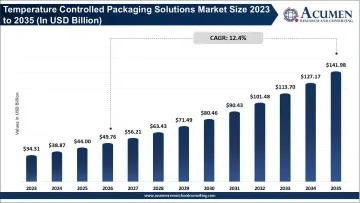
The global temperature controlled packaging solutions market size was valued at $44 billion in 2025 and is expected to reach at $141.98 billion by 2035, while expanding at a promising CAGR of 12.4% during the forecast period 2026 to 2035. Demand is supported by pharmaceutical and biotechnology distribution, vaccine shipments, clinical trials, biologics, cell and gene therapies, and the transportation of perishable food and other temperature-sensitive goods. Market development is also influenced by pharmaceutical manufacturing expansion, cross-border cold-chain logistics, packaging qualification requirements, and demand for reusable and sustainable thermal materials.
Temperature controlled packaging solutions are insulated packs and boxes used for storage, handling and transportation of materials with given temperature requirements. It includes insulated packs and shippers, active and passive temperature-controlled containers, refrigerants, phase change materials (PCM) and other packaging solutions and accessories for temperature-sensitive materials.
- Base Year Market Size (2025): $44.00 billion
- Current Year Market Size (2026): $49.76 billion
- Estimated Year Market Size (2035): $141.98 billion
- Forecast Period CAGR (2026-2035): 12.4%
Key Takeaways
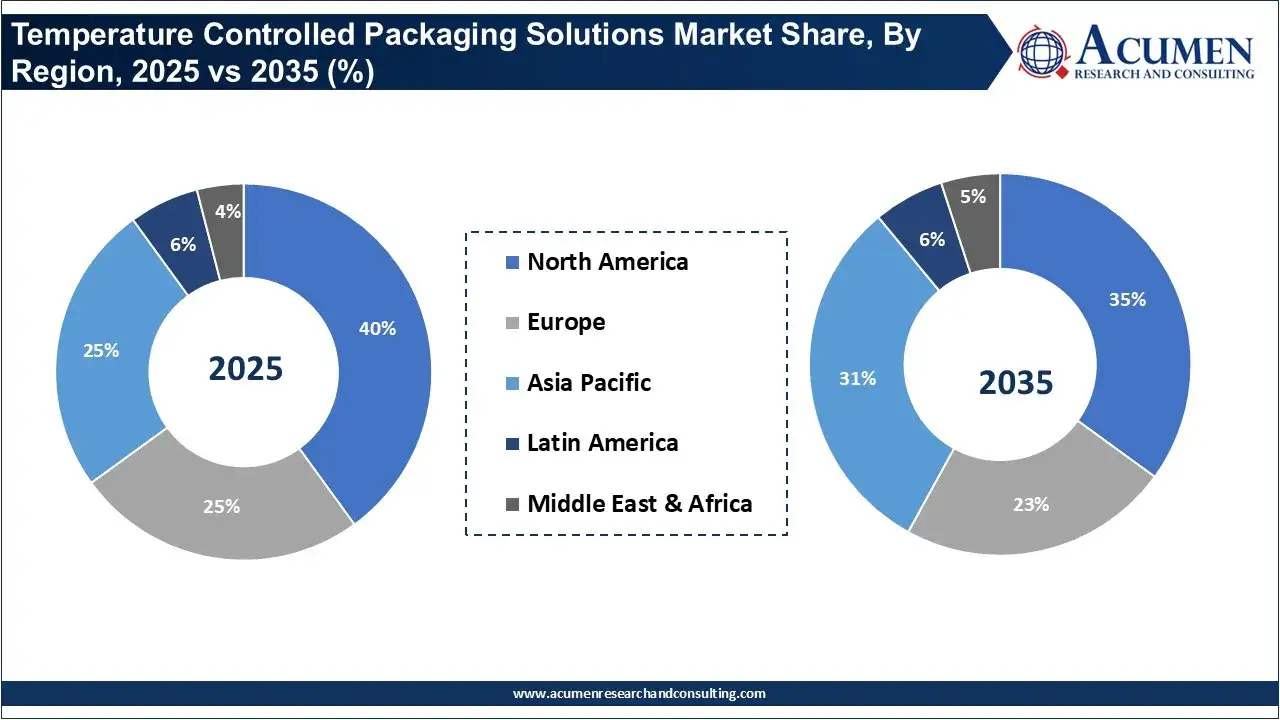
- By region: North America dominated the Temperature Controlled Packaging Solutions Market with a 40.0% share in 2025, generating USD 17.60 billion in revenue. Asia-Pacific is the fastest-growing region, with a projected CAGR of 15.1% from 2026 to 2035, and is expected to reach USD 44.01 billion by 2035.
- By system type: Passive systems dominated the market with a 64.0% share in 2025, supported by their flexibility, cost-effectiveness, and widespread use in temperature-sensitive shipping. Active systems ranked second with a 31.0% share, while hybrid systems accounted for the remaining 5.0%.
- By product type: Insulated shippers dominated the product type segment with a 47.0% share in 2025. Other products are projected to grow fastest, at a CAGR of 14.7% from 2026 to 2035, reaching USD 8.52 billion by 2035.
- By usability: Single-use packaging dominated the market with a 55.0% share in 2025, reflecting its convenience for one-way shipments and distribution routes where packaging recovery is difficult. Reusable packaging accounted for the remaining 45.0%, supported by opportunities to reduce packaging waste and reuse costs across established logistics networks.
- By end-use industry: Food & Beverages dominated the end-use industry segment with a 49.0% share in 2025, driven by the need to preserve the quality of perishable products during transportation. Healthcare & Pharmaceuticals ranked second with a 31.0% share, supported by demand for temperature-sensitive medicines, vaccines, and biologics.
Recent Trends
- Shift Toward Sustainable Thermal Packaging: Manufacturers are developing recyclable insulation, reusable shipping containers, and bio-based thermal materials to reduce packaging waste and environmental impact while maintaining temperature stability for sensitive pharmaceutical and food products.
- Integration of Smart Monitoring Technologies: Temperature-controlled packaging is increasingly incorporating data loggers, connected sensors, and real-time tracking systems that enable shipment visibility, temperature excursion detection, and improved quality control throughout cold chain transportation.
- Growing Adoption of Reusable Packaging Systems: Pharmaceutical companies, logistics providers, and food distributors are adopting reusable insulated containers and returnable packaging systems to reduce single-use material consumption and improve packaging cost efficiency across recurring shipping routes.
- Increasing Demand for Advanced Pharmaceutical Packaging: The expansion of biologics, vaccines, cell therapies, and gene therapies is driving demand for specialized packaging capable of maintaining narrow temperature ranges, supporting extended transit durations, and protecting high-value medical products.
Government Regulations, Policies, and Industry Standards
| Country | Key regulation / standard | Key requirement |
|---|---|---|
| United States | FDA 21 CFR Parts 210 and 211 | Drug manufacturing, storage, and distribution must follow applicable CGMP requirements. |
| Germany | EU Good Distribution Practice (GDP), 2013/C 343/01 | Qualified thermal packaging, temperature monitoring, and documented transport conditions. |
| United Kingdom | MHRA Good Distribution Practice (GDP) | Pharmaceutical distributors must maintain appropriate storage and transport controls. |
| India | CDSCO Good Distribution Practices for Biological Products | Requires appropriate packaging, temperature control, transport procedures, and records for biological products. |
| China | Good Supply Practice (GSP) for pharmaceutical distribution | Pharmaceutical distribution controls cover storage, transportation, and product quality management. |
Temperature Controlled Packaging Solutions Market Dynamics
Growth Drivers
- Expansion of Biopharmaceutical Supply Chains: Increasing distribution of vaccines, biologics, cell therapies, and temperature-sensitive medicines is driving demand for packaging solutions that maintain specified thermal conditions throughout storage, transportation, and last-mile delivery.
- Growth in Pharmaceutical Cold Chain Logistics: Rising pharmaceutical exports, cross-border clinical trials, and specialized medicine distribution are increasing the need for validated temperature-controlled packaging that preserves product quality across complex international supply chains.
- Increasing Demand for Fresh and Frozen Food: Growing consumption of perishable food, seafood, dairy products, and frozen meals is supporting demand for insulated containers, refrigerated packaging systems, and thermal materials that help maintain product freshness during transit.
Restraints
- High Packaging and Transportation Costs: Temperature-controlled packaging often requires specialized insulation, refrigerants, thermal monitoring, and validated shipping configurations, increasing logistics expenses for manufacturers, distributors, and healthcare providers.
- Complex Packaging Qualification Requirements: Pharmaceutical shipments frequently require thermal performance testing, lane qualification, and documented validation under different environmental conditions. These requirements increase preparation time and operational costs, particularly for global distribution networks.
- Environmental Impact of Packaging Materials: Conventional insulated packaging can rely on expanded plastics, multilayer materials, and single-use components that are difficult to recycle, creating waste management challenges and increasing pressure to adopt more sustainable alternatives.
Opportunities
- Sustainable Thermal Packaging Solutions: Development of recyclable insulation, reusable shipping containers, and bio-based thermal materials creates opportunities for packaging providers to reduce waste while maintaining temperature stability and product protection.
- Advanced Temperature Monitoring Technologies: Integration of connected sensors, data loggers, and real-time tracking systems creates opportunities to improve shipment visibility, detect temperature excursions, and strengthen quality assurance across pharmaceutical and food cold chains.
- Expansion of Cell and Gene Therapy Logistics: Increasing development of advanced therapies requiring tightly controlled temperature conditions creates demand for specialized packaging systems designed for ultra-low-temperature storage, cryogenic transportation, and high-value clinical shipments.
Challenges
- Maintaining Thermal Stability Across Transit Routes: Fluctuating ambient temperatures, transportation delays, customs clearance, and handling disruptions can compromise thermal performance, requiring packaging solutions tailored to specific shipping durations and environmental conditions.
- Managing Reverse Logistics and Reuse: Reusable temperature-controlled containers require efficient collection, inspection, cleaning, refurbishment, and redistribution systems. Coordinating these processes across geographically dispersed supply chains can increase operational complexity.
- Meeting Diverse Product-Specific Requirements: Different pharmaceuticals, biologics, vaccines, and food products require distinct temperature ranges, hold times, and handling conditions. Designing packaging that meets these requirements while balancing cost, weight, and protection remains challenging.
Regional Insights
Which Region Dominated the Temperature Controlled Packaging Solutions Market in 2025?
North America dominated the temperature controlled packaging solutions market in 2025, accounting for 40.0% of global revenue, equivalent to $17.60 billion. The region's established pharmaceutical industry, advanced distribution infrastructure, and extensive food supply chains support its leading position. Demand comes from biologics, vaccines, specialty medicines, clinical trials, and temperature-sensitive food shipments. North America is projected to generate $19.90 billion in 2026 and reach $49.69 billion by 2035, growing at a CAGR of 10.7% from 2026 to 2035.
Its market share is expected to decline from 40.0% in 2025 to 35.0% in 2035, reflecting faster expansion in other regions rather than a contraction in absolute revenue. The region's established cold-chain networks and demand for qualified packaging systems will continue to support market development.
“According to experts, pharmaceutical logistics requirements, food distribution efficiency, and continued adoption of reusable thermal packaging will remain important factors shaping regional demand.”
Why Is Asia-Pacific the Fastest-Growing Temperature Controlled Packaging Solutions Market?
Asia-Pacific represented 25.0% of the global temperature controlled packaging solutions market in 2025, with a revenue of $11.00 billion. It is forecast to register a CAGR of 15.1% from 2026 to 2035. Asia-Pacific is expected to be the fastest growing market among the majority of regions from the available forecast while its market size will reach at $12.44 billion in 2026 and $44.01 billion in 2035, and its share will be increased to 31.0%. Rising demand from pharmaceutical manufacturing, vaccine distribution, biotech research, food cold-chain, and other factors is contributing to its demand.
These markets are relevant for analysis as they have a certain stature within the pharmaceutical industry, infrastructure for healthcare and manufacturing of packaging materials, China, India, Japan and Korea. Demand covers the potential for moving products over long distances within different climates.
“As per experts, infrastructural investment in cold-chain logistics, growth in pharma export and implementation of innovative thermal packaging technology will help Asia-Pacific expand its dominance in the global arena.”
Temperature Controlled Packaging Solutions Market by Country
- United States: The U.S. is a key market with large pharma and biotech markets, test infrastructure and clinical-trial network. Demand is driven by biologics, vaccines, specialty medicines and direct-to-patient distribution, all requiring validated thermal packaging and robust temperature-tracking monitoring.
- China: China offers the largest growth market, with pharmaceutical manufacturing, vaccine distribution, biologic medicines and drug development, and ever-growing cold-chain infrastructure. The country's big domestic market and far-reaching retail and food distribution systems generate needs for insulated shippers, refrigerants, and temperature controlled containers in the healthcare and perishable foods supply chains.
- India: India is a key market for us, thanks to its presence in pharmaceutical manufacturing, vaccine manufacturing and growing healthcare distribution network. Pharmaceutical exports, immunization campaigns and investment in cold chain logistics drive the market for thermal packaging where high ambient temperatures and long-distance travel are involved.
- Germany is a European top-three market for demand, with the largest pharmaceutical production base, a vibrant and export-driven drug industry and strong logistical capability. Distribution requirements and validation requirements for validated and compliant shipping solutions will strengthen the demand for insulated containers, phase change materials and reusable thermal packaging.
- United Kingdom: Opportunities in pharmaceutical research, clinical studies, specialty pharmaceutical distribution, and healthcare logistics infrastructure. Pharmaceuticals distribution requirements comply with pharmaceutical distribution needs, thus creating additional requirement for insulated transportation (whether single-use or reusable) for biologics, clinical-trial materials, vaccines, and high-value medicines transported in the domestic and international supply chains.
- Japan: Japan market is mature with mature health care system, high product-quality requirements and sophisticated pharma distribution and supply chain. Demand for biologics, vaccines, diagnostics and temperature-sensitive medicines enable highly reliable insulated solutions, accurate thermal management and monitoring to be used.
Segmentation Insights
System Type Insights
Passive Systems: Passive systems dominated the market in 2025, accounting for 64.0% of the segment. These systems rely on insulation and cooling materials rather than powered refrigeration, making them suitable for pharmaceutical shipments, food distribution, and routine temperature-sensitive deliveries. Their relatively simple operation and flexibility support widespread use.
Active Systems: Active systems ranked second, with a 31.0% share in 2025. These solutions use powered temperature-control mechanisms to maintain specified conditions during transportation. They are relevant for shipments requiring tighter thermal control, longer transit durations, or specialized handling, including high-value pharmaceutical and biological products.
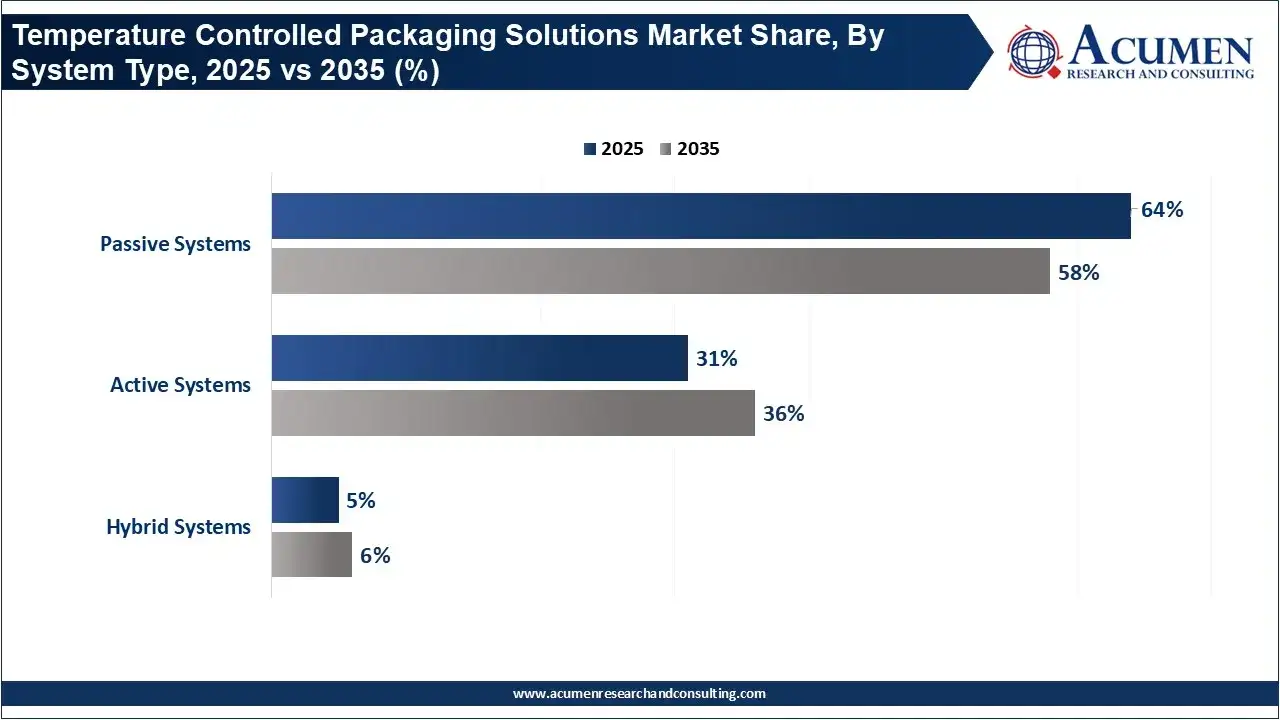
Hybrid Systems: Hybrid systems accounted for the remaining 5.0% of the market in 2025. Combining passive insulation with active temperature-control capabilities, these systems can support shipments with demanding thermal requirements. Their adoption depends on shipment duration, temperature specifications, infrastructure availability, and the cost of maintaining more complex packaging systems.
Product Type Insights
Insulated Shippers: Insulated shippers dominated the market in 2025, accounting for 47.0% of revenue. They are widely used to protect temperature-sensitive products during parcel shipments, pharmaceutical distribution, clinical trials, and food transportation. Their versatility across payload sizes and shipping routes supports their leading position. The segment is projected to grow at a CAGR of 11.8% from 2026 to 2035.
Insulated Containers: Insulated containers represented the second-largest segment, with a 30.0% share in 2025. Their durability and capacity make them suitable for bulk shipments, repeated transport cycles, and specialized pharmaceutical logistics. Demand is supported by the need to protect larger payloads and maintain thermal stability throughout distribution. The segment is expected to expand at a CAGR of 12.4% through 2035.
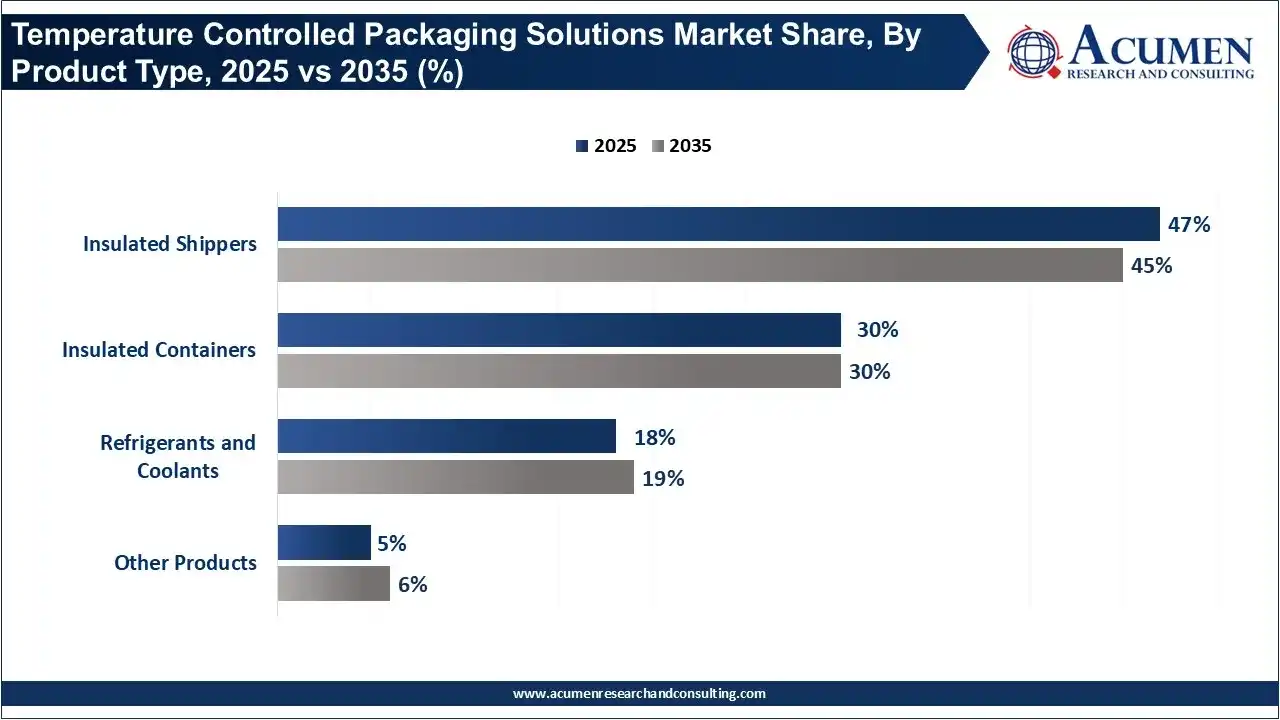
Refrigerants and Coolants: Refrigerants and coolants accounted for 18.0% of the market in 2025, making this the third-largest product segment. Gel packs, phase change materials, and other cooling media help maintain required temperatures inside insulated packaging. The segment is forecast to grow at a CAGR of 13.0% from 2026 to 2035, supported by demand for reliable thermal performance.
Usability Insights
Single-Use Packaging: Single-use packaging dominated the market in 2025, accounting for 55.0% of revenue. It is suitable for one-way shipments, international distribution, clinical trials, and delivery routes where recovering packaging is difficult or uneconomical. Its convenience and limited reverse-logistics requirements support adoption across pharmaceutical and food supply chains.
Reusable Packaging: Reusable packaging accounted for 45.0% of the market in 2025. These systems are designed for repeated shipping cycles and can reduce packaging waste when collection, inspection, and redistribution are efficient. They are particularly relevant for established pharmaceutical logistics networks and frequent shipping routes where the initial investment can be spread across multiple uses.
End-Use Industry Insights
Food & Beverages: Food and beverages dominated the market in 2025, accounting for 49.0% of share. Temperature-controlled packaging helps preserve product quality during the transportation of fresh produce, dairy, seafood, frozen foods, and other perishables. Demand is supported by expanding food distribution networks, longer delivery routes, and the need to reduce spoilage during storage and transit.
Healthcare & Pharmaceuticals: Healthcare and pharmaceuticals ranked second, with a 31.0% share in 2025. Biologics, vaccines, specialty medicines, and temperature-sensitive therapies require packaging capable of maintaining specified conditions throughout distribution. Pharmaceutical exports, clinical supply chains, and growing demand for advanced therapies support continued adoption of validated thermal packaging solutions.
Chemicals & Industrial Products: Chemicals and industrial products accounted for 8.0% of the market in 2025, making this the third-largest end-use segment. Certain specialty chemicals, laboratory reagents, and temperature-sensitive industrial materials require controlled transportation to preserve stability and product performance. Demand depends on the chemical formulation, handling requirements, and conditions specified for transportation.
Competitive Landscape
North America
- Cold Chain Technologies (United States)
- Sonoco ThermoSafe (United States)
- Pelican BioThermal (United States)
- CSafe (United States)
- Cryopak (United States)
- Inmark (United States)
Europe
- va-Q-tec (Germany)
- Sofrigam (France)
- Envirotainer (Sweden)
- DGP Intelsius (United Kingdom)
- Softbox Systems (United Kingdom)
- SkyCell (Switzerland)
Asia-Pacific
- Haier Biomedical (China)
- Daikin Industries (Japan)
- Mitsubishi Heavy Industries (Japan)
- Nippon Express Holdings (Japan)
Strategic Developments
- In February 2026, Cold Chain Technologies opened a 42,000-square-foot facility in Taloja, Navi Mumbai, strengthening its Indian operations and access to pharmaceutical manufacturing hubs across western India. The development illustrates investment in regional capacity and service infrastructure for temperature-sensitive shipments.
- In November 2025, Peli BioThermal announced facility expansions in Allentown, Pennsylvania, and Frankfurt, Germany. Its Allentown operation relocated to a 90,100-square-foot facility, approximately 43% larger than its previous site. The expansion demonstrates investment in temperature-controlled packaging operations serving pharmaceutical distribution networks in North America and Europe.
Segments Covered
By System Type
- Passive Systems
- Active Systems
- Hybrid Systems
By Product Type
- Insulated Shippers
- Insulated Containers
- Refrigerants & Coolants
- Other Products
By Usability
- Single-Use Packaging
- Reusable Packaging
By End-Use Industry
- Food & Beverages
- Healthcare & Pharmaceuticals
- Chemicals & Industrial Products
- Research & Clinical Laboratories
- Other End Users
By Region
- North America
- Europe
- Asia-Pacific
- Latin America
- Middle East & Africa
Looking for discounts, bulk pricing, or custom solutions? Contact us today at sales@acumenresearchandconsulting.com
Frequently Asked Questions

Related Market Research Reports
October 2026
October 2026
July 2026
May 2026
November 2026
November 2025
May 2025
April 2025