What is the Digital Twin Market Size?
The digital twin market size was recorded at USD 26.80 billion in 2025 and is expected to surge USD 577.12 billion by 2035; growing at a CAGR of 35.9% during the forecast period from 2026 to 2035. The combination of AI, generative AI, and cutting-edge simulation tools represents a truly significant opportunity for the digital twin market.
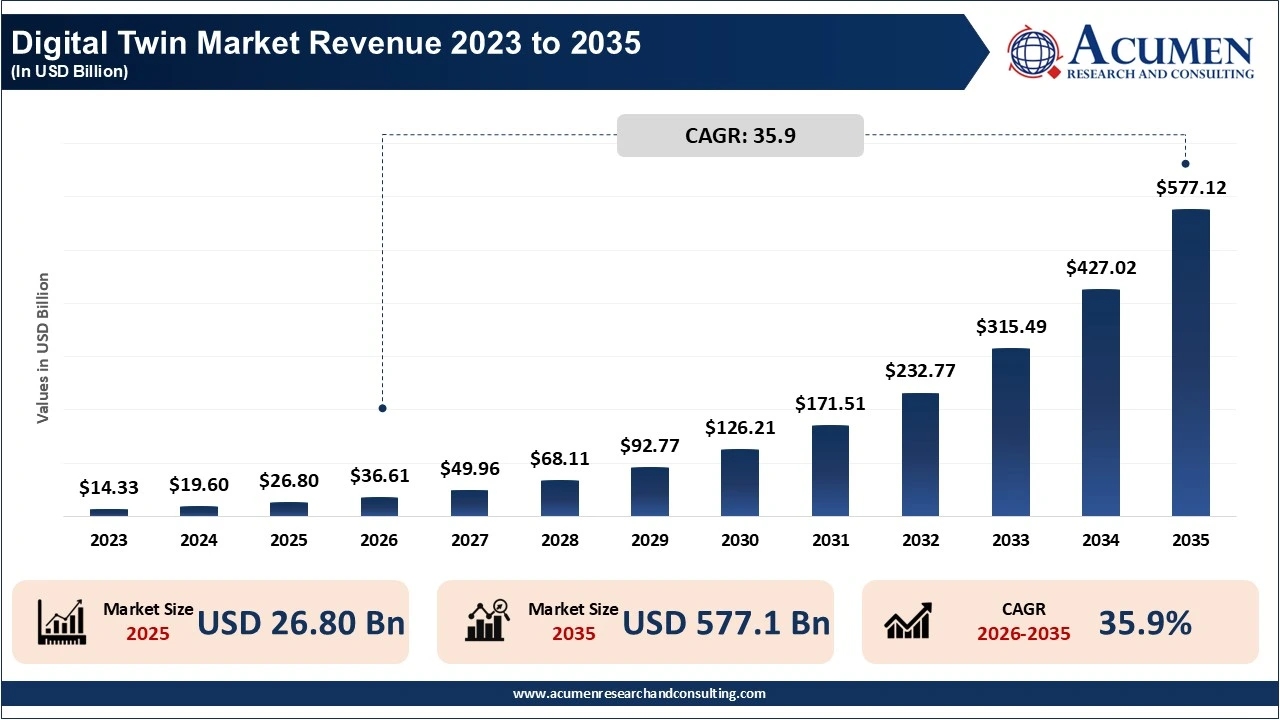
The digital twin market is the global market for the creation of virtual replicas of physical assets, systems, processes, and/or operational environments that can be used to monitor, simulate, analyze, and optimize a real-world entity. Digital twins gather data from sensors, IoT devices, software programs, and operational inputs in order to reproduce the dynamics of physical assets in various circumstances in real time.
Traditional simulation models offer a limited, static view; digital twins deliver real time, dynamically intelligent views. As intelligence is embedded within digital twin technology, it's commonly coupled with artificial intelligence, machine learning, cloud, and Industrial IoT to achieve benefits including predictive maintenance, operational efficiency, reduced downtimes, and quicker development cycles.
Digital Twin Market Statistics
- By solution, by solution, had a commanding share of 42% in 2025. The systems segment is growing due to a shift from asset-by-asset simulation towards enterprise-wide operational simulation. System digital twins combine multiple assets, workflow, environment, and production systems within a single simulation platform to improve collaboration, optimize performance, and inform strategic decisions in real-time.
- The process segment, by solution, had a second-largest share of 30% in 2025 as a result of its significant role in optimizing industrial workflows and improving efficiency. Process digital twins allow companies to optimize production processes and identify bottlenecks in industrial settings without affecting real-world operations. Pharmaceuticals, chemicals, and oil refining are among industries extensively using process twins for optimal throughput.
- By deployment, cloud segment, held the largest share of 58% in 2025 due to scalability, accessibility from centralized platforms and ability to process huge amounts of data in real-time across geographically dispersed facilities. Cloud-based digital twins combine assets and multiple facilities from different locations in a single simulated environment that provides greater insight and helps optimization and global manufacturing firms.
- The on-premise segment, by deployment, had the second largest share of 42% in 2025 due to data security concerns, compliance issues and infrastructure control needs. Defense, aerospace and healthcare industries heavily rely on on-premise deployment as it offers higher security for their operational data, allowing full control over simulation environments.
- By enterprise size, large enterprise segment held a dominant share of 78% in 2025 due to substantial capital resources, sophisticated digital infrastructure and complex operational demands. These organizations use digital twins to optimize extensive production systems, broad supply chains and many operational assets, helping to improve efficiency and mitigate risks; they also have greater technical capabilities and expertise to implement digital twin technologies along with AI, IoT, and ERP systems.
- Small and medium enterprises (SMEs), by enterprise size, had the second largest share of 22% in 2025 as cloud-based and SaaS digital twin platforms become more affordable and accessible. SMEs adopt digital twins to boost productivity, optimize resources, and eliminate inefficiencies. Falling simulation costs are making digital twins commercially viable for smaller businesses.
- By application, predictive maintenance held the largest share of 26% in 2025 as companies seek to minimize equipment failures and operational downtime. Digital twins monitor machine health in real-time through sensor data, AI-driven diagnostics, and historical performance patterns, predicting early signs of failure and enabling cost-effective maintenance.
- Product design & development, by application, had the second largest share of 18% in 2025 due to increasing demand for virtual prototyping and rapid product innovation. Engineers leverage digital twins to simulate product performance under real-world conditions, reducing the need for physical prototyping and accelerating time-to-market.
- By end-use industry, manufacturing held the largest share of 29% in 2025 due to the growth of smart factories, industrial automation, and AI-driven production planning. Manufacturers use digital twins to optimize machine performance, balance lines, and improve workflows, making them a core technology for efficient production in automated settings.
- Automotive & transportation, by end-use industry, held the second largest share of 16% in 2025 due to advancements in EV manufacturing, autonomous driving technology, and connected mobility systems. Digital twins are widely used in this sector for simulating batteries, performing crash tests, analyzing aerodynamics, and monitoring real-time vehicle performance.
AI-Driven Autonomous Digital Twin Expansion
Considering the current industry trends, perhaps the most significant opportunity within the digital twin market space relates to how artificial intelligence (AI) and autonomous actions can be seamlessly integrated within these existing digital twin systems. Where initial digital twin iterations have concentrated more heavily on monitoring and simulation, the market is increasingly seeing the rise of "intelligent twins," which are geared more towards predictive, adaptive and even self-optimizing actions.
Such advanced digital twins are poised to not only detect anomalies and predict failures but can be designed to autonomously reconfigure production plans, simulate operational risks, and propose actionable recommendations, even with no direct human input required. This is driving intense demand in value sectors such as the aerospace, EV manufacturing, industrial robotics, smart grids and health system markets.
Digital Twin Market Regional Outlook
Why has North America emerged as the leading regional market?
North America generated 37% of the total share in the digital twin market in 2025 and emerged as the leading regional market. The region holds a dominant position on the back of its highly automated industries, well-developed cloud infrastructure, and the widespread use of predictive technologies in the automotive, aerospace, manufacturing, and healthcare industries. North America is primarily led by the U.S., owing to the massive investments made in industrial IoT, AI-enabled manufacturing, and digital engineering solutions. This dominance is likely to continue with the presence of prominent software vendors and industrial simulation vendors in the region.
Why is Asia-Pacific anticipated to exhibit the highest CAGR?
Asia-Pacific is anticipated to exhibit the highest CAGR of 41.0% during the forecast period of 2026 to 2035. It is projected to gain a substantial share of the market as the digitization of the industry increases in China, India, Japan, and South Korea. China is making robust deployment of digital twin technologies in its smart factories whereas Japan is at the forefront in the robotics simulation and automobile manufacturing segment. The increase in smart city implementation and manufacturing sector upgradation in India is also expected to augment the market for digital twin platforms in the region.
Which are the Top Companies operating in the Digital Twin Market?
Major players in the digital twin market include Siemens AG, General Electric Company, Microsoft Corporation, IBM, PTC Inc., Dassault Systèmes, Ansys, Oracle Corporation, SAP SE, and Schneider Electric. These companies are driving innovation by combining industrial simulation, IoT integration, cloud infrastructure, and AI-powered analytics. Their significance lies in enabling enterprises to transition from reactive operations to predictive and autonomous systems, making them the backbone of next-generation industrial transformation.
Market Segmentation
By Solution
By Deployment
By Enterprise Size
- Large Enterprises
- Small and Medium Enterprises (SMEs)
By Application
- Predictive Maintenance
- Product Design & Development
- Business Optimization
- Performance Monitoring
- Inventory & Asset Management
- Supply Chain Optimization
- Remote Monitoring & Control
- Others
By End-use Industry
- Manufacturing
- Automotive & Transportation
- Agriculture
- Healthcare & Life Sciences
- Retail & Consumer Goods
- Telecommunication
- Energy & Utilities
- Residential & Commercial
- Aerospace
- Others
By Region
- North America
- Europe
- Asia Pacific
- Latin America
- Middle East & Africa
Contact Us:
Mr. Richard Johnson
Acumen Research and Consulting
India: +91 8983225533
E-mail: [email protected]