
Published : 06 Jul 2026
Author : Lucas Hoffmann



The artificial intelligence robots market size is expanding from USD 25 billion in 2025 to over USD 229.67 billion by 2035; growing at a CAGR of 24.8% during the forecast period of 2026-2035. The proliferation of service robots forms one of the largest long-term opportunities within the AI robots market. Moreover, electronics manufacturing, and warehouse automation create significant driver for the artificial intelligence robots market to boom.
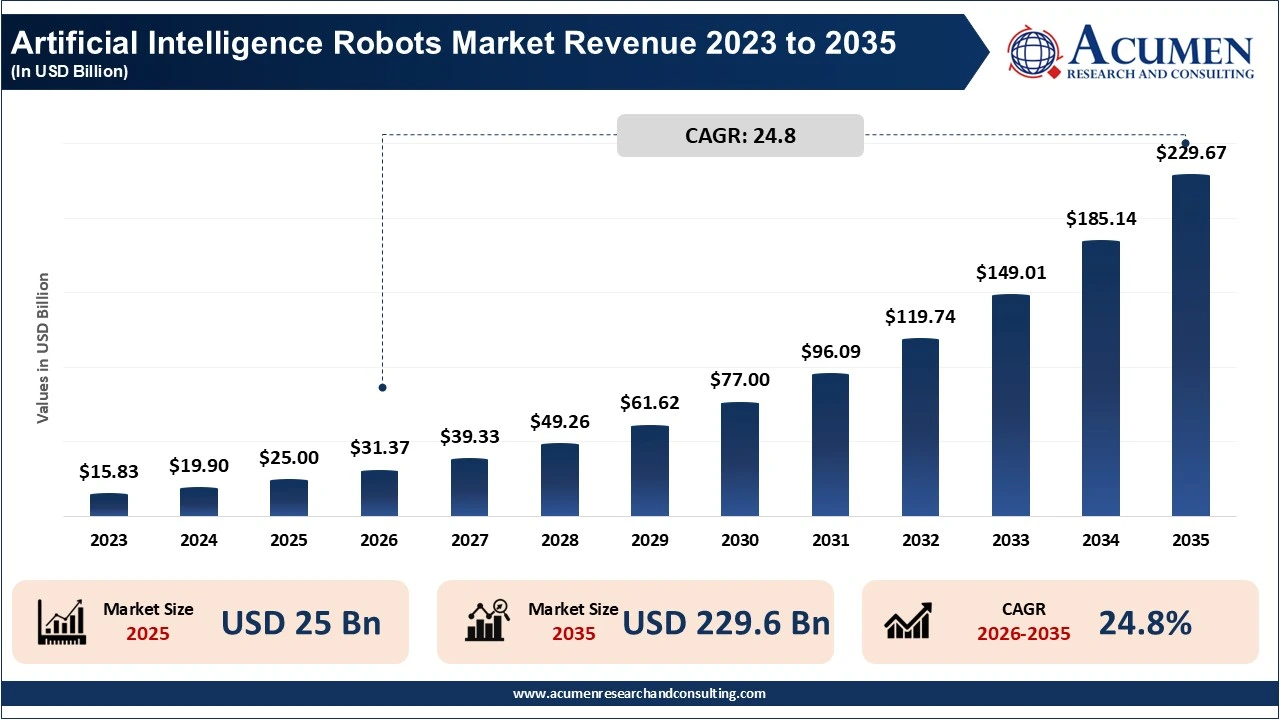
The market is understood as the global system comprising robotic devices combined with AI such as machine learning, natural language processing, computer vision, and reinforcement learning to facilitate autonomous or semi-autonomous decision-making, behavioral adaptation, and execution of intelligent operations. While ordinary robotic devices operate through coded instructions only, an AI robot would process sensory data, learn through interaction and thereby modify work routines and operations to conduct work with minimal or without human assistance.
The deployment of AI-robots are widespread throughout several environments like manufacturing units, hospitals, Warehousing units, retail environments, Agricultural units, Defense sectors and domestic segments of environment. By integrating sensor system, processing system, edge computing, cloud intelligent system and actuator system the AI based robot could do such complex tasks as predictive maintenance, autonomous navigation, recognizing objects, dealing with human beings, physical operations with extreme accuracy etc.
Rise of Physical AI and Autonomous Enterprise Robotics: Market’s Largest Opportunity
The most significant opportunity is the shift from digital AI to Physical AI, in which intelligent software moves beyond the screen and into the real world with hardware execution. Businesses across the manufacturing industry are beginning to pour resources into robots that don't just do boring tasks over and over again, but are able to conduct advanced, AI reasoning-based physical tasks within manufacturing facilities, warehouses, hospitals, or even out in the field. The autonomous warehouse, surgical robotics, military drones, humanoid labor systems, and infrastructure inspection robots represent significant market opportunities for AI robotics companies.
AI robots are moving from automated add-ons to critical infrastructure as the world faces both increasing labor shortages and an industrial need for greater precision at lower costs. Multimodal AI models, agentic AI, and robot foundation models will create robots that perceive, recall, plan, and react in real time to entirely new markets within healthcare for the elderly, retail with no human workforce, precision agriculture, and industrial self-healing systems.
Asia Pacific dominated the global AI robots market with a share of 40% in 2025. A massive manufacturing capacity, semiconductor production in huge volumes, aggressive adoption of automation in its core manufacturing industries (electronics, automobiles, consumer goods, logistics etc.) and the growing use of robotics hardware, semiconductors, sensors and actuators, in the region makes it the leading market worldwide.
It has already emerged as the global manufacturing hub of robotic hardware, sensors, actuators and AI chips and its highly vertically integrated ecosystem reduces the costs involved for production and robot implementation in a significant way.
China remained the largest in the region and in the world, capturing a share of more than 50% in global industrial robot installations annually. This is owing to the widespread use of industrial robots due to its huge scale smart factory initiatives, rise of EV manufacturing sector and chip self-sufficiency plans.
The number of industrial robots in China is reported to exceed 290,000+ annually making China the top market for robotic deployment in the world. Chinese governmental policies such as ‘Made in China 2025’ drive the automation of AI industrial robots.
Middle East and Africa is seen to witness a substantial growth of 28.8% CAGR up to 2035 making it the fastest-growing region in the AI robots market. Rapid market expansion in the region is propelled by a robust push of AI adoption via national AI transformations, development of smart infrastructure, industrial diversification, and increased utilization in oil & gas, defense, logistics and healthcare industries.
Saudi Arabia has been identified as the strongest growth driver in the MEA region, with the nation taking a prominent position with its Vision 2030, by undertaking massive investments in AI driven smart infrastructure, automated industrial sites, and futuristic cities such as NEOM. Increasing adoption of robots in oilfield automation, security systems, support services within healthcare sectors, and the initiative for reducing the economy's dependence on oil are creating a significant momentum for industrial robotics.
The key companies engaged in the AI robots market space consist of: NVIDIA Corporation, Tesla, Inc., ABB Ltd., Fanuc Corporation, KUKA AG, Boston Dynamics, Intuitive Surgical, Yaskawa Electric Corporation, Unitree Robotics, and Agility Robotics. Each of these organizations are influencing the market place through their advancements in AI processing, self-governing robots, humanoid robots, robotic automation, surgical robotic applications, and physical AI infrastructure, respectively, pushing the commercialization of intelligent robots forward in industrial and non-industrial applications and serving as cornerstones to a new era of physical AI.
By Robot Type
By Mobility Type
By Technology
By End User
By Region
Contact Us:
Mr. Richard Johnson
Acumen Research and Consulting
India: +91 8983225533
E-mail: [email protected]