
Published : 01 Jul 2026
Author : Simone Lamb



The sovereign cloud market, valued at USD 132.04 billion in 2025, is expected to hit USD 1,133.42 billion by 2035, reflecting a strong CAGR of 24.0% over the forecast period 2026 to 2035.
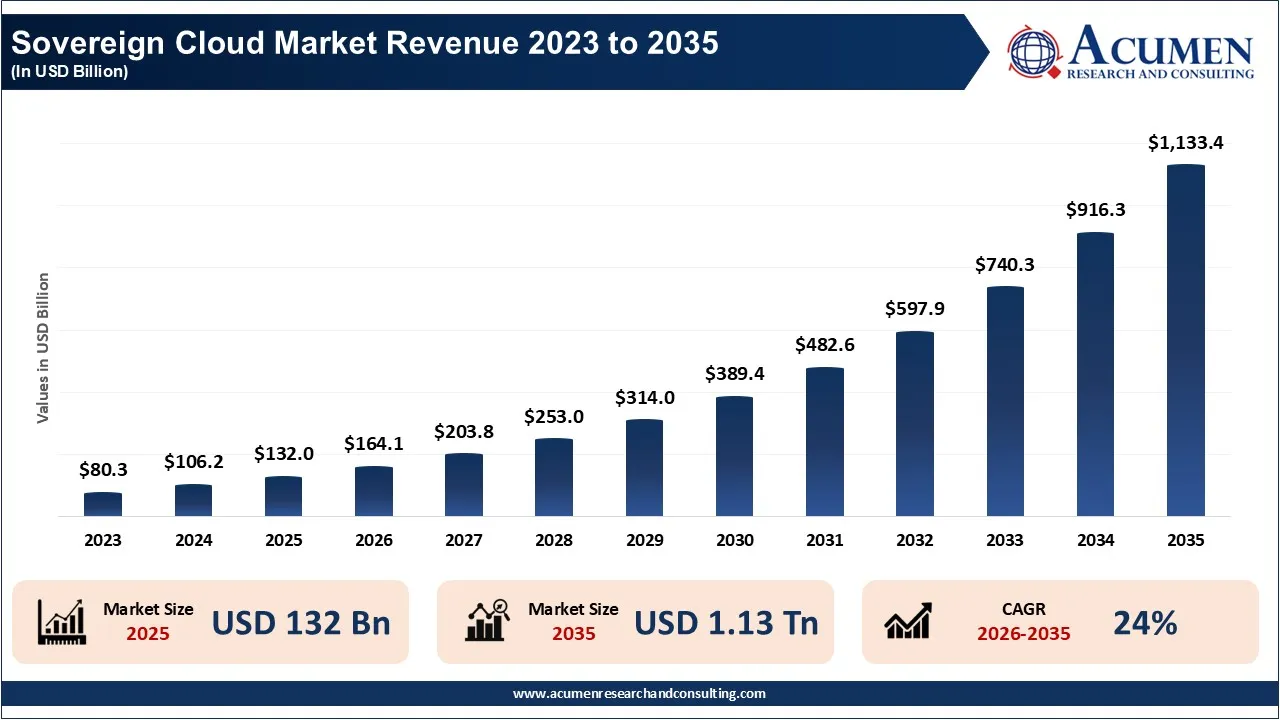
The sovereign cloud market is being strongly driven by the growing emphasis on data sovereignty, regulatory compliance, and national security, particularly among governments and highly regulated industries. As data protection laws such as GDPR become more stringent, organizations are required to ensure that sensitive data remains within national or regional jurisdictions and is governed by local authorities.
Sovereign cloud platforms address these needs by offering localized infrastructure, strict access controls, and enhanced transparency over data ownership and operations. This approach significantly reduced the risk associated with cross-border data transfer and build trust among public sectors, defense agencies, healthcare providers, and financial institutions.
At the same time, the market is benefiting from the broader shift toward cloud-native adoption and digital transformation, where organizations seek scalability and innovation without compromising control over critical workloads. Sovereign cloud solutions enable secure hybrid and localized cloud environments while supporting advanced technologies such as AI, analytics, and mission-critical applications.
Reflecting this trend, in January 2026, Amazon Web Services (AWS) launched its European Sovereign Cloud in Germany as an independent cloud infrastructure designed to meet strict EU data residency, operational autonomy, and compliance requirements. This development underscores the growing confidence in sovereign cloud models and highlights how leading provider are aligning their offerings with regional regulatory and security expectations.
Rising Demand for Data Sovereignty and Regulatory Compliance
The sovereign cloud market is primarily driven by the increasing need for organizations to maintain full control over sensitive data in line with strict national and regional regulations. Governments and regulated industries such as BFSI, healthcare, and defense must ensure that data is stored, processed, and governed within jurisdictions. Sovereign cloud solutions address these requirements by offering localized infrastructure, transparent governance models, and compliance with data protection laws, further making them essential for secure digital transformation.
Limited Availability of Skilled Sovereign Cloud Talent
Major restraints limited the growth of the market is the shortage of professionals with specialized expertise in sovereign cloud architecture, cybersecurity compliance, and localized cloud operations. Managing, implementing, and accessing sovereign-grade environments requires advanced skills in cloud orchestration, risk management, and regulatory compliance capabilities that are scarce and highly sought after across the global technology industry. This talent gap increases operational costs, slows innovation, and creates challenges for providers and enterprises aiming to deploy and scale sovereign cloud solutions efficiently.
Expansion of Digital Government and Critical Infrastructure Projects
The growing focus on digital governance, smart public service, and modernization of critical national infrastructure presents a strong opportunity for the sovereign cloud market. Governments are increasingly investing in secure, locally governed cloud platforms to support e-governance, defense systems, healthcare data platforms, and national AI initiatives. As these projects expand, sovereign cloud providers can play a central role in enabling secure innovations while ensuring compliance, resilience, and long-term data control.
The global market for sovereign cloud market has been segmented into deployment, functionality, enterprise size, end use, and region.
North America is the leading region of the sovereign cloud market due to its strong focus on digital sovereignty, and early adoption of regionally governed cloud infrastructures. Growing cybersecurity risks, stringent data privacy regulations, and government pressure on localized data storage are also boosting the expansion of North America’s sovereign cloud market. The sovereign cloud market is likely to remain highly competitive, with ongoing efforts by the U.S. federal government to improve IT infrastructure security and secure the nation’s data assets bolstering market growth in the segment. Secure cloud infrastructure, artificial intelligence-enabled cyber security solutions and regulatory compliant cloud architectures will only accelerate these growth trends.
Asia Pacific is the fastest-growing region, driven by rapid digital transformation, expanding government digitization programs, and rising concern about data localizations and national cybercity. Countries such as China, India, Japan, and South Korea are increasingly investing in sovereign and government-backed cloud platforms to support public services, critical infrastructure, and regulated industries. In addition, growing cloud adoption among enterprises, combined with evolving data protection laws and increasing geopolitical awareness, is accelerating sovereign cloud demand across the region.
Sovereign cloud companies profiled in the report include Microsoft Corporation, Amazon Web Services (AWS), Google Cloud, IBM Corporation, Oracle Corporation, OVHcloud, Deutsche Telekom (T-Systems), Atos SE, Thales Group, Alibaba Cloud, Huawei Cloud, and CloudSigma.
| Parameter | Details |
| Size in 2025 | USD 132.04 Billion |
| Forecast by 2035 | USD 1,133.42 Billion |
| CAGR During 2026 - 2035 | 24.0% |
| Largest Deployment Segment (% Share 2025) | Private- 50% |
| Largest Region Size (2025) | North America – 38% |
| Fastest Growing Region (% CAGR) | Asia - Pacific – 26.8% |
| Key Players Covered | Microsoft Corporation, Amazon Web Services (AWS), Google Cloud, IBM Corporation, Oracle Corporation, OVHcloud, Deutsche Telekom (T-Systems), Atos SE, Thales Group, Alibaba Cloud, Huawei Cloud, and CloudSigma. |
Contact Us:
Mr. Richard Johnson
Acumen Research and Consulting
India: +91 8983225533
E-mail: [email protected]