What is the South Korea Physical AI Market Size?
The South Korea physical AI market size is expanding from USD 112.5 million in 2025 to over USD 2,064 million by 2035 growing at a CAGR of 34.2% from 2026 to 2035. South Korea physical AI market is witnessing significant momentum, benefiting from its global competitiveness in robotics, semiconductors, smart manufacturing, and artificial intelligence development. AI is increasingly being integrated into physical infrastructure like industrial robots, collaborative robots, autonomous mobile robots, humanoids and intelligent manufacturing devices, revolutionizing processes in the automotive, electronics, logistics and healthcare sectors.
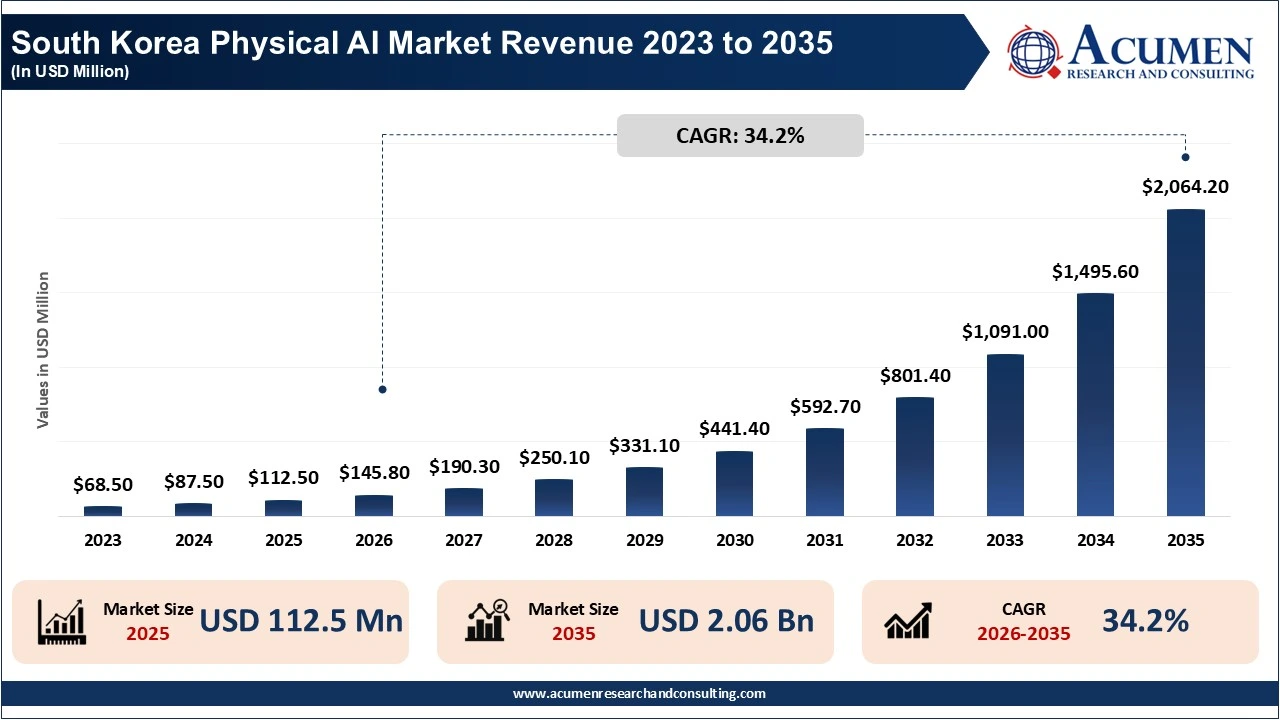
Supportive national policies on artificial intelligence, growing investments in AI chips, and faster implementation of smart factory solutions have paved the way for adoption of physical AI in the country. Moreover, collaborations between global technology firms, robotics startups and academia have expedited the market's expansion in the country.
South Korea Physical AI Market Statistics
- By deployment, on-device AI owned the South Korea physical AI market by commanding a 54.4% share in 2025. Increase in the number of deployments of industrial robots with AI, automated machinery, and smart medical devices has pushed the usage of edge computing to ensure timely decision-making. Rising concern for latency, operational integrity, and data safety have contributed to strengthening the demand for on-device AI.
- By deployment, the cloud-based AI stood as the second leading segment by contributing a share of 45.6% in 2025. More enterprises are capitalizing on the cloud-based infrastructure to centralize all the connected robots, industrial IoT systems, and twin digital platform to be placed across multiple sites. Expansion in 5G technology coupled with government-led digital initiatives are fueling the growth of cloud-based physical AI deployments.
- By component, the hardware was the top revenue-generating segment, holding a market share of 50.4% in 2025. South Korea's domestic strengths in semiconductor, robotics, and advanced electronics industry continues to fuel investments in AI processors, sensors, LiDAR, and other computing platforms embedded within robotic systems. The growth in automation across manufacturing industries have propelled the demand for intelligent robotic hardware.
- By component, software was the second most significant segment, garnering 37.4% of the total South Korea physical AI market share in 2025. Advances in the AI OS, computer vision platform, and robot learning framework have driven the development of highly adaptive and interactive physical AI. An increase in demand for predictive maintenance, continuous software updates, and remote monitoring has been driving the software adoption.
- By technology, computer vision technology registered the highest share of 44.2% in the South Korea physical AI market in 2025. It is used as an underpinning for robot perception, autonomous navigation, accurate inspection, and product quality control in various industrial settings. Improvements in the AI imaging algorithm, along with the deployment of high-resolution sensors have boosted the demand across numerous applications.
- By technology, speech/Natural Language Processing (NLP) captured the second highest share with a share of 20.6% in 2025. Deployments of interactive human-machine interfaces, conversational AI and multi-language speech recognition have boosted the adoption of service robots. Increased adoption of intelligent robots for use in the healthcare, hospitality, and retail sectors have fueled the demand for speech/NLP technology.
- By robot type/form factor, industrial robots occupied the majority share with a share of 41.8% in the South Korea physical AI market in 2025. The country's expertise in automotive, electronics, semiconductor, and battery manufacturing sectors continues to generate huge demand for AI-integrated automation. Government initiatives that promote Industry 4.0 have strengthened the demand for industrial robots in smart factories and advanced manufacturing.
- By robot type/form factor, the service robots sector claimed the second spot with a share of 12.9% in 2025. The increasing number of labor shortages, ageing population, and desire to boost operational efficiency are pushing the adoption of intelligent robots across service industries. The wide array of applications for service robots in healthcare, hospitality, logistics, and public sectors continue to create fresh growth opportunities.
- By application, manufacturing & automotive represented the leading application segment, accounting for a 23.8% share in 2025. Manufacturers are widely deploying physical AI solutions to boost production processes, ensure superior product quality, automate material handling, and reduce operational downtime. Support from government initiatives on the development of Industry 4.0 and smart factories further drive the adoption of the technology in the sector.
- By application, the healthcare constituted the second largest application with a share of 17.5% in 2025. Increase in the adoption of AI for surgical systems, rehabilitation robots, hospital logistics, and patient monitoring systems by healthcare providers are driving investments in the healthcare sector. Government funding for hospital modernization, increase in healthcare expenditure, and an ageing population will fuel demand for physical AI.
Can South Korea Become Asia's Physical AI Innovation Hub by 2030?
With its leading capabilities in semiconductor, robotics, AI research, and smart manufacturing, supported by robust government backing and increased private funding, South Korea has the potential to be one of Asia's leading centers of physical AI innovation. The nation is routinely among the most robot-intensive manufacturing countries in the world, with in excess of 1,000 industrial robots for every 10,000 manufacturing workers, which serves as a powerful springboard for deploying AI-enabled physical systems.
Moreover, the country produces more than a quarter of all global memory chip output; an advanced and critical technology for the chips used in edge AI devices, self-driving robots and smart machines. As spending on edge AI, machine vision, digital twins and synthetic data expands over the forecast period, South Korea stands to attract a significant influx of local and global investment to fuel its position as a worldwide innovation epicenter for next-generation physical AI.
What are the latest trends of the South Korea Physical AI Market?
- Faster Development of Humanoid Robots - Companies in South Korea are pushing ahead to develop physical AI enabled humanoid robots that can be programmed for the complex jobs and duties of a robot for industrial, logistics, and service jobs.
- AI in Smart Factories - Physical AI is now being adopted within smart factory type environments to manage predictive maintenance, automated inspection for quality, process control, and robotic/autonomous manufacturing.
- Growing Adoption of Cobots - Cobots are also gaining more traction with an increased number of small and medium sized businesses.
- Increased Investment in Robotics Foundation Models - Large, high technology corporations are investing heavily in the training of new types of AI model, robotics foundation models that leverage both simulated and real-world data.
Which are Top Companies operating in the South Korea Physical AI Market?
Physical AI landscape in South Korea is a competitive and comprehensive industry ecosystem, comprising globally strong companies with integrated and distributed value chain covering semiconductor and AI infrastructure, robotics, autonomous systems, and software intelligence. Samsung Electronics provides its cutting-edge AI processors, memories, and edge hardware systems, that enable various intelligent physical systems.
While SK Group is building a physical AI stack with AI cloud infrastructure, High Bandwidth Memories(HBM), and data centers from its affiliates SK Telecom and SK hynix to handle demanding physical AI work. In parallel, LG Electronics is fast tracking AI factories and Robotics LLMs with NVIDIA, and NAVER Corporation is enhancing its sovereignty in AI capabilities via hyper-scale AI infrastructures and data centers.
Market Segmentation
By Deployment
- Cloud-based AI
- On-device AI
By Component
- Hardware
- Software
- Services
By Technology
- Computer Vision
- Speech / Natural Language Processing (NLP)
- Gesture / Movement Recognition
- Reinforcement Learning & Control Systems
- Others
By Robot Type / Form Factor
- Industrial Robots
- Service Robots
- Humanoids/Social Robots
- Cobots
- Exoskeletons/Prosthetics
- Mobile Robots/Drones
By Application
- Healthcare
- Manufacturing & Automotive
- Logistics & Warehousing
- Retail & Hospitality
- Defense & Security
- Agriculture
- Education & Research
- Others
Contact Us:
Mr. Richard Johnson
Acumen Research and Consulting
India: +91 8983225533
E-mail: [email protected]