
Published : 01 Jul 2026
Author : Simone Lamb



The global agentic CPU market size is expected to skyrocket from USD 3.20 billion in 2025 to over USD 1,088.48 billion by 2035; growing at a CAGR of 79.1% from 2026 to 2035. Market is exploding as enterprises and hyperscale clouds move to AI system and machines that handle many complex tasks with little human interference. Accelerated adoption of scalable AI, the need for distributed compute, and hybrid cloud-native architecture are also the driving the trends.
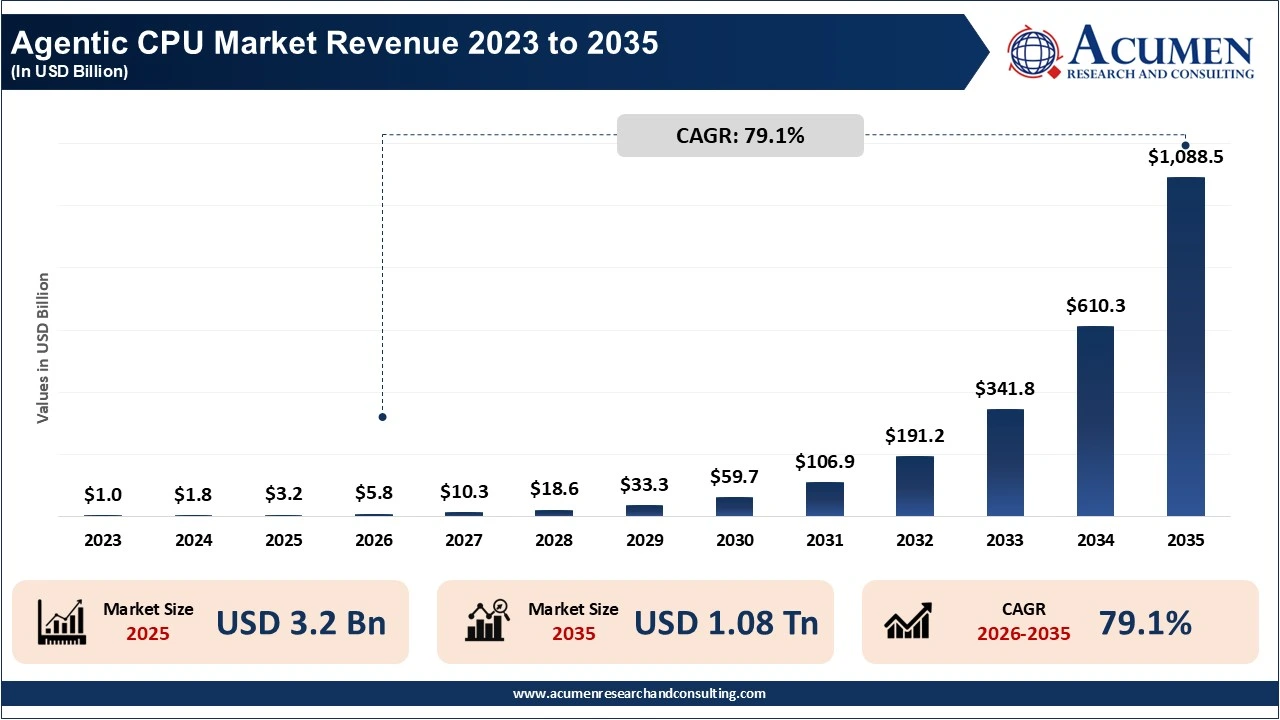
The agentic CPU market is the universe of processor technologies and computing infrastructure that is architecturally optimized for agent-based AI systems such as autonomous agents, AI copilots, and large language models combined with retrieval augmented inference. The CPU technology is ideally suited to serve agents needing constant inference capability, multistage reasoning and working with potentially large amounts of data held in memory for long time frames, or providing immediate guidance for decision-making in agent workflows.
The demand is also increased by demand for adaptable and highly distributed computing frameworks, and cloud-native hybrid deployment models. Finally, emerging hardware architectures from opensource designs coupled with CPU level hardware acceleration is changing the dynamic across hardware.
Market Opportunity: Expansion of AI-Native Compute Infrastructure and Autonomous Processing Systems
Scope of a huge opportunity based on high-speed development of AI-native computing infrastructure worldwide the global digital landscape. The expansion and deployment of massive compute environments globally will drive continued investment beyond multi-billion dollars and global demand for autonomous AI workloads demanding ongoing inference capabilities in a continuous, real-time format.
The movement of enterprise automation forward relies on high-performance compute capabilities for ongoing multi agent processes. The creation of a massive next-generation processing opportunity with support for intelligence spread across multiple machines in the world is on the table.
AI workload driven increases in global compute will be driven by ongoing worldwide AI-driven growth in digital infrastructure as AI enterprises invest billions in next-generation processors as demands for AI workloads jump with enterprise adoption of models of scale, efficiency and parallel computing.
North America dominated the market share with a share of 46% in 2025 due to its highly advanced semiconductor ecosystem, early integration of autonomous computing solutions and the established research and development infrastructure in AI. This is attributed to hyperscale cloud providers making large investments in developing and deploying AI infrastructure as well as increased integration of AI-driven workloads in various enterprises. The high adoption rate is influenced by large scale deployment of AI at hyperscale data centers across the U.S. and significant rise in use of AI across major industry sectors in North America.
The region contributes considerably to high-performance computing capabilities in AI across industries such as health, finance and manufacturing with strong government support for digital and autonomous technologies and significant contribution from leading companies like NVIDIA, AMD, IBM. This is reflected in high growth potential due to the increasing demand of advanced computing chips driven by AI adoption in applications ranging from image and natural language processing to autonomous driving.
The Asia Pacific market is expected to grow the fastest with a CAGR of 83.6% during the 2026-2035 period due to significant investments in semiconductors, AI development, and the increasing development of sovereign AI systems and robotics by countries like China, India, Japan, and South Korea. Significant advancements in developing sophisticated HPC (High-performance Computing) infrastructure and expansion of capabilities across all countries will cater the high demand from key economic blocs.
Increasing R&D focus, coupled with government initiative like Made in China and strategic investments in infrastructure by nations like South Korea, are spurring the development of sovereign AI system that rely heavily on advanced architectures. AI chips manufactured in China and Taiwan are extensively used by large semiconductor manufacturers as demand of powerful and energy efficient silicon architecture increases with every AI development.
High computing capacity for data analytics and AI-based machine learning drives significant growth of autonomous computing in these regions, and with growing adoption of high-tech applications by industries such as telecom, manufacturing and retail, demand for new computing architectures is escalating across the region. This can also be explained by a rapid shift in demand for intelligent system, especially in the automotive and smart manufacturing sector with demand for sophisticated ECUs and processors.
Europe is anticipated to grow consistently in the agentic computing technology in the forecast period on account of regulatory developments and advancements in AI technology and data sovereignty initiatives. Increasing efforts toward ensuring secure and energy-efficient computing solutions contribute to steady expansion in the use of agentic computing technology.
Agentic CPU players the agentic CPU market space is intensely contested by a variety of dominant semiconductor companies, major cloud providers, and AI hardware disruptors, including the likes of Intel, AMD, NVIDIA, ARM Holdings, and the latest ecosystem pioneers specializing in open architectures, such as RISC-V ecosystem stakeholders.
These key industry players act to define this nascent market by the speed at which they innovate new designs, tune CPUs to run specific AI workloads and begin implementing new architectural approaches to support more distributed and heterogeneity in silicon.
| By CPU Architecture | By Deployment Environment | By Application | By End User | By Region |
|
|
|
|
|
Contact Us:
Mr. Richard Johnson
Acumen Research and Consulting
India: +91 8983225533
E-mail: [email protected]