
Agentic CPU Market Size, Share, Growth, Report 2026 to 2035
Agentic CPU Market (By CPU Architecture: x86 Processors, ARM-Based Processors, RISC-V Processors, Custom Proprietary Architectures; By Deployment Environment: Cloud Data Centers, Enterprise Data Centers, Edge AI Infrastructure, Hybrid Cloud Infrastructure; By Application: AI Agent Orchestration, Multi-Agent Systems, Retrieval-Augmented Generation (RAG), AI Copilots & Digital Agents, Autonomous Software Development, Robotics & Physical AI, Research & Scientific Computing, Other Agentic Workflows; By End User) - Global Industry Analysis, Size, Share, Regional Analysis, Trends and Forecast 2026 - 2035
- Last Updated: 01 Jul 2026
- Report Code: ARC3939
- Category: ICT
Agentic CPU Market Size, Forecast 2026 to 2035
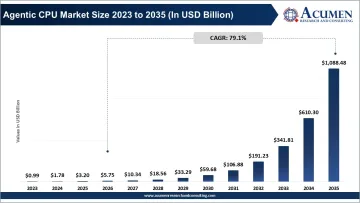
The global agentic CPU market size was valued at $3.20 billion in 2025, it is expected to reach $1,088.48 billion by 2035; growing at a CAGR of 79.1% during the forecast period of 2026-2035. Data center operators are expected to deploy over 14 million AI accelerator units by 2027, while enterprise spending on autonomous AI agents is projected to exceed $47 billion by 2028, accelerating the integration of agentic CPUs for low-latency reasoning, task orchestration, and real-time decision-making; while promoting the expansion of the agentic CPU market.
Report Highlights
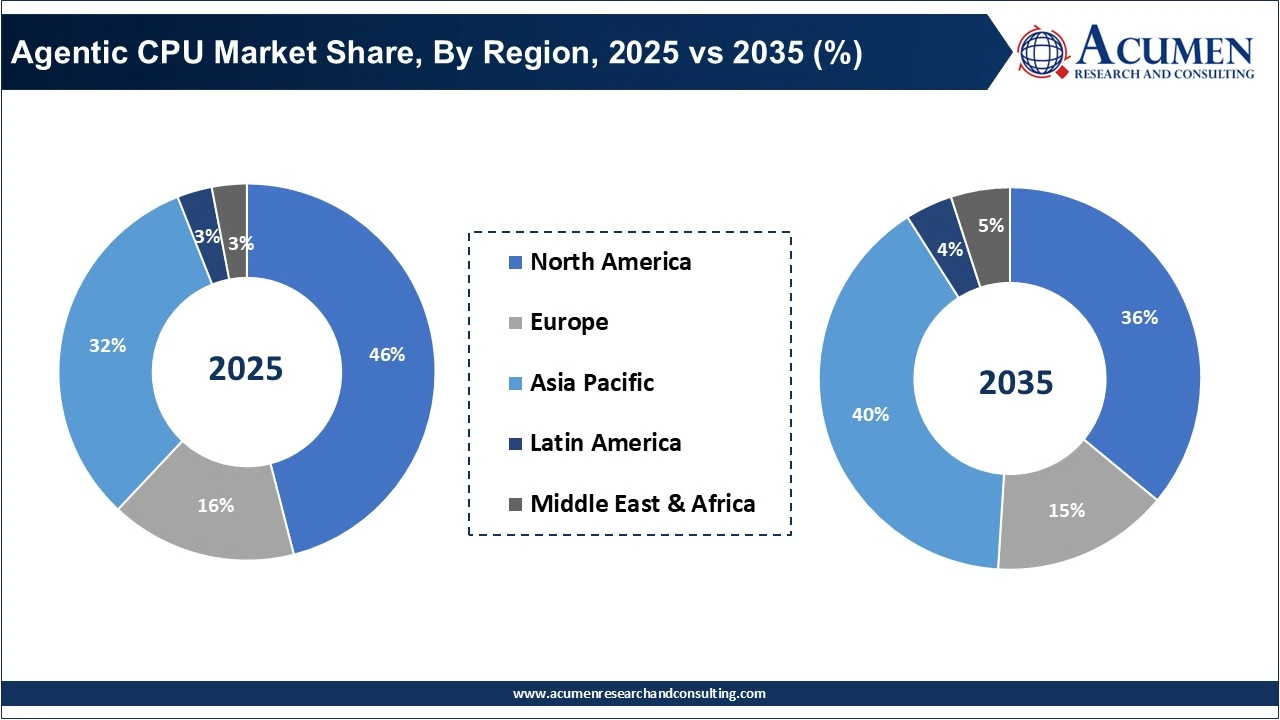
- By region, North America held largest market share of 46% in 2025, owing to robust semiconductor infrastructure, advanced AI environment and high enterprise AI adoption.
- By region, Asia Pacific is predicted to register fastest CAGR of 83.6% from 2026-2035, due to aggressive investments in semiconductor manufacturing, robotics, sovereign AI and AI compute infrastructure.
- By CPU architecture, the x86 processors segment held largest market share in 2025, representing 68%, driven by the mature software ecosystem, high compatibility with existing GPU infrastructure, and wide deployment in hyperscale AI environment.
- By CPU architecture, RISC-V processors segment is anticipated to register fastest CAGR of 98.2% from 2026-2035 due to its open source nature, coupled with increasing demand for customized AI-specific processor architectures.
- By deployment, cloud data centers segment held largest market share of 52% in 2025, driven by rapid deployment of hyperscale AI factories and autonomous large scale computing environments.
- Based on deployment, the hybrid cloud infrastructure segment is anticipated to witness fastest CAGR of 91.5% over the forecast period, fueled by growing adoption of hybrid cloud architecture among enterprises.
- By application, AI copilots & digital agents segment held largest market share of 26% in 2025 due to growing adoption of AI assistants among enterprises for automation, knowledge retrieval, and task execution.
- By application, RAG (Retrieval-Augmented Generation) segment held second largest market share of 18% in 2025 owing to its CPU-intensive requirement for retrieval, indexing and context gathering before AI inference.
- By end-user, hyperscale cloud providers segment held largest market share of 38% in 2025, driven by massive investments in AI infrastructure, GPU clusters and autonomous compute orchestration.
- By end-user, enterprise segment held second largest market share of 24% in 2025 owing to increasing adoption of AI agents in workflow automation, analytics and software development.
What is Agentic CPU Market?
The agentic CPU market involves building computer processors engineered for the workload of agentic artificial intelligence, or AI that plans, reasons, makes decisions and performs multi-step actions with minimal human oversight. Compared to general purpose CPUs, which generally are made for simpler tasks, these new processors are tuned for the high frequency memory accesses, low latency task orchestration and parallel process management, dynamic inference delivery needed for AI agents.
The rise of AI factories, hyperscale data centers, edge AI and enterprise automation systems are key growth drivers of the market where CPUs have been crucial for orchestrating GPUs, memory systems, and distributed AI tasks. Leading semiconductor players are now developing their own customized solutions to tackle this need which represents agentic CPUs as a unique and fast-growing market segment within the overall AI processor ecosystem.
Case Study: NVIDIA Vera CPU & Its Agentic AI Infrastructure
On May 2026, NVIDIA Corporation launched its Vera CPU, built to suit agentic AI workloads and to represent a radical departure in CPU architecture, evolving from CPUs designed for cloud virtualization to those built for orchestrating agents of autonomous AI. Featuring 88 custom Olympus cores and providing as high as 1.2TB/s LPDDR5X memory bandwidth, the Vera CPU allows the fastest possible tool calls, compilation of code, search-based actions, and reinforcement learning loops.
Key Snapshot of NVIDIA’s Breakthrough:
- On its internal tests Vera provided 1.8x higher sandbox performance than recent x86 CPUs at full load on agentic workloads while itsIPCwas 50% higher than Grace.
- The architecture also sustains over 90% of peak memory bandwidth utilization and reduces memory latency by 40%.
- Improves graph traversal workloads by more than 3x, directly addressing the CPU bottleneck in multi-step agentic workflows where CPUs can account for over 90% of total execution latency.
Market Dynamics
Driver
The Rise of CPU Bottlenecks in AI Inference and Agentic Workloads
The most potent driver of the agentic CPU market today stems from the growing recognition that the conventional CPU itself has become a bottleneck in current AI environments. While the GPU excels at accelerating training and some inference operations, CPU plays the critical role in agent orchestration-task scheduling, memory management, tool calls, API orchestration, and retrieval systems.
In a complex, agentic AI workflow with numerous reasoning loops and calls to external tools, CPU may contribute a substantial part of the overall workload latency. As enterprises shift to increasingly complex, multi-agent, real-time AI operations, the reliance on efficient CPU performance for autonomous execution will only grow, and a CPU built for generic server workloads will struggle under constant agentic tasks.
Restraint
Less Reliability on Software Ecosystem
A restraint to the market is the underdeveloped and non-standardized software ecosystem for the deployment of agentic CPUs. In parallel to the rapid development in AI hardware technology, frameworks for autonomous agents are diverse and non-uniform across various models, orchestrations, and execution environments. This fragmentation has led to the incompatibility issues when enterprises would like to incorporate agentic CPU into their IT infrastructure. This is because different AI agents might need different runtime, memory space architecture, or communication protocols, thus, limits compatibility and complicates the deployment.
Opportunity
Sovereign AI infrastructure Infrastructure
The rise of sovereign AI across the globe creates significant opportunity for the agentic CPU market. With governments worldwide looking to invest in domestic AI infrastructure to build national AI capacity and alleviate dependence on foreign cloud services.
These sovereign AI data centers require highly specialized compute architectures, needed for large-scale AI workloads, autonomous government operations, defense simulations, and public sector AI-use cases. Agentic CPUs can facilitate the orchestration of these infrastructure, especially in secure, local and low latency applications.
The United States, China, India, Japan, and European countries among others have significantly boosted their investments into AI supercomputing clusters, semiconductor fabrication, and sovereign cloud infrastructure, fueling substantial long-term demand for AI-specific CPUs.
Top Investments in Agentic CPU Industry Globally (2025-2026)
| Company | Investment Type | Strategic Focus |
|---|---|---|
| NVIDIA Corporation | Product commercialization pipeline | Scaling standalone Vera CPUs for agentic AI factories and hyperscale deployment |
| Oracle Corporation | AI infrastructure deployment | Expansion of OCI superclusters integrating agentic CPU infrastructure for high-throughput reasoning |
| CoreWeave, Inc. | AI compute infrastructure | Large-scale CPU-GPU integrated clusters for autonomous AI agent workloads |
| Advanced Micro Devices, Inc. | AI server CPU expansion | Expansion of EPYC server ecosystem optimized for orchestration-heavy agentic workloads |
| Intel Corporation | Xeon AI CPU development | Accelerating AI-native CPU roadmap for enterprise agentic systems |
Segmental Insights
CPU Architecture Insights
The x86 processors segment held the dominant market share of 68% in 2025, growing at a CAGR of 72.3% during the forecast period. X86 CPUs are still essential for orchestration workloads due to their mature software and ecosystem, and full integration with GPU infrastructure. Currently most of AI factories and enterprises compute cluster are fully optimized on x86-based CPU environment so that agentic workloads (multi-agent orchestration, retrieval pipelines and sandboxed execution) can be readily deployed on them.
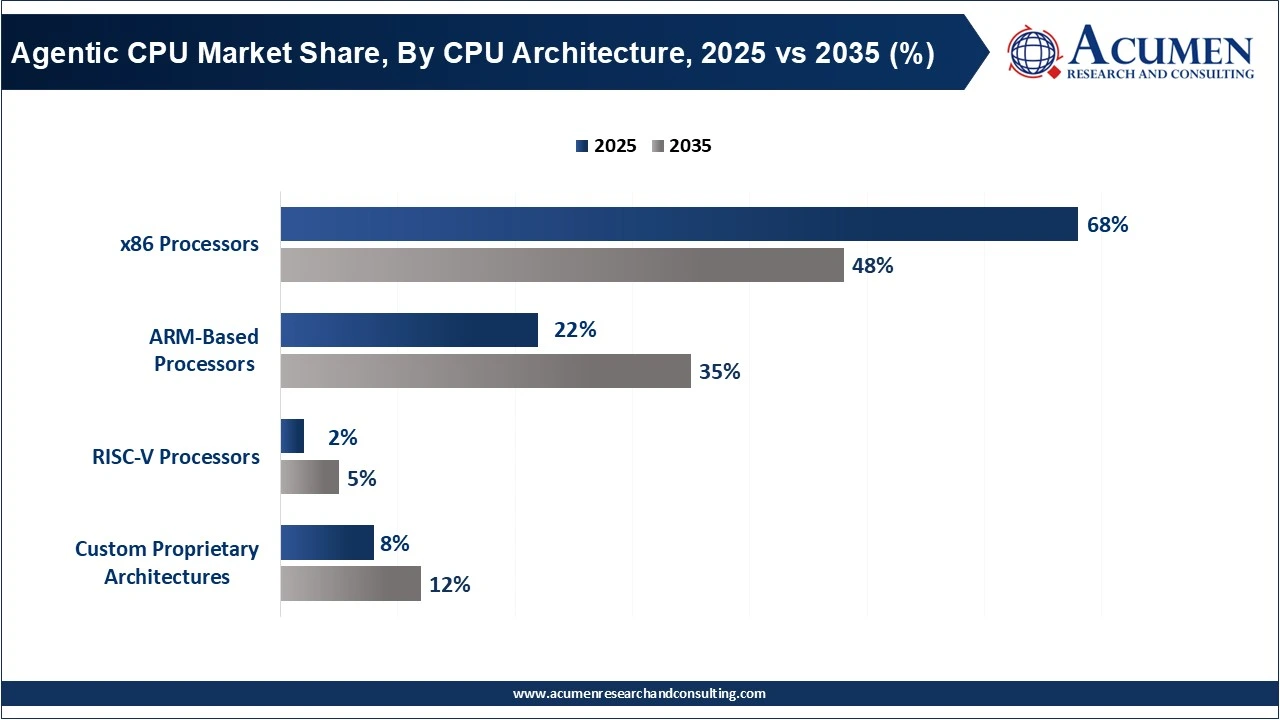
RISC-V processor segment is expected to expand the fastest with CAGR of 98.2% over 2026 to 2035. This growth represents the strong increase of interest towards open source CPU architecture with customization for AI tasks. RISC-V provide great extensibility which enables enterprises or semiconductor manufacturers to design tailored agentic CPU architecture around various reasoning tasks, memory characteristics and orchestration needs.
These architectures will offer performance benefits in designing autonomous agent hardware from scratch that are optimized around different decision-making, multi-agent orchestration and real-time inference requirements.
Deployment Insights
The cloud data centers segment held the largest market share of 52% in 2025 and will continue its leadership over the forecast period, growing at a CAGR of 76.2%. The increasing dominance of this segment is attributed to the rapid growth of hyperscale AI infrastructure worldwide.
Cloud data centers provide the fundamental deployment environment for large language models, autonomous AI agents, and multi-step reasoning systems, while agentic CPUs in this segment act as orchestration layers for GPU scheduling, memory allocation, retrieval pipelines and distributed job execution.
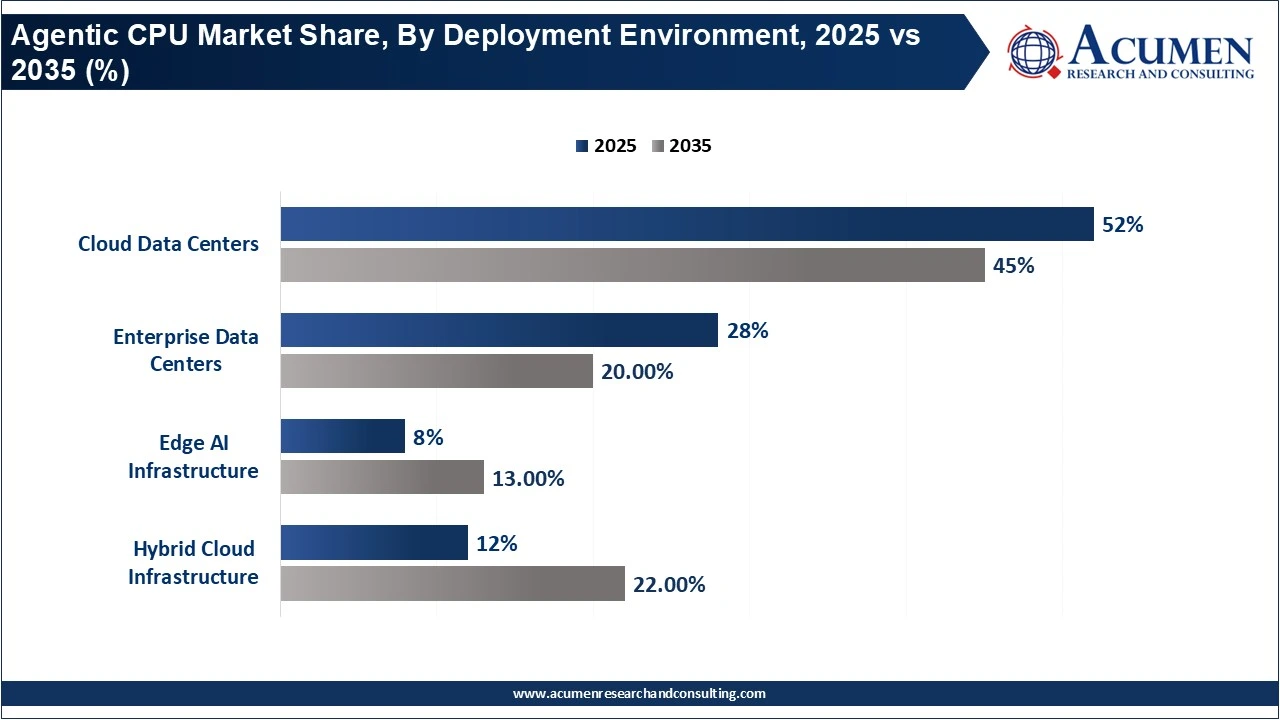
The hybrid cloud infrastructure segment is expected to witness the highest CAGR of 91.5% from 2026 to 2035. This surge in growth is attributed to enterprise need to combine on-premise security with cloud scalability. Hybrid deployments are essential for agentic AI as enterprises need to keep sensitive data on-premise, while utilizing cloud resources to manage large-scale reasoning and orchestration jobs, especially for industries like healthcare, finance, defense, and industrial automation.
Application Insights
The market share for the AI copilots & digital agents segment was 26% and was the largest application sector for agentic CPUs in 2025. AI Copilots is the largest commercialized agentic AI in enterprises as these AI copilots perform actions like code generation, customer support, automation, enterprise knowledge discovery and task completion. Agentic CPUs are vital in providing sustained reasoning cycles, memory recall, API calls and tool orchestration for the same.
Agentic CPU Market Share, By Application, 2025 (%)
| Application | Revenue Share, 2025 (%) |
|---|---|
| AI Agent Orchestration | 16% |
| Multi-Agent Systems | 10% |
| Retrieval-Augmented Generation (RAG) | 18% |
| AI Copilots & Digital Agents | 26% |
| Autonomous Software Development | 11% |
| Robotics & Physical AI | 7% |
| Research & Scientific Computing | 9% |
| Other Agentic Workflows | 3% |
The RAG segment held the second largest share at 18% in 2025. The RAG sector, which primarily consists of retrieving, indexing, vector search and context assembly before performing the actual GPU inference, holds the highest CPU dependency. This sector is driving heavily due to enterprises investing in private knowledge copilots and enterprise search.
End User Insights
Hyperscale cloud providers accounted for the largest market share at 38% in 2025 driven by aggressive investments in AI infrastructure, data center expansion, and autonomous compute environments. Hyperscalers need significant CPU orchestration capacity as they manage the compute and memory of thousands of GPUs and distributed AI agents. Agentic CPUs are quickly becoming integral to hyperscale AI factories and will continue to be the largest end user sector driven by expansion of AI cloud services.
Agentic CPU Market Share, By End User, 2025 (%)
| End User | Revenue Share, 2025 (%) |
|---|---|
| Hyperscale Cloud Providers | 38% |
| AI Model Developers | 18% |
| Enterprises | 24% |
| Government & Defense Organizations | 10% |
| Research Institutions | 4% |
| Telecommunications Providers | 6% |
The enterprise segment, at 24% in 2025, comprised the second-largest end user sector. Enterprises are quickly deploying AI agents for automated workflows, customer support, analytics, and software development. The increased adoption of enterprise AI platforms and autonomous systems is driving growth of agentic CPU infrastructure in enterprises. This segment will grow rapidly driven by increasing enterprise AI maturity.
Regional Analysis
- The North America agentic CPU market size was valued at $1.47 billion in 2025, it is expected to reach $391.85 billion by 2035; growing at a CAGR of 74.2% during the forecast period of 2026-2035.
- The Europe agentic CPU market size was valued at $0.51 billion in 2025, it is expected to reach $163.27 billion by 2035; growing at a CAGR of 77.8% during the forecast period of 2026-2035.
- The Asia-Pacific agentic CPU market size was valued at $1.02 billion in 2025, it is expected to reach $435.39 billion by 2035; growing at a CAGR of 83.6% during the forecast period of 2026-2035.
What Made North America Dominated Agentic CPU Market in 2025?
In 2025, North America accounted for 46% of the market share and would remain dominant, reaching $391.85 billion by 2035, with a CAGR of 74.2% as the region leads in semiconductor advancement, hyperscale AI infrastructure and enterprise AI deployment. The strong ecosystems present in North America due to players like NVIDIA Corporation, Intel Corporation, Advanced Micro Devices, Inc., Microsoft Corporation, amongst many others.
U.S. remained at the nucleus as demand for AI factories, sovereign AI programs and enterprise agentic implementations have rapidly evolved. Investments for AI super-computing and advanced data centers are increasing. Due to North America's leading position in terms of technology advancement and existing infrastructure, it would be able to hold the top rank globally.
Why is Asia Pacific to Witness Expansion in Agentic CPU Market by 2035?
Asia-Pacific is expected to grow at the highest CAGR of 83.6% from 2026 to 2035, and its share will increase from 32% in 2025 to 40% in 2035, making it the fastest growing market among all the regions. The growth of this region will be mainly due to significant investments made in semiconductor manufacturing, AI infrastructure, robotics and sovereign AI development across countries like China, Japan, South Korea and India, which are scaling AI compute infrastructure at a high pace.
China's robust ecosystem in semiconductors and AI industrialization are key growth drivers for this region; meanwhile, Japan and South Korea are accelerating its growth through robotics and semiconductor development whereas India's growth is rapid due to government's AI infrastructure support. The surging demand for AI sovereignty and industrial automation will make this region to the fastest growing market in the world.
Top 5 Countries
- United States - Spending in the U.S. on AI infrastructure represented nearly 45% of the world spend in 2025 with capital expenditure on enterprise AI exceeding $120 billion. As more than 60% of the world's hyperscale cloud providers are U.S.-based there is strong demand for agentic CPUs required to orchestra the huge number of GPUs needed, and for distribution of inference.
- China - In excess of 900 data centers focused on AI enable the large-scale rollout of autonomous AI workloads. In excess of 18 million AI-capable server CPUs are produced in China every year.
- Japan - Japan boasts more than 380,000 industrial robots in their market-an exceptionally high number for any single market-and this demands the adoption of low latency edge agentic CPUs. Semiconductor firms investing more than $12 billion in AI chip R&D in 2025 focused heavily on improving next generation CPU efficiency.
- Germany - Roughly $15 billion is being poured into Industry 4.0 and AI semiconductor programs in Germany in 2025 and more than 62% of automobile manufacturers are adopting AI agents for the design process, simulation, and their supply chains.
- India - More than 210 new AI-ready data centers were brought online between 2024 and 2025 boosting capacity enormously. Through its IndiaAI Mission the Indian Government promised over $1.25 billion to accelerate the development of infrastructure and compute resources for domestic AI adoption.
Major Companies
- NVIDIA Corporation
- Intel Corporation
- Advanced Micro Devices, Inc.
- Qualcomm Incorporated
- Arm Holdings plc
- Apple Inc.
- Amazon Web Services, Inc.
- Google LLC
- Microsoft Corporation
Recent News
- In May 2026, Intel released data center updates that included the new Intel Xeon 6+ processor, increased the 800 Series Ethernet, expanded with Intel Ethernet E835 controllers and network adapter, and shared updates on their AI acceleration roadmap including Crescent Island.
- In May 2026, Siemens announced its partnership with Arm to assist in the verification of the Arm AGI CPU and to help validate performance against future agentic AI workloads, thus enabling scalable, production-ready infrastructure. The Arm AGI CPU is developed based on Arm Neoverse Compute Subsystem (CSS) V3 platform for energy-efficient and high-performance computing for agentic AI and cloud data center deployments.
Segments Covered
By CPU Architecture
- x86 Processors
- ARM-Based Processors
- RISC-V Processors
- Custom Proprietary Architectures
By Deployment Environment
- Cloud Data Centers
- Enterprise Data Centers
- Edge AI Infrastructure
- Hybrid Cloud Infrastructure
By Application
- AI Agent Orchestration
- Multi-Agent Systems
- Retrieval-Augmented Generation (RAG)
- AI Copilots & Digital Agents
- Autonomous Software Development
- Robotics & Physical AI
- Research & Scientific Computing
- Other Agentic Workflows
By End User
- Hyperscale Cloud Providers
- AI Model Developers
- Enterprises
- Government & Defense Organizations
- Research Institutions
- Telecommunications Providers
By Region
- North America
- Europe
- Asia-Pacific
- Latin America
- Middle East & Africa
Looking for discounts, bulk pricing, or custom solutions? Contact us today at sales@acumenresearchandconsulting.com
Frequently Asked Questions

Other ICT Reports
April 2020
November 2022
October 2018
December 2024