
Direct-to-Chip Liquid Cooling Market Size, Share, Growth, Report 2026 To 2035
Direct-to-Chip Liquid Cooling Market (By Component: Cold Plates, Coolant Distribution Units (CDUs), Rack Manifolds, Quick Disconnects, and Secondary Fluid Network, Heat Rejection and Facility Water Integration, Coolants, Services; By Cooling Mechanism: Single-Phase Direct-to-Chip, Two-Phase Direct-to-Chip, By Heat Capture Configuration, Hybrid, Full Liquid Capture; By Rack Power Density: Below 50 kW per Rack, 50 to Below 100 kW per Rack, 100 to Below 200 kW per Rack, 200 kW per Rack and Above; By Processor / Device Cooled: GPUs and AI Accelerators, CPUs, Others; By Data Center Type: Hyperscale and Cloud, Colocation, Enterprise, Edge, Others; By Deployment Type; By End-Use Industry) - Global Industry Analysis, Size, Share, Analysis, Trends and Forecast 2026 - 2035
- Last Updated: 17 Nov 2026
- Report Code: ARC4009
- Category: ICT
Direct-to-Chip Liquid Cooling Market Size and Forecast 2026 To 2035
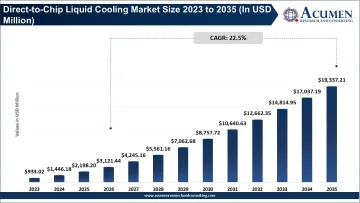
The direct-to-chip liquid cooling market size was valued at $2,198.20 million in 2025. The market is seen to reach at $19,337.21 million by 2035; expanding at a CAGR of 22.5% during the forecast period of 2026-2035. The market is expanding as AI workloads increase server power density, hyperscale data centers expand, and conventional air cooling faces thermal limitations. Demand for energy-efficient computing infrastructure is accelerating investments in advanced liquid cooling technologies.
Key Takeaways
- By Region: North America dominated the regional segment with a 41% share in 2025, equivalent to USD 901.26 million, and is projected to reach USD 6,961.39 million by 2035 at a CAGR of 20.9%.
- By component: Services dominated the component segment with a 25% share in 2025, generating USD 549.55 million, and are projected to reach USD 6,555.31 million by 2035 at a CAGR of 26.2%.
- By cooling mechanism: Single-phase direct-to-chip cooling dominated the cooling mechanism segment with an 85% share in 2025, generating USD 1,868.47 million, and is projected to reach USD 13,536.05 million by 2035 at a CAGR of 20.1%.
- By heat capture configuration: Hybrid heat capture dominated the heat capture configuration segment with an 80% share in 2025, generating USD 1,758.56 million, and is projected to reach USD 11,602.32 million by 2035 at a CAGR of 18.9%.
- By rack power density: The 50 to below 100 kW/rack segment dominated the rack power density segment with a 38% share in 2025, generating USD 835.32 million, and is projected to reach USD 4,254.19 million by 2035 at a CAGR of 15.8%.
- By processor / device cooled: GPUs and AI accelerators dominated the processor/device cooled segment with a 62% share in 2025, generating USD 1,362.88 million, and are projected to reach USD 13,536.05 million by 2035 at a CAGR of 23.9%.
- By data center type: Hyperscale and cloud data centers dominated the data center type segment with a 52% share in 2025, generating USD 1,143.06 million, and are projected to reach USD 9,668.60 million by 2035 at a CAGR of 22.0%.
- By deployment type: New-build deployments dominated the deployment type segment with a 64% share in 2025, generating USD 1,406.85 million, and are projected to reach USD 11,602.32 million by 2035 at a CAGR of 21.7%.
- By end-use industry: IT and telecommunications dominated the end-use industry segment with a 48% share in 2025, generating USD 1,055.14 million, and are projected to reach USD 9,088.49 million by 2035 at a CAGR of 22.2%.
Direct-to-Chip Liquid Cooling Market Size & Growth Projections
- Base Year Market Size (2025): $2,198.20 million
- Current Year Market Size (2026): $3,121.44 million
- Estimated Year Market Size (2035): $19,337.21 million
- Forecast Period CAGR (2026-2035): 22.5%
- Leading region: North America, supported by its established hyperscale data center ecosystem
Direct-to-Chip Liquid Cooling Market Overview
The global direct-to-chip liquid cooling market is gaining momentum as data center operators increasingly adopt advanced thermal management technologies to support high-performance computing, artificial intelligence, and cloud infrastructure. Direct-to-chip cooling uses liquid-filled cold plates attached to heat-generating components, such as CPUs and GPUs, to transfer heat more efficiently than conventional air-based systems. The growing deployment of high-density GPU servers and AI accelerators is increasing the thermal management requirements of modern data centers, encouraging operators to transition toward liquid cooling architectures.
Technological advancements in single-phase and two-phase cooling, alongside investments in manufacturing capacity and data center infrastructure, are further supporting market development. As AI computing requirements continue to increase, direct-to-chip cooling is becoming an important solution for managing heat loads, improving server performance, and supporting next-generation data center infrastructure.
Investment Trends
- Accelsius secures USD 65 million in Series B funding: Accelsius raised USD 65 million in a funding round led by Johnson Controls, with participation from Legrand. The investment is intended to expand its Austin manufacturing facility, accelerate international growth, and scale its two-phase direct-to-chip cooling technology for AI and high-performance computing infrastructure.
- Schneider Electric expands liquid cooling manufacturing in India: Schneider Electric launched a Motivair liquid cooling manufacturing facility in Bengaluru, marking its third global production site for this technology. The investment strengthens local manufacturing capabilities and supports growing demand for high-density cooling systems in India's expanding AI and data center market.
- Carrier increases its investment in ZutaCore: Carrier Ventures expanded its investment in ZutaCore to strengthen its direct-to-chip liquid cooling capabilities and develop integrated cooling solutions for high-density AI data centers. The move builds on their earlier investment and partnership announced in February 2025.
Direct-to-Chip Liquid Cooling Market Dynamics
Drivers
- Increasing AI and GPU infrastructure deployment: Growing adoption of artificial intelligence and GPU-intensive workloads is increasing server heat generation, encouraging data center operators to adopt efficient direct-to-chip cooling technologies.
- Rising data center rack power density: Higher computing capacity per rack is creating thermal management challenges, increasing demand for cold plates, coolant distribution units, and advanced liquid circulation systems.
Restraints
- High initial installation costs: Direct-to-chip cooling requires specialized components, piping, coolant distribution infrastructure, and installation expertise, increasing upfront investment for data center operators.
- Complexity of retrofitting existing facilities: Integrating liquid cooling into conventional data centers requires infrastructure modifications, equipment compatibility assessments, and operational adjustments, potentially slowing adoption among existing operators.
Opportunities
- Expansion of hyperscale AI data centers: Increasing investments in large-scale AI computing facilities create opportunities for suppliers of cold plates, coolant distribution units, pumps, and integrated cooling infrastructure.
- Advancements in two-phase cooling technologies: Improvements in two-phase cooling systems create opportunities to manage higher thermal loads while supporting compact server designs and improved computing performance.
Challenges
- Coolant leakage and system reliability: Maintaining leak-free connections, coolant quality, and stable fluid circulation remains essential to protecting sensitive electronic components and ensuring continuous data center operations.
- Standardization and compatibility requirements: Differences in server configurations, cooling architectures, and component specifications create integration challenges for manufacturers supplying solutions across diverse data center environments.
Technology and Infrastructure Analysis
| Technology / Infrastructure | Description | Role in Direct-to-Chip Liquid Cooling |
|---|---|---|
| Cold Plate Technology | Metal plates with internal liquid channels attached directly to CPUs, GPUs, and other heat-generating components. | Transfers heat directly from processors to circulating coolant, improving thermal management. |
| Coolant Distribution Units (CDUs) | Equipment that circulates, regulates, and distributes coolant through cooling loops. | Controls coolant flow, pressure, temperature, and heat transfer between server and facility cooling circuits. |
| Single-Phase Liquid Cooling | Uses liquid coolant that remains in its liquid state throughout the cooling process. | Provides consistent heat removal through cold plates and is widely used in direct-to-chip deployments. |
| Two-Phase Liquid Cooling | Uses a coolant that changes from liquid to vapor while absorbing heat and condenses back into liquid. | Supports high heat-transfer efficiency for increasingly powerful processors and high-density computing environments. |
| Coolant and Fluid Management | Includes water-based and engineered coolant fluids, filtration, and fluid-quality monitoring systems. | Maintains thermal performance, reduces contamination risks, and supports reliable cooling operations. |
| Pumps and Circulation Systems | Mechanical systems that maintain coolant movement through pipes, manifolds, and cold plates. | Ensure consistent coolant circulation and adequate flow rates across server racks. |
Direct-to-Chip Liquid Cooling Market Segmental Insights
Component Insights
Services: Services dominated the component segment with a 25.0% share in 2025, generating USD 549.55 million, supported by increasing demand for system design, installation, maintenance, and monitoring, and are projected to reach USD 6,555.31 million by 2035 at a CAGR of 26.2%. As operators increasingly deploy high-density AI infrastructure, service providers are also gaining opportunities through retrofit planning, system optimization, leak detection, and lifecycle maintenance.
Direct-to-Chip Liquid Cooling Market Share, By Component, 2025 & 2035 (%)
| Component | Revenue Share, 2025 (%) | Revenue Share, 2035 (%) |
|---|---|---|
| Cold plates | 24% | 20% |
| Coolant distribution units (CDUs) | 22% | 20.10% |
| Rack manifolds, quick disconnects & secondary fluid network | 14% | 12% |
| Heat rejection & facility water integration | 10% | 9% |
| Coolants | 5% | 5% |
| Services | 25% | 33.90% |
Cold Plates: Cold plates represented the second-largest component category with a 24.0% share in 2025, valued at USD 527.57 million, driven by their direct role in transferring heat from GPUs and CPUs to circulating coolant, and are projected to reach USD 3,867.44 million by 2035 at a CAGR of 20.2%.
Cooling Mechanism Insights
Single-Phase Direct-to-Chip: Single-phase direct-to-chip cooling dominated the cooling mechanism segment with an 85.0% share in 2025, generating USD 1,868.47 million, supported by established liquid circulation architectures and comparatively straightforward system integration, and is projected to reach USD 13,536.05 million by 2035 at a CAGR of 20.1%.
Two-Phase Direct-to-Chip: Two-phase direct-to-chip cooling is the second-largest and fastest-growing category, accounting for 15.0% of the market in 2025 and generating USD 329.73 million, with demand supported by its ability to manage high thermal loads through phase-change heat transfer; the segment is projected to reach USD 5,801.16 million by 2035 at a CAGR of 30.9%.
Heat Capture Configuration Insights
Hybrid (Liquid for Processors, Air for Remaining Components): Hybrid cooling dominated the heat capture configuration segment with an 80.0% share in 2025, generating USD 1,758.56 million, as it enables targeted liquid cooling for high-heat processors while retaining air cooling for other components, and is projected to reach USD 11,602.32 million by 2035 at a CAGR of 18.9%.
Full Liquid Capture: Full liquid capture accounted for the remaining 20.0% share in 2025, generating USD 439.64 million, and is expected to be the fastest-growing configuration with a CAGR of 30.9% through 2035 as increasing rack power densities encourage broader liquid-based heat removal across data center hardware.
Rack Power Density Insights
50 to Below 100 kW per Rack: The 50 to below 100 kW per rack category dominated the rack power density segment with a 38.0% share in 2025, generating USD 835.32 million, supported by increasing deployment of high-density computing infrastructure, and is projected to reach USD 4,254.19 million by 2035 at a CAGR of 15.8%.
100 to Below 200 kW per Rack: The 100 to below 200 kW per rack category held the second-largest share of 30.0% in 2025, generating USD 659.46 million, as AI and HPC workloads require greater thermal management capacity, and is projected to reach USD 7,348.14 million by 2035 at a CAGR of 25.4%.
200 kW per Rack and Above: The 200 kW per rack and above category is expected to be the fastest-growing segment, with a projected CAGR of 37.0% during 2026–2035, as next-generation AI infrastructure and increasingly powerful GPU clusters create demand for advanced high-capacity cooling systems.
Processor / Device Cooled Insights
GPUs and AI Accelerators: GPUs and AI accelerators dominated the processor/device cooled segment with a 62.0% share in 2025, generating USD 1,362.88 million, driven by increasing AI model training, inference workloads, and high-performance computing requirements, and are projected to reach USD 13,536.05 million by 2035 at a CAGR of 23.9%.
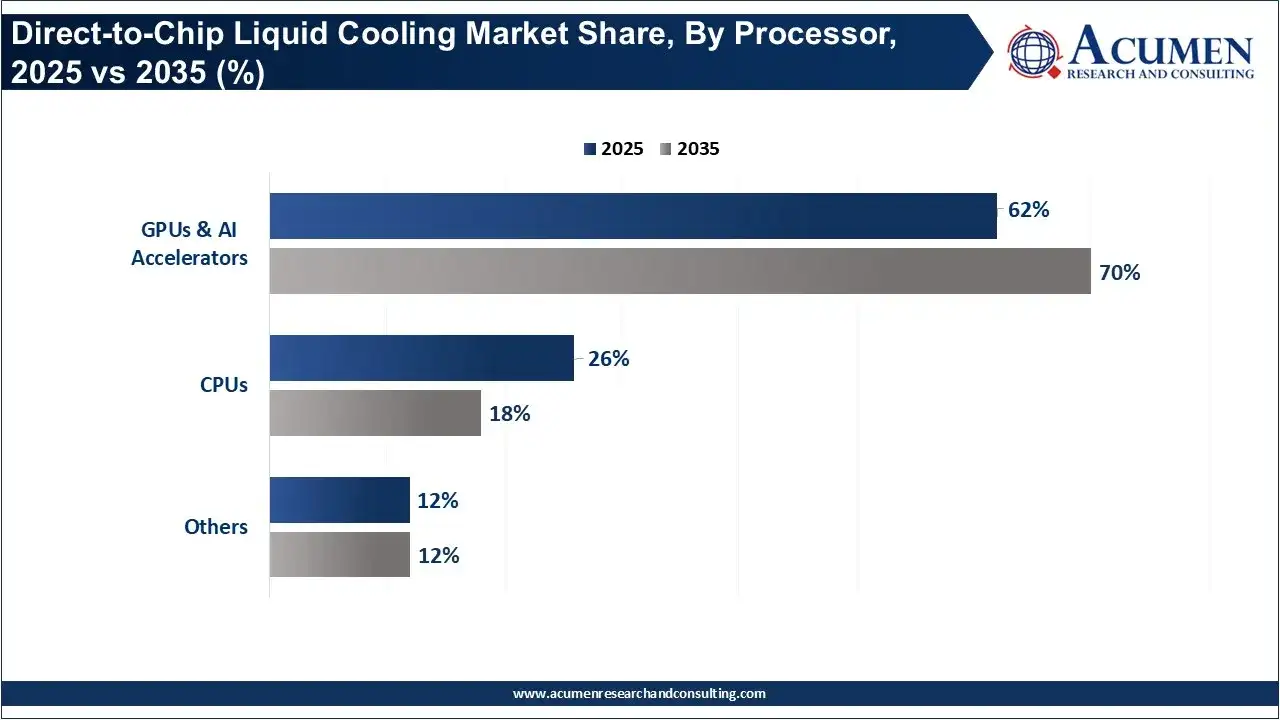
CPUs: CPUs represented the second-largest category with a 26.0% share in 2025, generating USD 571.53 million, supported by continued demand for processor cooling across enterprise and cloud servers, and are projected to reach USD 3,480.70 million by 2035 at a CAGR of 18.0%.
Data Center Type Insights
Hyperscale and Cloud (Including AI Neoclouds): Hyperscale and cloud data centers dominated the data center type segment with a 52.0% share in 2025, generating USD 1,143.06 million, supported by large-scale cloud infrastructure expansion and AI computing investments, and are projected to reach USD 9,668.60 million by 2035 at a CAGR of 22.0%.
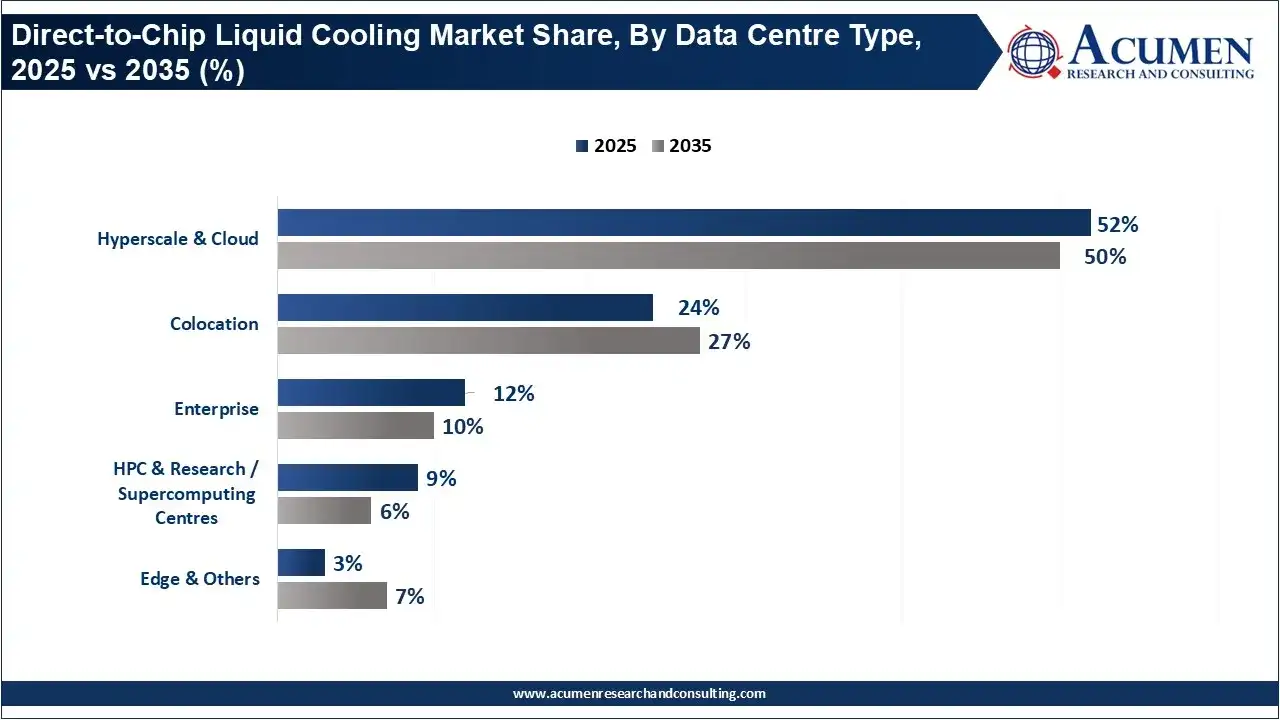
Colocation: Colocation facilities accounted for the second-largest share of 24.0% in 2025, generating USD 527.57 million, as businesses increasingly rely on third-party data center providers for scalable computing and liquid-cooled infrastructure, and are projected to reach USD 5,221.05 million by 2035 at a CAGR of 23.9%.
Deployment Type Insights
New-Build: New-build installations dominated the deployment type segment with a 64% share in 2025, generating USD 1,406.85 million, supported by the integration of liquid cooling into newly constructed AI and hyperscale data centers, and are projected to reach USD 11,602.32 million by 2035 at a CAGR of 21.7%.
Retrofit: Retrofit deployments accounted for a 36% share in 2025, generating USD 791.35 million, as existing data center operators upgrade cooling infrastructure to accommodate higher rack densities and GPU-based workloads, and are projected to reach USD 7,734.88 million by 2035 at a CAGR of 23.8%.
End-Use Industry Insights
IT and Telecommunications (Including Cloud and AI Service Providers): IT and telecommunications dominated the end-use industry segment with a 48.0% share in 2025, generating USD 1,055.14 million, supported by expanding cloud infrastructure, AI services, and high-density computing requirements, and are projected to reach USD 9,088.49 million by 2035 at a CAGR of 22.2%.
Direct-to-Chip Liquid Cooling Market Share, By End-use Industry, 2025 & 2035 (%)
| End-use Industry | Revenue Share, 2025 (%) | Revenue Share, 2035 (%) |
|---|---|---|
| IT & Telecommunications | 48% | 47% |
| BFSI | 12% | 11% |
| Government & Defence | 11% | 9% |
| Healthcare & Life Sciences | 8% | 9% |
| Manufacturing & Automotive | 7% | 8% |
| Energy & Utilities | 5% | 5% |
| Others | 9% | 11% |
BFSI: BFSI represented the second-largest end-use category with a 12.0% share in 2025, generating USD 263.78 million, driven by increasing demand for secure, reliable, and high-performance computing infrastructure for financial transactions, analytics, and digital banking, and is projected to reach USD 2,127.09 million by 2035 at a CAGR of 21.4%.
Direct-to-Chip Liquid Cooling Market Regional Analysis
Which Region Dominates the Direct-to-Chip Liquid Cooling Market?
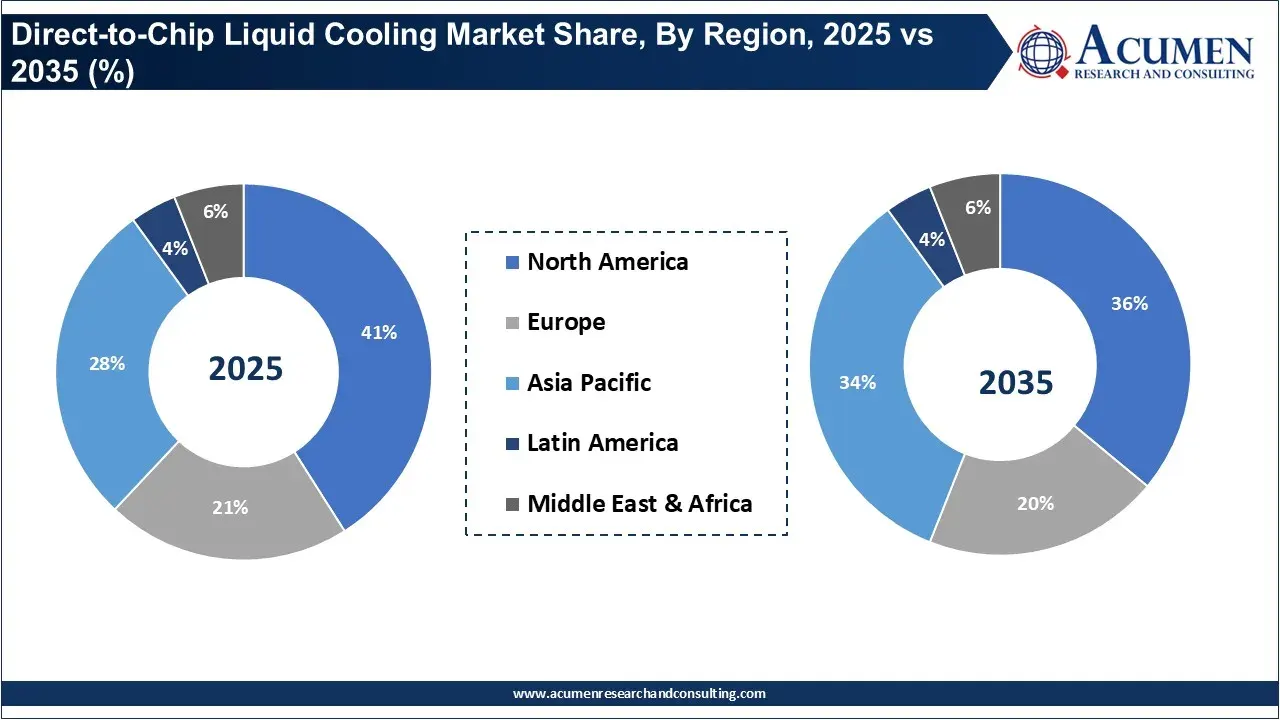
North America dominated the direct-to-chip liquid cooling market with a 41.0% share in 2025, generating USD 901.26 million. The region's leadership is supported by its established hyperscale data center ecosystem, strong presence of cloud service providers, and substantial investments in artificial intelligence infrastructure.
The United States is a major demand center, driven by the expansion of GPU-intensive computing facilities and increasing deployment of high-density server racks. Technology providers and data center operators are investing in advanced cold plates, coolant distribution units, and integrated thermal management systems to address rising processor heat loads. The region also benefits from the presence of established cooling technology manufacturers and infrastructure suppliers, supporting product development and deployment.
North America's market is projected to reach USD 6,961.39 million by 2035, expanding at a CAGR of 20.9% during 2026–2035. Although its share is expected to decline to 36.0% by 2035, the region is expected to remain the largest regional market.
Which Region Is Expected to Witness the Fastest Growth in the Direct-to-Chip Liquid Cooling Market?
Asia-Pacific is expected to be the fastest-growing regional market, with a projected CAGR of 24.8% during 2026–2035. The region accounted for 28.0% of the global market in 2025, generating USD 615.50 million, and its share is projected to increase to 34.0% by 2035.
Growth is supported by expanding data center capacity, increasing cloud adoption, and rising investments in artificial intelligence infrastructure across China, India, Japan, South Korea, and Southeast Asian markets. The development of AI computing clusters and high-performance data center facilities is increasing demand for advanced cooling systems capable of managing higher rack power densities.
Regional technology manufacturers and international cooling providers are also expanding their presence through manufacturing investments, partnerships, and infrastructure collaborations. Increasing focus on energy-efficient data center operations and the need to support GPU-intensive workloads are further strengthening adoption.
Country-Level Opportunity Analysis
- United States: The United States offers strong growth opportunities due to hyperscale data center expansion, increasing investments in AI computing infrastructure, and rising GPU server deployments. Major cloud providers and technology companies are accelerating high-density computing capacity, creating demand for advanced cold plates, coolant distribution units, and integrated direct-to-chip cooling systems.
- China: China presents significant opportunities through investments in domestic data center infrastructure, AI computing clusters, and high-performance computing facilities. Government-backed digital infrastructure initiatives and the expansion of cloud service providers are supporting demand for locally manufactured cooling technologies, advanced thermal management components, and energy-efficient liquid cooling systems.
- Germany: Germany's opportunity is supported by its established data center ecosystem, growing demand for cloud services, and emphasis on energy efficiency. Increasing investment in sustainable digital infrastructure and high-performance computing is creating opportunities for direct-to-chip cooling providers offering efficient heat transfer, reduced cooling energy consumption, and reliable data center thermal management.
- India: India is emerging as an attractive market due to expanding data center capacity, rapid cloud adoption, and rising investments in AI infrastructure. Growing demand for GPU-intensive computing, supported by digital transformation and data localization requirements, is creating opportunities for direct-to-chip cooling systems in new hyperscale and colocation facilities.
Direct-to-Chip Liquid Cooling Market Regulatory and Standards Landscape
| Regulation / Standard | Issuing Organization | Scope for to Direct-to-Chip Liquid Cooling |
|---|---|---|
| ASHRAE TC 9.9 Thermal Guidelines | ASHRAE | Provides thermal operating guidelines for IT equipment, including liquid-cooled systems, coolant temperature classes, and equipment reliability considerations. |
| ANSI/ASHRAE Standard 90.4-2025 | ASHRAE | Establishes energy-efficiency requirements for data center facilities, including mechanical and electrical system performance. |
| ASHRAE Liquid Cooling Guidelines | ASHRAE | Provides guidance on cold-plate systems, coolant quality, liquid distribution, and facility integration. |
| ISO/IEC 30134 Series | ISO / IEC | Defines key data center performance indicators, including Power Usage Effectiveness (PUE), Water Usage Effectiveness (WUE), and Energy Reuse Factor (ERF). |
| EN 50600 | European Committee for Electrotechnical Standardization | Covers data center infrastructure, availability, energy efficiency, and facility design considerations relevant to cooling installations. |
| EU Energy Efficiency Directive (EED) | European Union | Establishes energy-efficiency obligations and reporting requirements for data centers, encouraging improved cooling efficiency and resource management. |
| UL Safety Standards | Underwriters Laboratories | Relevant safety requirements may apply to electrical equipment, power distribution, controls, and components used in liquid cooling systems. |
| ASME Piping and Pressure Vessel Codes | American Society of Mechanical Engineers | Applicable requirements may govern pressure-containing equipment, piping, and heat-transfer components, depending on system design and jurisdiction. |
Top Players
- Vertiv (Westerville, Ohio, United States)
- Schneider Electric (Rueil-Malmaison, France)
- CoolIT Systems (Calgary, Alberta, Canada)
- Boyd (Pleasanton, California, United States)
- Asetek (Aalborg, Denmark)
- nVent (London, United Kingdom)
- Motivair (Buffalo, New York, United States)
- Delta Electronics (Taipei, Taiwan)
- Rittal (Herborn, Germany)
- Accelsius (Austin, Texas, United States)
Recent Breakthroughs
- November 2026: Advanced Cooling Technologies announced successful system-level testing of its 1 MW two-phase coolant distribution unit, demonstrating more than 1 MW of cooling capacity and operation across dynamic loads reaching 1,200 kW.
- September 2026: LG Electronics announced that its 2.6 MW coolant distribution unit had qualified as NVIDIA DSX Ready, following earlier qualifications for its 600 kW and 1 MW models.
Segments Covered
By Component
- Cold Plates
- Coolant Distribution Units (CDUs)
- Rack Manifolds, Quick Disconnects, and Secondary Fluid Network
- Heat Rejection and Facility Water Integration
- Coolants (Water-Glycol, Dielectric Fluids)
- Services (Design, Installation, Maintenance, and Monitoring)
By Cooling Mechanism
- Single-Phase Direct-to-Chip
- Two-Phase Direct-to-Chip
- By Heat Capture Configuration
- Hybrid (Liquid for Processors, Air for Remaining Components)
- Full Liquid Capture (Near-100% of Rack Heat)
By Rack Power Density
- Below 50 kW per Rack
- 50 to Below 100 kW per Rack
- 100 to Below 200 kW per Rack
- 200 kW per Rack and Above
By Processor / Device Cooled
- GPUs and AI Accelerators
- CPUs
- Others (Memory, Network Switch ASICs, Power Electronics)
By Data Center Type
- Hyperscale and Cloud (Including AI Neoclouds)
- Colocation
- Enterprise
- HPC and Research / Supercomputing Centers
- Edge and Others
By Deployment Type
- New-Build
- Retrofit
By End-Use Industry
- IT and Telecommunications (Including Cloud and AI Service Providers)
- BFSI
- Government and Defense (Including National Laboratories)
- Healthcare and Life Sciences
- Manufacturing and Automotive
- Energy and Utilities
- Others (Retail, Media, Education)
By Region
- North America
- Europe
- Asia-Pacific
- Latin America
- Middle East & Africa
Looking for discounts, bulk pricing, or custom solutions? Contact us today at sales@acumenresearchandconsulting.com
Frequently Asked Questions

Related Market Research Reports
November 2022
April 2025
May 2024
November 2022
October 2026
July 2022
July 2021
February 2024