
Post-Quantum Cryptography Market Size, Share, Forecast Report 2026 To 2035
Post-Quantum Cryptography Market (By Component: Software, Hardware, Services; By Cryptographic Function: Key Establishment / Encapsulation, Digital Signatures, Cryptographic Discovery, Inventory & Crypto-Agility Management; By Algorithm Family: Lattice-Based, Hash-Based Signatures, Code-Based, Others; By Deployment Mode: On-Premises, Cloud; By Organization Size, Large Enterprises, Small & Medium Enterprises; By Application: Network & Communication Security, PKI, Digital Certificates & Code Signing, Data-at-Rest & Database Encryption, Identity, Authentication & Payments, IoT, Embedded & Automotive Systems, Others; By End Use: Government & Defense, BFSI, IT & Telecommunications, Healthcare, Energy & Utilities, Automotive, Others) - Global Industry Analysis, Size, Share, Regional Analysis, Trends and Forecast 2026 - 2035
- Last Updated: 19 Nov 2026
- Report Code: ARC4011
- Category: ICT
Post-Quantum Cryptography Market Size, Forecast Report 2026 To 2035
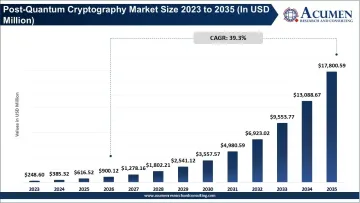
The global post-quantum cryptography market size was valued at $616.52 million in 2025 and is expected to reach at $17,800.59 million by 2035; expanding at a CAGR of 39.3% during the forecast period of 2026-2035. Increasing quantum computing advancements, rising cybersecurity threats, and the vulnerability of conventional encryption algorithms are accelerating demand for post-quantum cryptography. Growing government initiatives, regulatory preparedness, digital infrastructure modernization, and the need to protect sensitive information against harvest-now-decrypt-later attacks are further driving investments in quantum-resistant security solutions.
Key Takeaways
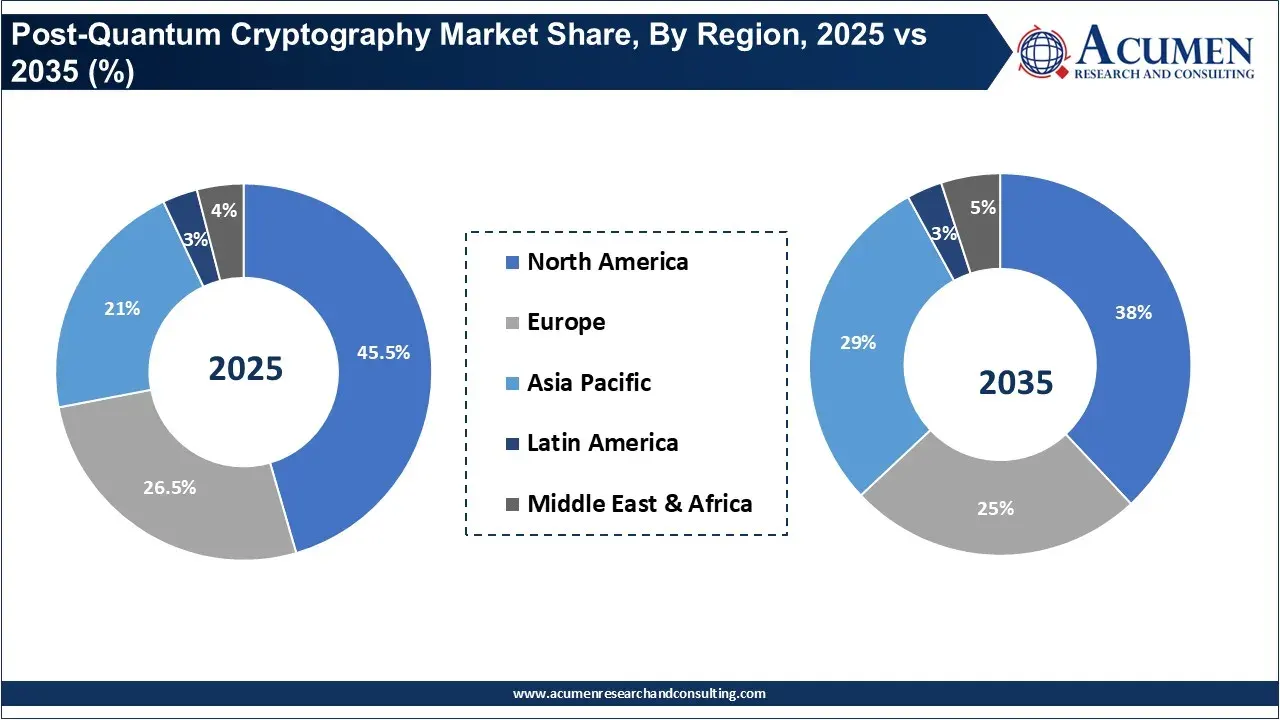
- By Region: North America dominated the regional segment with a 45.5% share in 2025, equivalent to USD 280.52 million. Its leadership is supported by advanced cybersecurity infrastructure, government-led quantum-readiness initiatives, NIST standardization activities, and strong adoption among financial institutions and technology companies.
- By Component: Software dominated the component segment with a 44.5% share in 2025, valued at USD 274.35 million. Its demand is supported by increasing integration of PQC libraries, crypto-agility platforms, and certificate lifecycle management solutions into existing enterprise security infrastructure.
- By Cryptographic Function: Key establishment and encapsulation dominated the cryptographic function segment with a 46.0% share in 2025, valued at USD 283.60 million. Its leadership reflects increasing demand for quantum-resistant key exchange mechanisms to secure enterprise communications, encrypted networks, and sensitive digital information.
- By Algorithm Family: Lattice-based algorithms dominated the algorithm family segment with a 79.0% share in 2025, generating USD 487.05 million. Their adoption is supported by the standardization of ML-KEM and ML-DSA and their suitability for commercial key establishment and digital signature applications.
- By Deployment Mode: On-premises deployment dominated the deployment mode segment with a 57.0% share in 2025, valued at USD 351.42 million. Its leadership is supported by the preference of government agencies, financial institutions, and large enterprises for direct control over sensitive cryptographic infrastructure.
- By Organization Size: Large enterprises dominated the organization size segment with a 75.0% share in 2025, equivalent to USD 462.39 million. Their extensive digital infrastructure, sensitive information assets, and complex encryption environments are driving demand for comprehensive quantum-resistant migration strategies.
- By Application: Network and communication security dominated the application segment with a 34.0% share in 2025, valued at USD 209.62 million. Increasing requirements for quantum-resistant TLS, VPN, and SSH protocols are supporting adoption across enterprise networks and digital communication infrastructure.
- By End Use: BFSI dominated the end-use segment with a 27.0% share in 2025, generating USD 166.46 million. The need to protect payment infrastructure, financial transactions, customer information, and long-term digital records is supporting PQC adoption across the financial services industry.
Post-Quantum Cryptography Market Overview & Scope
The post-quantum cryptography market comprises cryptographic algorithms, software platforms, hardware security solutions, and professional services designed to protect digital information against potential attacks from quantum computers. These technologies use mathematical approaches intended to resist attacks from both classical and quantum computing systems, addressing vulnerabilities associated with widely deployed public-key cryptographic algorithms such as RSA and elliptic-curve cryptography. The market includes lattice-based, hash-based, code-based, and other quantum-resistant cryptographic approaches, alongside hybrid cryptographic implementations that combine classical and post-quantum algorithms.
The market is gaining importance as governments, financial institutions, telecommunications providers, healthcare organizations, and technology companies evaluate their exposure to future quantum computing threats. Increasing awareness of harvest-now-decrypt-later attacks is encouraging organizations to prioritize the protection of sensitive information with long confidentiality requirements. Standardization initiatives are also supporting commercial adoption by providing organizations with validated cryptographic algorithms and implementation frameworks.
Enterprise Adoption and Deployment Analysis
- Early Cryptographic Readiness Assessments: Enterprises are conducting preliminary quantum-readiness assessments to identify existing cryptographic systems vulnerable to future quantum computing attacks. These assessments include reviewing encryption protocols, authentication mechanisms, digital certificates, key management systems, and third-party security dependencies.
- Cryptographic Asset Discovery and Inventory: Organizations are increasingly adopting cryptographic discovery tools to identify where RSA, ECC, and other quantum-vulnerable algorithms are deployed across applications, databases, networks, hardware, and cloud environments. Maintaining a centralized cryptographic inventory helps security teams prioritize migration activities.
- Harvest-Now, Decrypt-Later Risk Mitigation: Organizations handling confidential financial, government, healthcare, and intellectual property information are prioritizing quantum-resistant protection because intercepted encrypted information could become vulnerable to future decryption. This is particularly relevant for information requiring long-term confidentiality.
- Government and Defense Communications: Government agencies and defense organizations are evaluating PQC for classified communications, military networks, intelligence systems, secure databases, and national security infrastructure. Long confidentiality requirements and sensitive information exchange make cryptographic modernization a strategic priority.
- Cloud Computing and Enterprise Data Centers: Cloud service providers and enterprises are integrating post-quantum cryptographic capabilities into key management systems, encrypted storage, identity infrastructure, and network communication protocols. Cloud-based deployment also supports centralized cryptographic updates and scalable security management.
Post-Quantum Cryptography Competitive Technology Benchmarking
| Company | Core Technology Focus | Competitive Positioning |
|---|---|---|
| IBM Corporation | Quantum-safe enterprise security | Enterprise-wide quantum-safe security |
| Microsoft Corporation | Cloud and enterprise security | Large-scale cloud ecosystem integration |
| Google LLC | Internet and cloud cryptography | PQC deployment across internet infrastructure |
| Thales Group | Hardware and data security | Hardware-backed cryptographic protection |
| Cloudflare, Inc. | Internet infrastructure security | Internet-scale PQC implementation |
| PQShield Limited | Post-quantum cryptographic IP | Specialized PQC technology development |
| CryptoNext Security | Quantum-safe software | Specialized cryptographic software |
| ISARA Corporation | Quantum-safe cryptography | Cryptographic transition solutions |
Post-Quantum Cryptography Market Dynamics
Drivers
- Growing Threat of Quantum Computing to Existing Encryption: The advancement of quantum computing is increasing concerns regarding the vulnerability of conventional public-key encryption algorithms, particularly RSA and elliptic-curve cryptography. Organizations are investing in quantum-resistant alternatives to protect confidential information, financial transactions, digital identities, and critical communication infrastructure.
- Government-Led Standardization and Cybersecurity Modernization: Government initiatives and standardized cryptographic frameworks are accelerating enterprise readiness for quantum-resistant security. NIST's publication of FIPS 203, FIPS 204, and FIPS 205 provides standardized algorithms, encouraging cybersecurity vendors, financial institutions, and government agencies to incorporate PQC into long-term security modernization strategies.
Restraints
- High Implementation and Migration Costs: Transitioning existing cryptographic infrastructure to post-quantum algorithms requires investments in software upgrades, hardware replacements, security assessments, integration, and testing. Organizations operating extensive legacy systems may experience substantial migration expenses, particularly when replacing cryptographic components across geographically distributed IT environments.
- Performance and Infrastructure Compatibility Limitations: Post-quantum algorithms can introduce larger keys, ciphertexts, and digital signatures compared with conventional cryptographic mechanisms. These requirements may increase network bandwidth consumption, memory utilization, processing overhead, and latency, creating implementation difficulties for resource-constrained devices and performance-sensitive enterprise applications.
Opportunities
- Expansion of Quantum-Safe Cloud Security Solutions: Increasing enterprise migration toward cloud computing creates opportunities for integrating post-quantum cryptography into cloud security platforms, managed key management services, encrypted storage, and digital identity infrastructure. Cloud providers can commercialize scalable quantum-resistant security capabilities through subscription-based enterprise services and integrated cybersecurity offerings.
- Growing Demand for Cryptographic Discovery and Migration Services: Organizations require specialized solutions to identify vulnerable cryptographic assets, assess quantum-related risks, and implement migration strategies. This creates opportunities for cybersecurity consultants, software developers, and managed security providers offering cryptographic inventory, crypto-agility platforms, algorithm integration, and continuous monitoring services.
Challenges
- Complexity of Enterprise-Wide Cryptographic Migration: Organizations often operate interconnected applications, legacy databases, third-party platforms, and hardware devices using different cryptographic standards. Replacing vulnerable algorithms across these environments requires extensive coordination, interoperability testing, and risk prioritization, making large-scale PQC migration technically and operationally challenging.
- Uncertainty Around Long-Term Standards and Interoperability: Continuous cryptographic research and evolving standardization activities create uncertainty regarding future algorithm requirements and implementation approaches. Enterprises must ensure compatibility across vendors, protocols, and hardware platforms while maintaining flexibility to accommodate additional standardized algorithms and evolving cybersecurity requirements.
Post-Quantum Cryptography Market Regional Insights
Which Region Dominated the Post-Quantum Cryptography Market?
North America dominated the regional segment with a 45.5% share in 2025, generating USD 280.52 million. Its leadership is supported by the presence of established cybersecurity companies, advanced technology infrastructure, government-led quantum-readiness initiatives, and early adoption of post-quantum cryptographic standards. The United States represents a significant contributor to regional demand, supported by federal cybersecurity modernization programs and increasing requirements to protect sensitive government and commercial information against future quantum computing threats.
The region also benefits from strong participation from financial institutions, cloud service providers, defense contractors, and enterprise technology companies investing in cryptographic migration.
- The standardization of quantum-resistant algorithms by the National Institute of Standards and Technology (NIST) has further accelerated awareness and implementation planning across industries. Organizations are increasingly evaluating cryptographic inventories, upgrading encryption infrastructure, and integrating post-quantum algorithms into existing security platforms.
Although North America's market share is projected to decline to 38.0% by 2035, its revenue is expected to increase to USD 6,764.22 million, reflecting continued investment in enterprise cybersecurity modernization. The regional market is projected to register a CAGR of 36.8% from 2026 to 2035.
Which Region Is Expected to Be the Fastest-Growing in the Post-Quantum Cryptography Market?
Asia-Pacific is expected to be the fastest-growing regional market, registering a projected CAGR of 43.8% from 2026 to 2035. The region accounted for 21.0% of the global market in 2025, generating USD 129.47 million, and its share is projected to increase to 29.0% by 2035. Increasing investments in cybersecurity infrastructure, digital transformation, cloud computing, and advanced semiconductor technologies are creating favorable conditions for post-quantum cryptography adoption.
Countries such as China, Japan, South Korea, India, and Singapore are strengthening their cybersecurity capabilities through government initiatives, technology development programs, and investments in secure digital infrastructure. The expansion of digital banking, telecommunications networks, smart manufacturing, and connected devices is also increasing the need for advanced encryption technologies.
Financial institutions and government organizations are increasingly evaluating quantum-resistant security frameworks to protect sensitive information and critical digital infrastructure. Furthermore, growing regional research activities in quantum computing and cryptographic technologies are supporting the development of domestic capabilities.
Post-Quantum Cryptography Market Segmental Insights
Component Insights
Software: Software dominated the component segment with a 44.5% share in 2025, generating USD 274.35 million. Its leadership is supported by the growing integration of post-quantum cryptographic libraries, crypto-agility platforms, and certificate lifecycle management solutions into enterprise security infrastructure. Organizations are increasingly prioritizing software-based cryptographic upgrades to prepare existing systems for quantum-resistant encryption without replacing their entire security infrastructure.
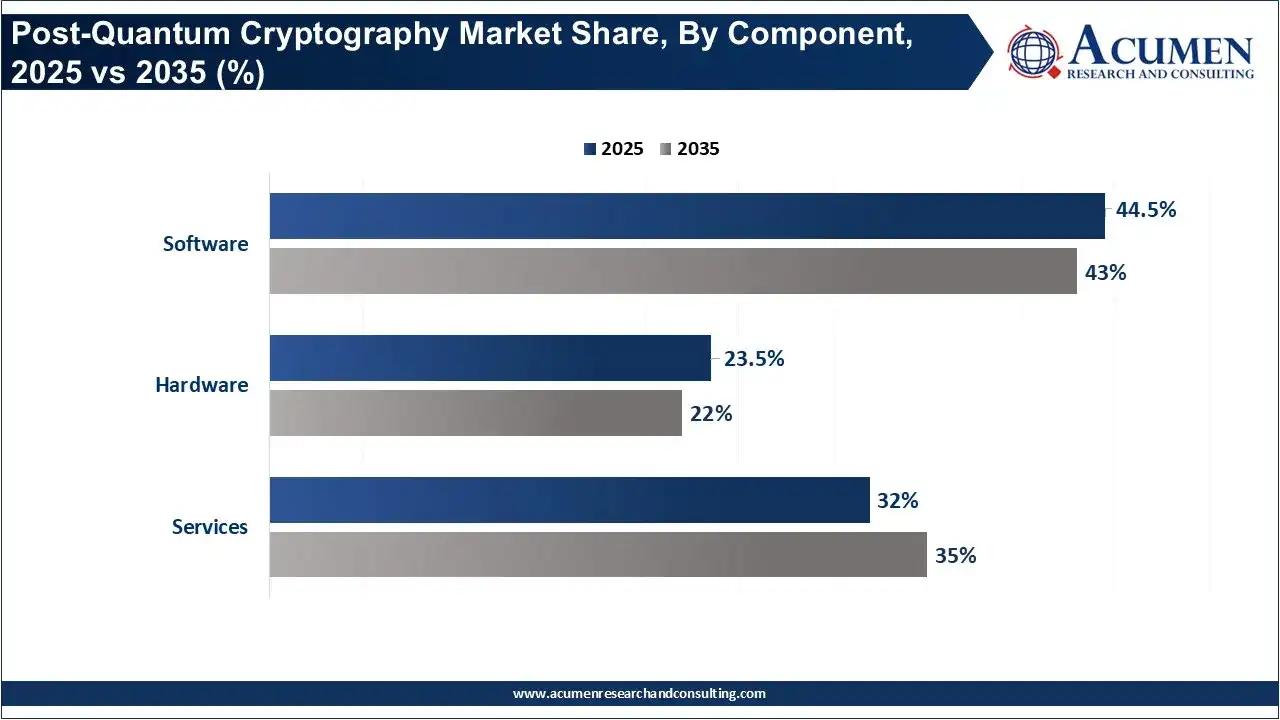
Services: Services represented the second-largest component segment with a 32.0% share in 2025, valued at USD 197.29 million. Demand is supported by the complexity of identifying vulnerable cryptographic assets, evaluating migration requirements, and implementing quantum-resistant algorithms across legacy IT environments. Consulting, cryptographic inventory, integration, and managed migration services are becoming increasingly important for enterprises with extensive digital infrastructure.
Cryptographic Function Insights
Key Establishment / Encapsulation: Key establishment and encapsulation dominated the cryptographic function segment with a 46.0% share in 2025, generating USD 283.60 million. The segment benefits from increasing adoption of ML-KEM and hybrid key exchange mechanisms designed to protect sensitive communications against future quantum computing threats. These capabilities are particularly important for securing TLS connections, VPNs, enterprise networks, and encrypted data exchanges. Revenue is projected to reach USD 7,120.24 million by 2035, at a CAGR of 37.4%.
Post-Quantum Cryptography Market Share, By Cryptographic Function, 2025 (%)
| Cryptographic Function | Revenue Share, 2025 (%) | Revenue Share, 2035 (%) |
|---|---|---|
| Key establishment / encapsulation (ML-KEM, hybrid key exchange) | 46% | 40% |
| Digital signatures (ML-DSA, SLH-DSA, FN-DSA, LMS/XMSS) | 30% | 38% |
| Cryptographic discovery, inventory & crypto-agility management | 24% | 22% |
Digital Signatures: Digital signatures represented the second-largest cryptographic function segment with a 30.0% share in 2025, valued at USD 184.96 million. Growing requirements for quantum-resistant authentication, document verification, software integrity, and secure digital transactions are supporting the adoption of post-quantum signature algorithms. ML-DSA, SLH-DSA, FN-DSA, and other signature technologies are gaining importance as organizations prepare to replace vulnerable public-key signature systems.
Algorithm Family Insights
Lattice-Based: Lattice-based algorithms dominated the algorithm family segment with a 79.0% share in 2025, generating USD 487.05 million. Their leadership is supported by the standardization of ML-KEM and ML-DSA and their suitability for key establishment and digital signature applications. The availability of standardized algorithms and growing integration into commercial cryptographic products are strengthening their adoption across enterprise and government security environments.
Code-Based: Code-based algorithms are expected to be the fastest-growing algorithm family, registering a projected CAGR of 48.9% from 2026 to 2035. Their market share is projected to increase from 5% in 2025 to 10% by 2035. Growing research into alternative quantum-resistant cryptographic approaches and diversification beyond lattice-based technologies are supporting interest in code-based solutions, including HQC and Classic McEliece. Revenue is projected to reach USD 1,780.06 million by 2035.
Deployment Mode Insights
On-Premises: On-premises deployment dominated the deployment mode segment with a 57% share in 2025, generating USD 351.42 million. Its leadership reflects the preference of government agencies, financial institutions, defense organizations, and large enterprises for direct control over cryptographic infrastructure, sensitive information, and security configurations.
Cloud: Cloud deployment represented the second-largest deployment category with a 43% share in 2025, valued at USD 265.10 million. Increasing adoption of cloud-native applications, distributed computing, and cloud-based security services is supporting the integration of post-quantum cryptographic capabilities into hosted environments. Cloud platforms also provide opportunities for centralized cryptographic updates and scalable security management.
Organization Size Insights
Large Enterprises: Large enterprises dominated the organization size segment with a 75.0% share in 2025, generating USD 462.39 million. Their leadership is supported by extensive IT infrastructure, large volumes of sensitive data, and complex cryptographic environments requiring systematic quantum-readiness initiatives. Financial institutions, telecommunications companies, and multinational corporations are increasingly evaluating cryptographic inventories and migration strategies to protect long-term information assets. The segment is projected to reach USD 11,748.39 million by 2035, at a CAGR of 37.5%.
Small & Medium Enterprises: Small and medium enterprises accounted for the remaining 25.0% share in 2025, generating USD 154.13 million. Increasing cybersecurity awareness, cloud-based security adoption, and the availability of managed cryptographic services are creating opportunities for PQC implementation among smaller organizations. SMEs can increasingly access quantum-resistant security capabilities through third-party providers without making substantial investments in dedicated infrastructure. This category is expected to be the fastest-growing organization size segment, registering a CAGR of 43.6% from 2026 to 2035, with revenue projected to reach USD 6,052.20 million by 2035.
Application Insights
Network & Communication Security: Network and communication security dominated the application segment with a 34.0% share in 2025, generating USD 209.62 million. Increasing requirements to secure internet communications, enterprise networks, remote access systems, and encrypted data exchanges are supporting adoption. The integration of post-quantum algorithms into TLS, VPN, and SSH protocols is becoming an important part of quantum-readiness strategies. The segment is projected to reach USD 5,340.18 million by 2035, registering a CAGR of 37.6%.
Post-Quantum Cryptography Market Share, By Application, 2025 (%)
| Application | Revenue Share, 2025 (%) | Revenue Share, 2035 (%) |
|---|---|---|
| Network & communication security (TLS, VPN, SSH) | 34% | 30% |
| PKI, digital certificates & code signing | 22% | 24% |
| Data-at-rest & database encryption | 14% | 14% |
| Identity, authentication & payments | 12% | 13% |
| IoT, embedded & automotive systems | 8% | 12% |
| Others | 10% | 7% |
PKI, Digital Certificates & Code Signing: PKI, digital certificates, and code signing represented the second-largest application segment with a 22.0% share in 2025, valued at USD 135.63 million. Organizations are evaluating quantum-resistant certificate authorities, digital identity infrastructure, and software signing mechanisms to maintain trust across digital ecosystems. The transition toward post-quantum digital signatures is particularly important for applications requiring long-term certificate validity and software integrity. Revenue is projected to reach USD 4,272.14 million by 2035, at a CAGR of 40.5%.
End Use Insights
Banking, Financial Services & Insurance (BFSI): BFSI dominated the end-use segment with a 27.0% share in 2025, generating USD 166.46 million. Financial institutions are increasingly prioritizing quantum-resistant encryption to protect payment networks, customer information, digital banking infrastructure, and long-term financial records. The sector's extensive dependence on public-key cryptography and secure digital transactions makes cryptographic migration an important cybersecurity priority. The segment is projected to reach USD 4,094.14 million by 2035, registering a CAGR of 37.1%.
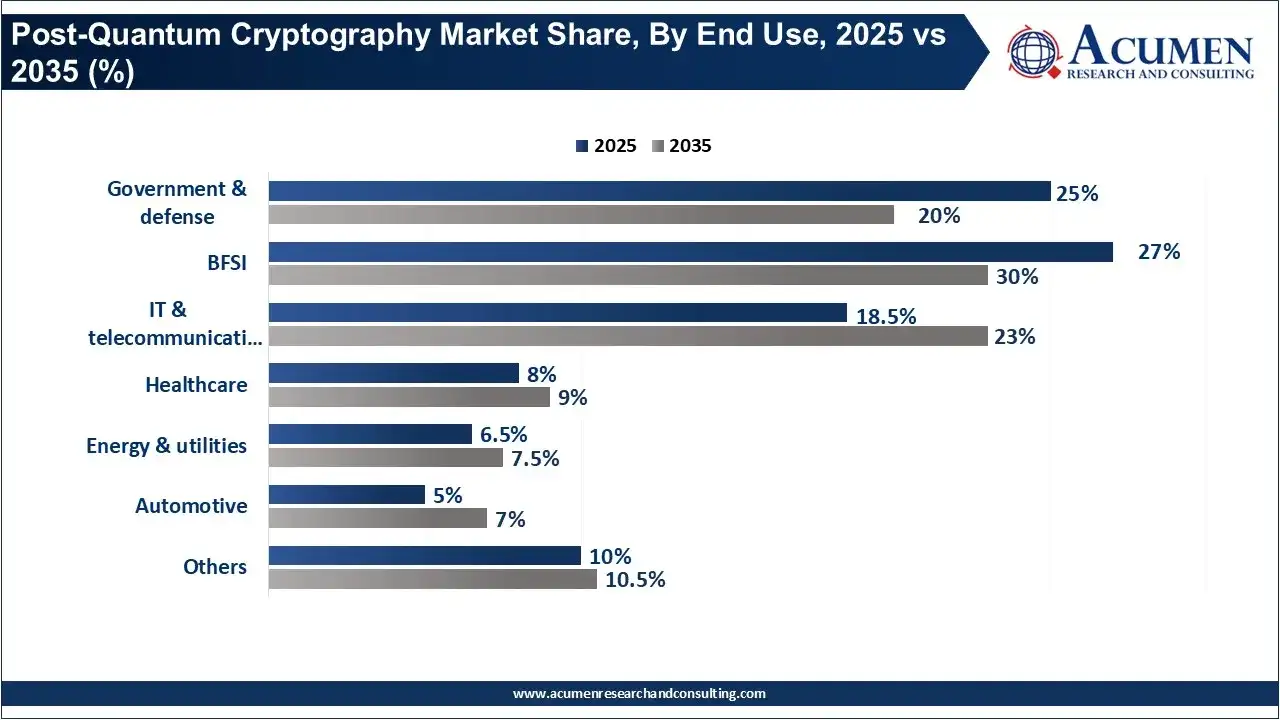
Government & Defense: Government and defense represented the second-largest end-use segment with a 25.0% share in 2025, valued at USD 154.13 million. National security requirements, classified communications, defense networks, and long-term protection of sensitive government information are supporting demand for post-quantum cryptographic solutions. Government-led quantum-readiness programs and cryptographic migration initiatives are further strengthening adoption. Revenue is projected to reach USD 3,560.12 million by 2035, at a CAGR of 36.2%.
Top Players
- IBM Corporation
- Microsoft Corporation
- Google LLC
- Thales Group
- Palo Alto Networks, Inc.
- Cloudflare, Inc.
- PQShield Limited
- Quantinuum Limited
- CryptoNext Security
- ISARA Corporation
Recent News
- October 2026: IBM announced IBM Quantum Safe, a unified enterprise solution designed to help organizations manage post-quantum cryptography migration through cryptographic discovery, risk assessment, remediation, and continuous governance.
- August 2026: Thales launched its Luna 8 Hardware Security Module (HSM), featuring quantum-resistant security capabilities to protect sensitive data, enterprise applications, and critical infrastructure against emerging quantum computing threats.
Segments Covered
By Component
- Software (PQC Libraries, Crypto-Agility Platforms, PKI/Certificate Lifecycle Management)
- Hardware (PQC-Enabled HSMs, Secure Elements, TPMs, Network Encryptors)
- Services (Cryptographic Inventory, Consulting, Migration & Integration, Managed Services)
By Cryptographic Function
- Key Establishment / Encapsulation (ML-KEM, Hybrid Key Exchange)
- Digital Signatures (ML-DSA, SLH-DSA, FN-DSA, LMS/XMSS)
- Cryptographic Discovery, Inventory & Crypto-Agility Management
By Algorithm Family
- Lattice-Based (ML-KEM, ML-DSA, FN-DSA)
- Hash-Based Signatures (SLH-DSA, LMS, XMSS)
- Code-Based (HQC, Classic McEliece)
- Others (Multivariate, Isogeny-Based, Other)
By Deployment Mode
- On-Premises
- Cloud
- By Organization Size
- Large Enterprises
- Small & Medium Enterprises
By Application
- Network & Communication Security (TLS, VPN, SSH)
- PKI, Digital Certificates & Code Signing
- Data-at-Rest & Database Encryption
- Identity, Authentication & Payments
- IoT, Embedded & Automotive Systems
- Others (Digital Assets, Email, Messaging)
By End Use
- Government & Defense
- Banking, Financial Services & Insurance (BFSI)
- IT & Telecommunications
- Healthcare
- Energy & Utilities
- Automotive
- Others (Retail, Manufacturing, Education)
By Region
- North America
- Europe
- Asia-Pacific
- Latin America
- Middle East & Africa
Looking for discounts, bulk pricing, or custom solutions? Contact us today at sales@acumenresearchandconsulting.com
Frequently Asked Questions

Related Market Research Reports
November 2026
November 2026
October 2026
October 2026
October 2026
October 2026
September 2026
September 2026