
Server CPU Market Size, Share, Trends, Forecast 2026 To 2035
Server CPU Market (By CPU Architecture: x86 Processors, ARM-Based Processors, Others; By Server Type: Enterprise, Cloud/Hyperscale, High-Performance Computing (HPC), Edge, Telecom; By Power Consumption / TDP: Low Power (<100W), Medium Power (100–200W), High Power (>200W); By CPU Core Count: Low Core Count (<16 Cores), Mid Core Count (16–64 Cores), High Core Count (65–128 Cores), Ultra-High Core Count (>128 Cores); By Application: AI/ML, Cloud & Virtualization, Database & Analytics, General Computing, HPC, Edge Computing) - Global Industry Analysis, Size, Share, Growth, Trends, Regional Analysis And Forecast 2026 To 2035
- Last Updated: 15 Jul 2026
- Report Code: ARC3952
- Category: Semiconductor and Electronics
Server CPU Market Size, Forecast 2026 To 2035
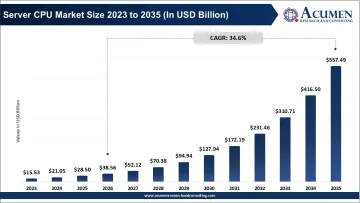
The global server CPU market size was valued at USD 28.50 billion in 2025, estimated to reach at USD 557.49 billion by 2035. The market is observed to grow at a CAGR of 34.6% during the forecast period of 2026-2035. The rapid deployment of edge computing infrastructure alongside global 5G network expansion is significantly increasing the demand for server CPUs designed for low-latency, distributed computing environments.
Report Highlights
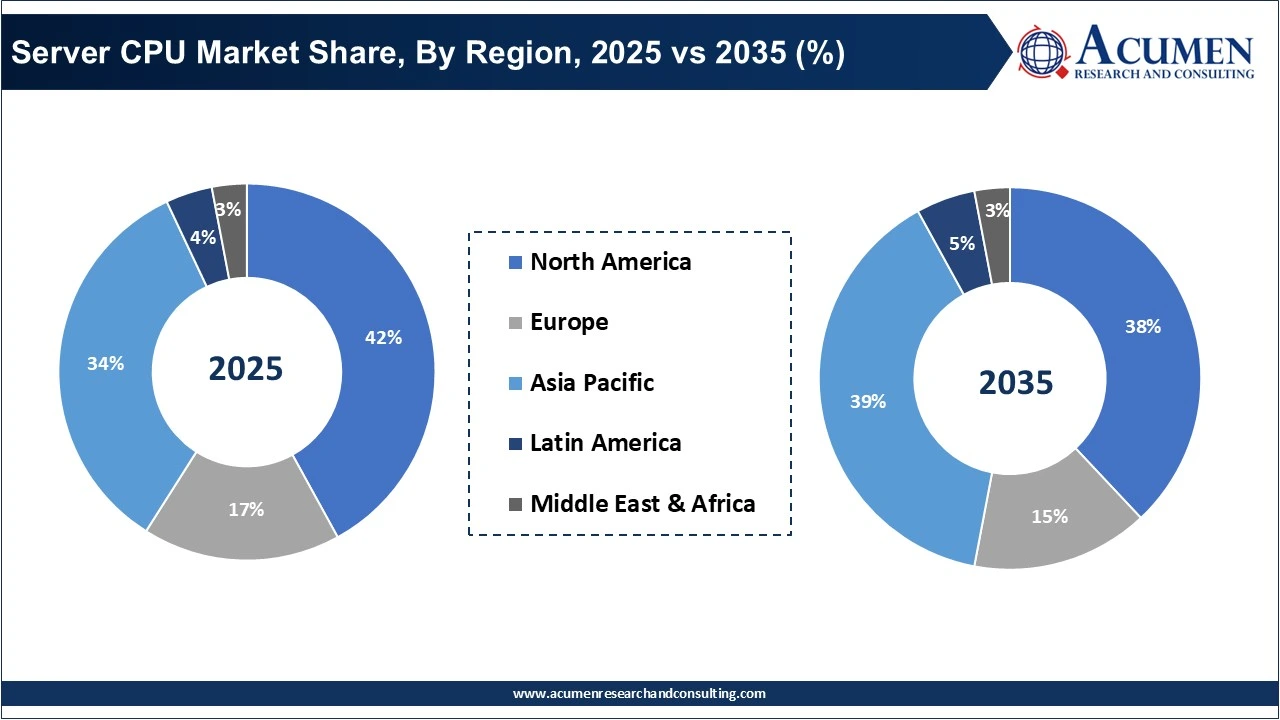
- By region, North America dominated the server CPU market with a 42% share in 2025, driven by the presence of leading semiconductor companies, hyperscale cloud providers, and significant investments in AI infrastructure and data centers.
- By region, Asia Pacific is projected to grow at the fastest CAGR of 36.6% during 2026–2035, supported by expanding semiconductor manufacturing, rapid cloud adoption, and increasing government investments in digital infrastructure.
- By CPU architecture, x86 processors held the largest market share of 87% in 2025, owing to their extensive enterprise software compatibility, strong virtualization capabilities, and widespread deployment across cloud and mission-critical workloads.
- By CPU architecture, ARM-based processors are expected to expand at the fastest CAGR of 48.1% between 2026 and 2035, driven by rising demand for energy-efficient, high-performance processors in hyperscale cloud and AI data centers.
- By server type, the cloud/hyperscale segment accounted for the largest 42% market share in 2025, fueled by rapid expansion of hyperscale data centers and growing enterprise migration to cloud environments.
- By server type, the edge segment is anticipated to register the fastest CAGR of 37.9% during the forecast period, supported by increasing deployment of IoT, 5G networks, and latency-sensitive applications.
- By power consumption/TDP, the 100–200W segment captured the largest 48% market share in 2025, owing to its balance between computational performance, energy efficiency, and operating costs.
- By power consumption/TDP, the high power (>200W) segment is expected to witness the fastest growth during the forecast period, driven by increasing AI training, high-performance computing, and large language model workloads.
- By CPU core count, the 16–64 core segment dominated the market with a 48% share in 2025, due to its versatility across enterprise servers, virtualization, cloud computing, and database applications.
- By CPU core count, the 65–128 core segment emerged as the second-largest category with a 32% share in 2025, supported by growing demand for AI inference, cloud-native applications, and high-performance computing.
- By application, cloud & virtualization held the largest market share of 35% in 2025, owing to increasing enterprise adoption of public, private, and hybrid cloud environments.
- By application, AI/ML accounted for 18% of the market in 2025 and is expected to witness strong growth, driven by rising adoption of generative AI, machine learning, and enterprise AI workloads.
What is Server CPU & How is it Growing?
The server CPU market revolves around the sector dealing with processors used for enterprise server, cloud, hyperscale data center, and HPC systems. The chips designed for servers offer features for sustained operation, higher number of cores, greater memory support, expanded security capabilities, and features designed for use in multi-processor configurations or a cloud environment.
The server CPU has been deployed to handle all of the computations necessary to support everything we do in the modern digital world including cloud computing, artificial intelligence (AI), big data, business applications, the edge, and mission-critical workloads. Growth of the server CPU market is propelled by, hyper-scale datacenter build-out and rapid deployment of AI and machine learning.
Additionally, greater requirement for energy-efficient, high performance solutions, ongoing investment in silicon node improvements and the advancement in chiplet design offer potential to the market to boom.
Trade & Tariff Analysis for Server CPUs
| Trade Policy / Initiative | Key Statistics |
|---|---|
| WTO Information Technology Agreement (ITA) | Covers approximately 200 information technology products, including semiconductors. Participating economies generally apply 0% Most Favoured Nation (MFN) customs duties on covered products. |
| HS Classification for Server CPUs | Server CPUs are generally classified under HS 8542.31 – Processors and Controllers, providing a standardized customs classification for international trade. |
| United States Export Controls (2022–Present) | The U.S. introduced expanded export controls on advanced computing chips and semiconductor manufacturing equipment beginning in October 2022, with additional updates in subsequent years targeting advanced AI processors. |
| U.S. CHIPS and Science Act | Allocates approximately US$52.7 billion to strengthen domestic semiconductor manufacturing, research, workforce development, and supply chain resilience. |
| European Chips Act | Mobilizes more than €43 billion in combined public and private investment to increase the EU's semiconductor manufacturing capacity and reduce external dependence. |
| China Semiconductor Strategy | China imported approximately US$173.4 billion worth of processors and controllers (HS 854231) in 2024, representing around 7.0% of its total merchandise imports by value. |
| ITA Expansion Agreement | The expanded ITA covers products representing approximately US$1.3 trillion in annual global trade and involves 54 WTO members, accounting for about 90% of global trade in covered products. |
| Global Semiconductor Supply Chain Diversification | Governments in the U.S., EU, Japan, South Korea, India, and Southeast Asia continue expanding semiconductor manufacturing through incentive programs and fabrication investments to improve supply chain resilience. |
Market Dynamics
Driver
Rising AI and Cloud Infrastructure Investments
The artificial intelligence (AI), cloud computing, and hyperscale data centers have experienced rapid growth. As industries are expanding to utilize the advantages of AI- powered applications, big data analytics, machine learning algorithms and high performance computing (HPC), and therefore requiring more processor core count, memory bandwidth, and power efficiency, the server CPU market will continue to experience a gradual increase.
Governments and enterprises across regions are expanding investments in cloud infrastructure, digital transformation, and AI-enabled data center. In June 2025, the company introduced their 5th Generation AMD EPYC processors providing greater performance, higher core counts, and improved power efficiency for AI, cloud and enterprise workloads for hyperscale and enterprise customers.
Restraint
High Development Costs and Semiconductor Supply Chain Complexity
Creating server CPUs also has significant cost barriers, such as processor designs, the most advanced semiconductor process technology and the associated manufacturing and chip package technology. To create future generation server CPUs, billion of dollars are needed for research and development (R&D) including latest semiconductor technology from most advanced wafer foundry for chip manufacturing along with a advanced chiplet packaging technology.
It costs a higher cost to fabricate a CPU using the most advanced process technology, this thus raises the barrier to market for new companies entering in server CPU business and pressure for pricing on existing manufacturers. For example, Intel adjusted its manufacturing strategy in April 2025 in order to address current market conditions and manage costs, while continuing to invest in both the company's manufacturing technology and future generation of server processors.
Opportunity
Growing Adoption of Energy-Efficient and AI-Optimized Server Processors
Growing importance of sustainability, power efficiency and AI infrastructure presents major growth opportunities for server CPU market. Data centre owners require more performant per watt processors in order to lower electricity consumption, cooling requirements and CO2 emission while increasing number of compute resources. Use of latest fabrication technologies, chiplet architecture, Arm-based server CPUs, and in-built AI accelerators creates room for opportunities for processor providers.
Moreover, expansion of edge computing, private AI infrastructure, and enterprise AI apps will further fuel expansion of high-performance server CPU market over the coming few years. For instance, in Apr 2025, Nvidia unveiled the next generation Grace Blackwell computing platform which pair energy efficient CPUs and high performing AI Accelerators to address big-scale AI Training, Inference and data centers which will offer significant performance improvements and lower power consumption for the enterprise data centers.
Regional Analysis
North America Server CPU Market Analysis
North America held 42% share in the global server CPU market in 2025 and was estimated to be the largest regional market in terms of revenue. Presence of major semiconductor companies like Intel Corporation, Advanced Micro Devices Inc (AMD), NVIDIA Corporation, Marvell Technology, and Ampere Computing, along with the large cloud computing service providers such as Amazon Web Services (AWS), Microsoft Azure, Google Cloud and Oracle Cloud Infrastructure is driving substantial growth of North America market.
Major enterprises are extensively investing in hyperscale data centers, AI infrastructure and enterprise cloud services, thus further bolstering the regional market growth. Moreover, the U.S is considered to be the hub for AI innovation and cloud computing as most hyperscale data centers exist here.
Significant investment is being done in enhancing the semiconductor manufacturing capacity of the country under the CHIPS and Science Act of the U.S. The proliferation of generative AI, machine learning and high-performance computing workloads have also fuelled demand for high-performance server processors, hence aiding the growth of the North American region. The modernization of enterprise systems, increased deployment of edge computing, and growing governmental investment in digital infrastructure are key growth factors.
Asia Pacific Server CPU Market Analysis:
In 2025, Asia-Pacific represents 34% of the market share in the energy-efficient server processors market, while in 2035, it will reach 39%. The region is expected to grow with a faster CAGR of 36.6% during the forecast period from 2026 to 2035. Asia Pacific is growing faster for hyperscale cloud infrastructure deployments across China, India, Japan, South Korea, Singapore and Australia.
Government of respective countries are investing heavily for developing and increasing semiconductor manufacturing including China’s integrated circuit development program, India’s Semiconductor Mission, Japan’s semiconductor revitalization program and South Korea’s K-Semiconductor Belt.
Further the manufacturing ecosystem is developed and robust supported by companies such as TSMC, Samsung Electronics and number of advanced packaging suppliers. The increase in enterprise digitization, the growing internet penetration, high deployment rate of AI based application, 5G infrastructure rollout, increasing penetration of cloud native services, will lead to increase in the adoption of energy-efficient server processors in the Asia Pacific during the forecast period.
Recent Investments & Funding: Country-level Analysis
U.S.
- The U.S. is the largest market for server CPU investment. Backed by the CHIPS and Science Act with $52.7 billion of government funding in domestic semiconductor manufacturing, research and development and workforce training programs, the country has witnessed steady growth in server CPU.
- Top players in the space including Intel, AMD, NVIDIA and Marvell are continuously pushing new generations of server processors, AI-optimized server CPUs and advancements in chip packaging.
- With hyperscale cloud service providers like Amazon Web Services (AWS), Microsoft Azure, Google Cloud investing tens of billions of dollars annually into AI data center expansion, demand for AI-optimized server processors is expected to rise.
China
- With heavy investments being made by the government into domestic semiconductor capabilities through national integrated circuit efforts, China is seeking to decrease its reliance on imported CPUs.
- The development of Arm-based and proprietary server CPUs for various sectors including cloud computing, enterprise servers, and government uses, is accelerating amongst local companies. Investment in data centers, and high-capacity AI infrastructure are contributing to deployment of Chinese server processors.
Japan
- Japan’s efforts in building its semiconductor eco-system include private and government-funded projects dedicated to advanced chip production and future computing technology.
- The country is putting considerable effort in expanding its data center capacity for both HPC, which is becoming critical for data driven scientific research and for the nation’s digital transformation, in addition to investment in efficient server solutions for the industrial use.
Germany
- In addition to Germany's commitment to the broader EU Chips Act, public investment for semiconductor manufacturing and infrastructure including data centers is growing.
- Research into areas including HPC and AI-infrastructure, combined with the push for technological advancement, continue to grow within the nation's private and public sectors.
- Investment in data center infrastructure and servers are also being driven by industry adoption of cloud and digital manufacturing under initiatives such as Industry 4.0 across its key industries.
India
- With significant government support under schemes like India Semiconductor Mission and PLI for semiconductors, investments are rapidly expanding within India to build the nation’s semiconductor footprint.
- Initiatives to promote data centers, cloud infrastructure, AI adoption, and digital public infrastructure are pushing for greater demand in enterprise servers and data center CPUs in India.
- Global investment by cloud providers and other data center companies is expected to result in long-term opportunities in server CPU market.
Segmental Insights
CPU Architecture Insights
With its market share in the segment being 87% in 2025, x86 continues to remain the architecture of choice for server market, the most essential for cloud infrastructure, virtualization and critical enterprise applications. Driven by Intel Xeon and AMD EPYC processors, which are present in government entities, enterprises, financial services firms, and major cloud providers, x86 has established a robust ecosystem with broad software and virtualization support.
Businesses opt for the x86 architectures, owing to comprehensive application support, reliability and security advantages and high-performance capabilities essential for databases and virtualization infrastructure. Furthermore, developments in chiplet design, improved memory bandwidth, improved artificial intelligence workloads and new packaging technologies have further solidified its competitive edge over alternative designs.
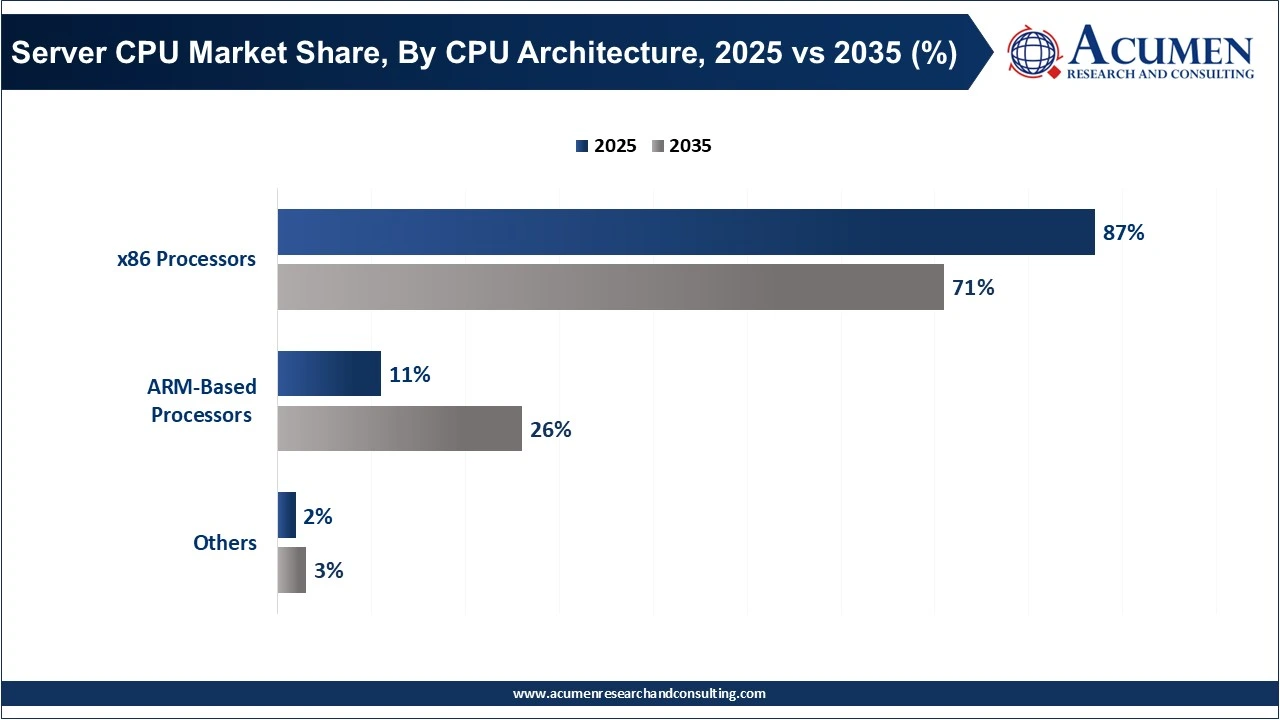
ARM-based processors is set to witness a strong CAGR of 48.1% from 2026 to 2035 and is estimated to contribute 26% share of the total server CPU market in 2035, compared to 11% share in 2025. High growth in demand for Arm processors in hyperscale data centers driven by the growing need for higher performance per watt and reduction in overall operation and energy costs.
Leading hyperscalers such as Ampere Computing, NVIDIA, AWS (Graviton) and several custom silicon providers are increasing deployments of Arm servers for their cloud-native infrastructure. Increased adoption of edge computing, AI workloads, and sustainability focus on data centers to boost demand for Arm server processors during the forecast period.
Server Type Insights
The cloud/hyperscale segment captured 42% of the global server CPU market share in 2025. Expansion of hyperscale data centers such as by Amazon Web Services (AWS), Microsoft Azure, Google Cloud, Oracle Cloud Infrastructure (OCI), Alibaba Cloud and Tencent Cloud have further widened the adoption of high-core count server processors.
Increasing migration of workloads to public cloud or hybrid cloud in enterprises, in addition to mounting demand for AI training and inference work loads, drives growth in requirements for processors that deliver increased scalability, memory bandwidth and computational performance.
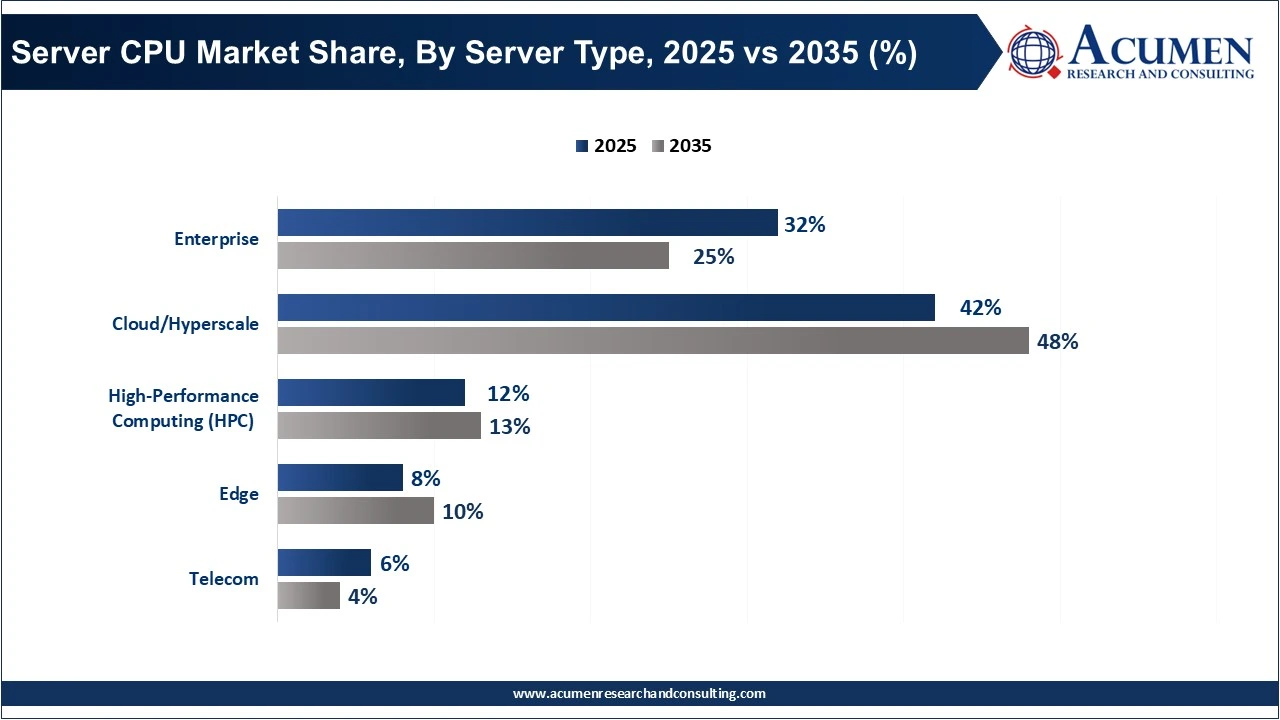
Among all segments, the edge server market is projected to rise at the fastest CAGR of 37.9% during the forecast period. Proliferation of IoT devices, autonomous machines, smart city initiatives, industrial automation, and 5G connected services necessitates the expansion of decentralized computing infrastructure. In response to demands for a faster application response, diminished latency, and lower bandwidth expenditure, businesses are striving to process data in proximity to customers.
Power Consumption/TDP Insights
In 2025 the 100-200W TDP segment dominated 48% of the worldwide server CPU market due to the right sweet spot of computation and efficiency The TDP range also fits best in enterprise servers, virtualized environment, cloud data centers, and data bases due to optimal performance with reasonable cooling and operational cost. Owing to semiconductor process improvements and the wide usage of chiplet architecture, with more intelligent power management functions, the power performance per watt ratio will grow over the period making medium power processors fit the wide array of workloads on the enterprise segment.
Server CPU Market Share, By Power Consumption / TDP, 2025 (%)
| Power Consumption / TDP | Revenue Share, 2025 (%) |
|---|---|
| Low Power (<100W) | 22% |
| Medium Power (100–200W) | 48% |
| High Power (>200W) | 30% |
The high power (>200W) market segment constituted 30% of the market size in 2025, it is also expected to be the fastest growing market segment over the forecast period, driven by the adoption of artificial intelligence training, large language models, high-performance computing (HPC) and hyperscale cloud. The increased usage of liquid cooling and advanced cooling technologies in order to support the adoption of high-TDP server processors.
CPU Core Count Insights
The 16-64/ mid core segment represented 48% of the world market for server CPUs in 2025, making it the largest server CPU segment. These server CPUs deliver the right mix of parallel performance and efficiency, making it the right product for server applications such as those run on behalf of enterprise environments, virtualization, cloud solutions and databases. This segment is applicable for nearly every vertical such as banking, healthcare, manufacturing, telecommunications and government institutions.
Server CPU Market Share, By CPU Core Count, 2025 (%)
| CPU Core Count | Revenue Share, 2025 (%) |
|---|---|
| Low Core Count (<16 cores) | 10% |
| Mid Core Count (16–64 cores) | 48% |
| High Core Count (65–128 cores) | 32% |
| Ultra-High Core Count (>128 cores) | 10% |
In 2025 the high core count (65-128) core segment controlled 32% of the market, fueled by higher AI inference requirements, cloud-native application, virtualization and high-performance compute. Workloads with a higher need for parallel compute in enterprise continue driving adoption of high core count processors. Meanwhile, chip makers, including Intel, are raising their core counts using chiplet architectures, and leveraging their newest semiconductor technologies to achieve improved scalability for the enterprise and hyper-scale data centers.
Application Insights
As of 2025, the cloud & virtualization application area represents the most prominent share of the global server CPU market 35%. A massive shift towards cloud-based systems, software-defined architectures, virtualization platforms, and hybrid cloud environments drove tremendous demand for enterprise-grade server CPUs.
Moreover, ongoing consolidation of applications by enterprises in favor of virtualization increases the utilization rates of servers, helping to lower the IT infrastructure costs of an organization. The modern server CPUs have extended high core count capabilities and features that facilitate virtualization extensions, AI acceleration, and heightened security at both the enterprise and hyperscale deployments.
Server CPU Market Share, By Application, 2025 (%)
| Application | Revenue Share, 2025 (%) |
|---|---|
| AI/ML | 18% |
| Cloud & Virtualization | 35% |
| Database & Analytics | 17% |
| General Computing | 15% |
| HPC | 9% |
| Edge Computing | 6% |
AI/ML application segment accounted for 18% share in 2025 and is one of the fastest growing segment of the server CPU deployments in the market. The increasing adoption of generative AI, machine learning, predictive analytics, recommendation engines, and natural language processing solutions in enterprises has increased the demand for high-performance processors that support the advanced workload of the AI application.
Manufacturers are incorporating the AI accelerators, massive cache-memory designs, high memory technologies, and optimized instruction sets into the subsequent generation server CPUs. The market size is expected to be driven by a greater scaling of AI in enterprises in the long term.
Recent News
- In February 2025, Intel expanded its Xeon 6 portfolio with the launch of the Xeon 6300 series processors for entry-level servers. The new processors offer up to 8 cores and 16 threads, DDR5 ECC memory support, PCIe 5.0 connectivity, and enhanced performance for small and medium-sized businesses, edge computing, and enterprise workloads. The launch strengthens Intel's position in the mainstream server CPU segment while improving power efficiency and workload performance.
- In July 2026, AMD confirmed the launch of its next-generation EPYC "Venice" server processors based on the Zen 6 architecture and built using TSMC's advanced 2 nm process technology. The company stated that the new processors deliver approximately 1.7× higher performance and efficiency than the previous generation, along with around 30% higher thread density, targeting AI, cloud computing, and hyperscale data center workloads.
Server CPU Market Competitive Landscape
1. Intel Corporation (Santa Clara, California, U.S.) - Intel is the leading x86 server CPU supplier, with its Xeon processors serving enterprise servers, cloud infrastructure, and high-performance computing (HPC) systems worldwide.
2. Advanced Micro Devices, Inc. (Santa Clara, California, U.S.) - AMD is the second-largest x86 server CPU supplier, its EPYC server processors provide strong performance, good power efficiency, and high core counts, especially for hyperscale cloud.
3. NVIDIA Corporation (Santa Clara, California, U.S.) - NVIDIA's presence in the server CPU space is growing with its Grace CPU platform that focuses on AI, HPC, and data-centric computing.
4. Ampere Computing LLC (Santa Clara, California, U.S.) - Ampere is a supplier of high-performance and energy-efficient Arm-based server processors targeted at cloud-native workloads.
5. IBM Corporation (Armonk, New York, U.S.) - IBM produces its own POWER processors that are optimized for critical enterprise workloads, financial services, and HPC environments.
6. Fujitsu Limited (Tokyo, Japan) Fujitsu offers a range of server processors for enterprise and supercomputing, including advanced Arm-based processor designs.
7. Huawei Technologies Co., Ltd. (Shenzhen, China) - Huawei is developing Kunpeng server processors to improve China's computing ecosystem and expand cloud services.
8. Oracle Corporation (Austin, Texas, U.S.) - Oracle leverages its custom server processor designs for its enterprise servers and cloud infrastructure (Oracle Cloud Infrastructure).
9. Marvell Technology, Inc. (Santa Clara, California, U.S.) - Marvell develops Arm-based data center CPUs and custom silicon solutions for hyperscale clouds.
10. Qualcomm Technologies, Inc. (San Diego, California, U.S.) - Qualcomm is leveraging its expertise in Arm-based mobile and AI chips to enter the server CPU market.
Segments Covered
By CPU Architecture
- x86 Processors
- ARM-Based Processors
- Others
By Server Type
- Enterprise
- Cloud/Hyperscale
- High-Performance Computing (HPC)
- Edge
- Telecom
By Power Consumption / TDP
- Low Power (<100W)
- Medium Power (100–200W)
- High Power (>200W)
By CPU Core Count
- Low Core Count (<16 Cores)
- Mid Core Count (16–64 Cores)
- High Core Count (65–128 Cores)
- Ultra-High Core Count (>128 Cores)
By Application
- AI/ML
- Cloud & Virtualization
- Database & Analytics
- General Computing
- HPC
- Edge Computing
By Region
- North America
- Europe
- Asia-Pacific
- Latin America
- Middle East & Africa
Looking for discounts, bulk pricing, or custom solutions? Contact us today at sales@acumenresearchandconsulting.com
Frequently Asked Questions

Other Semiconductor and Electronics Reports
July 2026
May 2023
August 2023
February 2023