
Sovereign Cloud Market Size, Share, Trends, Report 2026 To 2035
Sovereign Cloud Market (By Deployment: Public, Private, Hybrid; By Functionality: Data Sovereignty, Technical Sovereignty, Operational Sovereignty; By Service Model: IaaS, PaaS, SaaS; By Enterprise Size: Large Enterprises, Small & Medium Enterprises; By End User: Government & Defense, Healthcare, BFSI, Telecommunications, Energy & Utilities, Manufacturing, Others) - Global Industry Analysis, Size, Share, Growth, Trends, Regional Analysis And Forecast 2026 To 2035
- Last Updated: 26 Jun 2026
- Report Code: ARC3943
- Category: ICT
Sovereign Cloud Market Size, Forecast 2026 To 2035
The global sovereign cloud market size was estimated at USD 132.04 billion in 2025 and is projected to reach USD 1,133.42 Billion by 2035, expanding at a compound annual growth rate (CAGR) of 24.0% during the forecast period from 2026 to 2035.
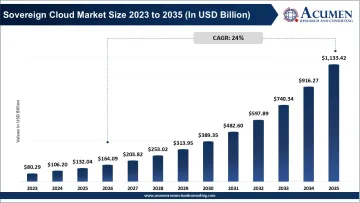
Report Highlights
- In 2025, North America led the market with the largest share of 38%.
- Europe held a notable share of 28% in 2025 in sovereign cloud market.
- The Asia Pacific region is expected to experience the fastest growth, registering a CAGR of approximately 26.8% from 2026 to 2035.
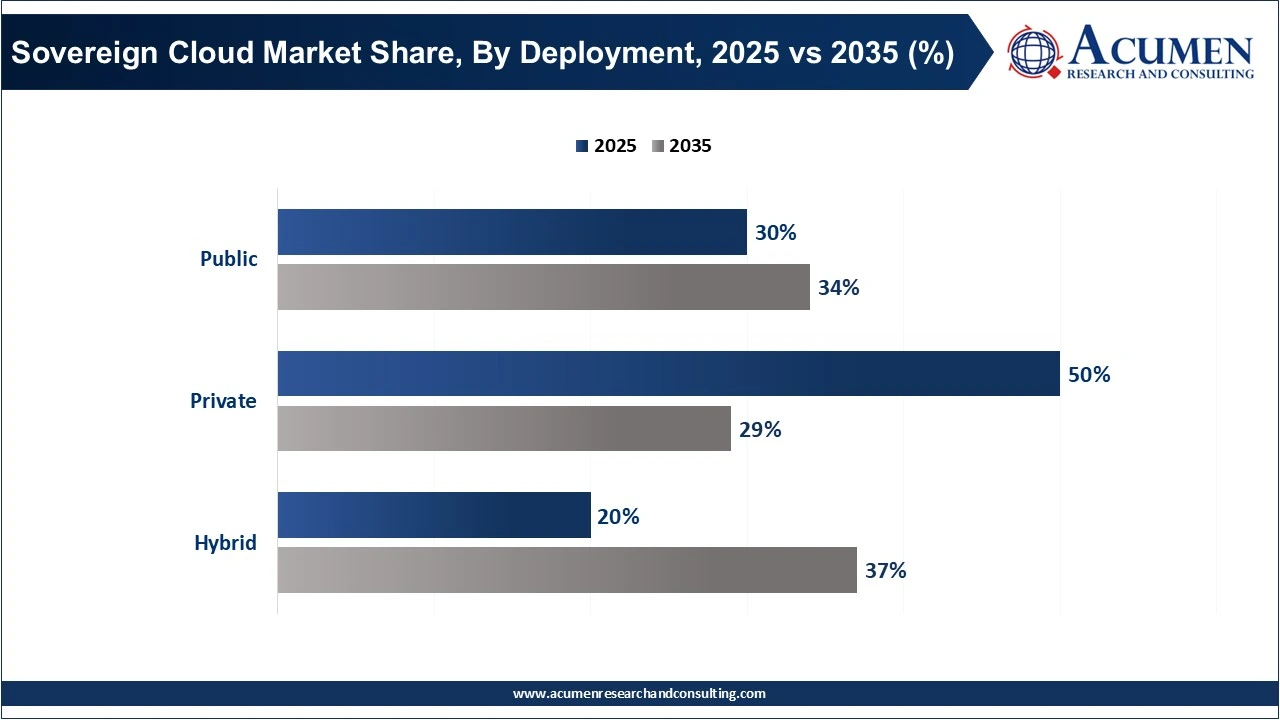
- By deployment, the private deployment segment led the market in 2025 with the share of 50%.
- By deployment, the hybrid segment is seen to grab 37% share by 2035 in the market.
- By functionality, the data sovereignty leads the market, contributing 48% of the overall functionality share.
- By functionality, the operational sovereignty segment held the second largest share of 30% in 2025.
- By service model, the IaaS segment led the market with 55% share in 2025.
- By service model, the SaaS segment held the second largest share of 25% in 2025.
- By enterprise size, the government & defense account for the largest portion of market adoption, holding around 38% of the total share.
- By enterprise size, the BFSI segment held the second largest share of 20% in 2025.
The sovereign cloud market is expanding rapidly because of governments around the world are creating stricter rules about how and where data must be stored and used. Governments and regulatory authorities are implementing stringent regulations that mandate sensitive data such as citizen information, financial records, healthcare data, and national security assets to be stored, managed, and processed within national borders to ensure legal compliance, data protection, and sovereign control. Regulatory frameworks like GDPR in Europe, data localization requirements across the Asia-Pacific region, and strict sector-specific compliance standards in industries including BFSI, defense, and public services are compelling organizations to adopt sovereign cloud solutions. These platforms offer advanced governance over data ownership, access controls, and encryption mechanisms, ensuring that data is managed within the legal jurisdiction of local authorities while data transfer and regulatory non-compliance to minimizing risks associated with cross-border.
Another significant driver of the market is the accelerating digital transformation of government agencies and regulated industries, along with increasing cyber security concerns. Initiatives such as public sector modernization, smart governance initiatives, and the adoption of cloud-native technologies are increasing, that drive a strong demand for secure and compliant cloud infrastructure that can support critical operations while ensuring data privacy and regulatory compliance. At the same time, growing cyber threats and geopolitical uncertainties are boosting demand for cloud environments that offer secure, operational transparency, and locally governed infrastructure. These rising needs for trusted and resilient cloud solution is fuelling sustained growth and attracting long-term investments in sovereign cloud market.
Market Dynamics
Market Drivers
1. Rising Data Sovereignty and Compliance Regulations
Governments around the world are increasingly enforcing strict data localization and privacy laws, such as GDPR in Europe and sector-specific mandates in Asia-Pacific, requiring sensitive data to remain within national borders. These regulatory laws are driving organizations to adopt sovereign cloud solutions that protect citizen and enterprise data while ensuring full compliance, security, and accountability. By providing controlled storage, access, and processing within local jurisdictions, sovereign cloud platforms help organizations minimize the risk of cross-border data transfer.
2. Accelerating Digital Transformation and Cybersecurity Needs
The increasing digitalization of government agencies, healthcare, finance, and other regulated sectors is boosting the need for secure, compliant cloud infrastructure. Coupled with growing cyber threats and geopolitical tensions, organizations are seeking trusted, locally governed cloud environments that ensure operational transparency and resilience. Additionally, advancements in hybrid and multi-cloud architecture are making sovereign cloud solutions scalable and cost-effective, encouraging adoption among both large enterprises and SMEs. This combination of digital transformation and security concerns is a powerful driver shaping market growth.
Market Restraints
1. High Implementation and Maintenance Costs
Implementing and managing sovereign cloud solutions requires significant investments in local data centers, compliance processes, advanced encryption systems, and specialized skilled personnel to ensure secure, compliant, and efficient operations. For many organizations, especially small and medium-sized enterprises (SMEs), the high initial investment and ongoing operational costs can pose a significant challenge, often slowing the adoption of sovereign cloud solutions. The financial burden also makes it difficult for smaller players to compete with large cloud providers, which in turn limits market growth.
2. Shortage of Technical Expertise
The sovereign cloud market faces significant restraint due to the shortage of skilled professionals with expertise in designing, implementing, and managing sovereign-grade cloud architectures. Specialized Expertise in areas like advanced cloud orchestration, cybersecurity compliance, localized data handling, and risk management is limited, creating high demand for talent. This gap not only increases operational challenges for providers but also slows innovation and adoption, as organizations struggle to find the right skills to build and maintain secure, compliant, and efficient sovereign cloud solutions.
Market Opportunities
1. Adoption of AI-based Sovereign Cloud Analytics
The integration of Artificial Intelligence (AI) and Machine Learning (ML) within sovereign cloud environments presents a strong market opportunity, as organizations aim to generate insights from sensitive data while maintaining jurisdictional control. Many organizations are limiting their use of global AI platforms due to concerns over intellectual property protection and data security, driving demand for more secure solutions. Sovereign clouds enable localized AI model training and interference under regional privacy standards, ensuring data remains within national boundaries. This capability is driving demand for sovereign AI analytics among research institutions, defense organizations, and high-tech industries that prioritize data security alongside innovation.
2. Emergence of Hybrid and Multi-Cloud Architectures
The growing adoption of hybrid and multi-cloud environments presents opportunities for sovereign cloud solutions to integrate seamlessly with public and private cloud platforms. Organizations require cloud solutions that are scalable, flexible, and cost-efficient, while ensuring full compliance with local data protection and maintaining control over sensitive information. Cloud providers that deliver interoperable, hybrid-ready sovereign solutions are well-positioned to meet these needs, supporting broader adoption across enterprises of all sizes and industries. This shift is encouraging innovation and contributing to a more dynamic and competitive sovereign cloud market.
Regional Insights
The North America sovereign cloud market is expected to expand from USD 50.18 billion in 2025 to over USD 317.36 billion by 2035, at a CAGR of 19.8% during the forecast period 2026 to 2035. North America dominated the sovereign cloud market with 38% share in 2025, supported by the robust digital ecosystem of the region and the adoption rate. Rapid cloud adoption by organizations and concerns around government privacy and data protection have fueled the interest in sovereign cloud technology, and big players like Amazon Web Services Inc., Google, and Microsoft Corp. have ramped up their efforts to establish sovereign cloud offering catering specifically to regulated organizations in countries including the United States and Canada. Increased cybersecurity risk, heightened data security concerns and government mandate to keep data localized have raised the preference for sovereign cloud technology. The initiative by the U.S. federal government to upgrade IT security for the protection of citizens and national interests is likely to pushes the market.
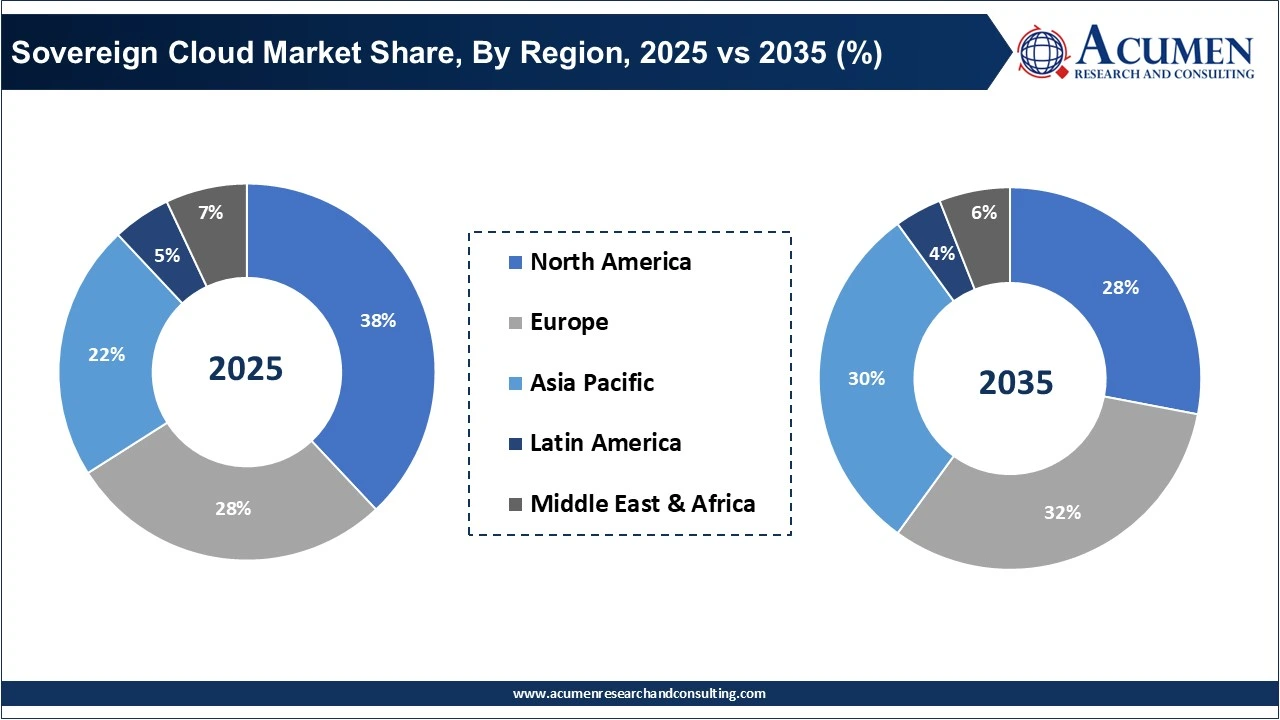
The Europe sovereign cloud market size was valued at USD 45.95 billion in 2025 and is projected to hit USD 362.70 billion by 2035 with a CAGR of 25.8% from 2026 to 2035. Europe held a significant share of 28% in 2025 in the sovereign cloud market due to a strict regulatory environment, mature digital infrastructure, and early adoption of cloud technologies. The region is home to some of the world's most stringent data privacy and sovereignty regulations, including GDPR, which requires organizations to store and process data within local borders. This regulatory focus has driven both public and private sector organizations to adopt a sovereign cloud solution that ensures compliance while maintaining operational efficiency. Additionally, the presence of established cloud providers, regional partnerships, and advanced IT ecosystems had strengthened Europe's position as the leading market.
The Asia-Pacific sovereign cloud market size reached at USD 36.10 billion in 2025 and is anticipated to surge USD 340.03 billion by 2035, reflecting a CAGR of 28.3% from 2026 to 2035. Asia Pacific is seen to expand at the CAGR of 28.3% in the sovereign cloud market during the forecast period, driven by rapid digitalization, expanding cloud infrastructure, and increasing awareness of data privacy and security regulations. Countries Such as China, India, Japan, and Australia are implementing local data protection laws and encouraging domestic cloud adoption, which has spurred significant demand for sovereign cloud platforms. The region's fast-growing sector, government digital initiatives, and rising investments in cloud-native technology are fueling rapid adoption. With ongoing efforts to modernize IT infrastructure and the increasing need for compliance and security, the Asia Pacific presents a high-growth opportunity for sovereign cloud providers, outpacing other regions in adoption rates.
Segmentation Insights
The worldwide market for sovereign cloud is split based on deployment, service model, functionality, enterprise size, end-user and geography.
Deployment Insights
The private deployment segment led the market with 50% market share in 2025, due to the rising emphasis towards private sovereign clouds for data control and access to sensitive information with custom infrastructure. Organizations in government, defense, healthcare, and the financial sector opted for these deployments to comply with local regulations of data residency and safeguard critical data without relying on third parties.
| By Deployment | Market Share, 2025 (%) | Key Highlights |
|---|---|---|
| Public | 30% | Strong preference for scalable, flexible, and compliance-ready cloud infrastructure. |
| Private | 50% | Demand for full control over sensitive data and localized infrastructure. |
| Hybrid | 20% | NA |
The hybrid segment is seen to grow rapidly while reaching at 37% share in 2035. The adoption of hybrid models has been further accelerated by the rising demand from businesses to meet varying data sovereignty, security, and flexibility requirements. Hybrid clouds combine private and public clouds to support organization to move and retain their sensitive workloads in on premises and less sensitive work load in public cloud and thereby increase their cost and speed in terms of application deployment and performance. Various segments like BFSIs, healthcare and government were keenly interested in exploring and adoption these types of hybrid solutions.
Functionality Insights
Data sovereignty dominated the market with 48% share of the sovereign market is because organizations prioritize compliance with national data protection laws and regulations. Industries such as BFSI, healthcare, and government rely on sovereign cloud solutions to ensure that sensitive information remains within local jurisdictions and under controlled governance. This focus on regulatory adherence reduced legal risks, enhanced operational security, and strengthened customer trust, making data sovereignty the most critical functionality in the market.
| Functionality | Market Share, 2025 (%) | Key Highlights |
|---|---|---|
| Data Sovereignty | 48% | Prioritization of compliance with regional data protection laws and regulations. |
| Technical Sovereignty | 22% | Need for advanced operational control, customizable cloud stacks, and hybrid integration. |
| Operational Sovereignty | 30% | Ensures secure, efficient, and controlled cloud operations across enterprises. |
The operatoinal sovereignty segment held the second largest share of the market with 30% share in 2025, owing to factors such as the surging need for autonomy and control over management, maintenance and support functions of cloud operations. Government and defense. Additionally, financial organizations are widely seeking to secure their operations via operational sovereignty by having cloud resources provisioned, hosted and supported by local workforces under their respective legal frameworks. Operational sovereignty ensures visibility and controls data jurisdiction, compliance with stringent domestic regulations and mitigates the dependency on overseas governed cloud operations.
Service Model Insights
The IaaS segment led the market with 55% share in 2025. Growing demand from various enterprises and governmental organizations is attributing to this strong position for IaaS. In IaaS, the services enable the companies to manage a secure and robust cloud infrastructure with a higher degree of control over computing capabilities, especially concerning data sovereignty, has significantly strengthened its adoption across regulated industries.
| Service Model | Revenue Share, 2025 (%) |
|---|---|
| IaaS | 55% |
| PaaS | 20% |
| SaaS | 25% |
On the other hand, the SaaS segment is seen to grow rapidly which also held a share of 25% in 2025, spurred by cloud security and regulated organizations' growing reliance on business applications for secure, compliant cloud usage. Sovereign SaaS solutions for collaboration, ERPs, and CRM are being widely used to meet local data residency and privacy legislation, with operational agility, reduced IT operational burden, and rapid software deployment further fueling demand.
Enterprise Size Insights
Large enterprises, in 2025 held the largest share of 78%, dominating the market because they handle substantial volumes of sensitive data and face rigorous regulatory obligations. Their significant IT budgets allow investment in advanced sovereign cloud solutions that ensure compliance, data protection, and operational continuity. Large organizations' multi-regional operations further increase the demand for cloud platforms with sovereign capabilities, reinforcing their dominance.
| Enterprise Size | Market Share, 2025 (%) | Key Highlights |
|---|---|---|
| Large Enterprises | 78% | Large IT budgets and multi-regional operations drive advanced cloud adoption. |
| Small and Medium Enterprises | 22% | Flexible, cost-effective solutions support SME digital transformation and security needs. |
Small and medium enterprises represent the fastest-growing segment which also held a share of 22% in 2025, as digital transformation accelerates multiple sectors working on small-scale. SMEs are increasingly adopting a sovereign cloud solution to access enterprise-grade security, compliance, and operations without investing heavily in on-premises infrastructure. Flexible subscription models and hybrid deployment options make it easier for SMEs to integrate these solutions, fueling rapid growth in this segment and expanding the overall market.
End User Insights
Government and defense segment dominated the market in 2025 with 35% share, due to the critical need for data sovereignty, secure cloud infrastructure, and regulatory compliance. These sectors handle highly sensitive citizen, military, and operational data, requiring locally governed cloud platforms that ensure security and operational transparency. The emphasis on protecting national and strategic information keeps government and defense organizations at the forefront of adoption.
The BFSI segment held the second largest share in 2025 of 20% driven by increasing security requirements for data, regulatory compliance and the need to secure sensitive financial data. Banks, insurers and other financial institutions are accelerating the use of sovereign cloud solutions as a way to enhance their security framework, maintain data residency and drive their digital banking initiatives while retaining control over customer data and transactions.
| End User | Market Share, 2025 (%) | Key Highlights |
|---|---|---|
| Government & Defense | 35% | High security, regulatory compliance, and data sovereignty requirements. |
| Healthcare | 12% | Digitization, patient data privacy, and regulatory compliance drive adoption. |
| BFSI | 20% | Strong demand for secure financial data management and compliance adherence. |
| Telecommunications | 10% | Growing network and service data management, regulatory compliance, and security needs. |
| Energy & Utilities | 8% | Digitalization of operations, grid management, and secure data handling. |
| Manufacturing | 7% | Adoption for operational efficiency, secure IoT integration, and compliance. |
| Others | 8% | Niche industries adopting sovereign cloud for specialized compliance and security needs. |
Healthcare is the fastest-growing segment of the market which also held a significant share of 12% in 2025, as hospitals, clinics, and research institutions increasingly digitize patient records and clinical operations. The sector faces stringent privacy regulations, such as HIPAA and GDPR, and requires secure, sovereign cloud platforms to protect sensitive health information. Growing adoption of telemedicine, health analytics, and digital health services is accelerating demand, positioning healthcare as a major growth in the sovereign cloud market.
Key Players
- ABB
- Aspen Functionality Inc. (Emerson Electric Co.)
- AVEVA Group Limited (Schneider Electric Group)
- General Electric Company
- Honeywell International Inc.
- Mitsubishi Electric Corporation
- Panasonic Corporation
- Rockwell Automation
- Rudolph Functionality (Onto Innovation)
- SAP SE
- Siemens
- Yokogawa Electric Corporation
Recent Developments
- In January 2026, AWS officially launched the European Sovereign Cloud (ESC) in Brandenburg, Germany, providing a fully independent cloud infrastructure that ensures strict EU data residency and operational control.
- In June 2025, Microsoft introduced its Sovereign Private Cloud (preview), integrating Azure Local with Microsoft 365 Local to deliver a secure, hybrid-ready cloud service for critical workloads, ensuring business continuity and compliance in controlled environments.
Segments Covered
By Deployment
- Public
- Private
- Hybrid
By Functionality
- Data Sovereignty
- Technical Sovereignty
- Operational Sovereignty
By Service Model
- IaaS
- PaaS
- SaaS
By Enterprise Size
- Large Enterprises
- Small & Medium Enterprises (SMEs)
By End User
- Government & Defense
- Healthcare
- BFSI
- Telecommunications
- Energy & Utilities
- Manufacturing
- Others
By Region
- North America
- U.S.
- Canada
- Europe
- U.K.
- Germany
- France
- Spain
- Rest of Europe
- Asia-Pacific
- India
- Japan
- China
- Australia
- South Korea
- Rest of Asia-Pacific
- Latin America
- Brazil
- Mexico
- Rest of LATAM
- The Middle East & Africa
- South Africa
- GCC Countries
- Rest of the Middle East & Africa (ME&A)
Looking for discounts, bulk pricing, or custom solutions? Contact us today at sales@acumenresearchandconsulting.com
Frequently Asked Questions

Other ICT Reports
January 2023
March 2021
September 2026
September 2026