
Active Pharmaceutical Ingredient Market Size, Share, Forecast 2026 To 2035
Active Pharmaceutical Ingredient Market (By Type of Synthesis: Biotech, Synthetic; By Type of Manufacturer: Captive APIs, Merchant APIs; By Type: Innovative APIs, Generic APIs; By Application: Cardiology, Orthopedic, Oncology, Endocrinology, Pulmonology, Gastroenterology, CNS & Neurology, Nephrology, Ophthalmology, Others) - Global Industry, Share, Analysis, Trends and Forecast 2026 - 2036
- Last Updated: 09 Jun 2026
- Report Code: ARC146
- Category: Healthcare and Pharmaceuticals
Active Pharmaceutical Ingredient Market Size, Forecast 2026 to 2035
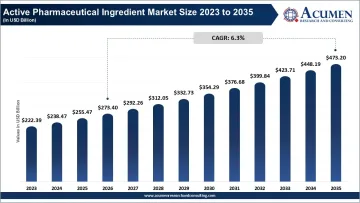
The active pharmaceutical ingredient market size was estimated at $255.47 billion in 2025 and is poised to reach at $473.20 billion by 2035 while growing at a CAGR of 6.3% during the forecast period of 2026-2035. The market is expected to boom with the rising rate of dug approval for novel ingredients from FDA and other regulatory bodies. Additionally, as governments in developing countries start prioritizing local production of therapeutics and associated drugs to lower the overall cost of treatment, the market is expected to witness massive expansion.
Report Highlights
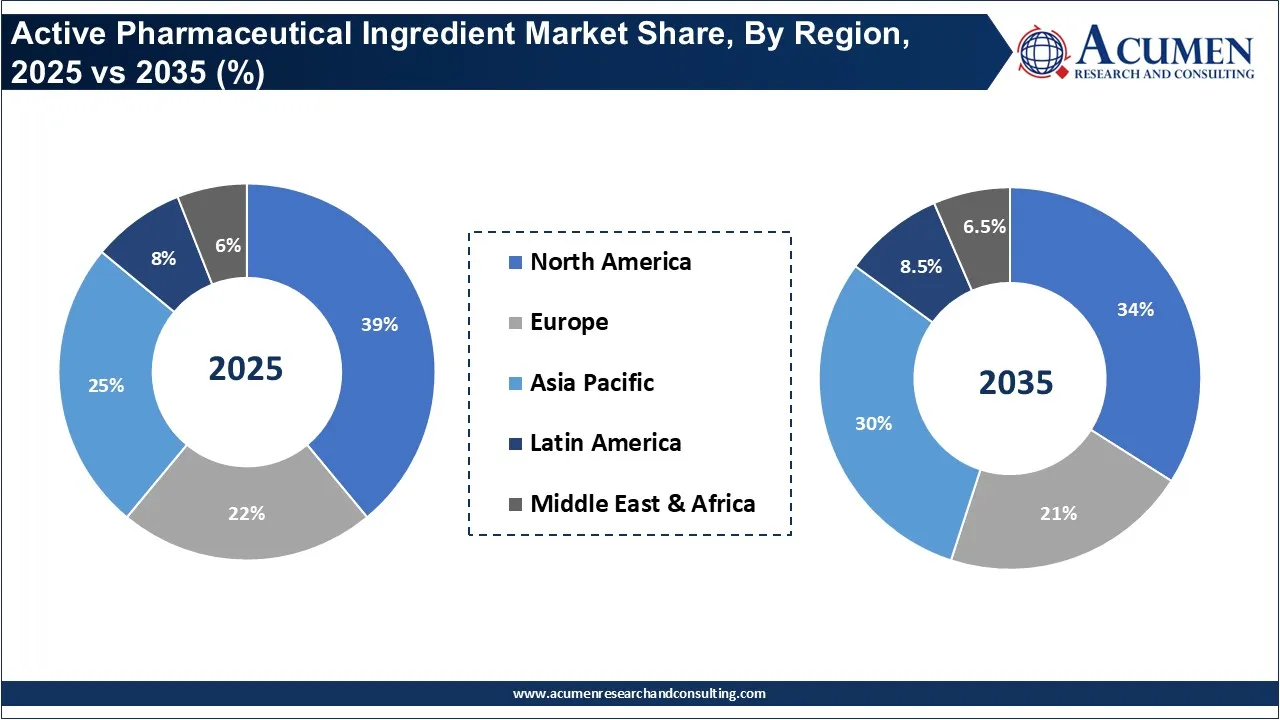
- North America commanded over 39% market share of active pharmaceutical ingredient in 2025 across regions. This can be attributed to the region’s enhanced pharmaceutical innovation capabilities, wide scope of biologics development activities and established regulatory environment catering to the demand for high-value API manufacturing.
- By region, Europe constituted about 22% of market share in 2025. Europe continues to be a dominant region in manufacturing high-purity and specialty API owing to advanced pharmaceutical infrastructure and rising investments in supply chain resilience.
- In 2025, Asia Pacific generated 25% market share in terms of regions and is expected to witness the highest CAGR of 8.5% over the forecast period. This is driven by the growing manufacturing capacity, cost-competitiveness of manufacturing, and rising exports of pharmaceutical products from the region.
- In 2025, the synthetic API segment held the dominant market share of over 74% in terms of type of synthesis. The segment continues to hold the major share due to the widespread use of synthetic API in a diverse array of pharmaceutical products and its established global manufacturing infrastructure.
- In 2025, the biotech API segment generated 26% market share in terms of type of synthesis. The rise in demand for biologics, biosimilars and advanced therapies are driving the adoption of biotechnology based API.
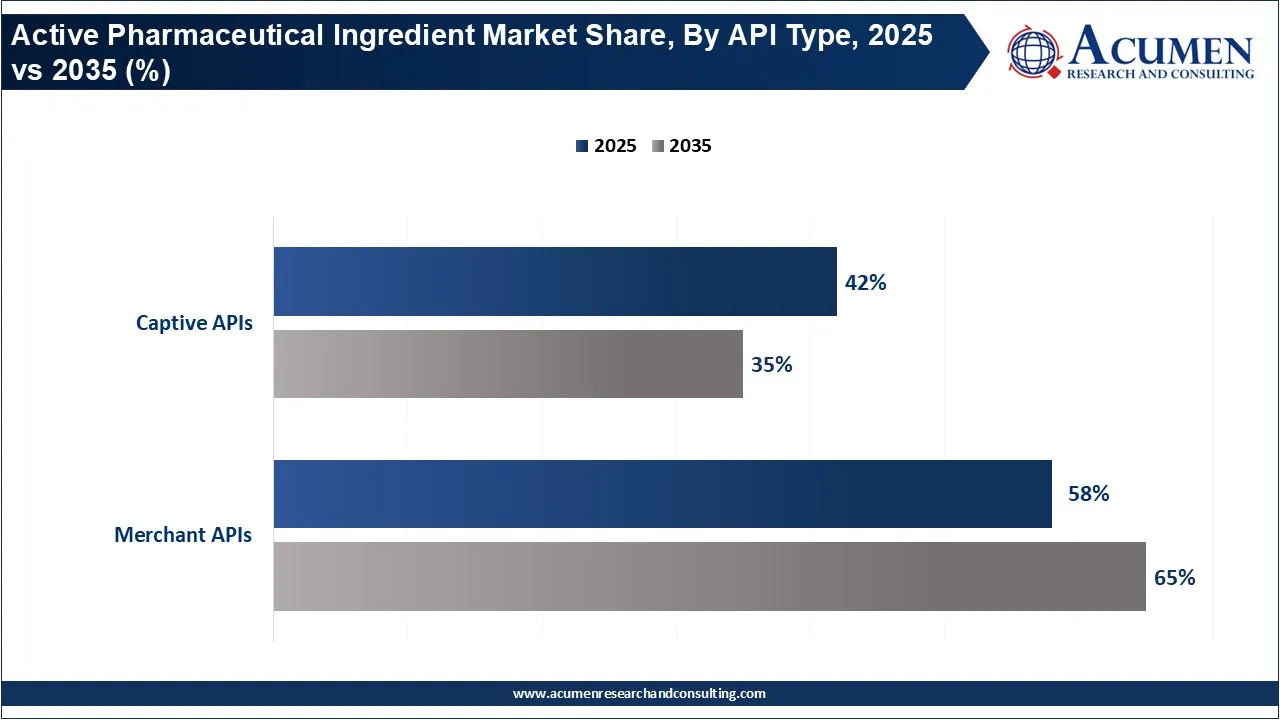
- By type of manufacturer, the merchant API segment led the market in 2025 with 58% market share and is expected to reach 7.6% CAGR over the forecast period. Increased outsourcing among pharmaceutical companies, rising demand for specialty API manufacturers among them will continue to drive market growth for the merchant segment.
- In 2025, the captive API segment held 42% market share in terms of type of manufacturer. Pharmaceutical companies are increasing their investment in the internal manufacturing capabilities of API to improve the quality control and security of the supply chain.
- By type of API, the innovative API segment commanded 66% market share in 2025. The ever-increasing investments in novel drug development and the need for specialty therapeutics are driving the market for innovative API.
- By type of API, the generic API segment held 34% market share in 2025. Growing demand for accessible healthcare with the availability of generic medicines continues to drive steady growth in the generic API market.
- By application, the oncology segment held the largest market share of 24% in 2025. Increased incidence of cancer and advances in targeted therapies are driving the demand for oncology related API across regions.
- In 2025, cardiology segment accounted for the second largest market share of 14% in terms of application. Rising prevalence of cardiovascular diseases and the need for long term treatment for the condition will continue to drive demand for cardiovascular related API.
Regulatory Approval & Compliance Statistics (2025–2026)
- There were 46 FDA approvals in 2025 representing one of the highest approval rates in five years demonstrating continued innovation, particularly within biologics and specialty therapeutics.
- There were 104 EMA recommended medicines in 2025 (38 new active substances demonstrating good conversion of pipeline candidates into approved therapies).
- Combined there were 39 oncology approvals (new or additional indications) by FDA and EMA in Q1 2025 demonstrating strong focus on cancer pipelines globally.
- FDA introduced a new "plausible-mechanism approval pathway" in 2025-2026, facilitating small cohort trials in rare diseases for approval.
Market Dynamics
Driver
Increasing Consumption of APIs with Rising Demand for Specialty Drugs & Biologics
The prevalence of chronic diseases, cancer, autoimmune diseases, and rare diseases are increasing the demand for the latest pharmaceutical treatments, stimulating pharmaceutical manufacturers to increase both innovative and biotech APIs production to develop higher value drugs. The market is witnessing increasing demand of complex active pharmaceutical ingredients owing to the global move towards personalized medicine, biologics & targeted drugs. Significant investment in the R&D of novel molecules by pharmaceutical manufacturers will lead to rise in market of API.
Restraint
Stricter Regulatory Norms and Compliance Difficulties
APIs manufacturing is governed by stringent regulatory norms defined by authorities like the FDA, EMA, PMDA and various other national bodies. The need to comply with GMP norms, quality standards, environmental norms, documentation norms makes it a challenging task to develop and produce APIs, which raises the overall operational complexity and the manufacturing cost.
Regular inspection by these regulatory authorities, the ever changing regulatory guidelines, and extended approval times delay the product commercialization and significantly add to the costs; especially for small and medium sized manufacturers of API. The problems often limit the entry and growth of the new players into the market.
Opportunity
Increase in Outsourcing of API Manufacture to Contract API Manufacturers/Merchant API Producers
The biggest opportunities available for the API market is the outsourcing of the manufacture of APIs to the niche contract API manufacturers/merchant API producers. Pharma companies are directing their efforts toward drug discovery, product development, and commercialization and in the interim outsourcing the manufacturing function to optimize costs and minimize capital costs.
The growing importance of CDMOs is opening up enormous opportunities to the world of API production. Start-ups and biotech firms rely increasingly on the help of external manufacturers for their access to technology and scale.
Regional Insights
Why does North America dominates in the active pharmaceutical ingredient market?
North America led the global API market in 2025 and captured more than 39% of the global revenue share. The region was supported by well-established pharmaceutical innovation and high biologics penetration with high degree of regulatory compliance. The United States alone holds the major share within the North America, it have more than 1500+ FDA registered API manufacturing sites and one of the top consumers of pharmaceuticals R&D, with more than USD 100+ billion spent on healthcare R&D every year.
The region was also one of the top consumers of the imported APIs, The U.S. imports roughly 70-80% of its active pharmaceutical ingredients from India, China, and Europe. Such type of market dynamic signifies the interconnected supply chains on a global scale. An ever-increasing demand for value-added biologics, oncology drugs and specialty therapies fueled strong domestic API innovation with high production of complex molecules and sterile API, supported by innovation in complex API production.
Why europe held significant share in the active pharmaceutical ingredient market?
The Europe held significant share of 22% in 2025 within the global active pharmaceutical ingredient market; it was driven by the strong pharmaceutical industry base and the stringent regulatory regime from European Medicines Agency (EMA). The European region is expected to hold an estimation of 15-18% share of the global API production capacity, with Germany, UK, France, Italy and Switzerland as the prominent players in pharmaceutical manufacturing. The region had expertise in producing the high-purity, complex and specialty APIs such as the oncology, immunology, biosimilars APIs.
“With around 300+ GMP certified API production sites, Germany stands as a mature market with high industrial maturity in the European region. Additionally, Europe has started to focus on pharmaceutical reshoring and supply chain robustness, by planning more than 30-40+ new API manufacturing sites between 2023-2025 and aiming to reduce the dependency on the imports from Asia.”
Why is Asia Pacific estimated to witness the highest CAGR in the active pharmaceutical ingredient market?
Asia-Pacific held 25% share in 2025 and is estimated to witness the highest CAGR of 8.5% during the forecast period. It was backed by rapid expansion of manufacturing capacity, cost-efficient production systems and the governmental focus and support for the pharmaceutical industry. The region constitutes more than 45% of the global API production volume and was known as the world's leading manufacturing base for API production. The upstream production of API intermediates and key starting materials is dominated by China which is contributing around 40-45% of the global market with more than 200+ large-scale chemical and pharmaceutical industrial clusters.
However, the India is the global leader for the generic API exports, and it was a supplier to 20%+ global generic API demand, it has more than 700 API manufacturing plants operating within regulated and semi-regulated markets across the globe.
Segmental Insights
Type of Synthesis Insights
In 2025, synthetic API segment occupied largest share of approximately 74% in global market and this dominance is due to its well established chemical manufacturing process, cost efficiency and large scale of production on regulated and semi-regulated market segments. Synthetic APIs are forming backbone for worldwide pharmaceutical production owing to easy availability of raw materials and mature production technologies and being widely utilized in the manufacturing of generic medicines in therapeutic segments of chronic diseases such as cardiovascular, diabetes and pain management drugs.
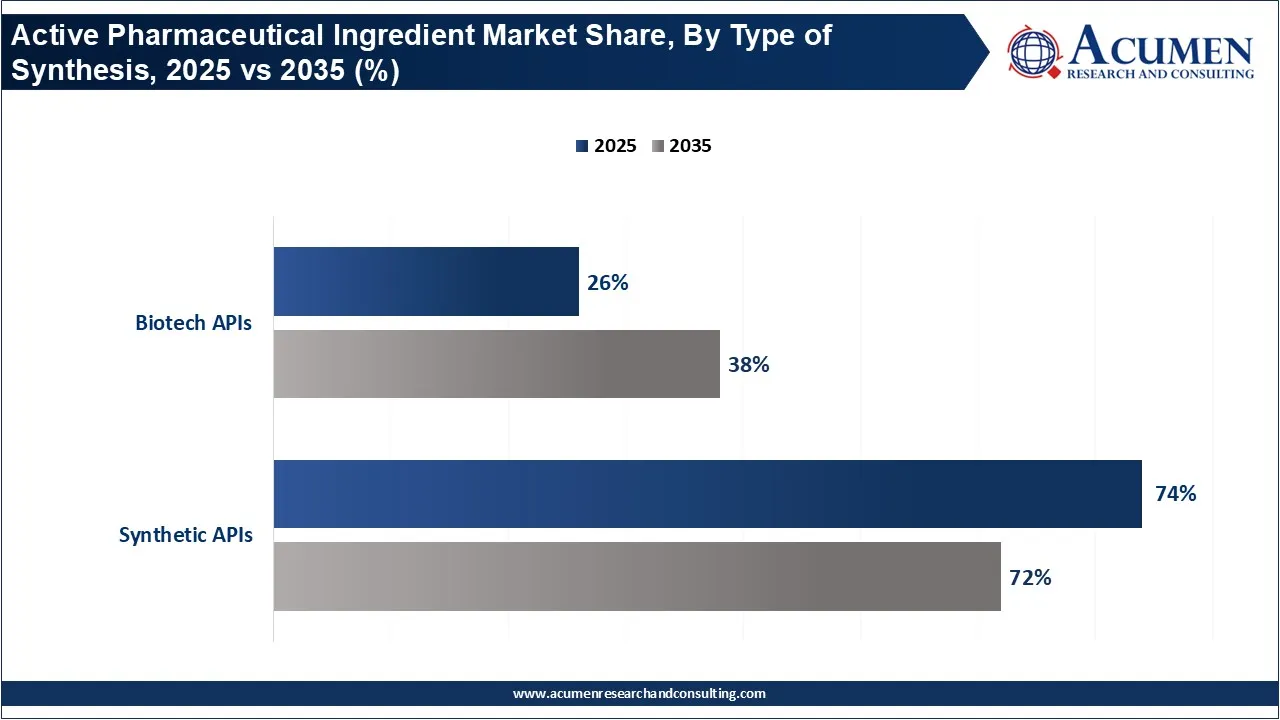
However, biotech API segment held 26% of market share, attributed to expansion of biologics, monoclonal antibody therapies and personalized medicines and rise in R&D of innovative biologics particularly in oncology and auto-immune diseases therapy and high demand for recombinant proteins and vaccines-based API.
Type of Manufacturer Insights
The merchant API segment held 58% of share while dominating and maintaining its critical role at CAGR of 7.6% in global market due to significant utilization of CDMOs by smaller and mid-sized pharmaceutical firms. Merchant API manufacturers offer cost effective and specialized solutions at desired scale, this benefit is being used by manufacturers of generic drugs and emerging biopharmaceutical organizations.
Captive API segment held 42% share in 2025 an is expected to grow considerably in the global market, due to pharmaceutical giants increasingly engaging in backward integration in the manufacturing of API so as to ensure the supply chain integrity, independence from third-party vendors and tighter control over regulatory compliance. Larger pharmaceutical organizations are investing in the in-house facilities of API production, in order to establish the control over quality and to protect Intellectual Property and risks associated with global supply chain.
Type of API Insights
In 2025, innovative API segment accounted for 66% market share in 2025 due to increasing investment of pharma companies in R&D, expanding demand for novel drug therapies, and supportive regulatory incentives for NME (new molecular entity) development. The trend in innovative API segment is dominated by increasing development of biologics, oncology and orphan drugs and specialty therapies where high value molecules require extensive manufacturing processes.
However, generic API segment held 34% share in 2025 and is also expected to have stable growth over the forecast period attributed to growing patent expiries, increased demand for affordable medications and widening accessibility to healthcare in the developing regions. Generic API manufacturers are serving large market in low-cost geography segments such as Asia-Pacific, Latin America and Africa, where government and healthcare organizations prioritize low-cost treatment.
Application Insights
Oncology segment held the largest share of 24% in the market for year 2025 owing to growing prevalence of cancer across the globe and increasing preference towards targeted drugs and rapid advancement in biologics and immunotherapy drugs and growing demand for monoclonal antibody, ADC (antibody-drug conjugate), and precision oncology treatment are demanding for highly specialized API in massive quantities.
API Market Revenue Share, By Application, 2025 (%)
| Application | Revenue Share, 2025 (%) |
|---|---|
| Cardiology | 14% |
| Orthopedic | 8% |
| Oncology | 24% |
| Endocrinology | 11% |
| Pulmonology | 9% |
| Gastroenterology | 7% |
| CNS & Neurology | 12% |
| Nephrology | 6% |
| Ophthalmology | 5% |
| Others | 4% |
On the other hand, cardiology segment held the second largest share of 14% in 2025 attributed to widespread occurrence of diseases worldwide especially of hypertension, diabetes, and thyroid disorders. Endocrinology APIs includes widely used drugs such as levothyroxine and insulin analogues and these drugs are seeing steady growth due to increase in metabolic disorder patients across the globe.
Key Companies
- AbbVie Inc.
- Merck & Co., Inc.
- Boehringer Ingelheim International GmbH
- Teva Pharmaceutical Industries Ltd.
- Cipla, Inc.
- Albemarle Corporation
- Bristol-Myers Squibb Company
- Sun Pharmaceutical Industries Ltd.
- Mylan N.V.
- Aurobindo Pharma
- Dr. Reddy’s Laboratories Ltd.
Recent News
- In April 2026, Warsaw announced the launch of a hybrid hub to reduce Europe’s reliance on Asian drugs and its supply. This hub aims to critically challenge Asian dominance, by opening an API manufacturing technology center in Poland.
- In March 2026, Hetero announced the export launch of semaglutide portfolio, by marking a significant step in expansion of GLP-1 therapies. This generic portfolio will focus on the treatment of type 2 diabetes and obesity. The announcement carried a strategic, multi-year rollout across more than 75 countries.
Market Segmentation
By Type of Synthesis
- Biotech APIs
- Monoclonal Antibodies
- Recombinant Proteins
- Vaccines
- Synthetic APIs
By Type of Manufacturer
- Captive APIs
- Merchant APIs
By Type
- Innovative APIs
- Generic APIs
By Application
- Cardiology
- Orthopedic
- Oncology
- Endocrinology
- Pulmonology
- Gastroenterology
- CNS & Neurology
- Nephrology
- Ophthalmology
- Others
By Region
- North America
- Europe
- Asia-Pacific
- LAMEA
Looking for discounts, bulk pricing, or custom solutions? Contact us today at sales@acumenresearchandconsulting.com
Frequently Asked Questions

Other Healthcare and Pharmaceuticals Reports
February 2020
March 2025
January 2020
December 2023