
Centrifugal Hydrogen Compressor Market Size, Share, Growth, Report 2026 to 2035
Centrifugal Hydrogen Compressor Market (By Compressor Configuration: Single-stage, Multi-stage; By Pressure Range: Low-pressure Compressors (<100 bar), Medium-pressure Compressors (100-350 bar), High-pressure Compressors (>350 bar); By Cooling Method: Air-cooled Compressors, Water-cooled Compressors; By Application: Hydrogen Production, Hydrogen Transportation & Pipeline Compression, Hydrogen Storage, Hydrogen Refuelling Stations, Industrial Hydrogen Processing; By End-use Industry: Oil & Gas, Chemical & Petrochemicals, Power Generation, Transportation & Mobility, Industrial Manufacturing, Metal & Mining, Renewable Energy & Green Hydrogen, Aerospace & Defense, Others) - Global Industry Analysis, Size, Share, Regional Analysis, Trends and Forecast 2026 - 2035
- Last Updated: 08 Jun 2026
- Report Code: ARC3935
- Category: Energy and Power
Centrifugal Hydrogen Compressor Market Size, Forecast 2026 to 2035
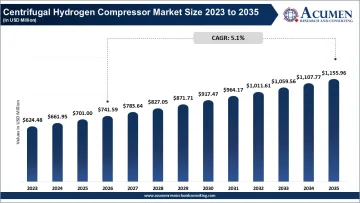
The global centrifugal hydrogen compressor market size was valued at USD 701.00 million in 2025 and is estimated to surpass around USD 1,155.96 million by 2035 growing at a CAGR of 5.1% from 2026 to 2035. Rising deployment of fuel cell vehicles, expansion of hydrogen pipeline networks, and increasing investments in large-scale hydrogen hubs are expected to support sustained market growth throughout the forecast period. Technological advancements aimed at improving compressor efficiency, reliability, safety, and energy consumption are further enhancing the adoption of centrifugal hydrogen compressors across industrial and energy sectors.
Report Highlights
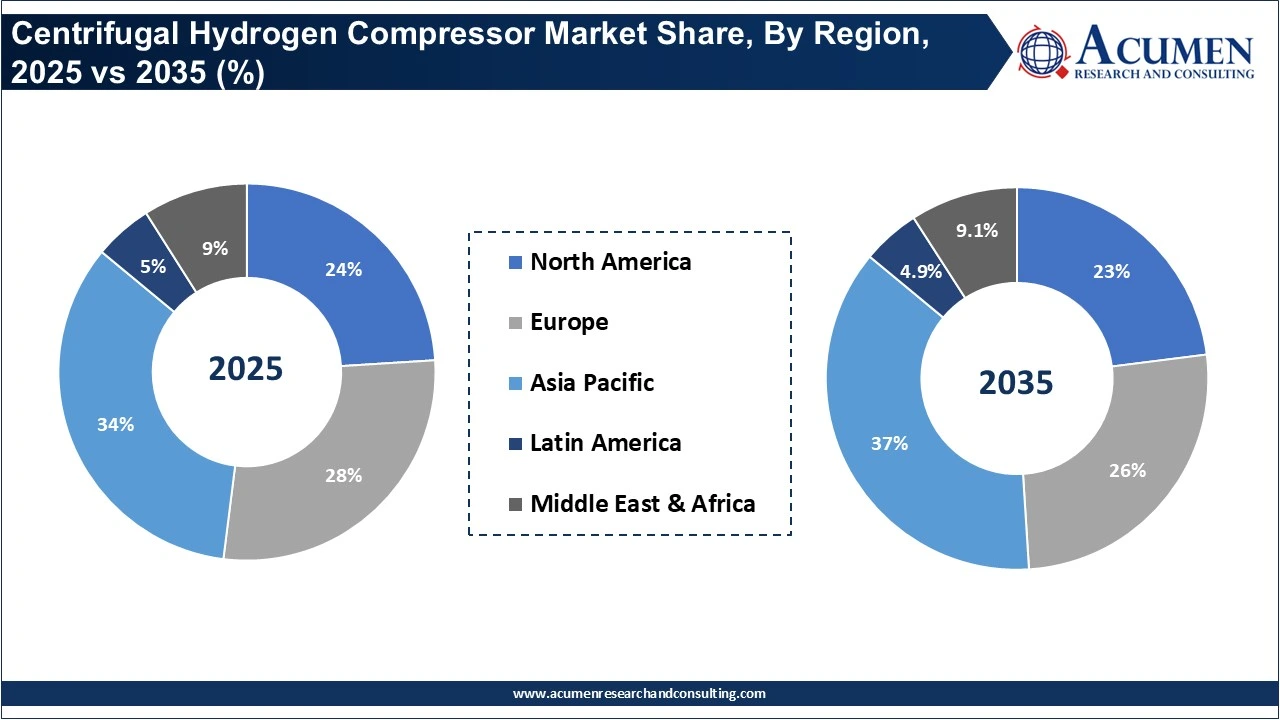
- By region, Asia Pacific dominated the hydrogen compressor market with 34% market share in 2025 and is anticipated to register the highest CAGR of 6.0%, as the governments and private players are investing heavily in the hydrogen economy and the industrial hydrogen infrastructure.
- By region, Europe held the second largest market share of 28% in 2025 due to robust government policies, government mandated clean energy goals and the massive green hydrogen projects planned in the region.
- By region, Middle East and Africa region is expected to grow at a CAGR of 5.2% owing to investments in green hydrogen production and export projects.
- By compressor configuration, the multi stage centrifugal compressors segment was the largest in 2025 with 72% market share due to the efficiency of reaching higher pressures for bulk production, storage & transportation of hydrogen.
- By compressor configuration, the single stage centrifugal compressors segment was the second largest share with 28% market share in 2025 due to their cost-effectiveness and suitable for medium-pressure industrial operations of hydrogen.
- By pressure range, the medium pressure compressors (100-350 bar) led the market with 46% market share in 2025 as it represents the best trade-off between compression efficiency, transportation needs and industrial processing requirements.
- By pressure range, the high pressure compressors (>350 bar) is predicted to experience highest CAGR of 7.0%, owing to increasing deployment of hydrogen refueling stations, fuel cell vehicles and high-pressure storage infrastructure.
- By cooling method, the water-cooled compressors occupied the largest market share of 68% in 2025 as they provide better thermal management and are highly reliable for industrial applications and continuous operations of hydrogen compression.
- By cooling method, air-cooled compressors accounted for the second largest market share of 32% in 2025 as they have relatively lower operational cost and are ideal for decentralized applications.
- By application, the industrial hydrogen processing dominated the market with 32% market share in 2025 due to extensive consumption of hydrogen in oil and gas refining, ammonia and chemical industries.
- By application, the hydrogen transportation and pipeline compression held the second largest market share with 24% in 2025 as expanding hydrogen distribution networks demand robust compression systems to maintain pressure and flow rates.
- By end-use industry, the chemical & petrochemicals occupied the leading market position with 30% market share in 2025 as hydrogen is an indispensable raw material for ammonia, methanol.
- By end-use industry, the oil & gas sector had the second largest share with 24% in 2025 as a variety of operations in the sector require hydrogen like hydroprocessing, fuel desulfurization.
Market Overview
The global centrifugal hydrogen compressor market is growing rapidly due to accelerating pace of hydrogen economy, rising investment in green hydrogen projects and increasing adoption of hydrogen as a low carbon energy carrier. The centrifugal hydrogen compressors are essential in hydrogen production, transportation, storage and application processes, they are applied to compress hydrogen gas at a wide range of pressure conditions, being widely adopted in oil refineries, chemical and petrochemical plants, hydrogen refueling station, industrial gas facilities and renewable energy projects.
Moreover, increase in adoption of fuel cell vehicles, build up of hydrogen pipelines and growing investment in large hydrogen hubs will also be a driver for continued market expansion over the forecast period. Also, advancements in technology towards increasing compressor efficiency, reliability, safety, and energy usage of centrifugal hydrogen compressors is driving the market growth.
Government Initiatives Supporting Hydrogen Compression
| Country | Initiative | Impact on Hydrogen Compressor Demand |
|---|---|---|
| China | Hydrogen Industry Development Plan (2021–2035) | Supports hydrogen production, transportation, storage, and fueling infrastructure expansion. |
| Japan | Basic Hydrogen Strategy | Promotes hydrogen imports, fuel-cell vehicles, and hydrogen supply chain development. |
| South Korea | Hydrogen Economy Roadmap | Targets large-scale deployment of hydrogen vehicles and fueling stations. |
| India | National Green Hydrogen Mission | Supports domestic hydrogen production capacity and infrastructure development. |
| United States | Regional Clean Hydrogen Hubs Program | Accelerates hydrogen production, storage, transportation, and industrial deployment projects. |
| Germany | National Hydrogen Strategy | Funds hydrogen pipelines, industrial decarbonization, and green hydrogen infrastructure. |
| Netherlands | Dutch Hydrogen Backbone Program | Develops national hydrogen transportation pipeline networks. |
| France | France Hydrogen Plan | Supports electrolyzer deployment and industrial hydrogen projects. |
| Saudi Arabia | Vision 2030 Hydrogen Initiatives | Encourages large-scale green hydrogen and ammonia production projects. |
| UAE | National Hydrogen Strategy 2050 | Expands hydrogen production, export infrastructure, and industrial hydrogen applications. |
Market Dynamics
Driver
Rapid Expansion of Hydrogen Infrastructure and Green Hydrogen Projects
The growing expansion of hydrogen infrastructure across the globe is the main driving force of the centrifugal hydrogen compressor market. Billions are being invested by both governments and private players in the development of hydrogen production plants, hydrogen hubs, hydrogen pipeline networks, hydrogen storage stations, and hydrogen fueling stations to support the global energy transition efforts.
Large scale green hydrogen projects are being developed using renewable energy resources and these require highly advanced multi-stage centrifugal compressors capable of managing huge amounts of hydrogen volumes throughout the hydrogen value chain.
Restraint
High Capital Costs and Technical Challenges Associated with Hydrogen Compression
The market is facing certain restraints such as high initial capital cost associated with hydrogen compression infrastructure development and the complexity involved in handling hydrogen gas. Hydrogen molecule are smaller than natural gas molecules, leading to a higher chance of leakages, materials degradation, and hydrogen embrittlement in compressor parts.
Manufacturers have to use special materials, advanced sealing mechanisms and sophisticated engineering designs in developing centrifugal hydrogen compressors and this raises the overall equipment cost. The energy intensive nature of hydrogen compression also leads to higher operational costs, limiting the capacity to be adopted in small hydrogen projects, increasing overall project costs for infrastructure development.
Opportunity
Growing Hydrogen Mobility and Long-Distance Hydrogen Transportation Networks
The speedy development of hydrogen-powered transport, together with long-distance distribution of hydrogen creates a huge opportunity for centrifugal hydrogen compressor market. Governments around Asia, Europe, North America, and the Middle East are pouring investment in setting up hydrogen refueling stations, in the production and sales of fuel cell vehicles, hydrogen trucking routes and in cross-border hydrogen pipelines.
Fuel cell buses, trucks, trains and industrial vehicles require high-pressure hydrogen infrastructure, which relies heavily on an advanced centrifugal hydrogen compressor system. In addition, the opening up of the export of hydrogen through various ports and international trade routes is also adding to the huge demand of infrastructure for transport and storing hydrogen. With the expansion of hydrogen usage to other new areas other than industrial uses, centrifugal hydrogen compressors are going to be a vital component in moving hydrogen around.
Regional Analysis
Asian Countries to Boom by 2035; Hydrogen Economy Initiatives to Support Dominance
Asia Pacific accounted for the largest share of the centrifugal hydrogen compressor market in 2025 at 34% share and is expected to witness the fastest CAGR of 6.0% during the forecast period. Increasing investments across hydrogen, rapidly decreasing decarbonization targets, growing demand for industrial hydrogen, and government support to hydrogen economy initiatives drive growth in the region.
Asia Pacific Centrifugal Hydrogen Compressor Market Drivers
- Massive investments in hydrogen production, storage, transportation, and mobility infrastructure are underway across China, Japan, South Korea, and India.
- China has launched many hydrogen city clusters and continuously increasing the usage of fuel-cell vehicles while Japan and South Korea continue to accelerate hydrogen mobility and energy transition initiatives.
- The growing number of green hydrogen projects and ongoing industrial decarbonization efforts would maintain a high demand for hydrogen compression technologies across the region.
Europe to Remain Second-Largest Shareholder
Europe held the second largest market share at 28% in 2025 owing to stringent climate targets, stringent policy support for hydrogen development and substantial investment in renewable hydrogen infrastructure. European Union's Hydrogen Strategy and REPowerEU have spurred the development of massive hydrogen production, storage, and transportation infrastructure across the continent.
Germany, Netherlands, France, and Spain are some of the countries actively developing hydrogen corridors, green hydrogen production facilities, and undertaking industrial decarbonization projects. The rise in the deployment of hydrogen refueling stations, hydrogen pipeline networks, and the adoption of hydrogen for industrial processes continues to fuel the demand for centrifugal hydrogen compressors across Europe.
Middle East and Africa to Grow Rapidly Due to Rising Exports
The Middle East and Africa region is expected to grow at a CAGR of 5.2% during the forecast period fueled by large-scale green hydrogen projects, favorable renewable energy resources, and increasing export of hydrogen. Countries such as Saudi Arabia, United Arab Emirates, Oman, and Egypt are pouring substantial investments into the development of hydrogen production infrastructure to emerge as future global exporters of hydrogen.
Large-scale green ammonia and renewable hydrogen production mega-projects are in the offing, generating a significant demand for the application of advanced hydrogen compression technologies. The region's strategic focus toward energy diversification and industrial decarbonization would ensure sustained long-term growth.
Segmental Analysis
Compressor Type Insights
In the centrifugal hydrogen compressor market, multi stage centrifugal compressors captured a major share of 72% in the market in 2025 and are majorly used across large scale hydrogen plants, hydrogen pipeline, storage terminals and industrial plants. Multi stage compressors are the most adopted choice for large scale hydrogen production, hydrogen pipelines, hydrogen storage terminals and in large scale industrial facilities for a higher compression and operational efficiency along with the required reliability.
Many of hydrogen applications require multi stages of compression for carrying the hydrogen and storing it safely at a higher pressure value thus making them best fit for industrial application. The deployment of green hydrogen projects, ammonia plants and hydrogen exports further boost the demand for multi stage compressors.
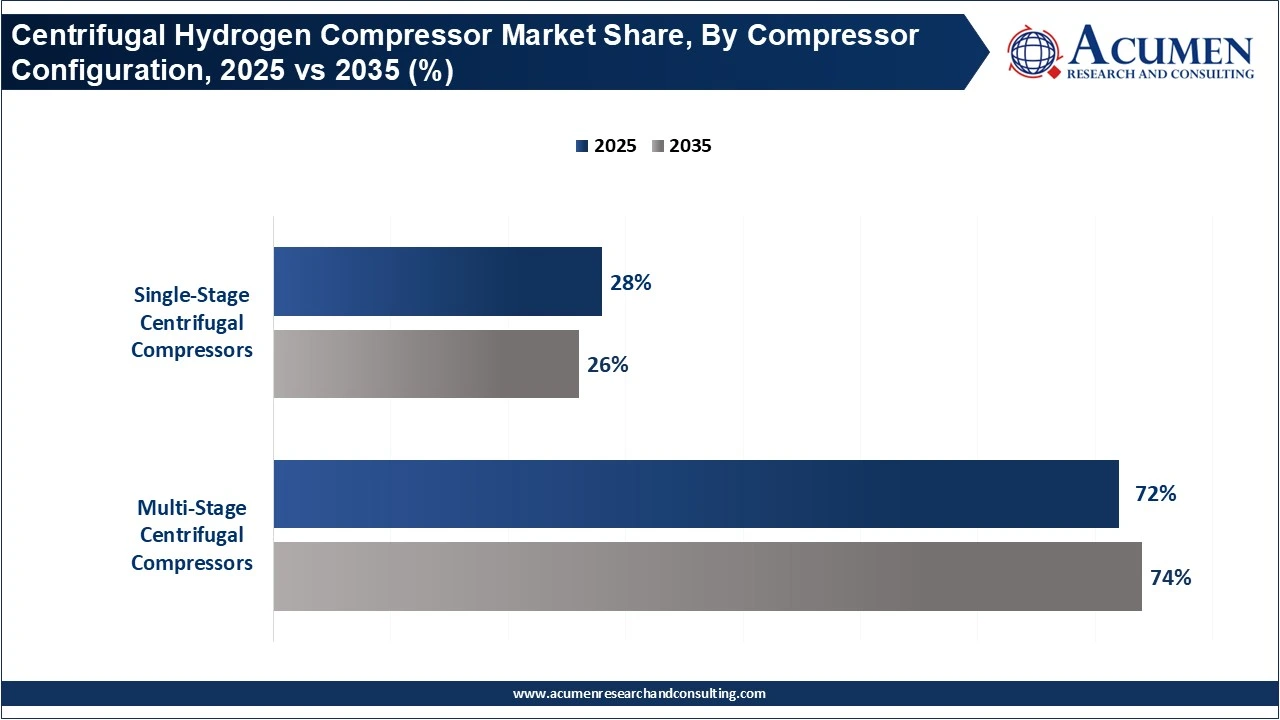
Single stage centrifugal compressors accounted for the second largest segment at 28% in 2025. They were used widely across low-pressure hydrogen applications and for low scale industrial applications. Common applications include hydrogen production plants, chemical processing plants and industrial gas applications where modest compression needs are to be met.
The simpler designs, low maintenance needs and lower cost operation make them a suitable choice for those hydrogen applications that do not need a very high discharge pressure. Increasing number of deployments of distributed hydrogen generation systems and local industrial hydrogen systems is driving demand for single stage centrifugal compressors.
Pressure Range
Medium-pressure compressors commanded a dominant share in the hydrogen compressor market by accounting for 46% of the revenue share in 2025, owing to their wide use in hydrogen transportation, storage, refining, petro chemicals, and handling of industrial hydrogen. This pressure range is ideal for balancing the operational efficiency, transportational need and safety of wide variety of hydrogen infrastructure projects. Hydrogen pipeline systems, industrial processing plants, and hydrogen storage applications typically fall in this pressure range. The increasing demand of hydrogen in various energy, chemical and manufacturing sectors is driving the requirement of medium-pressure compressors for the supply chain.
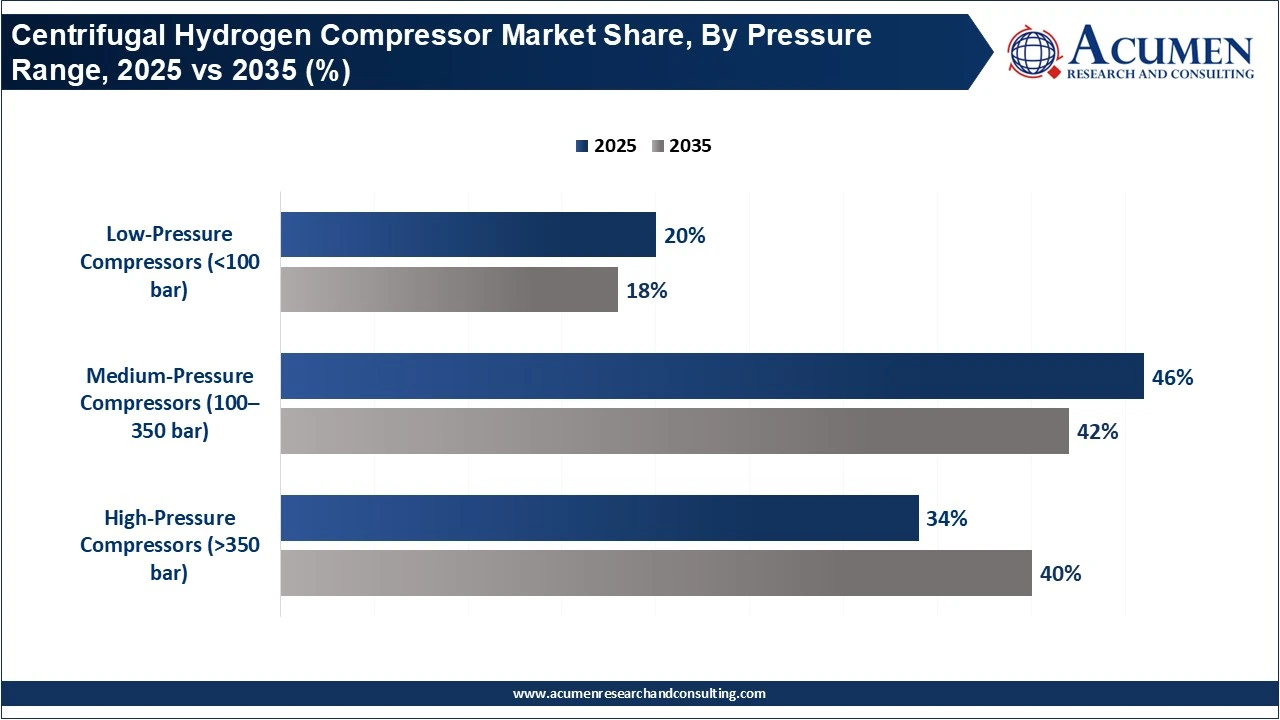
High-pressure compressors segment is projected to register the highest CAGR of 7.0% from 2026 to 2035, owing to their increased use in hydrogen refueling stations, fuel-cell mobility infrastructure and long-term hydrogen storage. Fuel-cell electric vehicles demand hydrogen to be stored at pressures ranging from 350 bar to 700 bar and therefore have an increased demand of high-pressure compression technologies.
“Japan, South Korea, Germany, China and the United States are heavily investing on high-pressure hydrogen infrastructure due to the expansion of hydrogen mobility project in the region. The rise in demand for green hydrogen and hydrogen export terminals is also a driving factor for the growth of this segment.”
Cooling Method Insights
The water-cooled compressors segment held the largest share of the centrifugal hydrogen compressor market at 68% in 2025, due to their improved thermal management and operational stability, especially at the large industrial scale where the compressors are in continuous operation under intensive conditions. Heat generated during the operation of the hydrogen compressors and high-efficiency cooling is imperative to the operational stability and reliability of the equipment.
Compared to the air-cooled compressor, the water-cooled compressor offers greater cooling efficiency and finds widespread application in hydrogen production plants, chemical processing plants, refineries, and large-scale hydrogen pipelines. The constant increase in industrial hydrogen infrastructure development globally contributes to the sustained demand of water-cooled compressor systems.
Centrifugal Hydrogen Compressor Market Revenue Share, By Cooling Method, 2025 (%)
| Cooling Method | Revenue Share, 2025 (%) |
|---|---|
| Air-Cooled Compressors | 32% |
| Water-Cooled Compressors | 68% |
The air-cooled compressors had the second-largest market share at 32% in 2025 due to their lower installation costs, lower water consumption requirements and appropriate for use at distributed hydrogen sites. They are widely employed at the remote sites, refueling stations and small-scale industries where the availability of water is limited. The ongoing growth of the distributed hydrogen production facilities and portable hydrogen systems is anticipated to further drive the adoption of air-cooled compression technologies.
Application Insights
Industrial hydrogen processing segment held a substantial share of 32% in 2025, driven by widespread utilization across refining, ammonia manufacturing, methanol production, petrochemicals and special chemical processes. These industrial plants need continuous operation of hydrogen compressor systems for effective process operation, material transfer, and storage.
Globally, industrial sector accounts for the largest consumption share of hydrogen by application, while refining and ammonia processes are the largest end use applications according to global energy studies. Furthermore, the push towards a low carbon future in industrial processes and the increasing deployment of green hydrogen are projected to boost demand of compressors in this segment.
Centrifugal Hydrogen Compressor Market Revenue Share, By Application, 2025 (%)
| Application | Revenue Share, 2025 (%) |
|---|---|
| Hydrogen Production | 20% |
| Hydrogen Transportation & Pipeline Compression | 24% |
| Hydrogen Storage | 12% |
| Hydrogen Refueling Stations | 12% |
| Industrial Hydrogen Processing | 32% |
Hydrogen transportation and pipeline compression represented the second-largest segment by share of 24% in 2025, largely due to mounting investments in hydrogen transport infrastructure and long-distance delivery systems. Hydrogen compressors are crucial in maintaining the flow rate and consistent pressure throughout the distribution pipelines.
Countries such as the U.S., Germany, Japan, China and the Netherlands are making huge investments to develop a hydrogen economy, building hydrogen transportation pipelines to support the new market. The increasing number of cross-border transport pipelines and hydrogen corridors are expected to drive the demand of centrifugal hydrogen compressors in the coming years.
End-use Industry Insights
The chemical & petrochemical end-use segment captured the largest market share of 30% in 2025 owing to the increasing consumption of hydrogen as a key input in ammonia production, methanol manufacturing, hydrocracking, hydrodesulfurization, and a plethora of other chemical manufacturing processes. The industrial input of hydrogen remains vital for the chemical industry globally, thereby creating constant demand for efficient compression units.
The trend towards green chemicals and sustainable ammonia production has fueled investment in green hydrogen projects across the world, and with the ongoing global push towards industrial decarbonization, we anticipate tremendous growth in hydrogen compressor installation within the chemical & petrochemical end-use industry.
Centrifugal Hydrogen Compressor Market Revenue Share, By End Use Industry, 2025 (%)
| End Use Industry | Revenue Share, 2025 (%) |
|---|---|
| Oil & Gas | 24% |
| Chemicals & Petrochemicals | 30% |
| Power Generation | 8% |
| Transportation & Mobility | 9% |
| Industrial Manufacturing | 7% |
| Metals & Mining | 5% |
| Renewable Energy & Green Hydrogen | 10% |
| Aerospace & Defense | 3% |
| Others | 4% |
The oil & gas end-use industry segment accounted for the second-largest market share of 24% in 2025 and this was largely due to its high application for hydrogen as an industrial input in refining, hydroprocessing, and fuel desulfurization processes. The production of clean fuels used for transportation and adherence to the rigid sulfur regulations require sufficient amount of hydrogen.
Most refineries are integrating the application of low-carbon hydrogen into their production processes as they shift toward sustainability, and ongoing upgrade of refinery facilities along with blue hydrogen projects will continue to open new growth opportunities for centrifugal hydrogen compressor manufacturing companies.
Top Companies
- Atlas Copco
- Siemens Energy
- Mitsubishi Heavy Industries
- Howden
- Burckhardt Compression
- MAN Energy Solutions
- Baker Hughes
- Ingersoll Rand
- Sundyne
- NEUMAN & ESSER
- Ebara Corporation
Recent News
- April 2026 – Garrett Motion Inc. (Nasdaq: GTX), a leader in differentiated turbocharging and electrification, is presenting its oil-free centrifugal compressors for data centers, battery energy storage systems (BESS) and broader industrial and commercial cooling applications, April 8-10 at the China Refrigeration Expo 2026.
- March 2026- Kawasaki Heavy Industries Ltd announced it has constructed a facility to demonstrate centrifugal hydrogen compressor for hydrogen liquefaction plants at Harima Works using 100% pure hydrogen gas,
Market Segmentation
By Compressor Configuration
- Single-stage Centrifugal Compressor
- Multi-stage Centrifugal Compressor
By Pressure Range
- Low-pressure Compressors (<100 bar)
- Medium-pressure Compressors (100-350 bar)
- High-pressure Compressors (>350 bar)
By Cooling Method
- Air-cooled Compressors
- Water-cooled Compressors
By Application
- Hydrogen Production
- Hydrogen Transportation & Pipeline Compression
- Hydrogen Storage
- Hydrogen Refuelling Stations
- Industrial Hydrogen Processing
By End-use Industry
- Oil & Gas
- Chemical & Petrochemicals
- Power Generation
- Transportation & Mobility
- Industrial Manufacturing
- Metal & Mining
- Renewable Energy & Green Hydrogen
- Aerospace & Defense
- Others (Includes research and specialty processing and emerging industrial applications)
By Region
- North America
- Asia Pacific
- Europe
- Latin America
- Middle East & Africa
Looking for discounts, bulk pricing, or custom solutions? Contact us today at sales@acumenresearchandconsulting.com
Frequently Asked Questions

Other Energy and Power Reports
March 2023
May 2024
November 2022
April 2025