
Electric Truck Charging Station Market Size, Share, Report 2026 To 2035
Electric Truck Charging Station Market (By Vehicle Category: Light-Duty Electric Trucks, Medium-Duty Electric Trucks, Heavy-Duty Electric Trucks; By Charger Technology: AC Charging, DC Fast Charging, High-Power DC Charging, Megawatt Charging System; By Deployment Type: Fleet Depot Charging, Public Truck Charging Hubs, Highway Corridor Charging, Distribution Center Charging, Opportunity Charging; By End User: Logistics & Freight, Retail & E-commerce, Municipal Fleets, Industrial, Fleet Operators) - Global Industry Analysis, Size, Share, Growth, Trends, Regional Analysis And Forecast 2026 To 2035
- Last Updated: 21 Jul 2026
- Report Code: ARC3954
- Category: Automotive And Transportation
Electric Truck Charging Station Market Size, Forecast 2026 To 2035
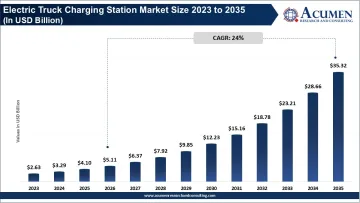
The global electric truck charging station market size was valued at USD 4.10 billion in 2025, it is expected to reach at USD 35.32 billion by 2035. The market is seen to grow at a CAGR of 24.0% during the forecast period of 2026-2035. Favorable government policies, financial incentives, and investments in zero-emission freight corridors are accelerating the deployment of electric truck charging stations. Regulatory initiatives promoting commercial vehicle electrification and public-private partnerships continue to strengthen market growth.
Report Highlights
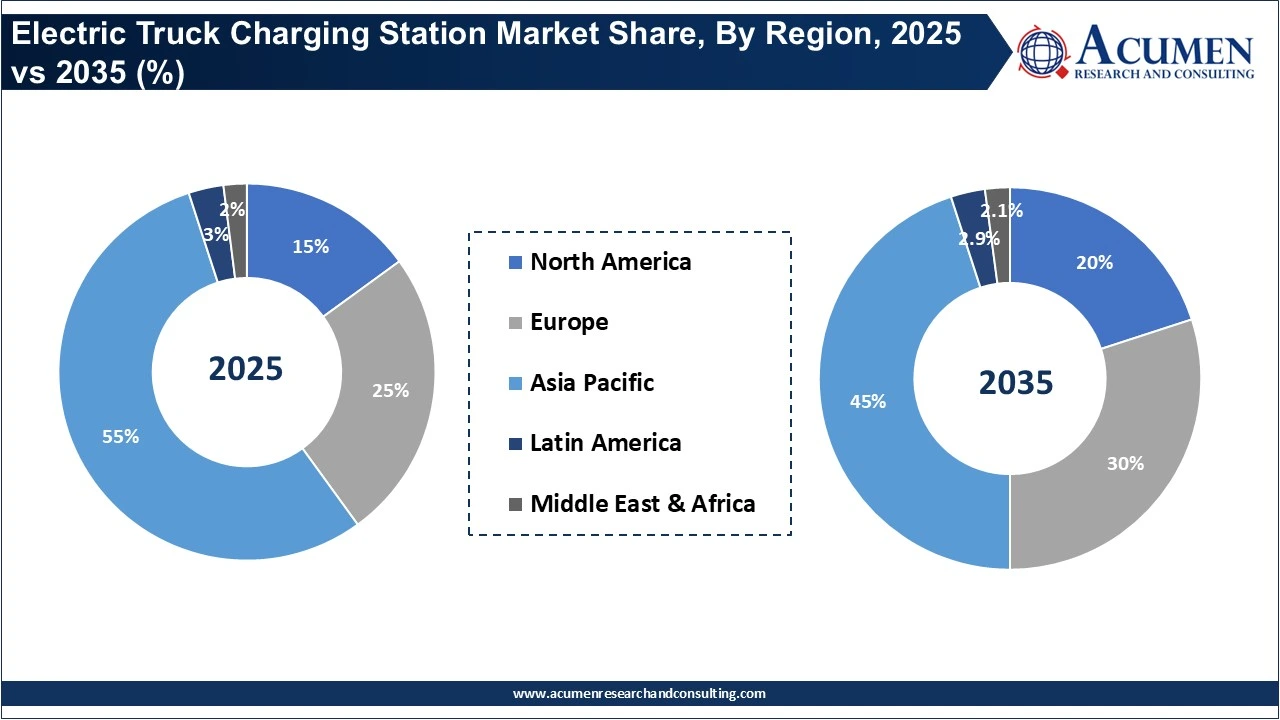
- By region, Asia Pacific dominated the market with the largest share of 55% in 2025 owing to its well-established electric commercial vehicle ecosystem, expanding charging infrastructure, and strong battery manufacturing capabilities.
- By region, North America is expected to expand at the fastest CAGR of 28.0% between 2026 and 2035 due to rising investments in high-power charging corridors, megawatt charging systems, and heavy-duty fleet electrification.
- By vehicle category, the light-duty electric trucks segment dominated the market with the largest share of 36% in 2025 due to the early adoption of electric commercial vehicles for urban logistics, last-mile delivery, and municipal transportation.
- By vehicle category, the heavy-duty electric trucks segment is expected to witness the fastest growth during the forecast period, which also held 30% share in 2025; owing to increasing electrification of long-haul freight fleets and rising deployment of megawatt charging infrastructure.
- By charger technology, the DC fast charging segment accounted for the largest market share of 40% in 2025 because it provides faster charging while supporting the operational requirements of commercial truck fleets.
- By charger technology, the Megawatt Charging System (MCS) segment is projected to grow at the fastest rate through 2035 as demand rises for ultra-fast charging solutions for heavy-duty electric trucks.
- By deployment type, the fleet depot charging segment held the largest share of 55% in 2025 owing to the widespread use of centralized overnight charging for commercial fleets operating on fixed routes.
- By deployment type, the highway corridor charging segment is anticipated to register the fastest CAGR of 37.2% from 2026 to 2035 driven by growing investments in charging infrastructure for long-haul electric freight transportation.
- By end user, the logistics & freight segment captured the largest market share of 40% in 2025 due to rapid electrification of freight transportation, parcel delivery, and third-party logistics fleets.
- By end user, the retail & e-commerce segment accounted for the second-largest share of 20% in 2025 supported by the increasing deployment of electric vehicles for last-mile and regional delivery operations.
How Is the Electric Truck Charging Station Market Evolving?
The electric truck charging station market is described as the market for the development, installation, operation, and maintenance of charging infrastructure used to power battery electric trucks (BETs) in commercial freight transport. This includes public charging networks, private charging depots, fleet charging centers, highway corridor charging points, and smart charging services linked to energy management systems.
The market is being transformed by efforts by commercial fleet operators, logistics service providers and governments to increase the deployment of zero-emission freight transport systems. This increased use of electric trucks is leading to investments in high-power charging infrastructure to provide the necessary power for long-distance transport operations and minimize truck downtimes.
Government Policies Supporting Electric Truck Charging Infrastructure
Incentives from governments, tougher emission standards for vehicles, increasing collaboration between public and private sectors and development of specific truck charging lanes are leading to market growth. Over the next 10 years the market is projected to grow significantly to provide flexible, efficient, interoperable charging for the expansion of electric power to medium and long distance freight transport operations.
- United States: The National Electric Vehicle Infrastructure (NEVI) Formula Program and Inflation Reduction Act (IRA) offer billions in grants, incentives and tax credits for building out high-power EV charging-including charging for medium- and heavy-duty electric trucks.
- European Union: The Alternative Fuels Infrastructure Regulation (AFIR) directs EU member countries to install high-power charging stations for heavy-duty vehicles along the Trans-European Transport Network (TEN-T), and the European Green Deal aims to promote electrified commercial vehicles.
- China: EV charging infrastructure is integrated into the country’s New Infrastructure Initiative and 14th Five-Year Plan, with government support and investment in subsidies, land use and utility infrastructure for widespread truck charging deployment.
- India: The government has supported installation of public fast chargers and commercial vehicle charging infrastructure, including for trucks and buses, through policies like PM E-DRIVE Scheme, FAME II program and National Electric Mobility Mission Plan (NEMMP).
- Japan: The Green Growth Strategy and subsidies by the Ministry of Economy, Trade and Industry (METI) promote the development of high-output charging infrastructure to encourage the widespread use of electric commercial vehicles.
- South Korea: Carbon Neutrality Roadmap and K-EV 100 initiative fund investments in ultra-fast charging and drive adoption of commercial electric vehicles and electric trucks through public-private partnerships for fleet electrification and commercial EV charging networks.
Market Dynamics
Driver
Rising Electrification of Commercial Vehicle Fleets Accelerates Charging Infrastructure Demand
The fast and widespread acceptance of battery electric trucks among logistics service providers, fleets, retailers, and e-commerce companies is fostering demand for dedicated charging infrastructure. Several countries around the world are coming up with stringent emission standards coupled with monetary benefits for encouraging the move from diesel-based trucks to zero emission alternatives.
The falling battery prices, enhancement of electric trucks in terms of range and company commitments to sustainability are driving the trend for fleet electrification. These increasing installations of electric trucks are giving rise to increased demand for dependable and high-powered charging infrastructure at the depots, logistics sites, ports and highway stretches, giving a push to the market.
Restraint
High Infrastructure Costs and Grid Capacity Constraints Limit Deployment
The high upfront cost of building high-power charging stations is another constraint on market growth. High-power megawatt-charging is necessary for electric heavy-duty trucks, which requires substantial upfront costs related to grid extensions, transformer costs and energy management solutions. Moreover, permitting difficulties, low grid capacity in industrial locations, and the energy needed can hinder the expansion of charging infrastructure and escalate project costs, particularly for those expanding to emerging markets.
Opportunity
Expansion of Megawatt Charging Systems (MCS) Creates New Growth Prospects
Commercialization of megawatt charging systems (MCS) offers considerable opportunity for electric truck charging stations The Megawatt Charging Systems (MCS) are next generation ultra-high power solutions, that will reduce recharging time for heavy duty electric trucks drastically compared to today's fast DC chargers.
Due to increasing electrification in the long-haul freight industry, fleet managers are likely to make investments in MCS based charging centers along primary transportation arteries. Increasing cooperation between truck manufacturers, charging equipment developers, utility and government will support megawatt charging build-out.
Regional Analysis
What Made Asia Pacific Dominate the Electric Truck Charging Station Market in 2025?
Asia Pacific captured a largest 55% share of 2025. The market leader attributes its leadership to the robust electric commercial vehicle ecosystem, with significant growth in electric truck production, the availability of abundant public and private charging stations, and robust investments in the battery sector. Increased Freight Transportation in the Asia Pacific is also the primary drivers which the deployment of truck charging stations is surging. High penetration of EV in logistics and an increased deployment of delivery vehicles in industrial and urban areas also lead the acceleration of truck charging stations deployment.
How is North America Growing in the Electric Truck Charging Station?
North America is projected to expand at the fastest CAGR of 28.0% between 2026 and 2035. Growth in North America is fuelled by large scale investment for medium- and heavy- duty truck charging corridor across the nation, the increasing deployment of medium- and heavy- duty trucks from logistics companies and retail corporations, and the successful commercialization of MW charging.
Growing deployment of megawatt charging is pushing electric utilities and infrastructure providers to enhance grid capacities and develop smart grid charging capabilities to serve MW high-power charging. Moreover, partnership between the government and the private sector is enabling faster rollout of truck charging hubs along significant transit corridors.
Which Countries Have the Largest Electric Truck Charging Networks?
| Country | Estimated Public Heavy-Duty EV Charging Network* | Private/Depot Charging Infrastructure | Key Charging Network Characteristics |
|---|---|---|---|
| China | Largest globally with thousands of high-power truck charging points across logistics hubs and expressways | Extensive private depot charging operated by logistics companies, ports, mining sites, and municipal fleets | World's most mature electric truck charging ecosystem supported by government mandates, OEM investments, and ultra-fast DC charging deployment. |
| United States | Rapidly expanding public corridor network along interstate freight routes | Large depot charging investments by Amazon, UPS, FedEx, PepsiCo, Walmart, and fleet operators | NEVI funding, utility investments, and partnerships are accelerating nationwide heavy-duty charging infrastructure. |
| Germany | Europe's largest public heavy-duty charging network | Strong depot charging adoption among logistics operators and industrial fleets | Focus on Autobahn freight corridors, Milence hubs, and Megawatt Charging System (MCS) pilot deployments. |
| Netherlands | Dense public charging infrastructure relative to country size | Extensive depot charging for urban logistics, ports, and municipal fleets | Leading European market for smart charging, renewable-powered charging stations, and logistics electrification. |
Segmental Insights
Vehicle Category Insights
The light-duty electric trucks segment occupied largest share 36% in 2025. It occupies highest position due to early commercial launch of light-duty electric delivery vans and light commercial vehicles used for city logistics, last-mile delivery, city service and retail distribution. Fleet customers select these vehicles with limited range due to its less battery capacity and availability of existing depot infrastructure for charging.
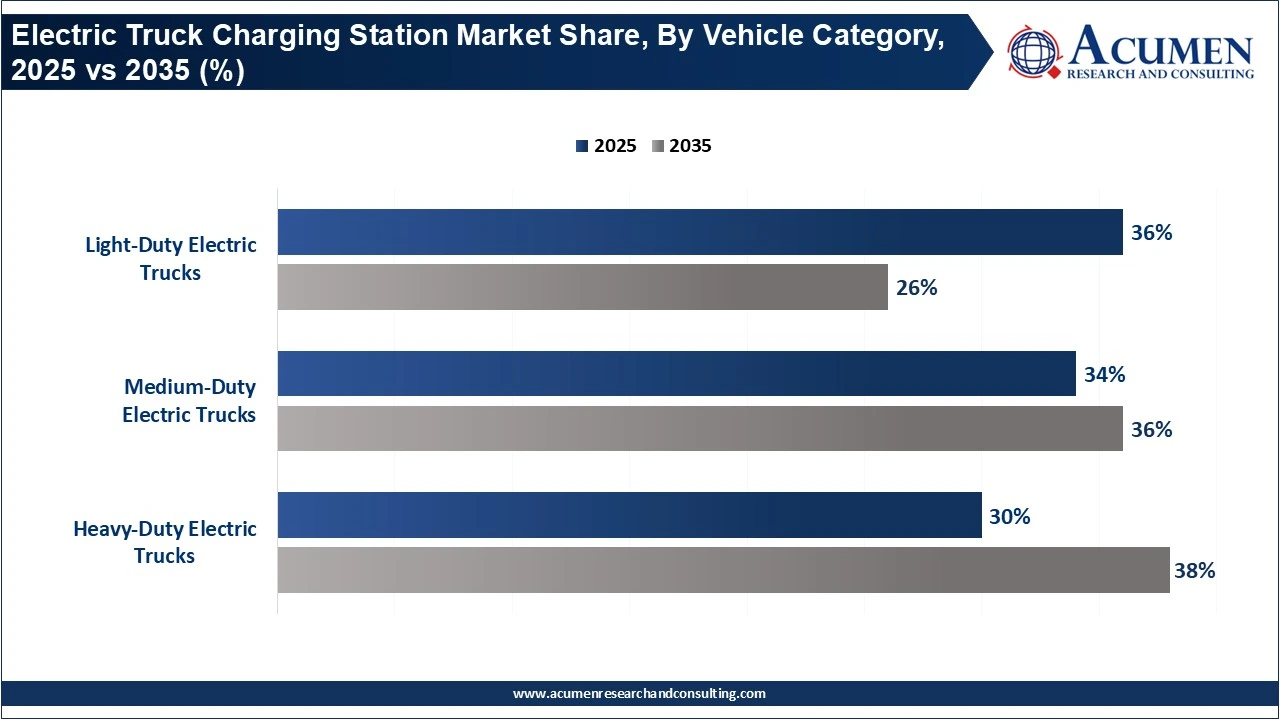
The heavy-duty electric trucks segment is predicted to experience rapid rate of growth and also accounted for 30% share in 2025. Demand from this segment comes from electrification of long-haul freight transport, growing battery electric heavy-duty trucks adoption, and increasing megawatt charging system investment.
As heavy-duty electric trucks contain large batteries for long routes they need ultra-fast charging infrastructure with high output, thereby driving investment in high power charging corridor, megawatt fleet charging stations, logistics hubs and high charging stations along highway. Battery tech advancement and charging standards maturation will make this segment the fastest growing in charging stations in near future.
Charger Technology Insights
The DC fast charging segment contributed the highest share of market revenue of 40% in 2025. DC fast chargers have been widely adopted for commercial electric trucks, due to significantly faster charging times as compared to AC charging, and economic viability for fleet operators. DC fast chargers are commonly adopted at fleet depots, distribution hubs, logistics centers, and commercial public charging stations, thus representing the present-day charging infrastructure standard in the medium-and heavy-duty truck fleet operations sector.
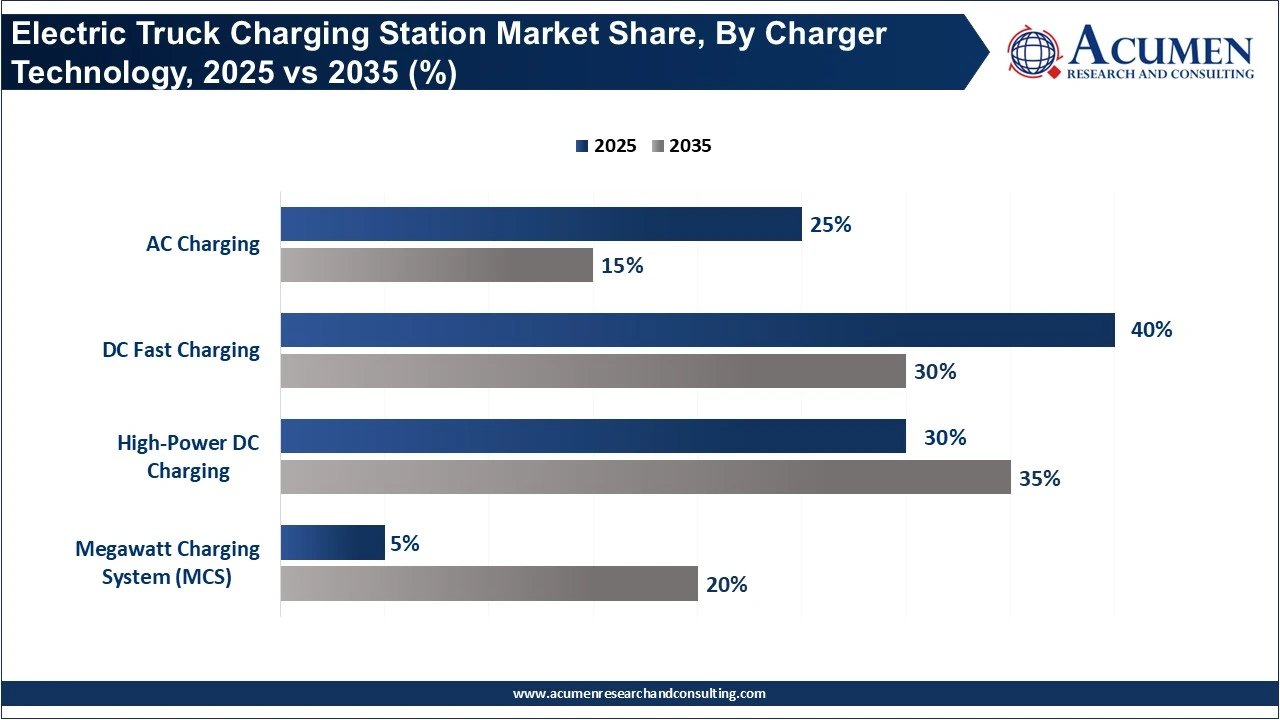
The Megawatt Charging System (MCS) segment is expected to grow at the fastest pace over the forecast period, with its market share growing from 5% in 2025 to 20% by 2035. The fast adoption of this segment is backed by increased demand for ultra-fast charging infrastructure to support charging power greater than one megawatt for heavy-duty trucks. With increased investment in freight corridors by the public, charging infrastructure owners, utilities and truck OEMs, the adoption of MCS will likely lead in all high-capacity commercial vehicle applications, given the growing penetration of electric long-haul trucking.
Deployment Type Insights
The fleet depot charging segment represented the largest market share in 2025 with 55%. Fleet depot charging station remained the preferred charging location, as commercial trucks predominantly follow predetermined routes and tend to return to central depots for overnight charging. Fleet operators can leverage depot charging solutions for better power costs, high charger utilization and efficient fleet management while avoiding operational interference.
Electric Truck Charging Station Market Share, By Deployment Type, 2025 (%)
| Deployment Type | Revenue Share, 2025 (%) | Revenue Share, 2035 (%) |
|---|---|---|
| Fleet Depot Charging | 55% | 45% |
| Public Truck Charging Hubs | 15% | 20% |
| Highway Corridor Charging | 10% | 25% |
| Distribution Center Charging | 15% | 8% |
| Opportunity Charging | 5% | 2% |
The highway corridor charging segment is anticipated to register the highest CAGR of 37.2% during the forecast period of 2026 to 2035. As long-haul electric trucks start to commercialize, high-power charging infrastructure is required to support charging stations in strategic locations across national freight corridors.
Various governments and infrastructure developers are heavily funding on highway charging networks that feature high power DC and Megawatt Charging System (MCS) chargers to offer seamless and sustained freight transportation services over long distances.
End User Insights
Logistics & freight held 40% market share in 2025 the segment dominated due to widespread electrification of the freight segment that include parcel deliveries, regional transporters, 3rd party logistics services and commercial freight fleets. In order to bring down the cost of fuel, adhere to regulatory norms and satisfy sustainability goals, large fleet operators are investing in building exclusive charging infrastructure.
Growing popularity of warehouse automation, increase in the adoption of regional freight transporters and demand generated due to e-commerce will lead to increased uptake of electric truck charging station in the years to come.
Electric Truck Charging Station Market Share, By End User, 2025 (%)
| End User | Revenue Share, 2025 (%) |
|---|---|
| Logistics & Freight | 40% |
| Retail & E-commerce | 20% |
| Municipal Fleets | 16% |
| Industrial | 14% |
| Fleet Operators | 10% |
The retail & e-commerce market captured the second position with a market share of 20% in 2025 due to the surge in e-commerce sales and an upsurge in electric vehicle penetration, particularly in the last mile and regional logistics. A greater number of retail businesses have been electrifying their transportation fleet for efficient delivery management, emission control and meeting corporate environmental standards.
Which Companies Are Building Electric Truck Charging Networks?
- Tesla – Expands its Supercharger network and develops Megawatt Charging Systems (MCS) to support the growing adoption of the Tesla Semi and heavy-duty electric trucks.
- ABB – Provides high-power DC fast charging solutions and collaborates with fleet operators, utilities, and governments to deploy commercial truck charging infrastructure globally.
- Siemens – Develops intelligent charging systems, grid integration technologies, and digital energy management solutions for commercial vehicle charging applications.
- Kempower – Specializes in scalable DC fast charging systems designed for electric truck depots, logistics centers, and fleet charging operations.
- Milence – Builds dedicated public charging corridors across Europe by deploying high-power charging hubs specifically for long-haul electric trucks.
- ChargePoint – Offers comprehensive fleet charging solutions, cloud-based charging management software, and high-power charging infrastructure for commercial fleets.
- EVgo – Expands public fast-charging infrastructure while increasing investments in commercial fleet charging solutions and heavy-duty vehicle electrification.
- BP Pulse – Invests in ultra-fast charging networks and partners with logistics companies to support commercial electric vehicle charging across key transportation corridors.
- Shell Recharge – Develops large-scale public and depot charging infrastructure while integrating renewable energy solutions for commercial fleet operators.
- Electrify America – Expands nationwide ultra-fast charging infrastructure in the United States, supporting the transition toward medium- and heavy-duty electric commercial vehicles.
Latest News
- July 2026: Germany approved the rollout of a nationwide fast-charging network for electric trucks. The project includes 124 charging sites with 836 charging points, comprising 447 Megawatt Charging System (MCS) chargers and 389 CCS chargers, with a long-term target of 350 truck charging locations by 2030.
- June 2026: China announced an ambitious heavy-truck electrification strategy targeting 40% of new heavy truck sales to be electric by 2030. The plan includes the deployment of 3,000 truck charging and battery swapping stations to support the country's expanding zero-emission freight network.
- March 2026: North America recorded its first public Megawatt Charging System (MCS) charging sessions for heavy-duty electric trucks, marking a significant milestone in commercial EV charging. The launch demonstrates the industry's transition toward ultra-fast charging infrastructure capable of supporting long-haul electric freight operations.
Segments Covered
By Vehicle Category
- Light-Duty Electric Trucks
- Medium-Duty Electric Trucks
- Heavy-Duty Electric Trucks
By Charger Technology
- AC Charging
- DC Fast Charging
- High-Power DC Charging
- Megawatt Charging System (MCS)
By Deployment Type
- Fleet Depot Charging
- Public Truck Charging Hubs
- Highway Corridor Charging
- Distribution Center Charging
- Opportunity Charging
By End User
- Logistics & Freight
- Retail & E-commerce
- Municipal Fleets
- Industrial
- Fleet Operators
By Region
- North America
- Europe
- Asia Pacific
- Latin America
- Middle East & Africa
Looking for discounts, bulk pricing, or custom solutions? Contact us today at sales@acumenresearchandconsulting.com
Frequently Asked Questions

Other Automotive And Transportation Reports
February 2023
December 2024
July 2024
July 2023