
Electric Truck Market Size, Share, Trends, Report 2026 To 2035
Electric Truck Market (By Propulsion Type: Battery Electric Vehicles (BEVs), Fuel Cell Electric Vehicles (FCEVs); By Vehicle Category: Light-Duty Electric Trucks, Medium-Duty Electric Trucks, Heavy-Duty Electric Trucks; By Driving Range: Short Range (<200 km/day), Medium Range (200–500 km/day), Long Range (>500 km/day); By End User: Logistics & Freight Companies, Retail & E-commerce Fleets, Government & Municipal Agencies, Construction & Infrastructure Companies, Industrial & Manufacturing Companies, Leasing & Fleet Management Companies, Small & Medium Businesses) - Global Industry Analysis, Size, Share, Growth, Trends, Regional Analysis And Forecast 2026 To 2035
- Last Updated: 20 Jul 2026
- Report Code: ARC3953
- Category: Automotive And Transportation
Electric Truck Market Size, Forecast 2026 To 2035
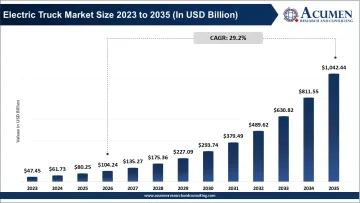
The global electric truck market size was valued at USD 80.25 billion in 2025, estimated to reach at USD 1,042.44 billion by 2035. The market is seen to expand at a promising CAGR of 29.2% during the forecast period of 2026-2035; driven by increasingly stringent emission regulations, corporate decarbonization commitments, advancements in battery technology, and expanding charging infrastructure, electric trucks are being adopted across last-mile delivery, regional distribution, and long-haul freight operations.
Report Highlights
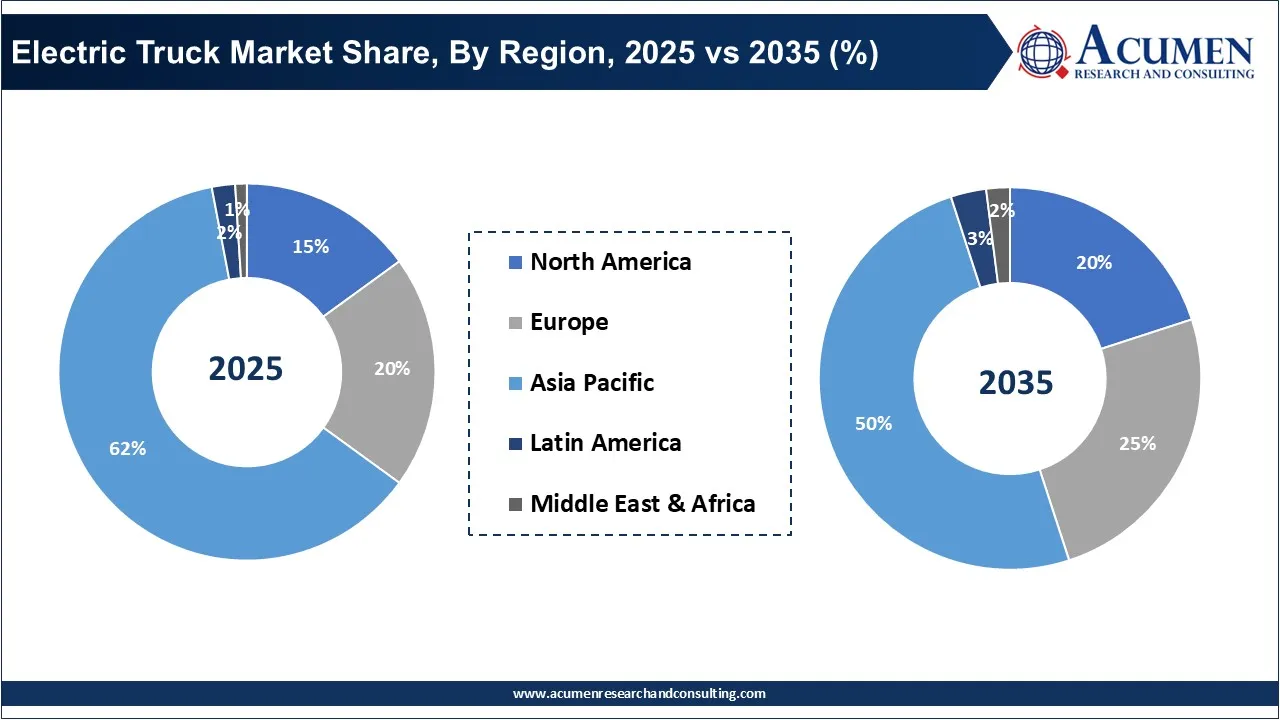
- By region, Asia Pacific dominated the electric truck market with the largest revenue share of 62% in 2025 due to its extensive EV manufacturing ecosystem, strong government incentives, and large-scale commercial fleet electrification.
- By region, Middle East & Africa is projected to grow at the fastest CAGR of 39.5% during 2026–2035, driven by rising investments in sustainable transport infrastructure, smart city developments, and zero-emission mobility initiatives.
- By propulsion type, battery electric vehicles (BEVs) held the largest market share of 97% in 2025 owing to their technological maturity, expanding charging infrastructure, and lower operating costs.
- By propulsion type, fuel cell electric vehicles (FCEVs) are expected to witness the fastest growth through 2035 as investments in hydrogen infrastructure and long-haul freight electrification continue to increase.
- By vehicle category, heavy-duty electric trucks accounted for the largest market share of 40% in 2025 due to growing adoption in long-haul freight, mining, and industrial transportation.
- By vehicle category, medium-duty electric trucks are anticipated to expand at the fastest CAGR of 31.8% during the forecast period, supported by increasing demand for regional logistics and urban freight distribution.
- By driving range, short-range electric trucks captured the largest market share of 45% in 2025 because of their extensive deployment in urban logistics, municipal services, and last-mile delivery.
- By driving range, long-range electric trucks are projected to register the fastest CAGR of 37.3% through 2035, driven by advancements in battery technology and megawatt charging infrastructure.
- By end user, logistics & freight companies held the largest market share of 35% in 2025 owing to rapid fleet electrification and corporate decarbonization initiatives.
- By end user, retail & e-commerce fleets accounted for the second-largest market share of 20% in 2025, fueled by the rapid expansion of online retail and demand for sustainable delivery fleets.
How Are Electric Trucks Transforming the Global Freight Industry?
The global freight sector is on the brink of a complete makeover as the entry of electric trucks offers a promising sustainable alternative to traditional diesel-fueled heavy-duty vehicles. Global electric truck sales surpass 400,000 units in 2025, almost double the numbers recorded in 2024 with electric trucks representing an estimated 9% of total truck sales worldwide, based on IEA. China maintains market leadership in adoption owing to robust incentives, substantial fleet electrification programs, and a mature electric vehicle manufacturing ecosystem.
“The blended average selling price for trucks in this segment stands around $200,000, considering our expert's estimate of $80.25 billion market size globally in 2025 sales to support 400,000 plus annual sales of these trucks.”
Global Electric Truck Sales (2024–2026)
- Worldwide sales of zero-emission trucks approximated 89,000 units during the first half of 2025, a increase of 136% from the first six months of 2024, showing faster adoption trends prior to record annual sales numbers in the full calendar year.
- In China, the new energy heavy-duty truck sector registered 18,007 new registrations for June 2025, an all-time monthly record, while battery-electric heavy-duty trucks held an approximate 22% share of the total heavy-duty truck market in the first half of 2025, up from 8.6% in the same period in 2024.
- Battery-electric heavy-duty truck sales increased 173% year on year for the first six months of 2025, building on 134% growth from 2023 to 2024 to position the sector as one of the quickest growing commercial vehicle categories across the globe.
- The U.S. produced roughly 12,000 electric trucks in 2025, predominantly medium-duty vehicles, and saw export volumes fall by 20% year on year as domestic interest mounted.
- Over 90% of all global capacity to manufacture electric trucks in 2025 was still in China, reflecting that the country continues to lead in terms of not just vehicle production, but also battery technology and supply chains.
- Global trade in electric trucks was an insignificant 12,000 units, roughly 3% of production, demonstrating that the production and manufacturing of electric trucks were overwhelmingly directed at domestic demand.
- Roughly 70 GWh of batteries have been delivered for heavy-duty electric trucks from 2023 to Q3 2025, with average battery capacity rising to around 310 kWh for each heavy-duty truck on the road.
- After electric heavy trucks represented about one third of all new heavy truck sales in 2025, China aims to have vehicles electric vehicles represent 40% of all new heavy trucks sold by 2030, leveraging the availability of incentives and Charging Infrastructure.
Market Dynamics
Driver
Stringent Emission Regulations and Fleet Electrification
As governments around the world implement stringent emissions regulations and zero-emission vehicle mandates to curbing greenhouse gas emissions from the transport industry - a major contributor to global CO emissions, fiscal incentives such as tax credits and purchase subsidies, along with low-emission zone regulations; are paving the way for the transition of fleets of diesel trucks to electric trucks.
Large logistics and e-commerce companies have also begun electrifying their fleets as part of the move toward corporate sustainability goals and to achieve operational cost savings, and improved driving ranges, greater energy storage through advanced battery technologies and extensive availability of charging stations have boosted the viability of electric trucks, especially for urban deliveries and regional freight services.
For instance: Amazon increased the use of electric delivery vehicles throughout Europe and North America in 2025 via collaboration agreements with prominent manufacturers, and DHL and FedEx continue their battery-electric vehicle rollout initiatives toward the goal of carbon neutral logistics.
Restraint
High Upfront Costs and Charging Infrastructure Gaps
Despite having much lower operating and maintenance expenses throughout a truck’s lifetime, electric trucks have a much higher sticker price than a comparable diesel truck on account of the expense of lithium-ion battery bundles. Long-term fleet buy is restricted, as the insufficient charging of high-power charging frameworks is mainly a limitation of medium- and also heavy-duty vehicles with much longer mileage.
Also after these obstacles, electric vehicles bring some operating drawbacks for fleet supervisors, consisting of concerns of grid capability, charging downtime, as well as the compromise in the payload capabilities that are a direct result of large battery loads, can postpone the speed at which fleets utilize electric vehicles, especially in creating economies.
Across the U.S., numerous North American long-haul freight carriers are reluctant to quit their diesel fleets as long as the absence of public megawatt-range charging locations in areas beyond the U.S.’s primary freight corridors keeps them from functioning with electric vehicles on cross-country hauls.
Opportunity
Emergence of Megawatt Charging Systems
Commercialization of megawatt charging infrastructure will be a breakthrough for the electric truck market by allowing trucks of this class to fully charge in less than an hour. Reducing the charging time will shorten the period of vehicle downtime, improve the overall efficiency of the transport park and will open new prospects for long-distance electrified freight transportation.
As part of the implemented programs and government support measures, charging infrastructure in corridors of intensive truck movement and grid strengthening by electricity companies are rapidly developing, as megawatt charging infrastructure is becoming more widespread. It is expected to eliminate a key impediment to the adoption of electric trucks in the heavy-duty class and promote the electrification of logistics on long-distance routes.
Regional Insights
What Made Asia Pacific Dominate the Electric Truck Market in 2025?
The Asia-Pacific electric truck market size reached at USD 49.76 billion in 2025 and is forecasted to hit USD 521.22 billion by 2035, growing at a CAGR of 26.1% during the predicted timeframe; owing to the extensive electric vehicle ecosystem of manufacturing plants, government incentives and progressive commercial vehicle electrification in the region. China's high rate of adoption of battery electric trucks, an array of subsidies, the initiatives of emission-free freight transportation and massive investments into battery manufacturing make it the main driver of the electric truck market in the Asia Pacific.
Moreover, manufacturers of global scale including BYD, FAW Jiefang, Dongfeng, Foton, and SANY maintain efficient production lines while also benefiting from local supply chains to cut production costs. Industrial decarbonization goals, commercial vehicle electrification mandates and investments in charging infrastructure have been instrumental in accelerating electric truck adoption in Japan, South Korea and India.
As e-commerce grows across Asia, it fuels demand for light and medium-duty electric trucks, whereas the increasing level of development in infrastructure has paved the way for the introduction of heavier-duty electric vehicles for industrial applications, such as those for the construction sector.
Top Government Incentives & Schemes for EVs in Asian Countries
| Country | Key Government Incentive / Scheme | Key Highlights |
|---|---|---|
| China | New Energy Vehicle (NEV) Purchase Tax Exemption & Trade-in Program | Provides purchase tax exemptions for eligible NEVs, vehicle scrappage and trade-in incentives, and support for commercial EV deployment. Beginning in 2026, the full tax exemption transitions to a 50% reduction as incentives gradually phase down. |
| India | PM E-DRIVE Scheme & Production Linked Incentive (PLI) Scheme | PM E-DRIVE (₹10,900 crore) supports demand incentives for electric commercial vehicles, including ₹500 crore allocated for e-trucks, charging infrastructure expansion, and domestic EV manufacturing. The PLI scheme encourages localized production of advanced automotive components and batteries. |
| Japan | Clean Energy Vehicle (CEV) Subsidy Program | Offers purchase subsidies for battery electric and fuel-cell commercial vehicles, with additional incentives supporting hydrogen-powered trucks, charging infrastructure, and domestic clean mobility technologies. |
| South Korea | EV Purchase Subsidies & K-EV Industrial Strategy | Provides national and local purchase subsidies for electric commercial vehicles, tax incentives, charging infrastructure investments, and financial support for battery manufacturing and next-generation EV technologies. |
| Thailand | EV 3.5 Incentive Program | Offers purchase subsidies, excise tax reductions, import duty exemptions, and incentives linked to domestic EV production. The scheme has attracted significant investments from global EV manufacturers while strengthening local manufacturing capacity. |
| Indonesia | National EV Acceleration Program | Provides VAT incentives, import duty exemptions for EV manufacturers, tax holidays, and incentives for battery manufacturing and domestic EV production to establish Indonesia as a regional EV manufacturing hub. |
North America Electric Truck Market Analysis
The North America electric truck market size was estimated at USD 12.04 billion in 2025 and is expected to attain USD 208.49 billion by 2035. It is anticipated to grow at a CAGR of 33.4% during the forecast period. This expansion was mainly due to increased funding for zero-emission freight corridors, enhanced emission standards for vehicles and the increased purchase of electric trucks by logistics and retail companies.
The U.S. Federal government's incentives and federal programs under the Clean Transportation Policy, together with California's Advanced Clean Trucks Regulation at the state level, provide an impetus to fleet operators to replace their diesel-powered commercial vehicles with their electric counterparts.
The key players Tesla, PACCAR, Rivian, Ford, General Motors are focusing on increasing production capacity, and on launching new commercial electric truck variants for regional freight and last-mile delivery. Extensive deployment of megawatt charging station and continued developments in the battery technology are also expected to boost the market growth in North America.
Electric Truck Industry Trends in Middle East and Africa
The Middle East & Africa market size was valued at USD 0.80 billion in 2025 and is expected to reach USD 20.85 billion by 2035, with a compound annual growth rate of 39.5% from 2026 to 2035. This is due to factors like rising government investment in sustainable mobility solutions, efforts towards economic diversification and modernizing commercial logistics infrastructure.
Nations such as United Arab Emirates (UAE), Saudi Arabia and South Africa are taking proactive measures, in line with their respective sustainability strategies, to foster zero-emission mobility, including significant investment in electric truck charging infrastructure and incentives to accelerate the adoption of electric commercial vehicles.
Mega smart city projects in the region, including Saudi Arabia’s NEOM, as well as smart city projects across the UAE are fueling demand for electric trucks for construction, municipal use, and goods movement.
Also, significant growth in e-commerce sector, along with development of logistic hubs, ports, and industrial areas in Gulf Cooperation Council (GCC) countries, are pushing fleet operators to shift towards electric trucks to minimize total cost of operation and also achieve decarbonization target set by corporations.
Segmental Insights
Propulsion Type Insights
In 2025, Battery Electric Vehicles (BEV) held a significant 97% share of the electric truck propulsion market as maturity in BEV technology, dropping battery prices, wider charging network coverage and cheaper running costs to the current diesel trucks pushed BEVs ahead of the rest. BEVs have become the preferred choice for urban logistics, municipal transportation, retail distribution, and regional freight operations where predictable routes and depot-based charging maximize operational efficiency.
Electric Truck Market Share, By Propulsion Type, 2025 (%)
| Propulsion Type | Revenue Share, 2025 (%) | Revenue Share, 2035 (%) |
|---|---|---|
| Battery Electric Vehicles (BEVs) | 97% | 90% |
| Fuel Cell Electric Vehicles (FCEVs) | 3% | 10% |
The Fuel Cell Electric Vehicles (FCEV) market share of only 3% in 2025 is projected to be the fastest growing propulsion technology with an anticipated 10% share of the electric truck market by 2035. This is because FCEV offer a wider driving range, quicker refueling times and greater payload capacity than BEVs making them ideal for both long haul freight and for use within heavy industry applications.
The growing investments in hydrogen production, refueling infrastructure and FCEV technology from both governments and commercial vehicle manufacturers will continue to drive FCEVs towards full commercialization within the next 10 years.
Vehicle Category Insights
The heavy-duty electric trucks segment held the largest share of the market in 2025 with 40%. Electric truck models designed for heavy-duty vehicles were significantly supported by increased electrification for long-haul freight movement, mining applications, logistics at construction sites, and operations in port transportation.
The adoption of heavy-duty electric trucks is increasing among the fleet operators to save on fuel expenses, comply with the regulatory emissions policies and attain the environmental targets set by the organization. Improved battery capacity, regenerative braking technology, EV drivetrains, and the development of high power charging infrastructure have made these vehicles more attractive for commercial purposes.
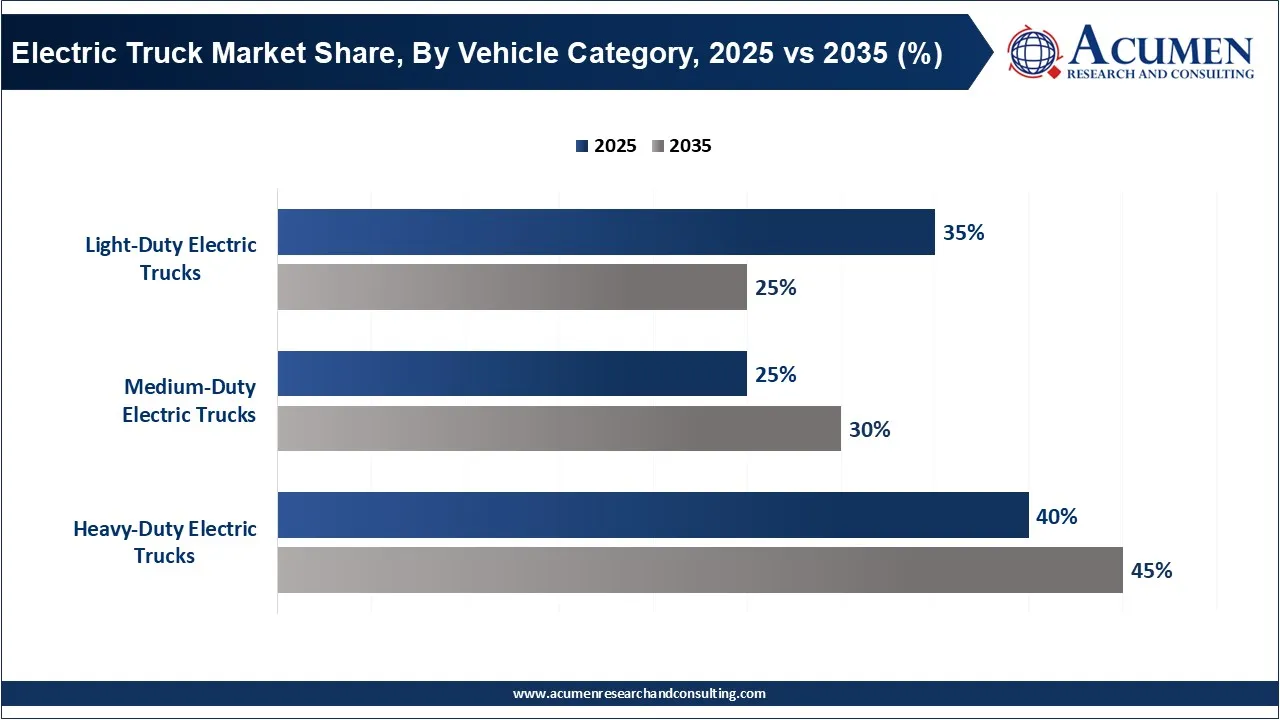
The second largest market segment is the medium-duty electric truck segment that accounted for 25% share of market in 2025 and is expected to witness the highest CAGR of 31.8% over the forecast period. The vehicles in this category are being increasingly used in regional distribution, distribution within cities, delivery of refrigerated products, and various utility and municipal applications where daily commute distances do not exceed the daily range that can be easily covered with existing infrastructure and the readily available charging points.
The demand from retail companies, food and beverages distribution businesses and third party logistic service providers is rising for this particular segment, along with falling battery prices and expanding charging infrastructure across the world will likely propel this segment.
Driving Range Insights
Short-range electric trucks (operating less than 200 km/day) made up 45% of the market share in 2025 as they dominated urban logistics, municipal operations, refuse collection, and last mile delivery due to regular daily journeys and access to overnight depot charging facilities. Fleet operators found they could efficiently utilize fleet vehicle capacity and avoid a vast and costly network of charging stations with the utilization of these vehicles, whose shorter battery ranges also reduced upfront cost for the operator.
Medium-range electric trucks generated the second largest market share of 40% in 2025 as demand for regional goods and freight transport continued to grow, along with highway charging infrastructure development and improvements in battery energy storage capacity.
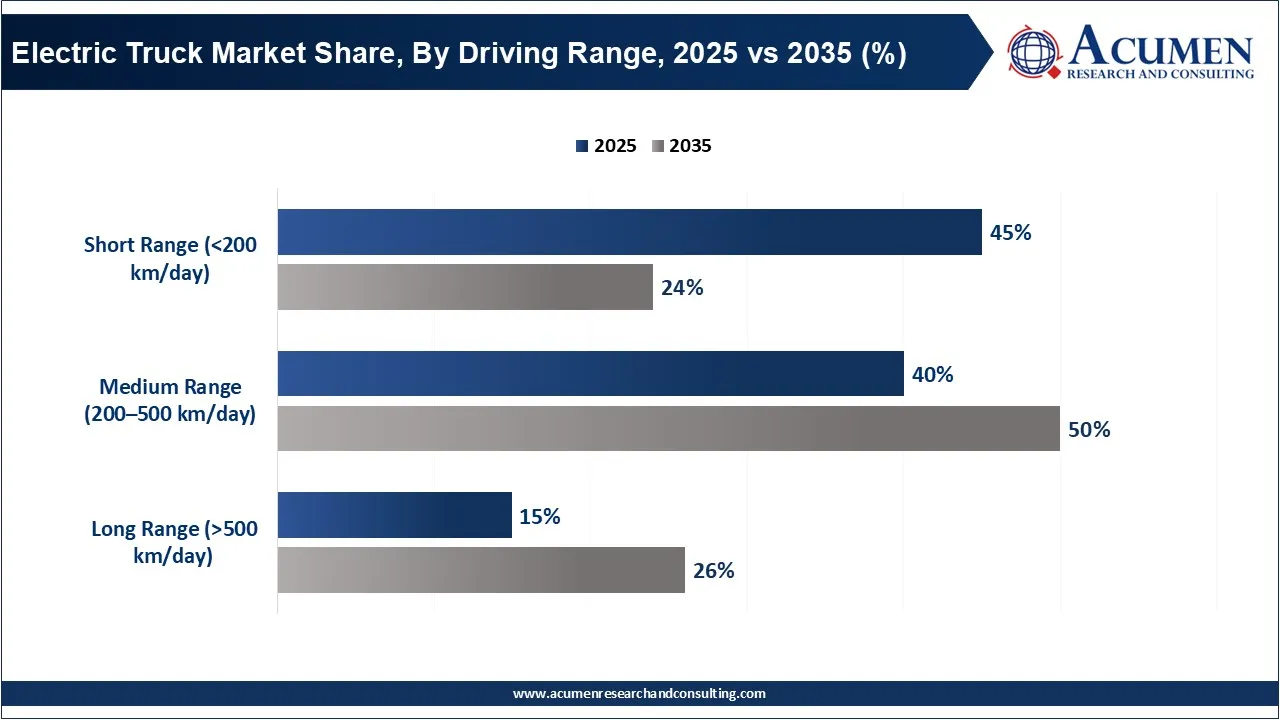
Long-range electric trucks had the smallest market share of 15% in 2025, but were expected to experience the highest CAGR of 37.3% from 2026-2035 owing to substantial developments in megawatt charging, high capacity battery systems, and hydrogen power for extended range. Investments are also growing into developing infrastructure and the creation of zero-emission freight routes through the US, Europe, and Asian regions to enable electric freight transport for medium to long haul journeys.
End User Insights
Logistics & freight contributed the largest share of 35% in 2025, spurred by growing pressure to limit transportation emissions while lowering operating costs. Major fleet owners are shifting from diesel-powered to electric truck options to fulfill corporate sustainability commitments, adhere to stricter emission regulations, and minimize fuel & maintenance costs.
The adoption of fleet electrification is more noticeable in regional freight transport, warehouse distribution, and dedicated logistics networks. The growing market for third-party logistics providers & cross-border freight transportation is anticipated to increase demand for electric trucks for fleet logistics.
Electric Truck Market Share, By End User, 2025 (%)
| End User | Revenue Share, 2025 (%) |
|---|---|
| Logistics & Freight Companies | 35% |
| Retail & E-commerce Fleets | 20% |
| Government & Municipal Agencies | 12% |
| Construction & Infrastructure Companies | 11% |
| Industrial & Manufacturing Companies | 9% |
| Leasing & Fleet Management Companies | 8% |
| Small & Medium Businesses | 5% |
The second largest share in 2025 of 20% was occupied by retail & e-commerce due to rise in online shopping, same-day delivery services & city delivery networks. Prominent retailers and e-commerce providers are focusing on building a fleet of electric delivery trucks to limit their carbon emissions, enhance operation efficiency, and promote sustainability objectives.
The fixed routing, depot charging facility, and improvement in vehicle fleet management software is suitable for electric vehicles used for transportation in the retail segment. An increase in e-commerce in both emerging and developed countries is likely to sustain the need for electric trucks for retail and e-commerce logistics.
Recent News
- In July 2025, Tata Motors agreed to acquire Iveco's commercial vehicle business in a deal valued at approximately ₹38,000 crore. The acquisition is expected to strengthen Tata Motors' global commercial vehicle portfolio and accelerate its electric truck expansion across Europe and other international markets.
- In June 2025, Toyota Motor Corporation and Daimler Truck finalized the merger of Hino Motors and Mitsubishi Fuso, establishing the new holding company Archion. The merger aims to jointly develop next-generation commercial vehicles, including battery-electric and hydrogen-powered trucks, while improving competitiveness in the global zero-emission truck market.
Top Companies
Asia Pacific
- BYD Company Ltd. (China)
- SANY Group (China)
- FAW Jiefang Group Co., Ltd. (China)
- Dongfeng Motor Corporation (China)
- Beiqi Foton Motor Co., Ltd. (China)
- Tata Motors Limited (India)
- Isuzu Motors Ltd. (Japan)
- Hino Motors, Ltd. (Japan)
- Mitsubishi Fuso Truck and Bus Corporation (Japan)
North America
- Tesla, Inc. (U.S.)
- PACCAR Inc. (U.S.)
- Nikola Corporation (U.S.)
- Rivian Automotive, Inc. (U.S.)
- Bollinger Motors (U.S.)
- General Motors Company (BrightDrop) (U.S.)
- Ford Motor Company (U.S.)
Europe
- Daimler Truck Holding AG (Germany)
- Volvo Trucks (Sweden)
- TRATON SE (Germany)
- Scania AB (Sweden)
- MAN Truck & Bus SE (Germany)
- Renault Trucks (France)
- Iveco Group N.V. (Italy)
- DAF Trucks N.V. (Netherlands)
- Mercedes-Benz Trucks (Germany)
- Designwerk Technologies AG (Switzerland)
Segments Covered
By Propulsion Type
- Battery Electric Vehicles (BEVs)
- Fuel Cell Electric Vehicles (FCEVs)
By Vehicle Category
- Light-Duty Electric Trucks
- Medium-Duty Electric Trucks
- Heavy-Duty Electric Trucks
By Driving Range
- Short Range (<200 km/day)
- Medium Range (200–500 km/day)
- Long Range (>500 km/day)
By End User
- Logistics & Freight Companies
- Retail & E-commerce Fleets
- Government & Municipal Agencies
- Construction & Infrastructure Companies
- Industrial & Manufacturing Companies
- Leasing & Fleet Management Companies
- Small & Medium Businesses
By Region
- North America
- Europe
- Asia Pacific
- Latin America
- Middle East & Africa
Looking for discounts, bulk pricing, or custom solutions? Contact us today at sales@acumenresearchandconsulting.com
Frequently Asked Questions

Other Automotive And Transportation Reports
November 2020
August 2020
July 2020
November 2024