
GPU as-a-Service (GPUaaS) Market Size, Share, Trends, Report 2026 To 2035
GPU as a Service Market (By Service Model: IaaS, PaaS; By GPU Type: High-End GPUs, Mid-Range GPUs, Low-End GPUs; By Deployment Model: Public Cloud, Private Cloud, Hybrid/Multi-Cloud; By Pricing / Business Model: Pay-as-you-Go / Pay-per-Use, Subscription-Based, Reserved / Committed Capacity, Spot / Preemptible; By Enterprise Size: Large Enterprises, Small & Medium Enterprises (SMEs); By Application: Artificial Intelligence & Machine Learning, High-Performance Computing (HPC), Graphics Rendering & Visualization, Others; By End User: IT & Telecommunications, BFSI, Healthcare & Life Sciences, Automotive & Mobility, Manufacturing, Others) - Global Industry Analysis, Size, Share, Growth, Regional Analysis, Trends and Forecast 2026 - 2035
- Last Updated: 04 Sep 2026
- Report Code: ARC3975
- Category: ICT
GPU as-a-Service (GPUaaS) Market Size, Forecast Report 2026 To 2035
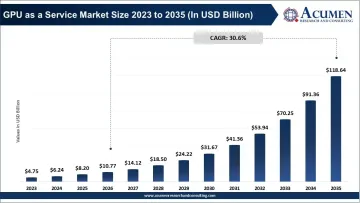
The global GPU as-a-service market size was valued at USD 8.20 billion in 2025 and is seen to reach at USD 118.64 billion by 2035, while showing a promising CAGR of 30.6% during the forecast period of 2026-2035.
Key Highlights
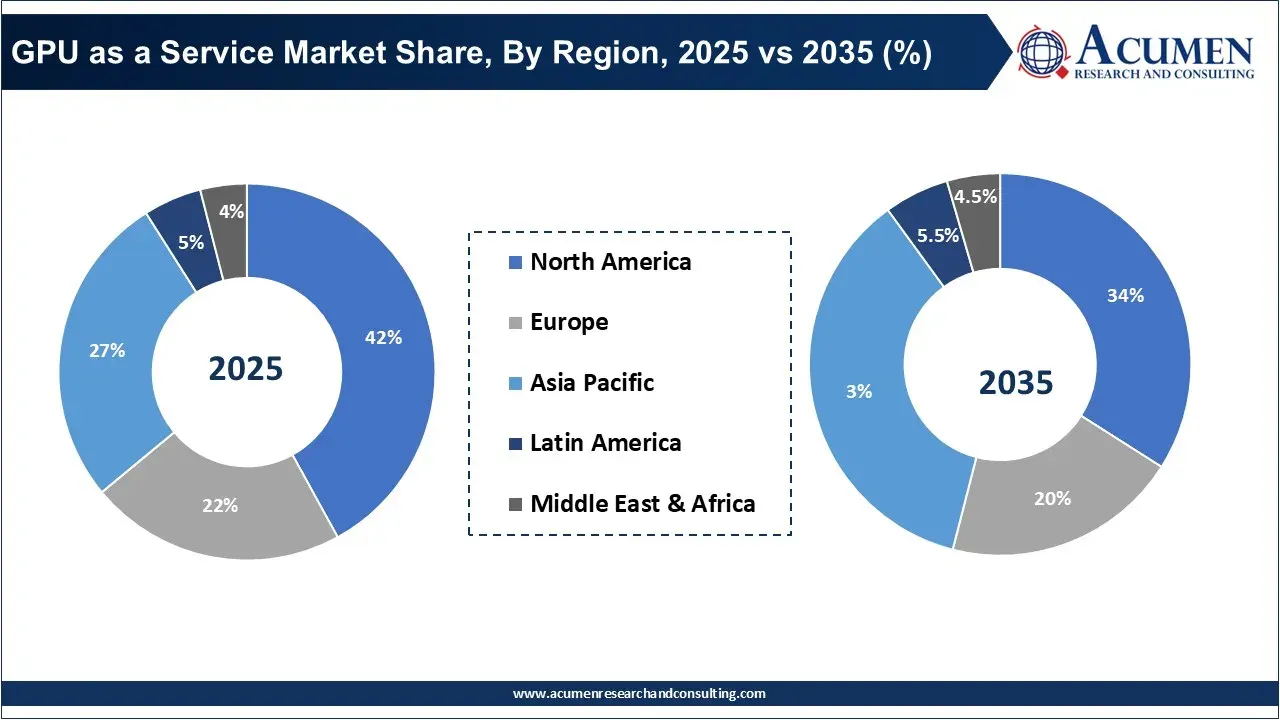
- By region, North America dominated with a 42.0% share in 2025, supported by established hyperscale cloud providers, AI companies, GPUaaS providers, and extensive data center infrastructure.
- By region, Europe held a 22.0% share in 2025, supported by enterprise AI adoption, sovereign-cloud initiatives, and increasing demand for localized and compliant AI computing infrastructure.
- By region, Asia-Pacific is projected to be the fastest-growing regional market, with its share expected to rise from 27.0% in 2025 to 36.0% by 2035, driven by expanding AI adoption and rapid investment in digital and GPU infrastructure.
- By service model, Infrastructure-as-a-Service (IaaS) held the largest share at 59.0% in 2025, driven by demand for flexible access to raw GPU infrastructure and greater control over computing environments.
- By service model, Platform-as-a-Service (PaaS) accounted for 41.0% in 2025, supported by growing demand for managed AI development, training, deployment, and orchestration environments.
- By GPU type, high-end GPUs dominated with a 68.0% share in 2025, reflecting strong demand for advanced computing capabilities across generative AI, LLMs, deep learning, and scientific workloads.
- By GPU type, mid-range GPUs captured 25.0% in 2025, supported by enterprises seeking cost-efficient accelerators for AI inference, development, visualization, and medium-scale analytics.
- By deployment model, public cloud led with a 63.0% share in 2025, driven by the ability to access expensive GPU infrastructure without significant upfront capital investment.
- By deployment model, hybrid/multi-cloud was the fastest-growing segment, with its share projected to increase from 20.0% in 2025 to 30.0% by 2035 as enterprises prioritize workload flexibility, cost optimization, data governance, and reduced vendor dependence.
- By pricing/business model, pay-as-you-go/pay-per-use dominated with a 42.0% share in 2025, reflecting demand for on-demand GPU capacity without long-term infrastructure commitments.
- By pricing/business model, reserved/committed capacity accounted for 28.0% in 2025, supported by enterprises with predictable GPU requirements for continuous inference, recurring training, and production workloads.
- By enterprise size, large enterprises dominated with a 72.0% share in 2025, supported by larger AI budgets, established cloud infrastructure, and extensive requirements for analytics, automation, and AI applications.
- By enterprise size, SMEs accounted for 28.0% in 2025, as GPUaaS lowers the capital and infrastructure barriers associated with deploying high-performance computing capabilities.
- By application, artificial intelligence and machine learning led with a 55.0% share in 2025, driven by increasing GPU requirements for model training, inference, and AI-powered applications.
- By application, high-performance computing accounted for 16.0% in 2025, supported by growing use of GPU acceleration across scientific research, engineering simulation, computational modeling, and other parallel-processing workloads.
- By end user, IT and telecommunications held the largest share at 24.0% in 2025, reflecting extensive GPU requirements for AI infrastructure, cloud computing, software development, data processing, and network optimization.
- By end user, BFSI accounted for 13.0% in 2025, driven by increasing adoption of GPU-accelerated computing for fraud detection, risk modeling, financial analytics, and generative AI.
GPUaaS Market Definition, Scope and Coverage
The scope for the GPU-as-a-Service (GPUaaS) market includes offerings relating to the outsourcing of GPU computation capabilities over the cloud in addition to the dedicated deployment as hosting service. GPUs could be shared among several users or could be reserved for a single dedicated application by allocating a portion of the processing powers from a pool of many processors.
This market includes infrastructure as a service and platform as a service to host the virtualized or dedicated GPUs, alongside capacity, networking, and storage along with orchestration, environments, software tools and applications for various compute-intensive applications which includes artificial intelligence, machine learning, HPC, graphics rendering, etc.
GPUaaS Startup Ecosystem
| Startup | Primary focus | Key GPUaaS offering / positioning |
|---|---|---|
| CoreWeave (U.S.) | Cloud GPU infrastructure | Specialized cloud infrastructure for AI and GPU-intensive workloads |
| Lambda (U.S.) | AI infrastructure | GPU cloud, workstations, servers, and AI infrastructure for developers and enterprises |
| Crusoe (U.S.) | AI cloud infrastructure | GPU cloud infrastructure designed for AI workloads and large-scale computing |
| RunPod (U.S.) | Developer-focused GPU cloud | On-demand GPU instances and serverless infrastructure for AI developers |
| Fluidstack (UK) | AI cloud infrastructure | GPU infrastructure and cloud computing for AI research and enterprise workloads |
| Vast.ai (USA) | GPU marketplace | Marketplace connecting users with distributed GPU computing resources |
What is Driving the Growth of the GPUaaS Market?
The demand for scalable, on-demand computing resources that a GPUaaS system can deliver, coupled with organizations adoption of more demanding workloads, will drive the growth of the GPUaaS market. Demand for high-performance GPUs will expand as more AI, machine learning, generative AI, large language models, AI inference, HPC and other accelerated computing applications are developed and deploy in the enterprise.
With the use of GPUaaS instead of buying and running its expensive GPU infrastructure companies will now be able to access just the computing capacity at the time where it needs it, thereby helping reduce upfront investments in infrastructure.
Data Sovereignty and Compliance Risks in GPUaaS Adoption
Data sovereignty and compliance requirements represent an important challenge to GPUaaS adoption, particularly for organizations handling sensitive, regulated, or geographically restricted data. When AI workloads are transferred to cloud-based GPU infrastructure, organizations must consider where their data is stored, where it is processed, which jurisdictions can access it, and how the cloud provider manages data throughout the computing lifecycle. Requirements relating to privacy, financial information, healthcare data, government information, intellectual property, and cross-border data transfers can therefore influence whether an organization is comfortable using GPUaaS.
GPUaaS Market Opportunity Matrix
Experts at Acumen Research & Consulting expect the best opportunities will arise where demands for the highest-end GPUs converge with rapid AI deployment and growing capacity. The primary opportunity is the demand arising from the use of AI and machine learning and then secondary opportunities as companies begin to use inference, their systems in a hybrid and multi-cloud environment, specialized GPU clouds or within their local regional ecosystems need agile access to accelerated computing. The matrix could be applied to investment decisions for capacity allocation, new products and market planning.
| Opportunity Area | Growth Potential | Strategic Opportunity |
|---|---|---|
| AI & Machine Learning | Very High | Expand GPU capacity for training, inference and model development |
| Hybrid/Multi-Cloud | High | Provide flexible workload placement and multi-cloud GPU access |
| AI Inference | High | Develop optimized infrastructure for high-volume inference workloads |
| Specialized GPU Clouds | High | Target AI startups, enterprises and compute-intensive workloads |
| Sovereign AI Infrastructure | High | Build localized GPU capacity for government and regulated workloads |
| HPC & Scientific Computing | Medium–High | Serve simulation, research and advanced computing applications |
GPU as-a-Service (GPUaaS) Market Segmental Insights
Service Model Insights
According to our research at Acumen Research & Consulting, Infrastructure-as-a-Service accounted for 59.0% of the GPUaaS market in 2025. It is because, for some clients, they might not really want a fully deployed app development infrastructure, but simply a raw accelerated computing infrastructure. Therefore, an IaaS-like offering of GPUaaS can allow to deliver and to rent GPU virtual machines, bare-metal hardware, networking, storage and other computing resources, including accelerated data.
This is very convenient for companies having their own AI software development stack and requiring control on the computing stack. This include a choice for a specific GPU configuration, a CUDA stack, libraries, an operating system, orchestration tooling, framework tools.
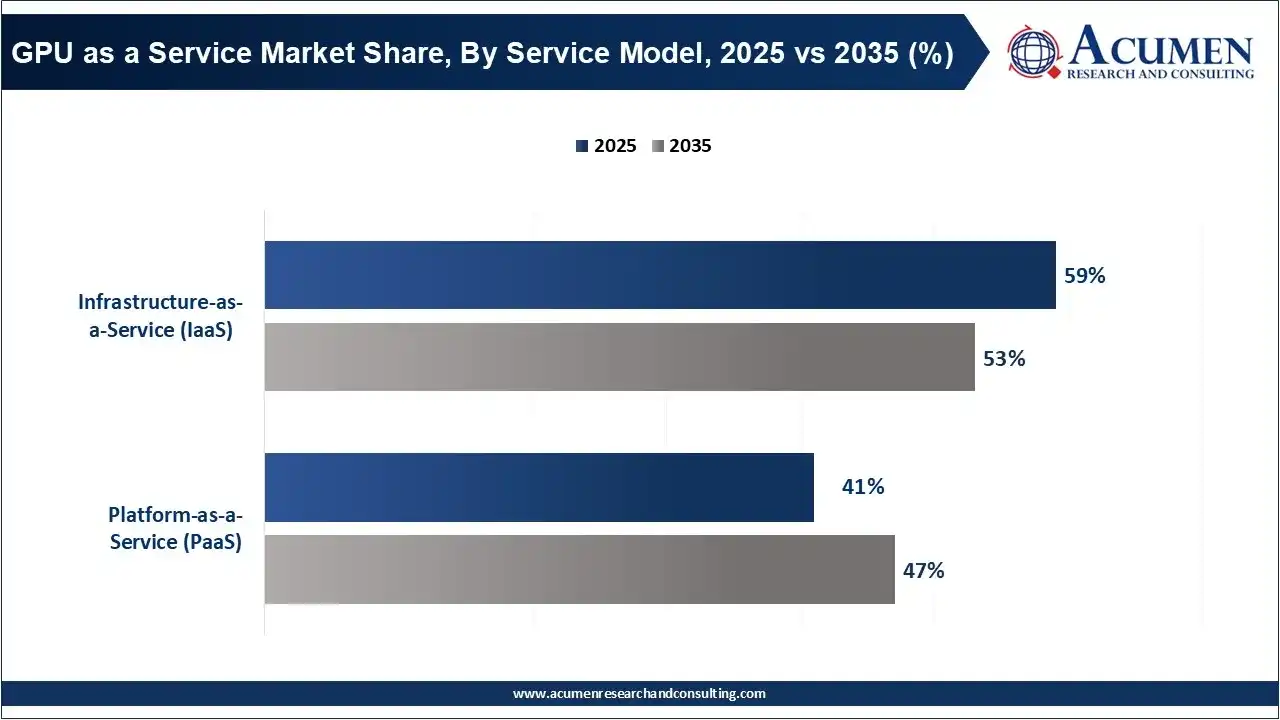
Platform-as-a-Service represented 41.0% of the GPUaaS market in 2025. PaaS provides a higher level of abstraction by giving developers managed environments and tools for developing, training, deploying, and managing AI applications. The growing importance of PaaS reflects a shift toward simplifying AI infrastructure management.
Organizations increasingly want to focus on models and applications instead of managing GPU provisioning, software environments, drivers, libraries, orchestration, and infrastructure configuration. PaaS can therefore become particularly valuable for enterprises that lack specialized GPU infrastructure teams. It can shorten deployment cycles and reduce the operational complexity associated with GPU-intensive AI workloads.
GPU Type Insights
The high-end GPU sector constituted 68% share of the overall GPUaaS market in 2025. The large share of high-end GPU services signifies a rising demand for higher compute capabilities demanded by today’s workloads. Generative AI, LLM, deep learning, high-end computer vision, scientific computing, and similar compute-intensive workloads may need substantially increased amounts of memory bandwidth, processing capacity, and accelerator performance.
High-end accelerators are cost-prohibitive at times and have challenges to remain fully utilized. Through rental of services, enterprises can access required amount of compute, without bearing total capital expenditure of having accelerators owned.
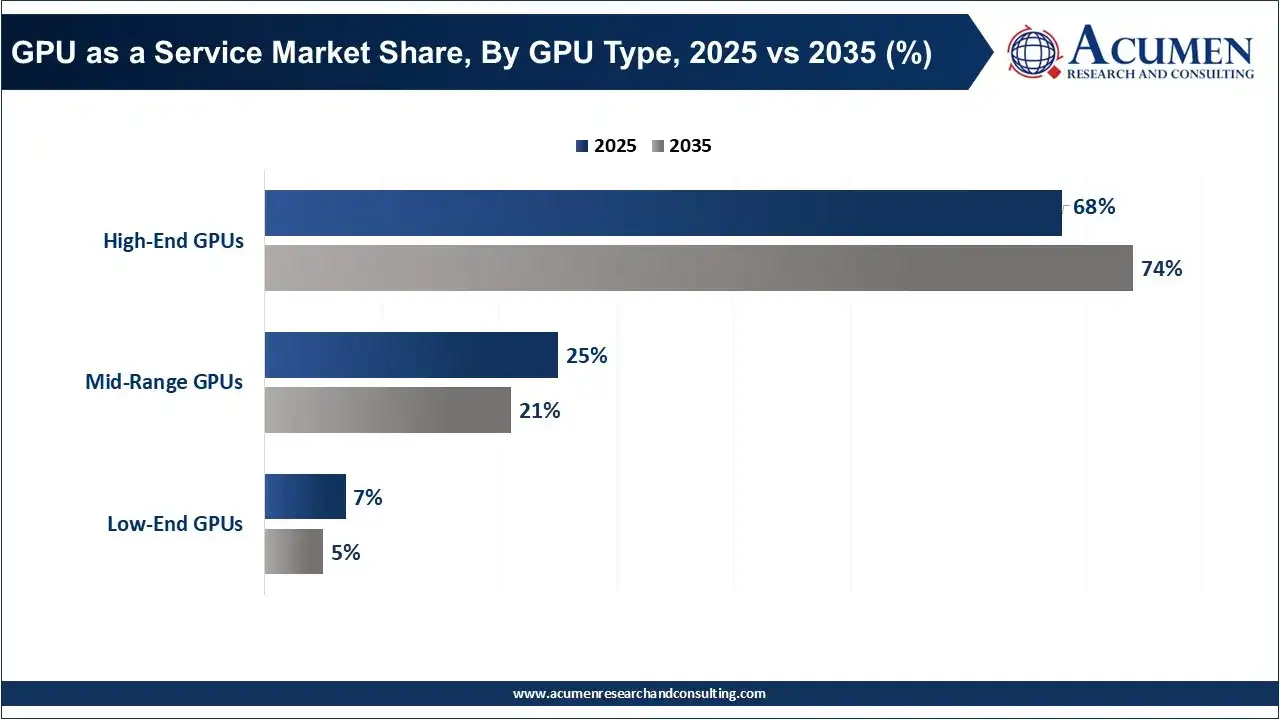
The mid-range GPU sector took up 25% of the market share in 2025. This segment applies to workloads that may not require highly compute intensive accelerators, or when cost is a major priority. Such workloads would comprise of lower AI model training and inference, visualizations and developments applications, medium scale analytics, and less computationally intensive use cases.
This sector also has a growing share of enterprises scaling up their AI operations from experimentation phase. The enterprise may use high-end GPU for training the models while the complementary production workloads for developing AI and inference may use lower cost accelerators.
Deployment Model Insights
In 2025, public cloud represented the largest deployment model, holding a 63% share of the GPUaaS market. The market is expected to grow to around $64.06 billion in 2035 with a 28.3% CAGR during 2026-2035.
The appeal for public cloud GPUaaS is based on the inherent value proposition of cloud services-clients are able to leverage expensive accelerator infrastructure without the need to acquire the hardware. This point is particularly pertinent for companies with uncertain and/or highly fluctuating GPU needs.
Demand for AI workloads could grow drastically from phase-to-phase when training models, launching products, performing trials, providing inference and running workloads to capacity increase. Organizations are provided with a cloud resource in order to leverage whatever infrastructure their workload demands for what they need, without fear of resource glut or insufficient compute.
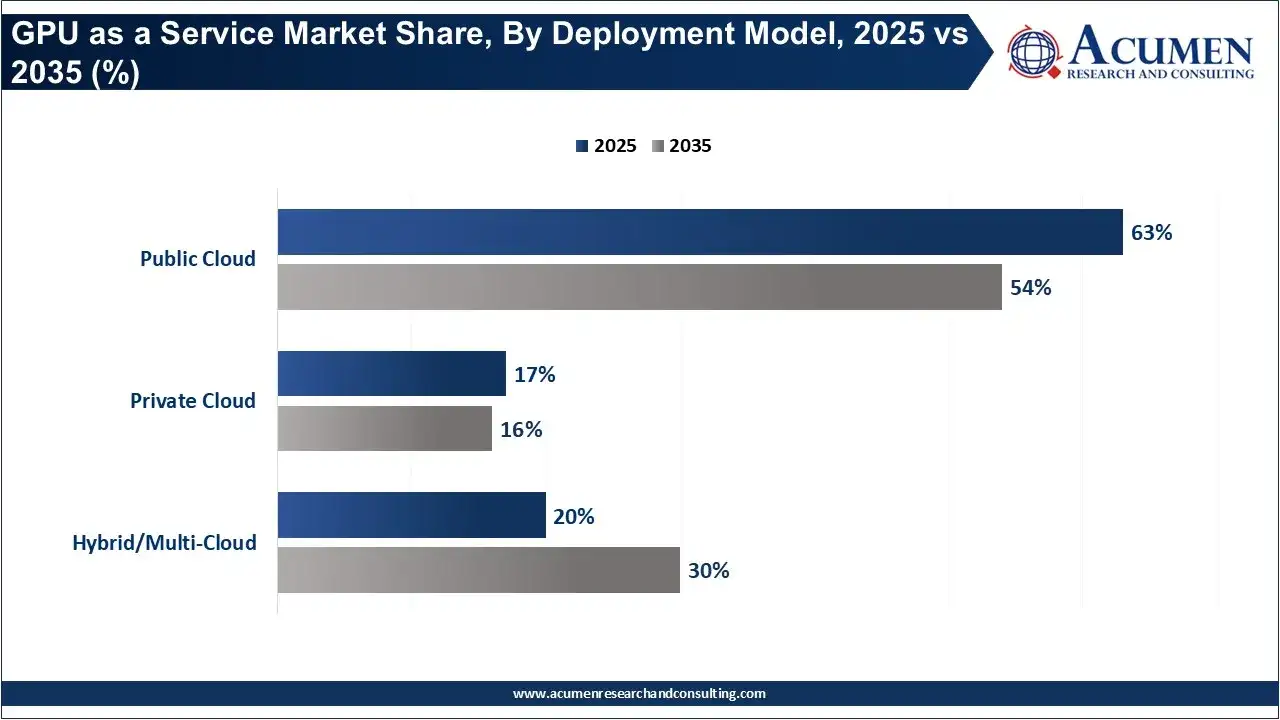
Hybrid/Multi-Cloud is the fastest-growing deployment segment, with its share expected to rise from 20.0% in 2025 to 30.0% by 2035. The market is projected to grow from approximately $2.15 billion in 2026 to $35.59 billion by 2035, representing a 36.6% CAGR from 2026 to 2035.
The growth of hybrid and multi-cloud GPUaaS reflects the increasing complexity of enterprise AI infrastructure. Organizations may not want to depend entirely on one cloud environment because of concerns involving workload portability, capacity availability, cost optimization, data governance, performance, and vendor dependence.
A hybrid strategy allows enterprises to combine private infrastructure with public GPU resources. For example, sensitive workloads or proprietary datasets may remain in controlled environments, while additional GPU capacity can be obtained from public cloud infrastructure during periods of high demand.
Pricing / Business Model Insights
Pay-as-you-go/pay-per-use contributed 42% of the GPUaaS market value in 2025 and dominated market share. A pay-per-use/pay-as-you-go model is often in line with the primary reason organizations opt for GPUaaS services which is access to costly computational infrastructure without making a heavy capital investment in the underlying GPU equipment. It is important for a business to be able to access GPU compute on a demand basis.
It appeals even to larger organizations who will have intermittent high-demand usage. For example a company running a training exercise may require extensive computing resources but will use considerably less when developing their models.
GPUaaS Market Share, By Pricing / Business Model, 2025 (%)
| Pricing / Business Model | Revenue Share, 2025 (%) |
|---|---|
| Pay-as-you-Go / Pay-per-Use | 42% |
| Subscription-Based | 18% |
| Reserved / Committed Capacity | 28% |
| Spot / Preemptible | 12% |
Reserved / committed capacity represented 28.0% of the market in 2025, making it the second-largest pricing/business model. This model is more suitable for organizations with predictable and sustained GPU requirements. Rather than acquiring capacity only when required, customers commit to GPU resources for an agreed period. The model can be attractive to enterprises operating continuous AI inference, recurring model-training workloads, large-scale analytics, or production applications with relatively predictable demand.
Enterprise Size Insights
In 2025, large enterprises contributed 72.0% to the market value as compared to small and medium enterprises’ 28.0% in the global GPUaaS market. The majority contribution comes from large enterprises due to larger overall AI budgets and cloud infrastructure. Such organizations are also likely to require the facility for advanced data analytics, automation and fraud detection.
GPUaaS Market Share, By Enterprise Size, 2025 (%)
| Enterprise Size | Revenue Share, 2025 (%) |
|---|---|
| Large Enterprises | 72% |
| Small & Medium Enterprises (SMEs) | 28% |
SMEs accounted for 28.0% of the GPUaaS market in 2025. Although smaller than the large-enterprise segment, SMEs represent an important addressable market because GPUaaS reduces the capital barrier associated with advanced computing. A smaller company developing an AI application may not have the financial resources or technical infrastructure to establish a dedicated GPU cluster. Cloud-based access allows the company to obtain high-performance computing resources without building a complete infrastructure environment.
Application Insights
In 2025, artificial intelligence & machine learning represented the largest application slice at 55.0% of the market. AI/ML's position as the largest application market speaks the most loudly to the trends defining the GPUaaS market. GPUs are uniquely well suited to the parallelizable nature of modern AI workloads, establishing accelerator technology as the infrastructure bedrock for creating AI models.
Perhaps more significantly, demand isn’t driven only by training new models. Instead, AI inference is becoming a progressively larger part of the GPU workload as the applications for models are integrated with products and services. Once an AI application is released, there needs to be ongoing hardware for it to fulfill incoming requests.
GPUaaS Market Share, By Application, 2025 (%)
| Application | Revenue Share, 2025 (%) |
|---|---|
| Artificial Intelligence & Machine Learning | 55% |
| High-Performance Computing (HPC) | 16% |
| Graphics Rendering & Visualization | 10% |
| Gaming & Interactive Applications | 8% |
| Video & Media Processing | 6% |
| Data Analytics & Other Compute-Intensive Applications | 5% |
High-performance computing accounted for 16.0% of the GPUaaS market in 2025, making it the second-largest application segment. HPC applications use GPU acceleration for computationally intensive workloads including scientific research, engineering simulation, computational modeling, and other workloads requiring substantial parallel processing.
Cloud GPU access allows researchers and enterprises to obtain additional capacity when simulations or computational projects require it. This can be especially relevant for computational fluid dynamics, molecular modeling, scientific simulations, and other workloads where processing requirements can increase significantly during specific project stages.
End User Insights
IT & Telecommunications accounted for 24.0% of the GPUaaS market in 2025, making it the largest end-user segment. The segment's leadership reflects the industry's direct involvement in cloud computing, AI infrastructure, software development, data processing, and telecommunications optimization.
Telecommunications companies are also increasingly adopting AI for network optimization, predictive maintenance, customer analytics, network planning, and automation. GPU acceleration can support these computational workloads, particularly as telecom operators expand their use of AI-driven network management.
GPUaaS Market Share, By End User, 2025 (%)
| End User | Revenue Share, 2025 (%) |
|---|---|
| IT & Telecommunications | 24% |
| BFSI | 13% |
| Healthcare & Life Sciences | 11% |
| Automotive & Mobility | 9% |
| Manufacturing | 8.50% |
| Media & Entertainment | 8% |
| Gaming | 7% |
| Retail & E-commerce | 6% |
| Government & Public Sector | 5% |
| Energy & Utilities | 4.50% |
| Other Industries | 4% |
BFSI represented 13.0% of the GPUaaS market in 2025, making it the second-largest end-user segment. Banks, financial institutions, insurance companies, and other financial organizations increasingly use GPU-accelerated computing for workloads such as fraud detection, risk modeling, financial analytics, algorithmic systems, and generative AI.
Fraud detection is an important use case because financial institutions process large volumes of transactions and need to identify anomalous behavior quickly. Machine-learning models can analyze large datasets to identify patterns associated with potentially fraudulent activity.
GPU as-a-Service (GPUaaS) Market Regional Insights
Why Does North America Lead the GPU as-a-Service Market?
North America commanded the largest global GPU as-a-Service (GPUaaS) market share, with 42% of the global market value in 2025. North America commanded a market share valued at roughly $3.44 billion in 2025 and growing to around $4.52 billion by 2026. This leading position was made possible by established hyperscale cloud providers, AI companies, dedicated GPU cloud service providers and ample datacenter capacity that form a ready market for providing and purchasing accelerated computing capabilities.
Concentration of AI and cloud infrastructure allows North American enterprises relatively easy access to GPU-accelerated computing capabilities. The robust cloud infrastructure established in North America further fuels access to the GPU required for computing intensive workloads in that sector by providing alternatives to building commensurate infrastructure themselves.
EU AI Infrastructure Investment and GPU Demand
Europe accounted for 22.0% of the global GPU as-a-Service market in 2025. The European GPUaaS market was valued at approximately $1.80 billion in 2025 and is projected to increase to approximately $2.37 billion in 2026. The region's market development is supported by strong enterprise AI adoption, sovereign-cloud initiatives, and increasing requirements surrounding data sovereignty.
European enterprises are increasingly seeking computing infrastructure that can support AI workloads while maintaining greater control over data location and processing environments. This creates an important role for GPUaaS because cloud-based GPU infrastructure can provide access to accelerated computing while supporting regional infrastructure and data-management requirements. Sovereign-cloud initiatives further strengthen the need for locally available computing resources capable of supporting AI applications.
Asia-Pacific GPUaaS Market: AI Infrastructure Expansion:
Asia-Pacific is well-poised to be the fastest-growing regional market for GPUaaS and the global market share for Asia-Pacific is expected to expand from 27.0% in 2025 to 36.0% in 2035. The size of the GPUaaS market in Asia-Pacific is valued at approximately $2.21 billion in 2025 and the predicted size for Asia-Pacific in 2035 is approximately $42.71 billion at a 34.8% CAGR between 2026-2035.
Rapid acceleration in demand of the Asia-Pacific GPUaaS market is attributed to expanding investment in artificial intelligence infrastructure, the prevalence of sovereign artificial intelligence initiatives, growth in cloud and data center infrastructure capacity, and the growing need for accelerated computing.
Sovereign artificial intelligence initiatives are especially important as it increasingly becomes a pillar of technological sovereignty. Governments and organizations now see access to high computing resources as integral for building their technical capacity.
GPUaaS Expansion & Investment Strategies by Country:
| Country | Expansion & Investment Opportunity | Key Investment Strategies |
|---|---|---|
| United States |
|
Invest in high-density AI data centers, next-generation GPU clusters, inference infrastructure, liquid cooling, power capacity and specialized GPU cloud platforms. |
| China |
|
Expand domestic GPU/cloud infrastructure, develop locally supported accelerator ecosystems, establish regional AI data centers and target government, industrial and enterprise AI workloads. |
| India | India is emerging as an important AI infrastructure market because of expanding cloud demand, comparatively attractive infrastructure economics and government emphasis on domestic AI capacity. | Expand GPU clusters around major data-center hubs, develop sovereign AI clouds, target startups and enterprises. |
| United Kingdom |
|
Develop regional GPU clusters, expand AI data-center capacity, target financial services and research workloads, and establish partnerships between GPU cloud providers and AI developers. |
| Japan |
|
Expand AI-ready data centers, semiconductor and memory infrastructure, enterprise GPU clouds and localized AI computing; target automotive, robotics, manufacturing and research workloads. |
| Singapore | Singapore is positioned as an Asia-Pacific infrastructure hub because of its established data-center, cloud and technology ecosystem. | Develop energy-efficient GPU infrastructure, serve Southeast Asian customers from Singapore-based facilities, and target financial services, AI startups and multinational enterprises. |
GPU as-a-Service (GPUaaS) Leading Companies
North America
- NVIDIA
- Amazon Web Services (AWS)
- Microsoft Azure
- Google Cloud
- CoreWeave
- Lambda
- Crusoe
- Vultr
- Oracle Cloud Infrastructure (OCI)
Europe
Asia-Pacific
- Alibaba Cloud
- Tencent Cloud
- Baidu AI Cloud
- Yotta Data Services
- Sify Technologies
- Sakura Internet
- NTT DATA
- GMO Internet Grou
Recent News
- In August 2026, Anthropic signed a reported $35 billion cloud-computing agreement with NVIDIA-backed GPU cloud provider Lambda to access AI computing infrastructure at a Texas data center. The facility, being developed by Hut 8, is expected to provide approximately 350 MW of capacity to support Anthropic's Claude AI and Claude Code workloads. The agreement highlights the growing importance of specialized GPU cloud providers and long-term capacity contracts as AI companies seek reliable compute at massive scale.
- In March 2026, Perplexity entered a multiyear agreement with CoreWeave to use dedicated GPU clusters powered by NVIDIA's Grace Blackwell technology for AI inference workloads. The partnership demonstrates how demand is expanding beyond model training toward large-scale inference as AI applications serve growing numbers of users. It also illustrates the increasing role of specialized GPUaaS providers in supplying dedicated infrastructure to rapidly scaling AI companies.
Segments Covered
By Service Model
- Infrastructure-as-a-Service (IaaS)
- Platform-as-a-Service (PaaS)
By GPU Type
- High-End GPUs
- Mid-Range GPUs
- Low-End GPUs
By Deployment Model
- Public Cloud
- Private Cloud
- Hybrid/Multi-Cloud
By Pricing / Business Model
- Pay-as-you-Go / Pay-per-Use
- Subscription-Based
- Reserved / Committed Capacity
- Spot / Preemptible
By Enterprise Size
- Large Enterprises
- Small & Medium Enterprises (SMEs)
By Application
- Artificial Intelligence & Machine Learning
- High-Performance Computing (HPC)
- Graphics Rendering & Visualization
- Gaming & Interactive Applications
- Video & Media Processing
- Data Analytics & Other Compute-Intensive Applications
By End User
- IT & Telecommunications
- BFSI
- Healthcare & Life Sciences
- Automotive & Mobility
- Manufacturing
- Media & Entertainment
- Gaming
- Retail & E-commerce
- Government & Public Sector
- Energy & Utilities
- Other Industries
By Region
- North America
- Europe
- Asia-Pacific
- Latin America
- Middle East & Africa
Looking for discounts, bulk pricing, or custom solutions? Contact us today at sales@acumenresearchandconsulting.com
Frequently Asked Questions

Other ICT Reports
October 2018
December 2025
March 2023
March 2023