
Military Sensors Cybersecurity Solutions Market Size, Share, Report 2026 To 2035
Military Sensors Cybersecurity Solutions Market (By Solution Type: Hardware, Software, Services; By Sensor Type: Radar, Electro-Optical / Infrared Sensors (EO-IR), Electronic Warfare & Signals Intelligence Sensors, Sonar & Underwater Sensors, Navigation & Positioning Sensors, Acoustic & Seismic Sensors, CBRN Sensors, Others; By Platform: Airborne, Naval, Submarine, Ground, Missile/Air Defense, Space, Others) - Global Industry Analysis, Size, Share, Regional Analysis, Trends and Forecast 2026 - 2035
- Last Updated: 15 Sep 2026
- Report Code: ARC3979
- Category: Aerospace And Defence
Military Sensors Cybersecurity Solutions Market Size, Forecast 2026 To 2035
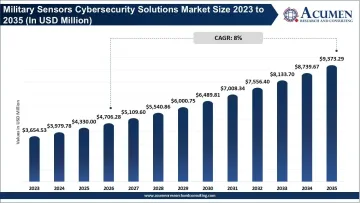
The global military sensors cybersecurity solutions market size was valued at USD 4,330 million in 2025. The market is observed to reach USD 9,373.29 million by 2035; while growing at a CAGR of 8% during the forecast period of 2026-2035. Increasing military investment in connected, AI-enabled, autonomous, and multi-domain defense systems is creating a larger requirement for cybersecurity protection across increasingly sophisticated sensor networks. The rapid expansion of electronic warfare, ISR, unmanned systems, and network-centric operations is further increasing the need to protect sensor integrity, communications, and mission-critical data from cyber and cyber-physical attacks.
Key Takeaways
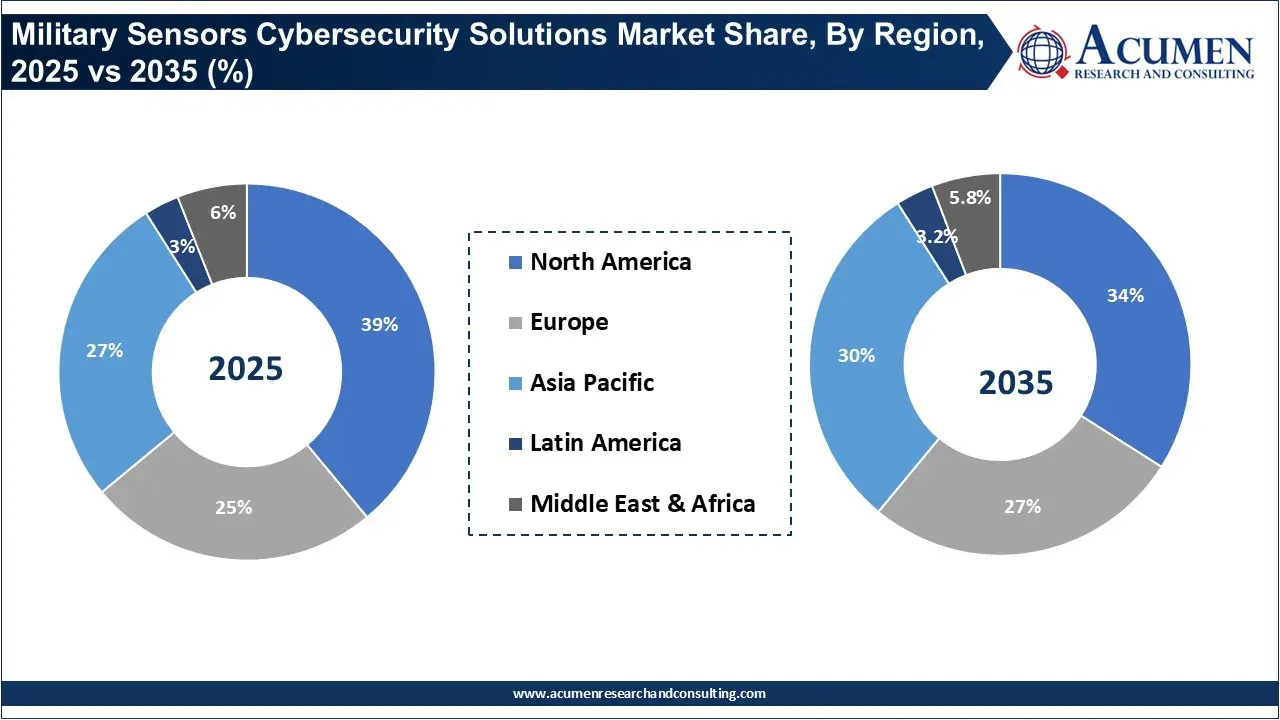
- By region, North America dominated the military sensor cybersecurity market in 2025 with a 39% share, supported by advanced defense infrastructure, high defense spending, leading defense technology companies, and extensive deployment of networked military sensing systems.
- By region, Asia Pacific accounted for 27% of the military sensors cybersecurity solutions market in 2025 and is projected to grow at the fastest regional CAGR of 9.2% during 2026–2035, driven by defense modernization, expanding military sensor deployments, autonomous platforms, and increasing investments in cyber resilience.
- By region, Europe held a 25% share of the military sensors cybersecurity solutions market in 2025, supported by defense modernization, interoperable military systems, C4ISR integration, and rising requirements for secure communications and resilient sensor networks.
- By solution type, software dominated the military sensors cybersecurity solutions market in 2025 with a 47% share, driven by the growing need to secure connected sensors, digital networks, command-and-control systems, and defense data infrastructure.
- By solution type, services held the second-largest share at 35% in 2025, supported by increasing demand for cybersecurity consulting, system integration, managed security, testing, incident response, and lifecycle support across complex military sensor environments.
- By sensor type, radar dominated the military sensors cybersecurity solutions market in 2025 with a 34% share, reflecting the critical role of radar in surveillance, early warning, air defense, target tracking, maritime monitoring, and other mission-critical defense applications.
- By sensor type, electronic warfare and signals intelligence (EW & SIGINT) accounted for an 18% share in 2025, supported by the growing strategic importance of protecting electromagnetic-spectrum operations, signal intelligence, and mission-critical sensor data.
- By sensor type, electronic warfare and signals intelligence (EW & SIGINT) is expected to grow at the fastest CAGR of 9.8% during 2026–2035, driven by rising dependence on electromagnetic-spectrum operations and increasing cybersecurity requirements for intercepting, analyzing, and exploiting sensitive signals.
- By platform, airborne platforms dominated the military sensors cybersecurity solutions market in 2025 with a 28% share, supported by the extensive deployment of radar, EO-IR, electronic warfare, navigation, and communication sensors across fighter aircraft, reconnaissance aircraft, helicopters, and unmanned aerial vehicles.
- By platform, naval platforms held the second-largest share at 20% in 2025, driven by the growing integration of radar, sonar, electronic warfare, navigation, communication, and surveillance sensors into networked maritime command-and-control architectures.
Executive Overview
The military sensors cybersecurity solutions market is growing strategically as defense forces rely more and more on networked sensors to provide surveillance, reconnaissance, targeting, navigation, electronic warfare, missile defense and battlefield awareness, etc. The growth in network-centric warfare, autonomous platforms, AI-powered sensing and digitized military architectures is generating and transporting larger quantities of mission-critical data across defense networks while it increases the attack surface.
As a result, military sensor cybersecurity means more than just cyber-protection of networks and covers sensor information itself, transmissions, firmware/software, interfaces, sensor-to-command streams from hacking, spoofing, tampering, malware, other cyber-physical attacks.
Global Military Spending & Its Projection
- China: China's military expenditure reached an estimated $336 billion in 2025, increasing 7.4% year over year. China has recorded continuous increases in military expenditure for more than three decades, supporting sustained investment in advanced military platforms, electronic warfare, cyber capabilities, and networked defense infrastructure.
- Russia: Russia spent an estimated $190 billion on its military in 2025, representing a 5.9% increase from 2024. Military expenditure remained exceptionally high relative to the country's economy, reflecting continued wartime spending and investment in defense capabilities.
- Germany: Germany recorded one of the fastest increases among the world's largest military spenders, reaching $114 billion in 2025, an increase of 24% from 2024. Germany ranked fourth globally, highlighting the acceleration of European defense modernization.
- India: India's military expenditure reached $92.1 billion in 2025, increasing 8.9% year over year and making India the fifth-largest military spender globally. The continued expansion of India's defense budget supports domestic military modernization, advanced surveillance capabilities, electronics, unmanned systems, and indigenous defense technologies.
- United Kingdom: The UK allocated approximately $89 billion to military expenditure in 2025, ranking sixth globally. Spending declined 2.0% from 2024, although the country remained among the world's largest defense spenders.
- Ukraine: Ukraine's military expenditure reached an estimated $84.1 billion in 2025, representing a 20% increase from 2024. Its exceptionally high defense expenditure reflects continued wartime mobilization and extensive investment in military capabilities.
Market Dynamics
Driver
Increasing Adoption of Networked Military Sensors
As the use of networked radar, EO-IR, EW, navigation, sonar and other defense sensors grows, security solutions for this infrastructure will also be required. It is becoming commonplace for sensors to share mission critical information with command-and-control stations, communication links, cloud resources and networked devices, significantly expanding the likely attack surface. This is the consequence of military reliance on multi-domain operations, autonomous and AI-enabled platform and connected C4ISR systems.
Restraint
Legacy Defense Systems and Integration Complexity
The presence of legacy military platforms and sensor systems can constrain the adoption of advanced cybersecurity solutions. Many defense systems were designed before current cyber threats emerged and may use outdated architectures, proprietary interfaces, or hardware that is difficult to upgrade without affecting mission performance.
Integrating modern cybersecurity technologies with these systems can require extensive testing, certification, customization, and lifecycle investment, increasing deployment complexity and costs.
Opportunity
AI-Driven Cybersecurity for Military Sensor Networks
The continued growth in the utilization of AI and ML presents tremendous opportunities in next generation of cybersecurity for military sensor networks. AI systems have the ability to learn massive amounts of sensor network and sensor data, detecting anomalies, detecting intrusions, assisting in faster responses, and many other features distributed throughout a defense environment.
With military forces growing use of autonomous systems and UAV's and increasing use of electronic warfare and multidomain capabilities, a strong need for advanced cyber solutions protecting dynamic sensor systems is expected to grow.
Regional Analysis
North America Military Sensors Cybersecurity Solutions Market Landscape & Dynamics
North America held the largest market share in the military sensors cybersecurity solutions market in 2025, at 39% of the total market. The increasing adoption of radar, EO/IR sensor, EW system, navigation sensor, and other connected sensing asset capabilities is expanding the military's attack surface. Advanced military infrastructure, increased defense spending and use of networked sensors for air borne, ground borne, ship borne, space-borne and missile defense platforms lead to dominant share of North America market.
Factors such as leading defense contractors, aerospace players, cybersecurity services providers, and hardware/software developer presence contribute towards higher demand in North America region. Additionally, increase in the deployment of the AI driven military systems, autonomous vehicles and platforms, cloud based defense systems and multi-domain operations are augmenting huge flow of data and significance of sensor information, hence demanding cybersecurity solutions.
Europe Military Sensors Cybersecurity Solutions Market Analysis
In 2025, Europe was valued second, in terms of the overall market, holding a share of 25%. Defense systems and operation were experiencing upgrade and advancement with military cyber defense becoming important for interconnected military defense systems.
The increase use of advanced sensing & surveillance system in air, navy, land-systems, and missile-defense systems of Europe also gives increased impetus to safe communication of data and network resilience in sensor systems.
The focus on interoperability between military defense systems of allied countries, due to a demand for commonality across national armed forces, has given immense impetus to cybersecurity as sensors are likely to operate as nodes within C4ISR frameworks. Issues related to electronic warfare, cyber espionage, compromise of critical infrastructure, threats on military communications network further boosted demand.
Asia Pacific Military Sensors Cybersecurity Solutions Market Opportunities & Strategic Outlook
Asia Pacific contributed a 27% share of the military sensors cybersecurity solutions market in 2025 thus ranking second largest by market share at the regional level while becoming one of the larger growth market region simultaneously, registering a CAGR of 9.2% in the forecast period 2026-2035.
The growth of the regional market is also driven by growing defense modernization programs, network extension of military sensors and rising expenditure in electronic warfare, surveillance technologies and interconnected digital defense platforms in the region.
Countries of the Asia Pacific are enhancing radar, EO-IR, underwater sensors, navigation, ISR capabilities, while simultaneously increasing spending in cyber defense solutions. Rapid implementation of UAVs, autonomous, naval platforms, missile-defense, satellite-based military systems has increased reliance on connected sensors for carrying out military operations successfully.
Consequently, data integrity, uninterrupted operational capability, anti-jamming capabilities and malware protection will only gain importance with the increasing trend of network-centric military operations.
Segmental Analysis
Solution Type Insights
Software dominated the military sensors cybersecurity solutions market by solution type in 2025, accounting for 47% of the total market. The dominance of software reflects the increasing need to protect the digital layer connecting military sensors, platforms, communication networks, command-and-control systems, and defense data infrastructure. Modern military sensors increasingly operate as part of integrated digital ecosystems rather than as standalone systems, making software-based cybersecurity essential for detecting, preventing, and responding to cyber threats.
Security software can provide capabilities such as intrusion detection, endpoint protection, network monitoring, threat intelligence, access control, encryption, vulnerability management, anomaly detection, and real-time threat response.
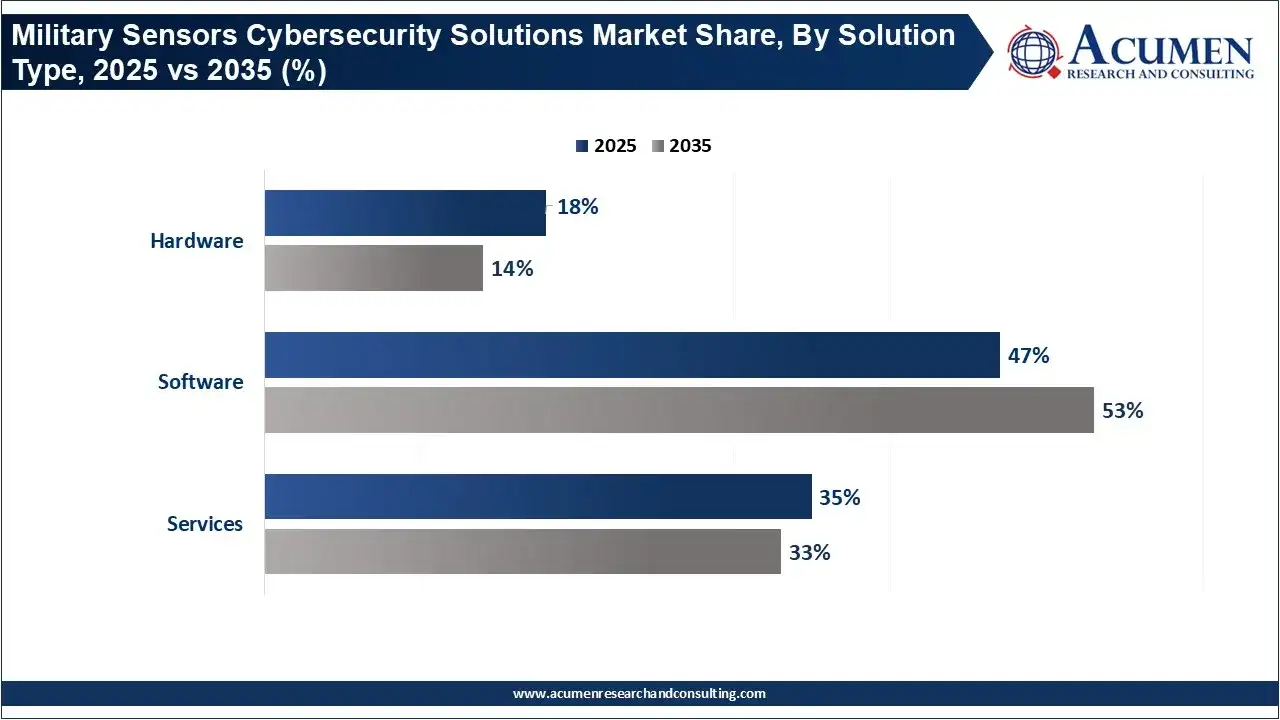
The services segment held the second-largest solution type in 2025 at 35%. The defense sector looks to cybersecurity services for design, deployment, management, monitoring, and ongoing enhancements of security architecture necessary for securing the sensor network and interlinked defense systems.
Services offered can take numerous forms, such as; consultancy; system integration; managed services; penetration testing; incident response; maintenance and life cycle support, among many others. Complex military sensor environments necessitate specific know how to achieve seamless integration of the cybersecurity capabilities and interlinking into and among older as well as newer systems.
Sensor Type Insights
Radar sensor sensors led the market in the military sensors cybersecurity solutions sector in 2025, taking a market share of 34 percent. In terms of market size in 2025 it held approximately $1,472.20 million of the market. Radar systems are basic to surveillance, early warning, air defense, detection and tracking of the targets in the battlefield, maritime monitoring and other types of defense systems hence they play a critical role in security systems and are the critical most assets.
Current radar systems use modern components like digital processing, wired or wireless connections, and software-defined capabilities and these use of systems further enhance vulnerability to cyberattacks in the system.
Military Sensors Cybersecurity Solutions Market Share, By Sensor Type, 2025 & 2035 (%)
| Sensor Type | Revenue Share, 2025 (%) | Revenue Share, 2035 (%) |
|---|---|---|
| Radar | 34% | 31% |
| Electro-Optical / Infrared Sensors (EO-IR) | 20% | 21% |
| Electronic Warfare & Signals Intelligence Sensors | 18% | 21% |
| Sonar & Underwater Sensors | 10% | 10% |
| Navigation & Positioning Sensors | 7% | 7% |
| Acoustic & Seismic Sensors | 4.10% | 4% |
| CBRN Sensors (Chemical, Biological, Radiation, Nuclear) | 3% | 3.10% |
| Others | 3.90% | 2.90% |
Electronic Warfare & Signals Intelligence (EW & SIGINT) sensors represented the second-largest sensor type in 2025, accounting for 18% of the market, while also registering the fastest projected growth among the sensor categories, with a CAGR of 9.8% during 2026–2035. The segment was valued at approximately $779.40 million in 2025 and is expected to reach $1,968.39 million by 2035. The rapid growth of EW and SIGINT cybersecurity is closely associated with the increasing importance of electromagnetic-spectrum operations in modern warfare. These systems collect, analyze, intercept, identify, and exploit electromagnetic signals, making the integrity, confidentiality, and availability of their data particularly important.
Platform Insights
Airborne platforms dominated the military sensors cybersecurity solutions market in 2025, accounting for 28% of the total market. The segment's leadership reflects the extensive use of sophisticated sensor systems across fighter aircraft, military transport aircraft, airborne early-warning platforms, reconnaissance aircraft, helicopters, and unmanned aerial vehicles. Airborne platforms rely on radar, EO-IR, electronic warfare, navigation, communications, and other sensors to support surveillance, targeting, reconnaissance, threat detection, and mission execution. As these aircraft increasingly become networked and software-intensive, cybersecurity has become critical for protecting sensor data, avionics interfaces, communication links, and mission systems.
Military Sensors Cybersecurity Solutions Market Share, By Platform, 2025 & 2035 (%)
| Platform | Revenue Share, 2025 (%) | Revenue Share, 2035 (%) |
|---|---|---|
| Airborne | 28% | 27% |
| Naval | 20% | 21% |
| Submarine | 12% | 12% |
| Ground | 19% | 18% |
| Missile/Air Defense | 14% | 15% |
| Space | 5% | 6% |
| Others | 2% | 1% |
As the second largest platform category, in 2025, military sensor cyber security accounts for the military platform's largest section- naval platform with a market size 20%. A well-established and wide network of radars, sonars, electronic warfare, navigation system, communications systems and surveillance sensors is indispensable to the operation of naval forces so that they can attain maritime situational awareness, and carry out warfare effectively. The adoption of central command and control (C2) architectures enables easier network sensors in naval platforms, making security vital for operationability and information security.
Military Sensor Cybersecurity Solution Supply Chain Structure
| Supply Chain Stage | Key Participants | Role in Military Sensor Cybersecurity |
|---|---|---|
| Raw Materials & Components | Semiconductor manufacturers, electronic component suppliers, secure chip manufacturers | Supply processors, memory, RF components, encryption-enabled chips, sensors, and other electronic components |
| Sensor Hardware | Radar, EO-IR, EW/SIGINT, sonar, navigation and CBRN sensor manufacturers | Develop and manufacture mission-critical sensing equipment used across military platforms |
| Cybersecurity Hardware | Secure processors, hardware security modules, trusted computing suppliers, network security hardware providers | Protect sensor hardware, data interfaces, communications links, and embedded systems |
| Cybersecurity Software | Cybersecurity vendors, defense software developers, threat intelligence providers | Provide intrusion detection, endpoint security, encryption, access control, anomaly detection, monitoring, and threat response |
| System Integration | Defense primes, aerospace companies, systems integrators | Integrate sensors, cybersecurity technologies, communications, C4ISR, command-and-control, and platform systems |
| Communication & Networking | Tactical network providers, secure communications companies, satellite and data-link providers | Enable secure transmission of sensor data across platforms and command networks |
| Testing & Certification | Defense testing organizations, cybersecurity assessment firms, certification bodies | Conduct vulnerability assessments, penetration testing, security validation, compliance testing, and accreditation |
| Managed Security & Operations | Managed security providers, defense cyber operations companies, SOC providers | Monitor military networks, detect threats, conduct incident response, and provide continuous security operations |
| Maintenance & Lifecycle Support | OEMs, cybersecurity service providers, system integrators | Provide software updates, vulnerability remediation, upgrades, maintenance, and long-term cybersecurity support |
| End Users | Army, Navy, Air Force, Space Force, intelligence and defense organizations | Operate protected sensors and use secured sensor data for surveillance, intelligence, targeting, navigation, and mission operations |
Mergers, Acquisitions and Strategic Investments
- Lockheed Martin was reported in 2026 to be leading discussions to acquire Ultra Maritime in a transaction valued at approximately $3.5 billion. Ultra Maritime specializes in anti-submarine and undersea defense technologies, including sensor-intensive systems used by the U.S. and UK navies.
- Defense technology company Space-Eyes agreed to go public through a proposed $638 million SPAC merger in 2026. The company develops AI-enabled counter-drone and geospatial intelligence technologies, including systems designed to identify and respond to drone-related threats.
Leading Companies
- Lockheed Martin Corporation
- Northrop Grumman Corporation
- RTX Corporation
- BAE Systems plc
- Thales Group
- Leonardo S.p.A.
- L3Harris Technologies, Inc.
- General Dynamics Corporation
- Honeywell International Inc.
- Boeing Company
Segments Covered
By Solution Type
- Hardware
- Software
- Services
By Sensor Type
- Radar
- Electro-Optical / Infrared Sensors (EO-IR)
- Electronic Warfare & Signals Intelligence Sensors
- Sonar & Underwater Sensors
- Navigation & Positioning Sensors
- Acoustic & Seismic Sensors
- CBRN Sensors (Chemical, Biological, Radiation, Nuclear)
- Others
By Platform
- Airborne
- Naval
- Submarine
- Ground
- Missile/Air Defense
- Space
- Others
By Region
- North America
- Europe
- Asia-Pacific
- Latin America
- Middle East & Africa
Looking for discounts, bulk pricing, or custom solutions? Contact us today at sales@acumenresearchandconsulting.com
Frequently Asked Questions

Other Aerospace And Defence Reports
April 2025
May 2024
October 2018
December 2024