
Artificial Intelligence Sensor Market Size to Hit USD 237.61 Billion by 2035, CAGR of 44.2%
Published : 21 Jul 2026
Author : Simone Lamb



What is the AI Sensor Market Size?
The global artificial intelligence (AI) sensor market size reached at USD 6.10 billion in 2025 and is expected to hit around USD 237.61 billion by 2035, expanding at a CAGR of 44.2% during the forecast period 2026 to 2035. The artificial intelligence sensor market is experiencing robust growth due to the increasing adoption of autonomous systems, industrial automation, and intelligent IoT devices across multiple industries. Continuous advancements in semiconductor technologies, edge AI computing, and computer vision algorithms are further accelerating the deployment of AI-powered sensing solutions worldwide.
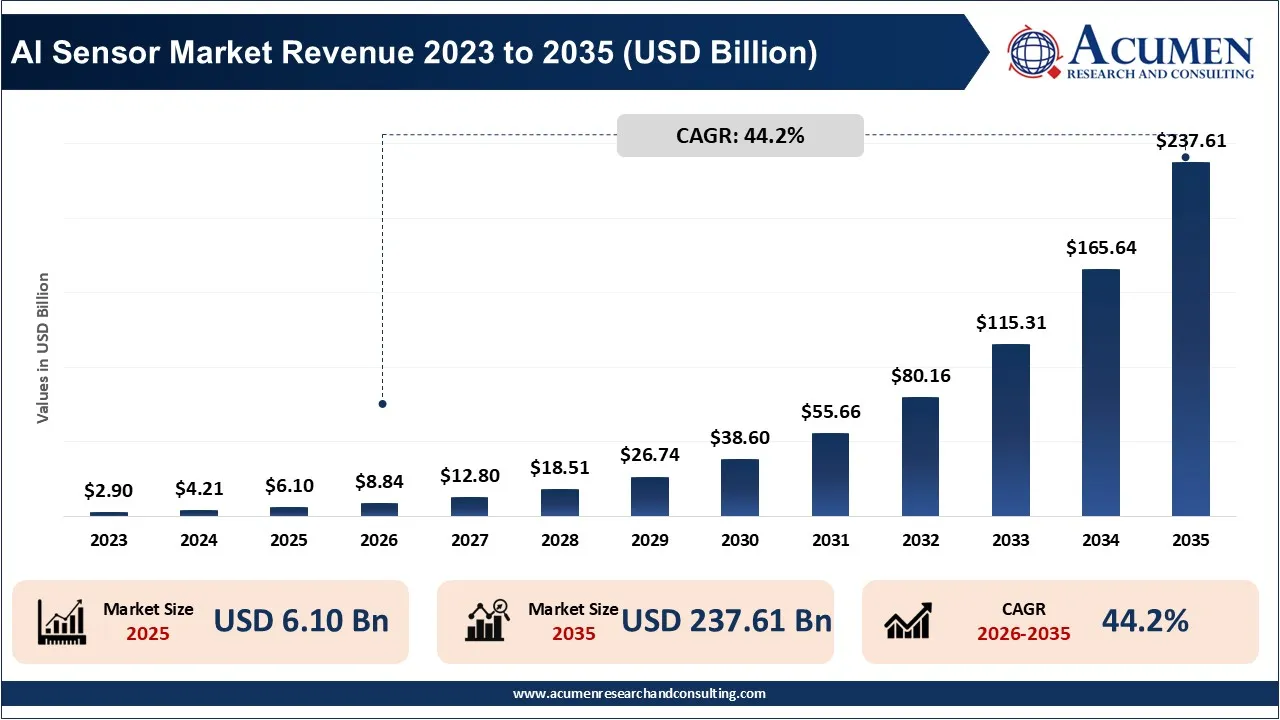
The AI sensor market includes intelligent sensing technologies that couple AI algorithms with sensors for capturing, processing, analyzing and interpreting real time environmental, vision, motion, audio and spatial data. AI sensors couple together various technologies that include artificial intelligence, machine learning, computer vision, sensor fusion, edge computing that allows autonomous perception, prediction, decision making and intelligent automation for variety of applications.
These sensors are being adopted in a variety of application areas, including autonomous vehicle systems, robots, industrial automation, consumer electronics, healthcare and medical devices, aerospace and defense equipment, smart city applications and IoT networks. Increasing demand for real-time intelligence and increased automation, real-time insights and decision-making have fuelled the demand for artificial intelligence sensors.
Artificial Intelligence Sensor Market Statistics
- By region North America accounted for the largest share of revenue of 36.0% in 2025 from AI sensor market. North America accounts for the major share because the use of AI enabled sensing technologies has been implemented on early stages in the automotive, robotics, healthcare, and industrial automation sector. The presence of leading players that produce semiconductors along with the existence of sophisticated AI based infrastructure will keep North America’s lead intact.
- By region Asia Pacific is poised to record a significant CAGR of 50.8% during the forecast period. The region’s growth is driven by the increasing industrial automation activities, expanding manufacturing sector of consumer electronics, robotics, and smart sensors. Several governmental support initiatives aimed at AI advancement, and significant investment across China, Japan, South Korea, and India are driving the market.
- By sensor type, image & vision sensors held the highest market revenue share of 34.0% in 2025. These sensors are majorly used in computer vision technologies including object detection, face recognition, navigational support, industrial inspections, etc. The ever-growing applications in autonomous vehicles, robots, and smart surveillance systems continue to contribute to the overall demand of image and vision sensors.
- By sensor type, proximity and distance sensors generated the second highest market share of 17.8% in 2025. The sensors enable obstacle detection, collision avoidance, navigational systems for robots, industrial automation. An increase in applications such as advanced driver assistance system and robotics is fueling the use of proximity and distance sensors.
- By component, hardware captured a dominant share of revenue with 68.0% in 2025 from the AI sensor market. AI sensor hardware including image and vision cameras, LiDARs, radars, processors, and sensing modules form the base of intelligent perception systems. Ongoing advancements in semiconductor technology and miniaturization are expected to propel growth of hardware component.
- By component, software generated a market share of 22.0% in 2025 from the AI sensor market. AI software facilitate sensors for feature fusion, inference of machine learning algorithms, real-time analytics and real-time decision-making on received data from the sensors. With increasing interest in edge artificial intelligence and automation, adoption of AI software in sensors is expected to rise rapidly.
- By deployment, edge AI sensors held a maximum share in AI sensor market which is 62.0% in 2025, in view of lower latency and increased efficiency for autonomous applications. The hardware and software components within AI sensors analyze and process data at the source, minimizing delay and ensuring real-time response. Early adoption by critical industries including autonomous driving and automation of factories are the driving factors for growth of edge AI sensors.
- By deployment, cloud-connected AI sensors garnered second largest market share revenue of 38.0% in 2025 from AI sensor market. Data management, large-scale analytics, remote monitoring, and AI training are conducted by these sensors using the cloud resources. An increased usage of connected device networks and large scale cloud infrastructure across different industries are leading the cloud connected AI sensors market.
- By end-user industry, automotive and transportation held a lion's share of the global AI sensor market with 27.0% in 2025. With an increased integration in the vehicle's adas, navigation systems, automatic driving platforms, and anti-collision systems, AI sensors are expected to witness significant demand. Rapid investment in smart mobility is boosting the market across automotive and transportation industry.
- By end-user industry, consumer electronics represents second largest market revenue with a share of 20.0% in 2025 from AI sensor market. Image and vision sensors are increasingly incorporated in smartphones, wearable electronics devices, AR/VR glasses and smart home devices to enable advanced user experience. Driven by the growing demand for intelligent and connected consumer devices, AI sensors in consumer electronics industry are rapidly being adopted.
Will Edge AI Sensors Become the Foundation of Fully Autonomous Intelligent Systems?
The edge intelligence revolution opens significant new possibilities for the AI sensor market. Increasingly, as AI is applied to smart connected machines, including autonomous driving, collaborative robots (cobots), smart factories, medical devices and IoT products such as intelligent cameras, people and object detection devices require intelligence and decision making at the device or network edge level. By processing information on the spot rather than sending all of it to a central data centre, AI sensors will dramatically reduce lag time, boost privacy, enable greater reliability, lower cloud costs and improve system design efficiency.
Artificial Intelligence Sensor Market Regional Outlook
North America accounted for the largest share of the artificial intelligence sensor market in 2025, attributing to the well-established semiconductor infrastructure, cutting-edge artificial intelligence research and development (R&D), and high uptake of intelligent sensors in the automotive, healthcare, robotics and industrial sectors. The existence of top AI-focused firms, semiconductor manufacturers and manufacturers of self-driving vehicles has propelled artificial intelligence sensors towards faster innovation and commercialization.
The artificial intelligence sensor market in Asia Pacific is likely to be among the fastest growing over the predicted timeframe due to rapid industrial growth, growing electronic manufacturing base and an ever increasing number of artificial intelligence robot applications. The economic superpowers like China, South Korea, Japan and India have made massive investments in their manufacturing of semiconductors, artificial intelligence and autonomous mobility. Artificial intelligence sensors manufacturers could gain significant momentum in the region.
The Latin American market will be gradually influenced by smart technologies with adoption across the industrial sectors and smart city development initiatives, the MEA (Middle East & Africa) market is poised for steady rise, fueled by rise in smart city development initiatives and automation technologies.
Top Companies in the Artificial Intelligence Sensor Market
The artificial intelligence sensor market is characterized by the presence of various global semiconductor companies, sensor providers, and AI technology companies heavily investing in developing smart sensing platform and edge AI innovations. The prominent vendors in the market consist of Sony Group Corporation, Samsung Electronics Co., Ltd., Intel Corporation, NVIDIA Corporation, Qualcomm Incorporated, STMicroelectronics N.V., Infineon Technologies AG, Texas Instruments Incorporated, Bosch Sensortec GmbH, and OmniVision Technologies, Inc.
These players contribute to growth in this market by offering AI image sensors, LiDar sensors, radar, edge AI processors, Mems sensors, and sensor fusion platform in Automotive, industrial, Consumer electronics and Healthcare sector. Investments in AI silicon, image sensors and strategic collaborations with Automotive and robotics industries are also contributing to the innovation.
Segment Covered
By Sensor Type
- Image & Vision Sensors
- Motion & Inertial Sensors
- Pressure Sensors
- Temperature Sensors
- Proximity & Distance Sensors
- Acoustic Sensors
- Chemical & Environmental Sensors
- Others
By Component
- Hardware
- Software
- Services
By Deployment
- Edge AI Sensors
- Cloud-Connected AI Sensors
By End-User Industry
- Automotive & Transportation
- Consumer Electronics
- Industrial & Manufacturing
- Healthcare & Medical Devices
- Aerospace & Defense
- Retail & E-Commerce
- Energy & Utilities
- Agriculture
- Telecommunications
- Smart Buildings & Smart Cities
- Others
By Region
- North America
- Europe
- Asia Pacific
- Latin America
- Middle East & Africa
Contact Us:
Mr. Richard Johnson
Acumen Research and Consulting
India: +91 8983225533