
Predictive AI Market Size to Surge USD 155.88 Billion by 2035, CAGR of 21.6%
Published : 21 Jul 2026
Author : Lucas Hoffmann



What is the Predictive AI Market Size?
The global predictive AI market size was accounted for USD 22 billion in 2025 and is expected to surge USD 155.88 billion by 2035, growing at a CAGR of 21.6% over the forecast period from 2026 to 2035. The increasing volume of enterprise data, rapid adoption of cloud computing, and growing demand for real-time predictive decision-making are significantly driving the growth of the predictive AI market. Additionally, advancements in machine learning algorithms, high-performance computing, and generative AI technologies are enabling organizations to improve forecasting accuracy, operational efficiency, and customer experience across multiple industries.
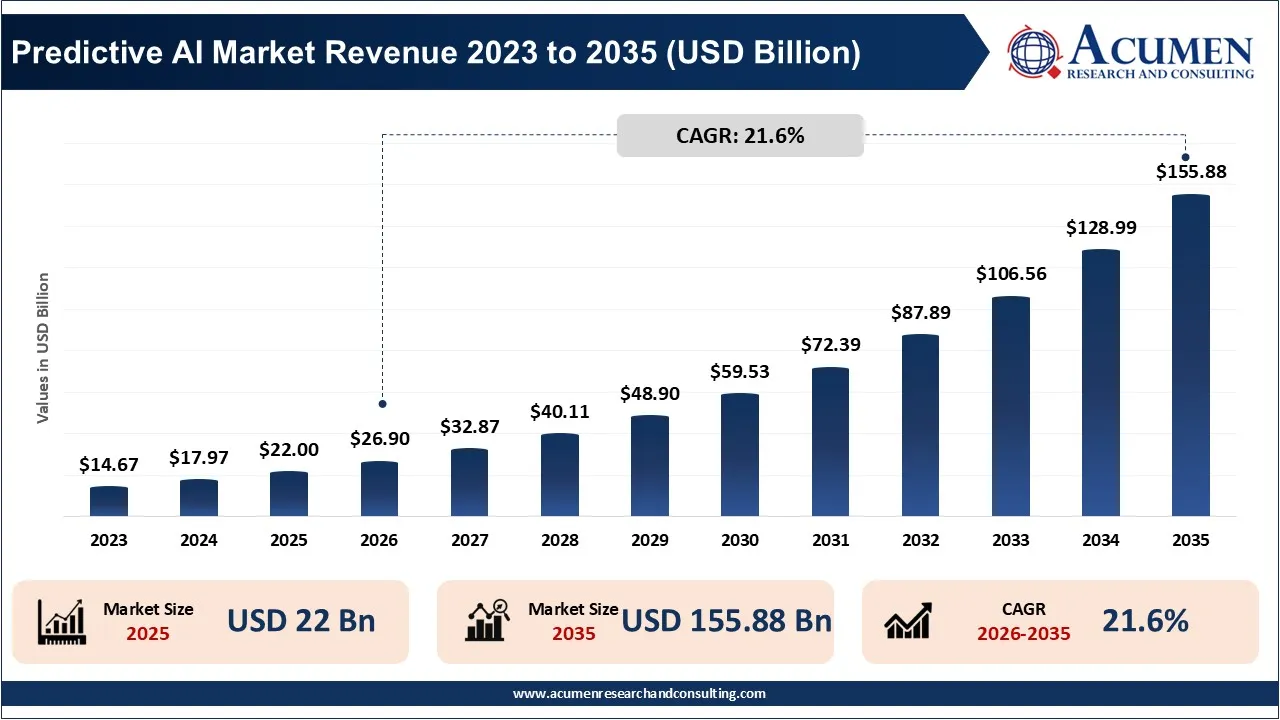
The predictive AI market refers to the global industry that includes a provider of AI-powered prediction solutions that predict future trends, risks, business, and future events using current and past data. Predictive AI uses ML, DL, NLP, predictive modeling, statistical learning, and other cutting-edge technology to aid in business and organization decisions through proactive methods. These solutions are widely implemented through hybrid, on-premises, and cloud environments.
Some of the key predictive AI use cases include customer analytics, risk management, revenue forecasting, demand planning, fraudulent activities, predictive maintenance, etc.
Increase in digitalization, increased data in businesses and enterprise, and the need for the automation tools will drive the growth of the market.
Predictive AI Market Statistics
- By region, North America is expected to maintain the largest share, accounting for 40% of the global predictive AI market in 2025. Key factors supporting its market growth include increasing commercialization of artificial intelligence (AI) technology, advancement of cloud infrastructure, and extensive adoption of predictive analytics solutions across enterprises in the region. Rapid deployment of AI technology by major technology companies in North America further drives the regional market.
- By region, Asia Pacific is projected to experience a high growth rate with a CAGR of 25.5% during the forecast period. Increasing deployment of industrial automation, growth in the digital transformation sector, and government support for AI development are fueling rapid adoption of AI in the Asia Pacific region. This region is characterized by a surge in technology investment in countries such as China, Japan, India, and South Korea.
- By component, software represented a major share of 64% of the global predictive AI market in 2025. Enterprises increasingly use predictive analytics, forecasting, and business intelligence tools to improve operational efficiency. These platforms enable businesses to analyze complex datasets and make data-driven decisions. The adoption of AI-powered software solutions, cloud native analytics, and a range of predictive software tools continues to support the segment.
- By component, hardware accounted for the second-largest share in the global predictive AI market, which was 21% in 2025. This growth in the hardware segment can be attributed to increasing deployment of hardware for artificial intelligence processing including AI accelerators, CPUs, GPUs, and edge computing hardware to run increasingly complex predictive AI algorithms. The demand for advanced high performance computing solutions also supports growth in the hardware segment.
- By technology, machine learning was a prominent technology with a 42% share in the global predictive AI market in 2025. Machine learning (ML) technology continues to lead the predictive AI market as it is efficient in analyzing structured data and is one of the most widely used prediction technologies for applications such as predictive maintenance, fraud detection, forecasting, and predictive modeling.
- By technology, deep learning technology garnered 26% of the predictive AI market share in 2025. Deep learning is increasingly adopted by the industry to analyze large sets of unstructured data, such as images, videos, text and audio, and generate predictive insights for multiple applications. This technology provides accurate prediction outcomes.
- By deployment, cloud-based deployment represented 56% revenue share of the global predictive AI market in 2025. Cloud deployment is preferred due to flexibility, scalability, cost efficiency, and quick setup time for predictive AI solutions. Rise in adoption of cloud AI platforms is contributing to market growth.
- By deployment, hybrid deployment segment is projected to witness the fastest growth during the forecast period with a CAGR of 25.9% from 2026 to 2035. Hybrid deployment model combines the advantages of both cloud and on-premises deployment and offers benefits such as enhanced security and regulatory compliance while providing flexibility for managing sensitive business data.
- By enterprise size, large enterprises dominated the market with 72% of the total predictive AI market share in 2025. Large enterprises typically have high investments, extensive data assets and infrastructure to implement predictive AI capabilities for analyzing complex data, automating processes and gaining competitive advantage. Ongoing adoption of enterprise AI strategy also supports growth in this segment.
- By enterprise size, SMEs held a market share of 28% in 2025. Increasing adoption of cost-effective Software-as-a-Service (SaaS)-based predictive AI solutions and no-code AI tools is empowering small and medium enterprises (SMEs) to utilize AI. Also, increasing initiatives in the digital transformation are supporting the segment growth.
- By application, customer analytics was the leading application of predictive AI, holding 22% market share in 2025. Businesses use predictive analytics for understanding customer behavior, predicting purchasing trends, improving personalization, reducing churn rates and enhancing customer experiences. The growing need to gain data-driven insights about customers drives this segment's growth.
- By application, demand forecasting held the second-largest share, at 18% in the global predictive AI market in 2025. Predictive AI is used for optimizing inventory, improving production planning, strengthening the supply chain, and better understanding market fluctuations. The dynamic economic environment and changing customer demands are leading enterprises to implement demand forecasting solutions.
- By end-use industry, BFSI industry occupied the largest share of the predictive AI market, standing at 24% in 2025. Banks and other financial institutions adopt predictive AI solutions to detect fraud, predict loan defaults, assess credit risk, and analyze customer behavior. The need for fraud detection, enhanced customer engagement, and regulatory compliance is driving the market.
- By end-use industry, manufacturing sector held the second-largest market share, with 15% in 2025. The manufacturing industry leverages predictive AI for predictive maintenance, optimization of production processes, quality control, and demand forecasting in the supply chain. Adoption of Industry 4.0 technologies, automation, and digital transformation are key factors driving growth in this segment.
Can Generative AI Accelerate the Next Evolution of Predictive AI?
AI companies can empower enterprises to enhance the decision-making and predictive processes through generative AI’s synergy with predictive AI organizations can forecast the business results, build action-based recommendation for business, build simulated business models for different cases, facilitate the planning of strategic initiative, optimize decision support applications; Generative AI with the support of predictive AI can help enterprises optimize the whole process real-time, improve robustness of business process, customize customer experience with excellent efficiency, build the business in accordance with customer behavior, open up new revenue streams for the solution provider.
Predictive AI Market Regional Outlook
North America is estimated to hold the largest share of the predictive AI market in 2025 because of the well-established AI ecosystem, advanced cloud capabilities, and substantial integration of AI analytics solutions by enterprises. The U.S. is contributing majorly to the regional market due to consistent R&D investment in AI, robust adoption of AI across sectors such as BFSI, healthcare, retail, and manufacturing, and considerable penetration by AI technology providers.
Asia-Pacific is projected to register the highest growth rate during the forecast period as a result of increased adoption of digital technologies and cloud, in conjunction with proactive government initiatives aimed at stimulating AI-related innovation. Countries like China, India, Japan, and South Korea are witnessing massive investments in AI R&D, smart manufacturing, fin-tech solutions, and intelligent automation.
Latin America’s adoption is being driven by increasing digital transformation by companies and adoption of cloud technologies, and the Middle East & Africa region sees a surge in investments toward AI-enabled smart cities, the banking and finance sector, and the public sector’s transformation programs.
Who are the top companies in the Predictive AI Market?
The predictive AI market is quite competitive, and prominent technology giants are constantly investing in developing next-generation AI platforms, cloud analytics solutions, machine learning algorithms, and enterprise automation technologies. Some of the dominant players in the market are the likes of Microsoft Corporation, Google LLC, Amazon Web Services (AWS), IBM Corporation, Oracle Corporation, SAP SE, SAS Institute Inc., Salesforce Inc., Intel Corporation, and NVIDIA Corporation.
These major players are continually leveraging innovation across AI software, cloud services, AI accelerators, analytics platforms, and industry-specific predictive solutions to deepen the penetration of predictive AI in enterprise operations worldwide. Also, the players in the market are actively involved in strategic mergers, acquisitions and partnerships within generative AI and LLMs (large language models).
Segments Covered
By Component
- Software
- Hardware
- Services
By Technology
- Machine Learning
- Deep Learning
- Natural Language Processing (NLP)
- Computer Vision
- Others
By Deployment
- Cloud-Based
- On-Premises
- Hybrid
By Enterprise Size
- Large Enterprises
- Small & Medium Enterprises (SMEs)
By Application
- Customer Analytics
- Demand Forecasting
- Fraud Detection
- Risk Management
- Predictive Maintenance
- Sales & Revenue Forecasting
- Others
By End-Use Industry
- BFSI
- Manufacturing
- Healthcare
- Retail & E-commerce
- IT & Telecommunications
- Energy & Utilities
- Government
- Others
By Region
- North America
- Europe
- Asia-Pacific
- Latin America
- Middle East & Africa
Contact Us:
Mr. Richard Johnson
Acumen Research and Consulting
India: +91 8983225533