
Artificial Organs Market Size to Reach USD 63.31 Billion by 2035, Reflecting a CAGR of 8.2%
Published : 15 Sep 2026
Author : Lucas Hoffmann



What is the Artificial Organs Market Size?
The global artificial organs market size was valued at USD 28.71 billion in 2025 and is projected to reach at USD 63.31 billion by 2035; growing at a CAGR of 8.2% over the forecast period from 2026 to 2035. Developments in cell-based technologies, 3D bioprinting, microfluidics, and hybrid artificial organs are creating new opportunities for the market to expand beyond traditional mechanical organ replacement toward increasingly sophisticated and integrated solutions.
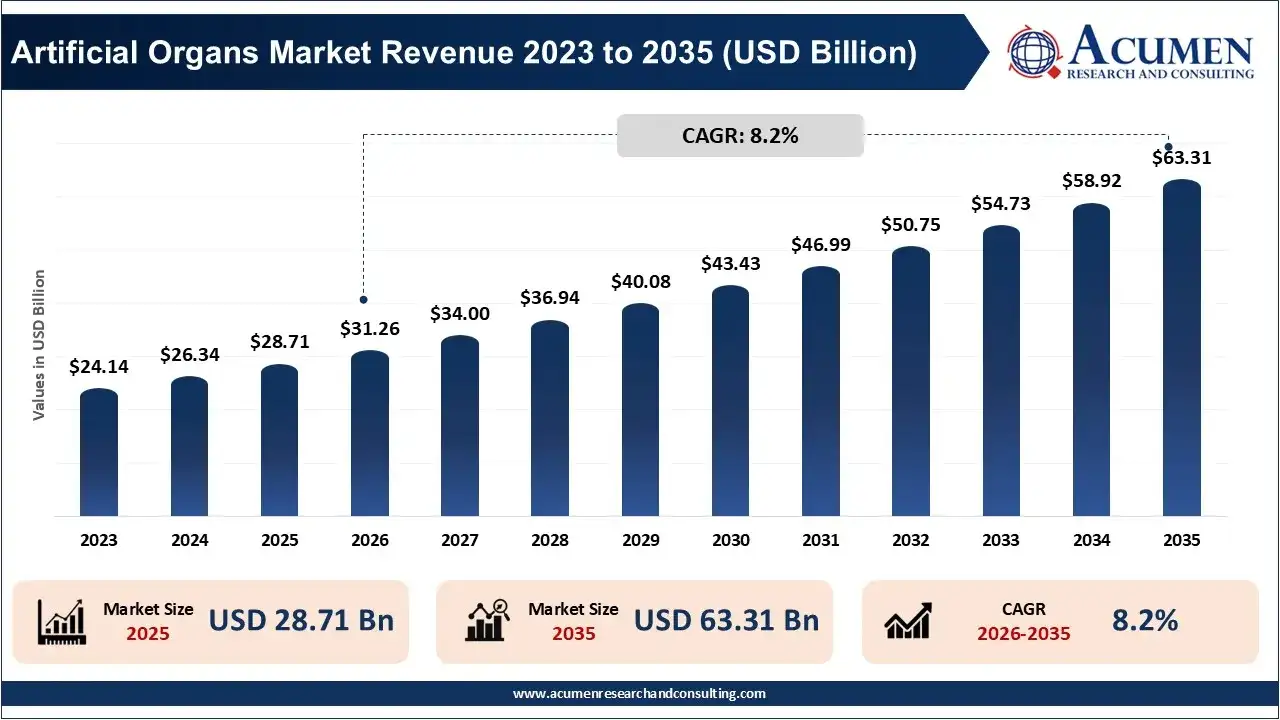
The artificial organs market represents a rapidly evolving segment of the medical technology industry focused on developing solutions capable of substituting for or assisting essential human organ functions when natural organs become damaged or fail. It includes established artificial-organ technologies as well as emerging platforms that combine mechanical systems, electronics, sensors, biomaterials, living cells, tissue engineering, and regenerative medicine.
Growth is supported by the growing need for advanced treatment options for patients with organ failure, increasing adoption of implantable and long-term organ-support systems, and continuous technological improvements aimed at enhancing durability, biocompatibility, efficiency, and physiological responsiveness.
Regulatory & Reimbursement Analysis
| Region / Market | Regulatory Framework | Reimbursement Considerations |
|---|---|---|
| North America | Artificial-organ technologies are primarily regulated as medical devices, with the U.S. FDA playing a central role in classification, clinical evaluation, premarket authorization, and post-market surveillance. | Reimbursement generally depends on device indication, clinical evidence, coding, coverage policies, and payer requirements. |
| Europe | Artificial-organ devices are subject to the EU Medical Device Regulation (MDR), including conformity assessment, clinical evaluation, quality management, and post-market surveillance requirements. | Reimbursement varies substantially across European countries and depends on national health systems, health technology assessments, and hospital purchasing policies. |
| Asia-Pacific | Regulatory requirements differ by country, with agencies such as China's NMPA, Japan's PMDA/MHLW, and India's CDSCO overseeing medical-device approvals. | Public insurance programs, private insurance, and hospital-based purchasing influence reimbursement and accessibility. |
| Latin America | Medical devices are regulated through national authorities, with Brazil's ANVISA representing one of the region's most important regulatory bodies. | Reimbursement is influenced by public healthcare programs, private insurers, and hospital procurement budgets. |
| Middle East & Africa | Regulatory requirements vary considerably by country, with several markets increasingly strengthening medical-device registration and quality requirements. | Reimbursement depends on government healthcare programs, private insurance coverage, and hospital procurement. |
Artificial Organs Market Latest Trends
- Rapid Advancement in 3D Bioprinting: 3D bioprinting is emerging as a major trend, enabling the fabrication of patient-specific tissues and increasingly complex organ structures. Advances in multimaterial, embedded, and volumetric bioprinting are improving structural accuracy and supporting the development of vascularized tissue constructs.
- Integration of Artificial Intelligence: AI is increasingly being incorporated into artificial-organ development to optimize biomaterials, predict organ and donor compatibility, support bioprinting processes, and enable real-time monitoring. AI-enabled manufacturing and quality-control systems are particularly important for moving bioprinted organs toward scalable production.
- Shift Toward Bioartificial and Hybrid Organs: Research is moving beyond purely mechanical replacements toward bioartificial organs that combine living cells, biological matrices, engineered scaffolds, and electronic or mechanical components. Technologies such as cell encapsulation, decellularization and recellularization, organoids, and tissue-engineered scaffolds are gaining importance in this transition.
- Growing Focus on Patient-Specific Organ Replacement: Personalized artificial organs are gaining attention as manufacturers and researchers seek to match anatomical and physiological characteristics more closely to individual patients. Customized designs can potentially improve compatibility, functionality, and clinical outcomes while reducing complications associated with conventional replacement technologies.
What is the Future Outlook of the Artificial Organs Market?
Looking ahead, the artificial organs market is projected to continue to grow due to an aging global population with increasing levels of organ failure, prevalence of chronic diseases, and persistent shortages in donor organ availability. From traditional mechanical solutions toward new era bioartificial organs, tissue-engineered transplants, 3D bioprinted organ structures, intelligent prosthetics, and bioelectronic hybrid devices will be the growth trajectory for the industry.
In this context, significant progress in 3D bioprinting techniques, AI algorithms, innovative biomaterials, stem cell therapy, the use of organoids, and recellularization technologies are providing the pathway for developing personalized bio-functional organs. Nevertheless, a few significant barriers such as vascularization, immunological compatibility, upscaling of manufacturing, regulation, lifelong integration, and cost will need to be addressed for widespread availability.
Artificial Organs Market Regional Highlights
- North America: In 2025, North America held the largest market share of 39.96% driven by advanced infrastructure, high technology penetration, and significant industry investment. North America’s mature industry ecosystem is likely to maintain its dominant position throughout the forecast period.
- Europe: With a market share of 27.86% in 2025, Europe is projected to witness an increase at a CAGR of 8.6% over the forecast period from 2026 to 2035. Increasing investments, technological progress and governmental initiatives that encourage technological upgradation are expected to propel the growth of European markets. Increasing end-user’s need for innovative and efficient solution offerings are expected to fuel region market.
- Asia Pacific: Asia Pacific accounted for a market share of 22.41% in 2025 to emerge as another dominant region for market growth. Expected to grow at a CAGR of 7.4% between 2026 to 2035, the Asia Pacific market is driven by rising industrial growth, increasing investments and adoption of advanced technologies by the major countries in the region. Increasing demand form emerging Economies is expected to drive the growth of the market.
- Latin America: Latin America accounted for a share of 5.87% in the market in 2025. Growth in investments, adoption of advanced technologies and improving infrastructure in the region are driving the growth of the market. However, economic volatilities and lack of widespread technological adoptions could hamper the market growth in this region during the forecast period.
- Middle East & Africa: Middle East & Africa grabbed a share of 3.90% in 2025. The Middle East & Africa market has considerable investment opportunities and will drive market growth by investing in the new technology with advanced infrastructure in the region. Governments and private players are pushing toward initiatives to improve the infrastructure of these countries through technological up gradation.
Artificial Organs Market Segments Covered
By Organ Type
- Artificial Kidney
- Artificial Heart
- Artificial Lung
- Artificial Liver
- Artificial Pancreas
- Others
By Fixation/Mode of Use
- Implantable
- Externally Worn / Wearable
- Extracorporeal
By Duration of Use
- Temporary / Short-Term
- Long-Term / Chronic
- Permanent
By Material
- Silicone
- Polyurethane / Other Polymers
- Metals / Metal Alloys
- Ceramics / Glass
- Biomaterials
- Composite / Hybrid Materials
- Other Materials
By Technology
- Mechanical / Fluidic Technology
- Electronic / Sensor-Controlled Technology
- Microfluidic Technology
- Bioengineering / Cell-Based Technology
- Tissue Engineering / Regenerative Technology
- 3D Bioprinting
- Hybrid / Other Emerging Technologies
By Functional Mechanism
- Mechanical Artificial Organs
- Electronic / Electromechanical Artificial Organs
- Bioartificial Organs
- Tissue-Engineered Organs
- Hybrid / Integrated Artificial Organs
By Region
- North America
- Europe
- Asia-Pacific
- Latin America
- Middle East & Africa
Contact Us:
Mr. Richard Johnson
Acumen Research and Consulting
India: +91 8983225533